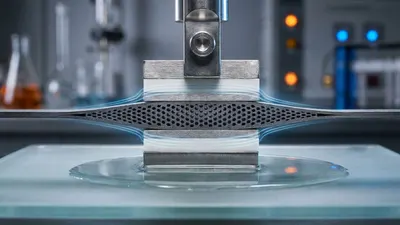
Engineering Auxetic Response in MXenes with Atomic Perforations
Discover how computational modeling shows that creating atomically precise perforations in 2D MXenes can induce a negative Poisson's ratio, or auxetic response.

Imagine a street that is easier to drive down in one direction than the other, not because of a "one-way" sign, but because the road itself is subtly shaped to favor forward momentum. This is the essence of a fascinating new theoretical discovery in the world of quantum physics. For decades, the primary tool for creating directional, or "nonreciprocal," behavior in electronics has been the magnetic field. It acts like a universal traffic cop for electrons, forcing them to turn in predictable ways. But what if we could achieve this one-way effect without the magnet? What if the material itself could be engineered to have an intrinsic directional preference? This is precisely the frontier being explored in a new theoretical paper that proposes a novel way to control the flow of electricity, opening the door to a new class of microscopic electronic components.
In the world of electronics, most simple conductors obey a principle called reciprocity. If you apply one volt across a resistor and get one amp of current, Ohm's law predicts that if you reverse the voltage to negative one volt, you will get negative one amp of current. The resistance is the same regardless of the direction of the current. This is reciprocal behavior. However, many essential electronic components, like diodes and isolators, are nonreciprocal. They behave differently for forward and reverse currents, allowing them to rectify signals or protect circuits from unwanted feedback. To achieve this nonreciprocity, designers almost always have to break what physicists call time-reversal symmetry. A simple way to understand this is to imagine a video of billiard balls colliding. If you play the video in reverse, the scene still obeys the laws of physics. That system has time-reversal symmetry. Now, imagine a video of an electron spiraling in a magnetic field. If you play that video backward, the electron appears to spiral in the wrong direction for that same magnetic field. The magnetic field has broken the time-reversal symmetry. This principle is the workhorse behind many nonreciprocal devices, but it comes with a significant cost. Generating magnetic fields requires magnets or electromagnets, which are bulky, consume power, and are difficult to integrate into the tiny, nanoscale circuits that power modern technology. The core problem this research addresses is the search for a new physical mechanism to create nonreciprocal charge transport without breaking time-reversal symmetry, thereby eliminating the need for magnets. In a theoretical study, researchers Harsh Varshney and Amit Agarwal have outlined a path to do just that.
The central idea proposed by Varshney and Agarwal is to use a combination of quantum mechanics and geometric asymmetry to create a "ratchet" for electrons. Instead of an external magnetic force, their method relies on the intrinsic properties of the material and the wavelike nature of electrons. The concept is known as longitudinal nonreciprocal transport. "Longitudinal" means the effect occurs along the direction of the current flow, unlike the Hall effect where the voltage appears perpendicular to the current. "Nonreciprocal" means the resistance measured depends on the direction of the current. The key is to create a potential energy landscape for the electrons that is spatially asymmetric—think of a saw-tooth pattern at the nanoscale. An electron moving in one direction encounters a series of short, steep hills and long, gentle slopes. An electron moving in the opposite direction sees long, gentle climbs and sudden drops. Even though the underlying laws of physics are the same forwards and backward in time, this asymmetric landscape, when combined with an oscillating electric field (an AC signal), can "pump" electrons more easily in one direction than the other. This process, often called a quantum ratchet, creates a net DC voltage that adds to or subtracts from the resistance depending on the current's direction. This generates the desired nonreciprocal effect while time-reversal symmetry remains perfectly intact.
The researchers' theoretical model is built upon the unique properties of graphene, a single layer of carbon atoms arranged in a honeycomb lattice. Graphene is an ideal platform for exploring this phenomenon for several reasons. Its two-dimensional nature confines electrons to a plane, making them easier to control with electric fields. Furthermore, electrons in graphene behave as "massless" particles, described by the Dirac equation, which gives them exceptionally high mobility and unique responses to external fields. The proposed system involves a sheet of graphene where a specific, spatially asymmetric potential is created. This could be achieved by placing patterned gates above or below the graphene sheet. By applying different voltages to these gates, one can create the desired saw-tooth-like energy landscape for the electrons moving within the graphene. To activate the nonreciprocal effect, two electrical signals are applied. The first is the DC current (I) that we want to measure the resistance of. The second is a high-frequency AC electric field applied along the same direction. The magic happens in the interplay between the electrons, the asymmetric potential, and this AC field. The AC field causes the electrons to oscillate back and forth. In the asymmetric landscape, this oscillation is not perfectly symmetric. The electrons are more likely to be "kicked" over the gentle slopes of the potential than the steep ones, leading to a net directional drift. This quantum pumping mechanism generates a second-harmonic voltage (a DC voltage at twice the frequency of the AC input is a hallmark of this type of nonlinear response) that is proportional to the square of the current. The total measured voltage is no longer just V = IR. It becomes V = IR + γI², where γ is a coefficient that captures the strength of the nonreciprocal effect. When you reverse the current, the I² term remains the same, but the IR term flips its sign. This leads to a different total resistance for forward and reverse currents, achieving the goal of magnet-free nonreciprocity. This entire mechanism relies on the precise control and pristine electronic environment offered by materials like high-quality turbostratic graphene flakes.
As this is a theoretical work based on calculations and modeling, the findings are predictions about how such a system would behave. Varshney and Agarwal used the Boltzmann transport formalism, a powerful tool for describing how charge carriers move through a material, to model their proposed graphene device. Their calculations predicted that a measurable nonreciprocal response should indeed emerge under the right conditions. They showed that the strength of the effect depends critically on the shape of the asymmetric potential, the frequency and amplitude of the applied AC field, and the temperature. One of the key findings is that the effect is a nonlinear response. In a simple resistor, voltage is linearly proportional to current. Here, the nonreciprocity appears as a second-order, or quadratic, correction to Ohm's law. This means the difference in resistance between forward and reverse currents becomes more pronounced at higher current densities. Their model provides a quantitative framework for predicting the magnitude of this effect, giving experimentalists a clear target for what to look for. The research establishes a concrete theoretical foundation for a new class of electronic phenomena, moving it from a purely abstract concept to a plausible, testable system within the realm of modern graphene electronics.
This theoretical result is significant for both fundamental physics and practical engineering. From a physics perspective, it demonstrates a new pathway to achieving nonreciprocal transport, a phenomenon previously thought to be inextricably linked to the breaking of time-reversal symmetry. It expands our understanding of quantum transport in asymmetric systems and adds a new tool to the condensed matter physicist's toolkit. For engineers, the implications are even more direct. The ability to create nonreciprocal components without magnets could be transformative. It paves the way for miniaturizing a wide range of devices, from signal rectifiers and isolators to circulators used in communications technology. By removing the need for bulky, power-hungry magnetic elements, these new components could be integrated directly onto semiconductor chips, leading to smaller, lighter, and more energy-efficient electronic systems. This is particularly relevant for high-frequency applications, such as in the terahertz (THz) frequency range, where conventional components are notoriously difficult to build. Graphene is already a star material for THz technology, and this work suggests a new function it could perform in that domain.
It is crucial to emphasize that this research is a theoretical proposal. The primary limitation is the absence of experimental verification. While the calculations are rigorous, the real world often introduces complexities that are difficult to capture in a model. The first and most significant hurdle will be fabricating the device. Creating a clean, precisely shaped asymmetric potential on a graphene sheet at the nanoscale is a formidable challenge in materials science and nanotechnology. It will require advanced lithography techniques and depend heavily on scalable, high-quality graphene manufacturing techniques. Another challenge will be measuring the predicted effect. The nonreciprocal voltage signal may be small and could be obscured by noise or other electronic effects in a real device. The theoretical model also likely makes certain simplifying assumptions, for instance, about the nature of electron scattering from impurities or defects in the graphene lattice. The influence of these real-world imperfections will need to be studied experimentally. Finally, the operating conditions required to observe the effect, such as low temperatures or specific AC frequencies, might limit its immediate practical use. The next critical step is for experimental physicists to attempt to build and test a device based on this theoretical blueprint.
While still in the conceptual stage, the potential real-world graphene applications stemming from this work are exciting. The most immediate application would be in high-frequency signal processing. The ability to create an on-chip, magnet-free rectifier could be a breakthrough for terahertz (THz) communication and imaging systems. Such a device could efficiently convert weak, high-frequency AC signals into a measurable DC voltage, forming the basis for sensitive THz detectors. Another potential application is in creating miniature radio-frequency (RF) isolators or circulators. These devices ensure that signals travel in only one direction within a circuit, preventing damaging reflections and interference. Today, they rely on magnetic ferrite materials, making them bulky and incompatible with chip-scale integration. A graphene-based nonreciprocal device could perform the same function in a microscopic footprint. Beyond communications, this principle could be used for energy harvesting, designing devices that can capture ambient electromagnetic waves and convert them into usable DC power. The sensitivity of the nonreciprocal effect to the local electronic environment also suggests possibilities for developing new types of sensors.
If you take away just one idea from this research, it should be this: Scientists have theoretically designed a way to make electricity flow more easily in one direction than the other in graphene, without using any magnets. This is achieved by using a clever combination of a nanoscale saw-tooth-like landscape for electrons and an oscillating electric field, a mechanism that relies on quantum mechanics and geometric design rather than magnetic force.
What is nonreciprocal charge transport in simple terms?
In essence, nonreciprocal charge transport means that a material's resistance to electrical current is different depending on whether the current is flowing forward or backward. Think of it like a one-way valve for electricity, where it's easier for electrons to move in one direction than the opposite one. This is unlike a standard resistor, which resists current equally in both directions.
Why is it important to achieve this without a magnetic field?
Magnetic fields are the traditional way to force nonreciprocal behavior, but they require magnets or electromagnets. These components are bulky, consume energy, generate heat, and are very difficult to shrink down to the size of a modern microchip. Developing a magnet-free method allows for the creation of smaller, more efficient, and fully integrated electronic components like rectifiers and isolators.
What does "time-reversal symmetry" mean in this context?
Time-reversal symmetry is a fundamental concept in physics which states that the laws of physics should work the same if you were to play time backward. A magnetic field breaks this symmetry because the force it exerts on a moving charge depends on the direction of motion in a way that looks wrong in reverse. The significance of this new research is that it produces a nonreciprocal (one-way) effect while preserving this fundamental symmetry.
Is this a real device that is available now?
No, not yet. The paper by Varshney and Agarwal is a theoretical work. It presents the mathematical model and calculations that predict this effect is possible in a carefully designed graphene system. The next step is for experimental physicists to build a prototype device in the lab to prove that the theory works in practice.
Why is graphene the material of choice for this theory?
Graphene is ideal for several reasons. Its electrons move with extremely high speed and are confined to a 2D plane, making them highly responsive to electric fields. Its atomic structure is nearly perfect, which minimizes unwanted electron scattering. Finally, its electronic properties can be precisely tuned by external gate voltages, making it a perfect testbed for creating the complex, asymmetric energy landscapes required for this new effect.
The theoretical discovery of longitudinal nonreciprocal charge transport with time-reversal symmetry represents a subtle but profound shift in our understanding of how electricity can be controlled at the quantum level. By proposing a viable, magnet-free mechanism based on the geometric and quantum properties of a graphene system, Harsh Varshney and Amit Agarwal have provided a blueprint for a new generation of electronic components. While the road from theory to application is long and requires surmounting significant experimental challenges, the potential payoff is immense. This research opens a new avenue for developing ultra-compact, energy-efficient devices for signal processing, communications, and sensing. It is a powerful reminder that even after centuries of study, the electron still holds new secrets, and materials like graphene continue to provide the ideal stage for their discovery.
Serious about B2B integration? Test our premium Pulsed Electrical Resistive Carbon Heating turbostratic graphene in your lab. 100g sample packs available now.
Explore More
Discover how computational modeling shows that creating atomically precise perforations in 2D MXenes can induce a negative Poisson's ratio, or auxetic response.
Discover how anisotropically strained twisted bilayer graphene creates commensurate moiré superlattices, a breakthrough for engineering predictable...
Researchers have demonstrated a novel method for transporting quantum information, using wave-like electron oscillations in graphene to carry flying qubits...