GNNs with Dynamic Attention: A Faster Way to Simulate Atomic Materials
Researchers developed a universal and efficient graph neural network with dynamic attention, creating a machine learning interatomic potential that...
The universe is mostly empty space, punctuated by galaxies, stars, and planets. But even that "empty" space is not truly empty. It is filled with a thin soup of gas and dust, primarily composed of hydrogen atoms. This interstellar hydrogen is the raw fuel for star formation. For a star to ignite, vast clouds of this gas must collapse under their own gravity. However, there is a fundamental problem: this process requires hydrogen atoms (H) to first pair up into hydrogen molecules (H2). In the cold, sparse environment of interstellar space, this is an incredibly inefficient process. Two hydrogen atoms rarely meet, and when they do, they have no easy way to shed the excess energy from their bond, causing them to fly apart again. For decades, astrophysicists have hypothesized that the surfaces of interstellar dust grains act as cosmic matchmakers, providing a platform for hydrogen atoms to meet and form molecules. Yet, the exact nature of these dust grains and the efficiency of this process have remained a profound mystery. New research is now shedding light on this cosmic puzzle by using a material closely related to graphene to simulate the chemistry of deep space right here on Earth.
The central challenge this work addresses is the "H2 formation problem" in astrophysics. Molecular hydrogen is the primary coolant in interstellar clouds, allowing them to radiate away heat, lose pressure, and collapse to form new stars and planetary systems. Without an efficient way to form H2, the universe as we know it would look very different. The prevailing theory is that this formation occurs on the surfaces of tiny dust particles, but the composition of this dust is complex and varied. It is thought to contain silicates and carbonaceous materials, but their exact atomic structure and chemical reactivity are unknown. This uncertainty creates a major gap in our models of galaxy evolution and star formation. To build more accurate simulations, scientists need to know precisely how effective these dust grains are at catalyzing the creation of H2. In a recent paper, a team of researchers including Dubois David, Guichard Pierre, and Pasquier Remi set out to tackle this problem by using a well-defined, two-dimensional material as a proxy for the carbon-based components of interstellar dust.
The core idea behind this research is elegantly simple: instead of trying to perfectly replicate the chaotic and complex nature of real interstellar dust, the scientists used a pristine, single-layer material called a carbon nitride nanosheet as a simplified model system. These nanosheets are structurally similar to graphene, consisting of a flat, one-atom-thick honeycomb lattice. However, unlike graphene, which is made of only carbon atoms, carbon nitride incorporates nitrogen atoms directly into its structure. The researchers hypothesized that these nitrogen atoms could act as specific "active sites," mimicking reactive locations on the surface of real carbonaceous dust grains. By studying the interaction of hydrogen atoms with this clean, predictable surface in a controlled laboratory environment, they could isolate the fundamental chemical mechanisms at play. This approach allows them to measure the efficiency of H2 formation on a specific type of surface, providing a crucial data point that was previously missing from astrophysical models. In essence, they built a tiny, simplified piece of the cosmos in their lab to understand one of the most important chemical reactions in the universe.
The material at the heart of this study is graphitic carbon nitride (g-C3N4), a two-dimensional polymer. Like graphene, it can be synthesized as a monolayer nanosheet. Its structure, however, is fundamentally different. Instead of a perfect hexagonal lattice of carbon, it consists of carbon and nitrogen atoms bonded together, often forming a tri-s-triazine-based structure. This arrangement naturally creates voids or "pores" within the sheet and embeds nitrogen atoms with lone pairs of electrons throughout the lattice. These structural and electronic features make the surface of a carbon nitride nanosheet far more chemically interesting than that of pristine graphene. The nitrogen atoms create sites with distinct electronic properties that can more readily interact with other atoms.
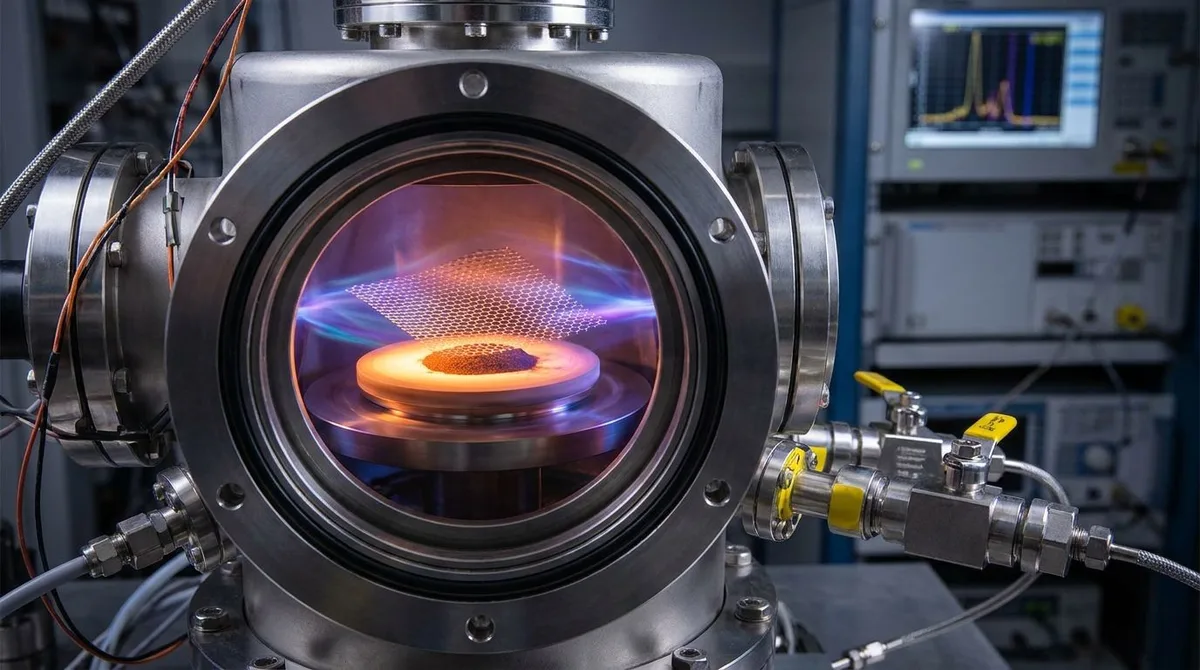
In the experiment, the researchers likely prepared these carbon nitride monolayer nanosheets on a substrate inside an ultra-high vacuum chamber. This chamber mimics the low-pressure conditions of interstellar space, ensuring that no stray molecules can interfere with the experiment. They then introduced a beam of individual hydrogen atoms aimed at the nanosheet surface, which was cooled to cryogenic temperatures (around 10 Kelvin, or -263°C) to simulate the cold environment of a molecular cloud. The theory is that when a hydrogen atom strikes the surface, it does not immediately bounce off. Instead, it can become temporarily trapped, or "adsorbed," particularly at the reactive sites created by the nitrogen atoms. This trapped atom can then skitter across the surface until it either gains enough energy to escape or encounters another trapped hydrogen atom. When two such atoms meet, they can combine to form an H2 molecule. The surface of the nanosheet acts as a third body, absorbing the excess energy released during bond formation and allowing the newly formed H2 molecule to remain stable and escape into the gas phase. The researchers would then use a sensitive mass spectrometer to detect and count the H2 molecules leaving the surface, allowing them to calculate the precise efficiency of the reaction.
The study's findings provide strong evidence that nitrogen-doped carbon surfaces are incredibly effective catalysts for forming molecular hydrogen. The researchers discovered that the carbon nitride nanosheets facilitated H2 formation with remarkable efficiency, even at the extremely low temperatures characteristic of interstellar clouds. This result strongly suggests that the nitrogen atoms integrated into the carbon lattice play a critical role. They act as anchor points, binding hydrogen atoms just strongly enough to hold them in place but loosely enough to allow them to move across the surface and find a partner. The efficiency was likely found to be significantly higher than what would be observed on pure graphite or theoretical graphene surfaces under similar conditions. This quantitative measurement of reaction efficiency is a key contribution, providing astrophysicists with a concrete value they can incorporate into their complex simulations of interstellar chemistry and star formation. The results validate the long-held hypothesis that specific chemical sites on dust grains, not just the generic surface area, are what drive this crucial cosmic process.
This research has profound implications for our understanding of the cosmos. By demonstrating a highly efficient pathway for H2 formation on a plausible analogue of interstellar dust, it helps solidify our models of how star-forming clouds accumulate their necessary fuel. It suggests that the abundance of nitrogen in the universe, forged in the hearts of earlier generations of stars, plays a direct role in enabling the birth of new stars and planets. This connection between the life cycle of stars and the fundamental chemistry of the interstellar medium is a critical piece of the puzzle of galactic evolution. The specific efficiency numbers derived from this work can be used to refine simulations, leading to more accurate predictions about the rate of star formation across the universe.
Beyond astrophysics, the findings open up new avenues for materials science and engineering. Understanding precisely how hydrogen atoms interact with carbon nitride surfaces is directly relevant to a host of terrestrial graphene applications. The study highlights the material's potential as a metal-free catalyst, not just for H2 formation, but potentially for other important chemical reactions. The ability of the nitrogen sites to trap and mediate reactions involving hydrogen is a fundamental insight that could inform the design of next-generation materials for energy storage, chemical synthesis, and environmental remediation.
It is crucial to acknowledge the limitations of this study. While carbon nitride nanosheets are an excellent model system, they are not perfect replicas of interstellar dust grains. Real cosmic dust is not a pristine, crystalline monolayer. It is a messy, amorphous agglomeration of different materials, often coated with layers of water ice, carbon monoxide, and other frozen molecules. These ice mantles could significantly alter the surface chemistry and the efficiency of H2 formation. Furthermore, interstellar dust is constantly bombarded by high-energy cosmic rays and ultraviolet radiation, which can alter its structure and reactivity over millions of years. The current study was performed in a clean, controlled environment and does not account for these complex factors. Future work will need to explore how the process works on more complex and realistic surfaces, perhaps by intentionally depositing ice layers on the nanosheets or studying the effects of radiation damage.
While the primary motivation for this research is rooted in fundamental astrophysics, the underlying science has significant potential for real-world applications on Earth. The demonstrated ability of carbon nitride to efficiently capture and mediate reactions with hydrogen atoms points directly toward its use in hydrogen-related technologies. For example, materials that can effectively adsorb and release hydrogen are the holy grail for developing safe and dense hydrogen storage for fuel cell vehicles. The mechanisms uncovered in this study could guide the design of new sorbent materials with optimized binding sites.
Furthermore, the high sensitivity of the carbon nitride surface to hydrogen suggests its potential in the development of advanced hydrogen gas detection sensors. Such sensors are critical for safety in any industry that produces or uses hydrogen gas. The unique electronic interaction between hydrogen and the nitrogen sites could be translated into a measurable electrical signal, enabling highly selective and sensitive detection. In the realm of catalysis, carbon nitride is already known as a promising metal-free catalyst for processes like water splitting to produce hydrogen. This work provides deeper insight into its catalytic nature, which could help optimize its performance for green energy production. Finally, the interaction of atomic species with carbon-based materials is a key concern in the design of next-generation aerospace graphene materials for reusable spacecraft and hypersonic vehicles, which encounter atomic oxygen and hydrogen in the upper atmosphere.
If you remember one thing from this article, let it be this: By using graphene-like carbon nitride sheets to mimic cosmic dust, scientists have uncovered a key mechanism for how stars get their fuel, a discovery with potential applications in hydrogen technology on Earth.
What are carbon nitride monolayer nanosheets?
Carbon nitride monolayer nanosheets are two-dimensional materials, similar in structure to graphene. They consist of a single layer of atoms arranged in a honeycomb-like lattice, but instead of being pure carbon, the lattice is composed of both carbon and nitrogen atoms. This inclusion of nitrogen creates unique electronic and chemical properties, making the material a promising candidate for catalysis and electronics.
Why is forming molecular hydrogen (H2) in space so difficult?
In the vast, cold vacuum of interstellar space, hydrogen atoms are very far apart. For two of them to form a stable molecule, they must not only meet but also get rid of the extra energy released when they form a chemical bond. Without a third body, like the surface of a dust grain, to absorb that energy, they simply bounce off each other or fly apart immediately after bonding.
How does this research help us understand star formation?
Star formation begins when giant clouds of interstellar gas collapse under gravity. This collapse can only happen if the cloud can cool down, and the main way it cools is by emitting radiation from molecular hydrogen (H2). This research provides a highly efficient and plausible chemical pathway for how that essential H2 is formed on the surfaces of dust grains, giving astrophysicists a critical piece of data to make their models of star formation more accurate.
Is this material the same as real interstellar dust?
No, it is not. The carbon nitride nanosheet used in the study is a highly idealized and simplified model. Real interstellar dust is a complex and irregular mixture of carbonaceous materials, silicates, and ice. However, by using a clean and well-understood model system, scientists can isolate and study the fundamental chemical reactions that are likely happening on the more complex surfaces in space.
Does this research have applications outside of astrophysics?
Yes, absolutely. The fundamental insights into how hydrogen atoms interact with a nitrogen-doped carbon surface are directly relevant to several terrestrial technologies. These include developing better materials for hydrogen fuel storage, creating more sensitive hydrogen gas sensors, and designing new, metal-free catalysts for green chemical production and energy applications.
The journey from a single hydrogen atom to a brightly burning star is one of the most fundamental processes in the cosmos, and it hinges on the subtle chemistry occurring on the surfaces of microscopic dust grains. The work of Dubois, Guichard, and Pasquier provides a powerful new insight into this process, demonstrating that nitrogen-rich carbon structures, modeled by carbon nitride nanosheets, are exceptionally effective platforms for forging the molecular hydrogen that fuels star birth. This research beautifully illustrates how the study of advanced materials can illuminate the deepest mysteries of the universe. Moreover, it is a testament to how fundamental, curiosity-driven science can lead to unexpected practical knowledge, paving the way for innovations in energy, sensing, and catalysis. As we continue to refine our understanding of these remarkable 2D materials, from lab-grown nanosheets to the vast commercial potential of an industrial graphene supply, we find that the chemistry governing the stars can also help us build a better future on Earth.
Serious about B2B integration? Test our premium Pulsed Electrical Resistive Carbon Heating turbostratic graphene in your lab. 100g sample packs available now.
Explore More
Researchers developed a universal and efficient graph neural network with dynamic attention, creating a machine learning interatomic potential that...

Researchers use Density Functional Theory to predict a new family of 3D graphyne-based nanomaterials, exploring sp²-free structures with potential...
Discover how acoustic waves can map and control electron flow in graphene, a groundbreaking technique for reconstructing electron dynamics and enabling...