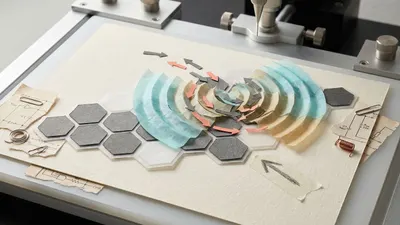
Acoustic Waves Map Electron Flow in Graphene for Future Electronics
Discover how acoustic waves can map and control electron flow in graphene, a groundbreaking technique for reconstructing electron dynamics and enabling...

For over two decades, the world of materials science has been captivated by graphene, the single-atom-thick sheet of carbon with seemingly miraculous properties. Its strength, conductivity, and flexibility have promised to revolutionize everything from electronics to construction. Yet, as with any material, graphene has its limits. Its inherent two-dimensional nature presents challenges for creating bulk, three-dimensional objects, and its lack of an electronic band gap restricts its use in certain semiconductor applications. This has spurred a global search for new forms of carbon, or allotropes, that retain carbon's fundamental advantages while offering new, complementary functionalities. What if we could design, from the atom up, a three-dimensional carbon lattice with properties fundamentally different from both graphene and diamond?
The versatility of carbon stems from its ability to form different types of chemical bonds, a property known as hybridization. Graphene's flat, hexagonal lattice is built from $sp^2$ hybridized carbon atoms, forming strong double bonds that allow electrons to move freely, making it an excellent conductor. Diamond, on the other hand, is built from $sp^3$ hybridized atoms, forming a rigid tetrahedral network of single bonds that locks electrons in place, making it an electrical insulator. While materials like graphynes—theoretical cousins of graphene that incorporate linear, $sp$-hybridized carbon chains—have been proposed, they still rely heavily on the foundational $sp^2$ framework. The central challenge this new research addresses is the exploration of a completely different design space: can we create a stable, three-dimensional carbon nanomaterial that completely omits the ubiquitous $sp^2$ bond? In a recent theoretical study, researchers Djardiel da S. Gomes, Alexandre F. Fonseca, and Marcelo L. Pereira set out to answer this very question, using powerful computational tools to predict the existence and properties of such a novel material family. Their work aims to fill a critical gap in the carbon allotrope library, proposing structures with the potential for tunable electronic properties and inherent three-dimensionality that graphene lacks.
Imagine you have two types of LEGO bricks. One is a flat triangle ($sp^2$ carbon) and the other is a four-pronged jack ($sp^3$ carbon). Graphene is like a perfectly flat mosaic made only of the triangles. Diamond is a 3D jungle gym made only of the jacks. Now, imagine a third type of brick: a straight rod ($sp$ carbon). Graphynes are typically made by connecting the flat triangles with these straight rods, creating a sheet with built-in holes. The core idea behind this new research is to throw away the flat triangle bricks entirely. Instead, the scientists computationally explored what would happen if you built a 3D structure using only the four-pronged jacks ($sp^3$ carbons) as connection points, or nodes, and linked them together using the straight rods ($sp$ carbons) as spacers. This creates an entirely new architectural style for carbon. The resulting structure is an open, porous, three-dimensional framework. By avoiding the conductive $sp^2$ bonds of graphene, this new material is predicted to behave not as a metal, but as a semiconductor, a class of materials essential for modern electronics. The length of the connecting rods and the arrangement of the nodes could be varied, allowing scientists to theoretically tune the material's properties for specific tasks.
This research is purely theoretical, meaning the new materials were designed and tested within a supercomputer, not synthesized in a laboratory. The scientists employed a powerful computational method called Density Functional Theory (DFT). DFT is a quantum mechanical modeling technique that allows researchers to calculate the electronic structure of a material and predict its properties based only on the arrangement of its atoms. It essentially solves the complex equations governing electron behavior to determine the most stable, lowest-energy state of a system.
The process began with a hypothesis: a stable 3D carbon structure could be formed by linking tetrahedral $sp^3$ carbon nodes with acetylenic ($sp$-hybridized) carbon chains of varying lengths. The researchers designed several candidate structures on their computers, defining the initial positions of each carbon atom. They then ran DFT simulations on these virtual crystals. The simulation iteratively adjusts the positions of the atoms and the distribution of their electrons until the total energy of the system is minimized. If the final structure has a low formation energy and maintains its integrity under simulated vibrations (a test for dynamic stability) and temperature changes (a test for thermal stability), it is predicted to be a physically plausible material that could potentially be synthesized in the real world. This computational approach allows for the rapid exploration of countless possibilities without the time and expense of physical experimentation, providing a crucial roadmap for future lab work.
The DFT simulations performed by Gomes, Fonseca, and Pereira yielded exciting predictions. Their calculations confirmed that several variations of these novel $sp^3$-$sp$ carbon lattices are indeed energetically stable. These structures, which they termed "$sp^2$-free graphyne-based nanomaterials," represent a new, theoretically viable class of carbon allotropes. The most significant finding relates to their electronic properties. Unlike semimetallic graphene, which has no band gap, these new 3D materials were all predicted to be semiconductors. A band gap is an energy range where no electron states can exist, and it is this property that allows a material to act as an electronic switch, turning current on and off.
Crucially, the researchers found that the size of the band gap could be tuned by changing the length of the $sp$-carbon chains connecting the $sp^3$ nodes. Longer chains resulted in smaller band gaps, while shorter chains led to larger ones. This tunability is a holy grail for materials scientists, as it suggests these materials could be custom-designed for specific electronic or photonic graphene applications. Furthermore, the simulations predicted these materials to be mechanically robust. Despite having very low densities due to their porous, open-framework structures, the strong covalent carbon-carbon bonds throughout the lattice are expected to give them high stiffness and strength. This combination of low weight, high strength, and tunable electronic properties is exceptionally rare.
The prediction of a new family of stable carbon allotropes is a significant event in materials science. This work pushes the boundaries of what we thought was possible with carbon. The primary importance lies in the potential to overcome some of graphene's key limitations. The discovery of a 3D carbon framework with a direct, tunable band gap could open new avenues for the development of next-generation graphene electronics. These materials could form the basis for transistors, sensors, and optoelectronic devices that are built entirely from carbon, offering potential advantages in speed, efficiency, and miniaturization.
Moreover, the inherent three-dimensionality and high porosity of these predicted structures are immensely valuable. The vast internal surface area could make them exceptional candidates for applications in catalysis or as electrodes in high-performance batteries and supercapacitors, a key area of research in energy storage nanocomposites. Their predicted low density and high mechanical strength also point toward potential use as advanced structural materials, particularly in aerospace composites where every gram of weight saved is critical. This theoretical work provides a blueprint for a new class of multifunctional materials, guiding experimentalists toward synthesizing carbon structures with precisely engineered properties.
It is essential to emphasize the primary limitation of this study: it is entirely computational. While Density Functional Theory is a highly reliable and predictive tool, it remains a simulation. The models make certain approximations, and the prediction of stability does not guarantee that the material can be synthesized in a real-world laboratory. The synthesis of such a complex, ordered, and purely bonded carbon structure would be an immense chemical challenge. Creating a network of only $sp$ and $sp^3$ bonds while completely avoiding the formation of the more common and often more stable $sp^2$ bonds would require extremely precise and controlled reaction conditions.
The next critical step is for experimental chemists and materials scientists to attempt to create these materials. This would likely involve complex bottom-up synthesis techniques, perhaps using molecular precursors that are designed to self-assemble into the predicted lattice. If they can be synthesized, even in small quantities, their actual properties must be measured and compared to the theoretical predictions. Researchers would need to verify their crystalline structure using techniques like X-ray diffraction, confirm their electronic band gap with spectroscopy, and test their mechanical strength with nanoindentation. Only through physical synthesis and characterization can the true potential of these predicted nanomaterials be fully understood and validated.
Assuming these $sp^2$-free carbon materials can be successfully synthesized, their unique combination of properties suggests a wide range of potential real-world applications. In electronics, their tunable semiconductor nature could lead to carbon-based field-effect transistors that are smaller and more efficient than silicon-based devices. They could also be used in photodetectors or light-emitting diodes, with the color of light they absorb or emit being tuned by the material's specific geometry.
In the realm of energy storage, their high surface area and porous 3D structure would be ideal for supercapacitor electrodes, allowing for the rapid storage and release of electrical charge. They could also serve as a lightweight, high-capacity anode material for lithium-ion batteries. The porous framework might also be perfectly suited for gas storage, particularly for hydrogen, which could be a critical component of future clean energy systems. Finally, their predicted high strength-to-weight ratio makes them a compelling target for creating next-generation composite materials. By embedding these 3D carbon lattices into polymers, it might be possible to create materials for aircraft, spacecraft, and high-performance vehicles that are stronger and lighter than anything available today.
If you remember just one thing from this research, let it be this: scientists have used computer simulations to predict a completely new class of three-dimensional carbon materials built without the $sp^2$ bonds that define graphene. By using only linear ($sp$) and tetrahedral ($sp^3$) carbon bonds, they have designed a family of lightweight, strong, and porous semiconductors whose electronic properties can be precisely tuned, opening a new chapter in the search for advanced carbon nanomaterials.
What is graphyne and how is it related to graphene?
Graphyne is a theoretical allotrope of carbon, similar to graphene in that it is a two-dimensional, single-atom-thick sheet. However, while graphene is composed purely of $sp^2$-hybridized carbon atoms in a hexagonal lattice, graphyne's structure also incorporates $sp$-hybridized carbon atoms, creating acetylenic linkages that introduce pores into the sheet. This new research takes inspiration from graphyne's use of $sp$ bonds but combines them with $sp^3$ nodes in 3D instead of $sp^2$ nodes in 2D.
What does "$sp^2$-free" mean and why is it important?
The term "$sp^2$-free" means that the material's atomic structure contains no carbon atoms with $sp^2$ hybridization, the type of bonding that forms the flat, hexagonal rings of graphene and is responsible for its high electrical conductivity. This is important because removing these bonds fundamentally changes the material's properties. It transforms the material from a conductive semimetal into a semiconductor with an electronic band gap, which is essential for building transistors and other electronic components.
What is Density Functional Theory (DFT)?
Density Functional Theory, or DFT, is a powerful computational method used in physics and chemistry to investigate the electronic structure of materials. Instead of trying to solve for the complex interactions of every single electron, DFT simplifies the problem by focusing on the spatial density of electrons. This allows scientists to calculate a material's total energy, predict the most stable arrangement of its atoms, and determine its electronic, magnetic, and optical properties from first principles, all within a computer simulation.
Is this new material available for purchase or use now?
No, this material is not available today. The research described is a theoretical prediction based on computer simulations. While the calculations suggest the material should be stable and possess remarkable properties, it has not yet been synthesized in a laboratory. The paper serves as a scientific guide, encouraging experimentalists to try and create this new form of carbon. It represents the first step in a long process of material discovery and development.
How is this predicted 3D material different from 3D graphene foam?
Three-dimensional graphene foam is typically made by assembling or growing 2D graphene sheets into a macroscopic, porous 3D structure. While the overall object is three-dimensional, at the atomic level it is still made of interconnected $sp^2$-hybridized graphene sheets. The material predicted in this research is fundamentally different; it is a continuous, covalently bonded crystal lattice that is three-dimensional at the atomic scale, constructed from a repeating unit cell of $sp^3$ and $sp$ carbon atoms, with no $sp^2$ graphene sheets present at all.
The theoretical prediction of $sp^2$-free, graphyne-based 3D nanomaterials represents a significant and creative leap in computational materials science. By moving beyond the well-trodden ground of $sp^2$-dominated carbon allotropes, Djardiel da S. Gomes, Alexandre F. Fonseca, and Marcelo L. Pereira have illuminated a new and promising path for material design. Their work provides a compelling theoretical foundation for a class of materials with a rare and valuable combination of properties: a tunable band gap, low density, high mechanical strength, and inherent three-dimensionality. While the road from theoretical prediction to practical application is long and challenging, this research acts as a vital signpost, directing the efforts of experimentalists toward a new frontier. It underscores the power of computation to dream up novel atomic architectures that could one day solve some of our most pressing engineering challenges, complementing the incredible materials, like the industrial graphene supply available today, with the specialized solutions of tomorrow.
Serious about B2B integration? Test our premium Pulsed Electrical Resistive Carbon Heating turbostratic graphene in your lab. 100g sample packs available now.
Explore More
Discover how acoustic waves can map and control electron flow in graphene, a groundbreaking technique for reconstructing electron dynamics and enabling...
New theoretical research shows how controlling graphene's energy gap under periodic driving can generate high-frequency current oscillations, a key step for...
Research on magic-angle twisted bilayer graphene reveals a new geometric component of superfluid stiffness, a key property for robust Kekulé superconductivity.