
Josephson effect in graphene Corbino disks
Explore the Josephson effect in graphene Corbino disks, a breakthrough offering gate-tunable control over quantum supercurrents for next-gen sensors and...
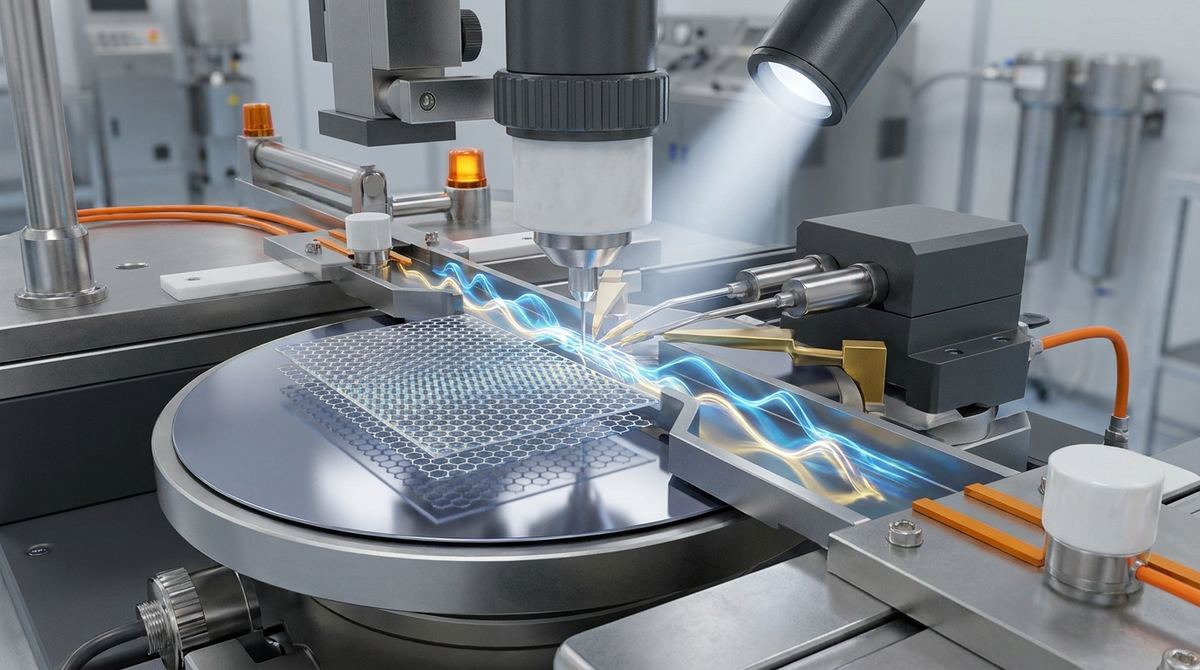
Imagine a world where electricity flows without any resistance, where power lines never heat up and lose energy, and where computers operate at unimaginable speeds. This is the promise of superconductivity, a remarkable quantum phenomenon that has captivated scientists for over a century. While we have known about superconductors for decades, many operate only at impractically low temperatures. The quest for room-temperature superconductivity is one of the holy grails of materials science. In recent years, a surprising material has emerged as a leading platform for exploring new and exotic forms of this phenomenon: twisted bilayer graphene. By simply stacking two sheets of graphene and twisting them by a tiny, precise "magic angle," a flat, inert carbon sheet transforms into a complex quantum playground, hosting a unique type of superconductivity that scientists are just beginning to understand.
The discovery of superconductivity in magic-angle twisted bilayer graphene (MATBG) opened a floodgate of questions. The way electrons achieve a zero-resistance state in this system does not fit neatly into the conventional theory of superconductivity, known as BCS theory, which perfectly explains the behavior of simple metals at low temperatures. This places MATBG in the category of "unconventional" superconductors, a family of complex materials whose inner workings remain a deep mystery. A central part of this mystery is understanding what makes the superconducting state stable. A key metric for this stability is a property called "superfluid stiffness" (or superfluid density). It essentially measures how much energy it costs to twist or disturb the collective quantum state of the superconducting electrons. A higher stiffness means a more robust superconductor, one that can better resist being broken by temperature fluctuations or electrical currents. In a new theoretical study, researchers Ke Wang, Qijin Chen, Rufus Boyack, and K. Levin sought to unravel the origins of this stiffness in MATBG, proposing that a crucial piece of the puzzle has been overlooked: the geometry of the quantum world itself.
The central idea proposed by the researchers is that the superfluid stiffness in a specific type of graphene superconductivity is not just determined by the number of superconducting electrons, as is conventionally thought. Instead, it has a second, significant component that arises directly from the quantum geometry of the electrons' wavefunctions. Think of the superconducting state as a vast, synchronized dance of electron pairs. The conventional view of stiffness is like knowing how many dancers are on the floor. The more dancers, the more robust the performance. The new idea is that the specific, intricate steps of the dance—the geometric shape and phase of the electron wavefunctions—also contribute directly to the performance's stability. This particular dance is called "Kekulé superconductivity." The name comes from the Kekulé structure of benzene, a pattern of alternating single and double bonds. In graphene's honeycomb lattice, a similar distortion can occur, creating a rhythmic pattern in the bond lengths. The theory suggests that when superconductivity emerges within this distorted lattice, the electron pairs inherit its unique geometric character, and this character provides an extra, "geometric" source of stiffness, making the superconductivity stronger than it would be otherwise.
The system at the heart of this research is magic-angle twisted bilayer graphene. It starts with two single-atom-thick sheets of graphene, each a perfect hexagonal lattice of carbon atoms. When one sheet is placed on top of another and rotated by a very specific angle, around 1.1 degrees, a new, larger-scale pattern emerges called a moiré superlattice. This moiré pattern acts like a new landscape for the electrons moving through the graphene. This new landscape dramatically changes their behavior. Instead of zipping past each other at high speed as they do in single-layer graphene, the electrons are forced to slow down and interact with each other much more strongly. These strong interactions are the key to unlocking exotic quantum states. Under these conditions, the electrons can spontaneously organize themselves into insulating states, magnetic states, or, most importantly, a superconducting state where they form "Cooper pairs" and flow in perfect unison without resistance. This platform for creating and tuning complex electronic states has made MATBG one of the most exciting systems in modern physics, pushing the boundaries of graphene electronics. The theoretical work explores what happens if this superconducting state also involves a Kekulé-type distortion of the underlying atomic lattice, linking the material's physical structure directly to its exotic electronic properties.
Through detailed theoretical calculations, the research team quantified the superfluid stiffness for a MATBG system exhibiting Kekulé-patterned superconductivity. Their primary finding is that the stiffness is composed of two distinct parts: a "conventional" term and a "geometric" term. The conventional term is proportional to the number of electron pairs that have condensed into the superconducting state, which is the standard picture. The geometric term, however, is new and profound. It depends on the quantum geometric properties of the electronic bands, specifically something called the Berry curvature. This property describes how an electron's quantum wavefunction twists and turns as it moves through the crystal lattice. In the proposed Kekulé superconductor, this geometric contribution is not negligible; the model shows it can be a substantial fraction of the total stiffness. This means that the intrinsic quantum geometry of the material's electronic structure, shaped by the Kekulé distortion, directly bolsters the stability of the superconducting state. It provides a hidden source of strength that cannot be accounted for by simply counting the number of superconducting electrons.
This finding is significant because it provides a new design principle for engineering robust superconductors. If a material's quantum geometry can be manipulated to enhance superfluid stiffness, then we are no longer limited to just trying to increase the number of superconducting electrons. We can potentially tune the stability of the superconducting state by manipulating the atomic lattice itself. Techniques like applying strain, choosing a specific substrate for the graphene to sit on, or using electric fields could all be used to influence the underlying geometry and, therefore, the strength of the superconductivity. Scientifically, it deepens our understanding of the link between topology, geometry, and superconductivity, which is a major frontier in condensed matter physics. For the broader field of graphene applications, it suggests that the unique structural tunability of graphene is not just a curiosity but a powerful tool. By understanding these fundamental connections, we might one day learn to design materials with optimized superconducting properties from the ground up, rather than discovering them by chance.
It is crucial to recognize that this work is a theoretical model. It presents a compelling and mathematically rigorous argument, but it is a prediction that must be confirmed by experiment. The first challenge for experimentalists will be to definitively identify whether the superconductivity observed in MATBG actually has the proposed Kekulé character. This is a subtle structural and electronic feature that can be difficult to measure directly. Second, experiments would need to be designed to isolate and measure the geometric contribution to the superfluid stiffness. This is a non-trivial task that may require developing new measurement techniques. Furthermore, the model makes certain assumptions and simplifications about the system. The real material is messier, with disorder, strain variations, and other competing electronic states that could complicate the picture. This theory is a vital new piece of the puzzle, but the full picture of superconductivity in MATBG will only emerge from a close collaboration between theoretical predictions and experimental verification.
While this fundamental research is far from commercialization, its long-term implications are vast. Enhanced superfluid stiffness is directly related to a higher critical current density—the maximum amount of current a superconductor can carry before its zero-resistance state breaks down. Materials with high critical currents are essential for most practical superconducting applications. This includes creating powerful, lightweight magnets for MRI machines, particle accelerators, and future fusion reactors. It is also critical for developing a lossless energy grid, which could save enormous amounts of energy currently wasted as heat in conventional copper wires. In the realm of computing, robust superconductors are the building blocks for certain types of quantum computers and ultra-fast, low-power classical computer circuits. This research, by providing a new recipe for enhancing superconductivity through geometric engineering, could ultimately guide the development of materials for these transformative technologies. It informs the entire supply chain, from creating specialized forms of industrial graphene supply to building the next generation of quantum devices.
If you take away just one idea from this research, let it be this: in the quantum realm of magic-angle graphene, the stability of its superconductivity depends not only on *how many* electrons participate, but on the intricate geometric *shape* of their collective quantum state. The physical structure of the material imprints a geometric character onto the electrons, and this geometry provides a hidden source of strength, making the superconducting state more robust. It is a beautiful example of how the fundamental geometry of space at the quantum level can give rise to powerful, macroscopic phenomena.
What is twisted bilayer graphene?
Twisted bilayer graphene is a material made by stacking two single-atom-thick sheets of carbon and rotating one sheet slightly relative to the other. This simple twist creates a large-scale moiré interference pattern that fundamentally changes how electrons behave, transforming the material from a simple conductor into a platform for discovering exotic quantum states like unconventional superconductivity.
Why is the "magic angle" so important?
The "magic angle," approximately 1.1 degrees, is a specific twist angle in twisted bilayer graphene where electron-electron interactions become dominant. At this angle, the moiré pattern causes the electrons to slow down dramatically, allowing their mutual repulsion and attraction to orchestrate complex collective behaviors. It is this fine-tuned condition that enables the emergence of superconductivity and other strongly correlated electronic phases.
What is superconductivity?
Superconductivity is a quantum mechanical phenomenon where certain materials, when cooled below a critical temperature, can conduct electricity with zero electrical resistance. In this state, electrons form pairs called Cooper pairs, which can move through the material's atomic lattice without losing any energy as heat, allowing for the persistent flow of current.
What does "superfluid stiffness" mean for a superconductor?
Superfluid stiffness is a measure of the robustness of the superconducting state. It quantifies the energy required to create a twist or variation in the collective motion of the superconducting electron pairs. A material with high superfluid stiffness has a more stable superconducting state that can withstand higher temperatures, magnetic fields, and electrical currents before losing its zero-resistance property.
Is this technology ready to be used in products?
No, this research is at a very early, fundamental stage. It is a theoretical study that provides a new understanding of the physics behind superconductivity in a highly specialized lab material. While the insights gained could one day guide the design of better superconducting materials for real-world applications, significant experimental verification and materials engineering challenges must be overcome before this knowledge can be translated into commercial products.
The theoretical work by Wang, Chen, Boyack, and Levin adds a crucial new dimension to our understanding of unconventional superconductivity. By identifying a geometric contribution to superfluid stiffness in Kekulé-patterned magic-angle graphene, they have illuminated a powerful, hidden mechanism that stabilizes this exotic quantum state. This insight shifts the focus from a purely particle-based view to one that embraces the profound role of quantum geometry. It suggests that the path toward more robust and potentially higher-temperature superconductors may lie not just in finding new materials, but in learning to precisely engineer the geometric and topological landscape in which electrons live. This is a pivotal step forward in the grand challenge of harnessing the remarkable power of quantum materials.
Serious about B2B integration? Test our premium Pulsed Electrical Resistive Carbon Heating turbostratic graphene in your lab. 100g sample packs available now.
Explore More
Explore the Josephson effect in graphene Corbino disks, a breakthrough offering gate-tunable control over quantum supercurrents for next-gen sensors and...

Researchers reveal a theoretical low-field metal-insulator transition in AB-stacked bilayer graphene, a breakthrough that could enable ultra-efficient...

Researchers develop a new imaging technique to map the Meissner effect and superfluid stiffness in a graphene superconductor, revealing crucial nanoscale...