
Visualizing Superconductivity in Graphene at the Nanoscale
Researchers develop a new imaging technique to map the Meissner effect and superfluid stiffness in a graphene superconductor, revealing crucial nanoscale...
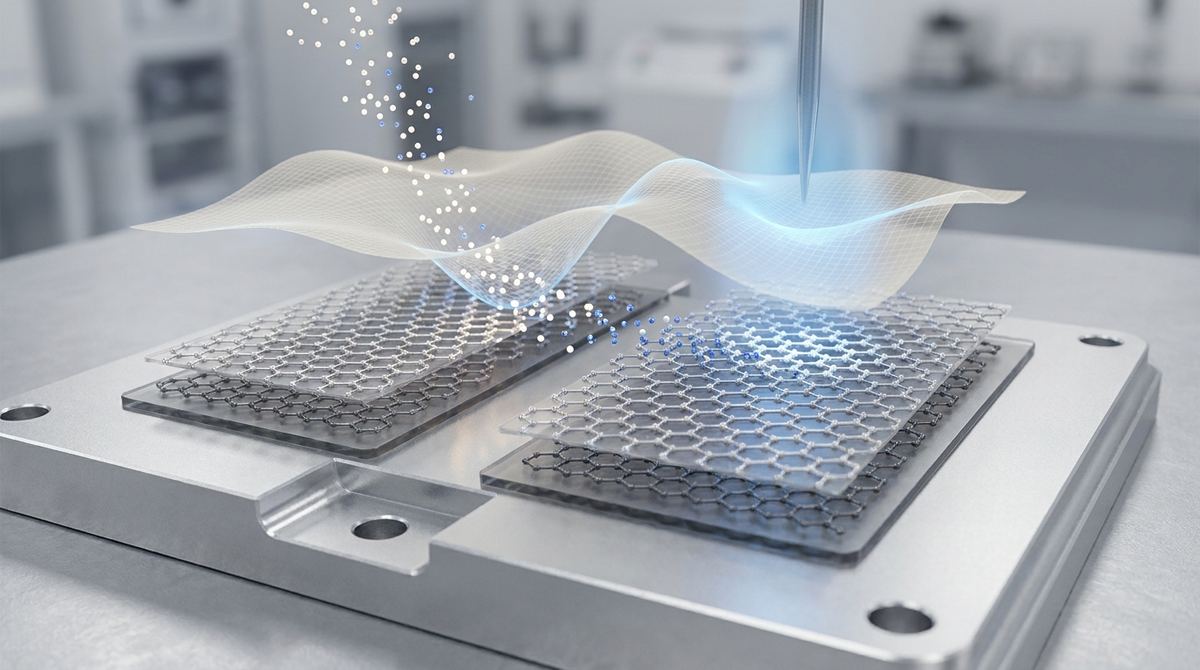
Imagine a light switch the size of a molecule. For decades, the engine of modern computing, the transistor, has been on a relentless journey of miniaturization, allowing us to pack billions of them onto a single chip. But this journey is approaching its physical limits. As switches become smaller, they leak current and generate immense heat, threatening to halt the progress we've come to expect. To continue advancing, we need a fundamentally new kind of switch, one that operates on different principles and consumes a tiny fraction of the energy. New theoretical research into the unique properties of bilayer graphene offers a tantalizing glimpse into what such a switch might look like, proposing a way to turn a material from a perfect conductor to a perfect insulator with an exquisitely gentle touch.
The fundamental challenge in post-silicon electronics is control. A transistor's job is to act as a gate, either allowing electrical current to flow (the "on" state) or stopping it completely (the "off" state). An ideal switch would use minimal energy to flip between these states and would have zero resistance when on and infinite resistance when off. While single-layer graphene is a phenomenal conductor, its lack of an electronic band gap means it's "always on," making it unsuitable for digital logic on its own. The problem, therefore, is how to engineer a graphene-based system that can be reliably and efficiently switched off. Previous efforts have often required extreme conditions, such as cryogenically low temperatures or enormously powerful magnetic fields, rendering them impractical for consumer devices. A recent theoretical paper by a team of physicists, including Amarnath Chakraborty, Aleksandr Rodin, Shaffique Adam, and Giovanni Vignale, directly confronts this issue by exploring a novel physical mechanism within a special two-layer arrangement of graphene. Their work aims to find a pathway to an efficient electronic switch that operates under much more technologically friendly conditions.
The central concept proposed by the researchers is a phenomenon known as a correlation-driven metal-insulator transition. Instead of thinking of electrons as individual particles moving through a wire, imagine them as a dense crowd of interacting entities. In most metals, these electrons flow freely. The researchers' theory suggests that in AB-stacked bilayer graphene, under specific conditions, applying a small electric field can cause the electrons to suddenly and collectively "jam." This isn't a gradual slowing down; it's an abrupt phase transition where the electrons, due to their mutual repulsion, spontaneously organize themselves into a locked, immobile state. This collective gridlock effectively stops all current flow, turning the material from a metal into an insulator. The key insight is that this traffic jam can be triggered with a very small "push" from an external electric field, which is why the researchers highlight it as a "low-field" transition. It's a way to achieve perfect "off" state control by leveraging the complex quantum dance of the electrons themselves, rather than by brute force.
To understand this breakthrough, we must first distinguish between different forms of graphene. A single sheet of graphene is a semimetal, where electrons behave as if they have no mass, allowing them to move at incredible speeds. This is great for conduction but offers no way to stop the current. The system explored in this research uses bilayer graphene, specifically in what is called AB-stacking or Bernal stacking. In this configuration, two graphene sheets are laid on top of each other, but the top sheet is shifted slightly so that only half of its carbon atoms sit directly above the atoms of the bottom layer. This specific geometry is not just an incidental detail; it is the foundation of the entire effect.
This AB-stacked structure fundamentally changes the electronic properties. When a perpendicular electric field, known as a displacement field, is applied across the two layers, it creates an imbalance between them. This breaks the system's symmetry and, crucially, opens up a tunable band gap. A band gap is an energy range that electrons are forbidden from occupying, and its presence is what defines a semiconductor. By creating and controlling this band gap, bilayer graphene can, in principle, be switched off, unlike its single-layer counterpart.
This is where the new theory comes into play. The researchers modeled what happens within this semiconducting state when you start adding charge carriers (a process called doping) while the material is also subjected to a weak magnetic field. Standard theory would suggest that adding more carriers should make the material a better conductor, more metallic. However, the model developed by Chakraborty and his colleagues shows that the interactions between the electrons themselves become a dominant force. The band structure of the bilayer graphene confines the electrons in a way that magnifies their mutual repulsion. At a certain critical density of carriers, this repulsion becomes so strong that it is more energetically favorable for the electrons to lock into a rigid, insulating configuration than to flow as a current. This spontaneous ordering is the metal-insulator transition. The displacement field acts as the primary control knob, setting the stage by opening the band gap, while the carrier density and a small magnetic field act as the triggers for this collective electronic phase change. This nuanced interplay is central to the field of graphene electronics.
Through rigorous theoretical calculations, the research team mapped out the conditions under which this exotic electronic state should appear. Their model predicts a sharp and clear transition from a conducting quantum Hall metal state to a fully insulating state. This is not a gradual change in resistance but a true phase transition, analogous to water freezing into ice. One of the most significant findings is the "low-field" nature of this phenomenon. The metal-insulator transition is predicted to occur at magnetic field strengths that are orders of magnitude lower than those required for many other exotic quantum effects.
The researchers identified the underlying cause as a many-body correlation effect. In simpler terms, the behavior of the system is not dictated by the properties of individual electrons but by their collective, interacting behavior. Their model successfully demonstrates that the unique electronic bands of AB-stacked bilayer graphene create a perfect environment for these interactions to become the star of the show, leading to a spontaneous symmetry breaking that drives the system into an insulating phase. They have provided a clear theoretical roadmap, predicting the specific carrier densities and field strengths where experimentalists should look for this remarkable transition.
This theoretical discovery is significant because it provides a new blueprint for an ultra-efficient electronic switch. Traditional transistors work by using an electric field to create an energy barrier that blocks electrons. This process is effective but imperfect, leading to leakage current and heat. The mechanism described here is fundamentally different. It doesn't just block electrons; it transforms the very electronic state of the material from a fluid-like conductor to a crystal-like insulator. Such a phase-change switch could theoretically be far more abrupt and complete, leading to a much better "on/off" ratio and drastically lower power consumption.
The low-field requirement is arguably the most important aspect for practical consideration. Many fascinating quantum phenomena in materials require colossal magnetic fields, which can only be generated by bulky, expensive, and power-hungry superconducting magnets. This has confined them to research laboratories. A phenomenon that occurs at low magnetic fields has a much clearer path toward integration into a compact, scalable device. This discovery deepens our fundamental knowledge of correlated electron physics in two-dimensional materials and suggests that these complex quantum interactions, once seen as a nuisance, could be harnessed for new technologies. The potential economic impact of such a low-power computing paradigm is enormous, a key driver in ongoing graphene market research.
It is crucial to frame this work with the appropriate context: it is a theoretical prediction. While grounded in well-established physical principles, the metal-insulator transition described in the paper has yet to be observed in a laboratory. The first and most important step for future work will be experimental verification. This will involve fabricating extremely high-quality AB-stacked bilayer graphene samples, which remains a challenge for many graphene manufacturing techniques, and then performing delicate electronic transport measurements at low temperatures to see if the predicted transition occurs.
Furthermore, theoretical models often rely on ideal conditions. Real-world materials contain impurities, defects in the crystal lattice, and interactions with the substrate they are placed on. Any of these imperfections could potentially disrupt the delicate electronic correlations required to trigger the insulating phase. Another critical unknown is temperature. Many quantum phase transitions only manifest at temperatures near absolute zero. While the theory provides the groundwork, experiments will be needed to determine the temperature stability of this new insulating state. Pushing its operating temperature towards room temperature would be a monumental challenge but is essential for any widespread application.
While still in the realm of fundamental physics, the long-term application of this research is clear: the creation of a new class of ultra-low-power electronic devices. The most direct application would be in a correlation-driven transistor for digital logic. Such a device could form the building blocks of computer processors that consume orders of magnitude less power than current silicon-based technology, enabling more powerful mobile devices, longer-lasting batteries, and more efficient data centers.
Beyond conventional computing, this principle could be applied to new forms of memory, where information is stored not as a trapped charge but as the electronic phase of the material (metal or insulator). This could lead to non-volatile memory that is both fast and highly durable. The extreme sensitivity of the transition to electric fields and charge density also suggests potential use in next-generation graphene sensors. A device based on this effect could act as an incredibly precise electrometer, capable of detecting the presence of just a few extra electrons in its vicinity.
If you take away just one idea from this research, let it be this: scientists have theoretically shown that two stacked layers of graphene can be flipped between a perfect electrical conductor and a perfect insulator using a very small electric field. This switch works not by simply blocking electrons, but by triggering a collective "traffic jam" where the electrons' own repulsion forces them into an immobile, insulating state. This discovery charts a new course toward building the ultimate energy-efficient electronic switch.
What is a metal-insulator transition?
A metal-insulator transition is a phenomenon where a material switches its fundamental electronic properties. In the metallic state, it conducts electricity easily, like copper. In the insulating state, it strongly resists the flow of electricity, like rubber. This ability to switch between conducting and non-conducting states is the basis of all digital electronics.
Why is "low-field" so important for this research?
The term "low-field" means the effect can be triggered without needing extremely strong magnetic or electric fields. Many quantum effects require massive, cryogenically cooled superconducting magnets to generate the necessary fields, making them impractical for anything outside a lab. A low-field effect has a much greater potential to be engineered into a compact, energy-efficient device like a chip in your phone.
What is AB-stacked bilayer graphene?
AB-stacked bilayer graphene consists of two sheets of graphene where the second layer is slightly offset relative to the first. This specific alignment breaks the symmetry of the system and, unlike single-layer graphene or other stacking arrangements, allows an electric field to open up a tunable band gap, which is essential for turning the material into a semiconductor and enabling the "off" state.
Is this a new type of transistor?
This research does not present a finished transistor. Instead, it reveals a new physical principle that could be used to build a radically new type of transistor. It is a theoretical blueprint that shows how a material can be made to switch, which experimentalists and engineers can now try to build into a working device.
How is this different from how current silicon transistors work?
Current silicon transistors, known as FETs, work like a valve. A gate voltage controls an electric field that either allows a channel of electrons to flow or depletes that channel to stop the flow. The mechanism in this paper is a phase transition; the gate voltage would trigger a change in the entire electronic state of the material itself, transforming it from a conductor to an insulator in a collective, abrupt manner, which could be much more efficient.
The theoretical work by Amarnath Chakraborty, Aleksandr Rodin, Shaffique Adam, and Giovanni Vignale provides a profound insight into the rich and often counterintuitive world of quantum materials. By demonstrating the possibility of a low-field, correlation-driven metal-insulator transition in AB-stacked bilayer graphene, they have laid out a compelling and plausible path toward overcoming some of the most significant barriers in modern electronics. While the journey from a theoretical model to a commercial device is long and filled with challenges of fabrication and experimental validation, this research shines a bright light on a promising new direction. It reinforces the idea that the future of computation may not lie in simply shrinking silicon, but in harnessing the complex, collective quantum phenomena that emerge in advanced materials like graphene.
Serious about B2B integration? Test our premium Pulsed Electrical Resistive Carbon Heating turbostratic graphene in your lab. 100g sample packs available now.
Explore More
Researchers develop a new imaging technique to map the Meissner effect and superfluid stiffness in a graphene superconductor, revealing crucial nanoscale...

Discover how compositional complexity in medium-entropy MXenes, a new class of 2D materials, is creating surfaces with ultralow friction for next-gen machines.

Researchers demonstrate a novel graphene-optimized 4H-SiC PIN diode with ultra-fast time resolution, paving the way for next-gen particle detectors.