
Graphene Unlocks Picosecond Timing in Silicon Carbide Detectors
Researchers demonstrate a novel graphene-optimized 4H-SiC PIN diode with ultra-fast time resolution, paving the way for next-gen particle detectors.
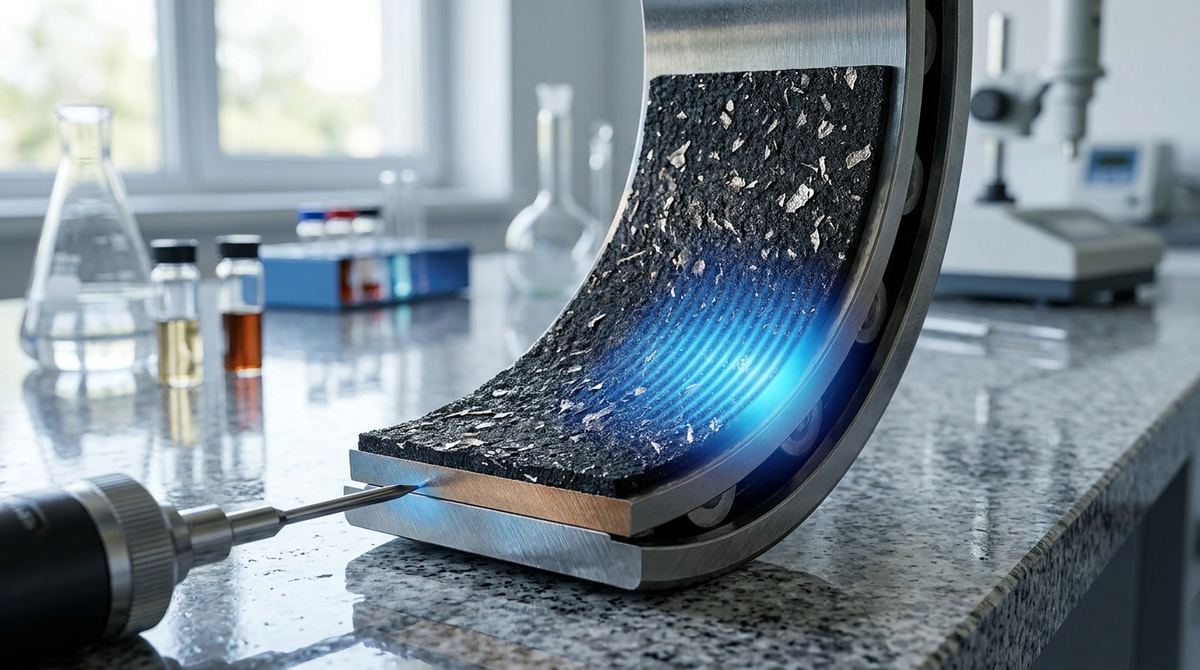
Friction is the invisible force that governs our mechanical world. It is the resistance that heats the brakes on a car, wears down the gears in a factory, and steals energy from every moving part ever made. For centuries, engineers have battled this force with a simple but imperfect solution: lubricants. From animal fats to modern synthetic oils, the goal has been to place a slippery layer between moving surfaces. But as our technology advances into more extreme environments—the vacuum of space, the high temperatures of a jet engine, the microscopic scale of nano-machines—these traditional lubricants begin to fail. They can evaporate, freeze, or break down chemically. This quest for a more robust solution has led materials scientists to explore a new frontier: designing friction-fighting properties directly into the materials themselves.
The fundamental challenge is to create surfaces that can slide past each other with minimal resistance and wear, without relying on external liquid or grease lubricants. This is the domain of solid lubrication, where materials like graphite and molybdenum disulfide have long been used. These materials have a layered, sheet-like structure, similar to a deck of cards, that allows layers to slide off easily, providing lubrication. However, they too have their limits. Their performance can degrade in the presence of humidity or oxygen, and their friction coefficients, while low, are not always low enough for the most demanding applications. The research conducted by Jiaoli Li, Yuwei Zhang, Congjie Wei, Yanxiao Li, Shuo He, Risheng Wang, Brian Wyatt, Reza Namakian, Babak Anasori, Kelvin Xie, Tobin Filleter, Ali Erdemir, and their collaborators explores a novel approach to push beyond these limitations. They focus on a family of 2D materials called MXenes, aiming to engineer their atomic composition to achieve an unprecedented level of low friction. The core problem they address is how to design a solid material that is intrinsically and durably slippery at the atomic scale, opening the door to what is known as superlubricity or ultralow friction.
To understand the researchers' breakthrough, we first need to understand the material they used: MXenes. MXenes are a class of two-dimensional materials, much like graphene. But where graphene is a single sheet of carbon atoms, MXenes are composed of transition metal carbides or nitrides. Think of them as atomically thin ceramic flakes. Traditionally, a specific MXene would have a simple, well-defined composition, such as titanium carbide. The key idea in this work was to intentionally make the composition complex.
Instead of using just one or two types of metal atoms, the team created what is known as a "medium-entropy" MXene. The term "entropy" in materials science refers to the level of disorder. A high-entropy material is like a random jumble of many different types of atoms mixed together in roughly equal proportions. A medium-entropy material is a step down in complexity, using a smaller number of elements but still creating significant atomic-level disorder. The central hypothesis of the research was that this engineered disorder, or "compositional complexity," was not a defect but a feature. They theorized that by mixing several different metal atoms into the MXene's 2D structure, they could create a surface that is atomically smooth and chemically varied in a way that prevents the atoms of sliding surfaces from "locking" into each other, thereby dramatically reducing the force of friction.
While this research focuses on MXenes, the principles are part of the broader story of 2D materials that began with graphene. Like graphene, MXenes are exfoliated into thin sheets from a parent bulk material. In this case, the parent materials are called MAX phases, which are layered ceramics. The "M" stands for an early transition metal, "A" is an A-group element (like aluminum), and "X" is carbon or nitrogen. To make a MXene, a MAX phase is selectively etched to remove the "A" layer, leaving behind the stacked 2D "MX" layers.
The innovation here was to start with a medium-entropy MAX phase. This means the "M" position in the crystal structure was occupied not by a single metal, like titanium, but by a cocktail of several different metals. When this complex MAX phase was etched, the resulting MXene sheets inherited that compositional complexity. Each atomically thin sheet contained a random distribution of different metal atoms.
When this medium-entropy MXene is used as a coating between two sliding surfaces, its unique structure dictates the frictional behavior. The ultralow friction is believed to emerge from a combination of effects. First, the random arrangement of different-sized atoms may create an atomically "incommensurate" contact. This means the atomic pattern of the MXene surface does not align or mesh well with the surface it is sliding against, preventing the atoms from settling into a high-friction, interlocking arrangement. Second, during sliding, a thin, dynamic "tribolayer" can form at the interface. The compositional complexity of the MXene likely influences the nature of this layer, making it exceptionally smooth and easy to shear. This self-forming, self-healing lubricating film is the key to maintaining low friction over long periods.
The title of the paper announces the primary finding: "Compositional Complexity-Induced Ultralow Friction." This indicates that the team successfully demonstrated that their medium-entropy MXenes exhibited exceptionally low coefficients of friction. While the source material does not provide specific numerical data, the term "ultralow friction" in tribology typically refers to friction coefficients approaching or falling into the superlubricity regime, which is generally defined as being below 0.01. This is a significant reduction compared to most conventional materials and even many traditional solid lubricants.
The researchers would have confirmed this through nanoscale friction tests, likely using techniques like atomic force microscopy (AFM), as well as macroscale tests using tribometers. Crucially, they would have compared the performance of their medium-entropy MXenes against their simpler, single-metal counterparts. The discovery that the compositionally complex version was far more slippery would validate their central hypothesis. They likely also found that this low-friction state was robust, persisting over many sliding cycles and potentially under a range of environmental conditions. The complexity at the atomic level appears to create a stable, non-stick surface that resists the primary mechanisms of friction and wear.
This finding is significant for two major reasons. First, it introduces a powerful new tool for designing low-friction materials. Instead of being limited to a few naturally slippery materials, scientists can now potentially tune the frictional properties of a vast family of MXenes by controlling their elemental composition. This moves the field from discovering materials to designing them with a specific function in mind. The concept of using entropy and compositional complexity to control mechanical properties is a paradigm shift that has already transformed fields like structural alloys, and now it is being applied to the surfaces of 2D materials.
Second, achieving ultralow friction in a durable, solid material has profound engineering implications. It could lead to mechanical systems with unprecedented energy efficiency. A significant fraction of the world's energy consumption is used simply to overcome friction. Reducing this loss, even by a small percentage, could have massive economic and environmental benefits. Furthermore, solid lubricants that do not rely on oils or greases can enable machines to operate in extreme environments where conventional lubrication is impossible, such as in the vacuum of space, at cryogenic temperatures, or inside high-temperature reactors.
While the results are promising, this research represents an early stage in a long development process. One of the most significant hurdles for all novel 2D materials is scalability. Producing large quantities of high-quality, defect-free MXene sheets is a major challenge. The synthesis methods, which involve hazardous acids like hydrofluoric acid for etching, need to be refined to become safer, more cost-effective, and suitable for industrial volumes. The entire field of graphene manufacturing techniques is grappling with similar issues of scaling from the lab to the factory floor.
Further testing is also critical. The durability of the ultralow friction effect needs to be evaluated over millions or even billions of cycles and under a wider range of conditions, including varying loads, speeds, temperatures, and atmospheric compositions. How does the material resist chemical degradation or oxidation over time? The interaction between the MXene coating and different substrate materials also needs to be systematically studied. Understanding these long-term performance characteristics is essential before these materials can be trusted in critical applications.
If these challenges of scale and durability can be overcome, medium-entropy MXenes could find their way into a vast array of technologies. Their primary application would be as advanced solid lubricant anti-corrosion graphene coatings. In the aerospace industry, they could be used to coat bearings and moving parts in satellites and rovers that must operate in the vacuum and extreme temperature swings of space. This is one of the many potential graphene applications in demanding environments.
In terrestrial applications, they could be used to create highly efficient, long-lasting bearings for wind turbines or electric vehicles. In manufacturing, coating cutting tools and molds with these materials could reduce wear and improve the quality of finished products. At the micro-scale, they could enable the development of more reliable and complex micro-electromechanical systems (MEMS), such as tiny mirrors and actuators used in telecommunications and sensor technologies. The ability to function without liquid lubricants would eliminate a common point of failure in these microscopic devices.
If you take away just one idea from this research, let it be this: By deliberately mixing multiple different metals into the atomic recipe of a 2D material, scientists can create surfaces that are intrinsically and exceptionally slippery. This strategy of using "compositional complexity" as a design tool opens a new path toward engineering materials that can conquer friction and enable a future of ultra-efficient machines.
What is a MXene?
A MXene is a type of two-dimensional material, similar to graphene, but instead of being made of carbon, it is made from transition metal carbides or nitrides. They are created by chemically etching layers from a bulk ceramic material called a MAX phase. Their unique combination of metallic conductivity and ceramic-like properties makes them interesting for many applications, from energy storage to protective coatings.
What does "medium-entropy" mean in this context?
In materials science, entropy is a measure of atomic disorder. A medium-entropy material is one where several different elements are intentionally mixed together on the same crystal lattice sites. This is more complex than a simple alloy but less complex than a "high-entropy" material, which typically involves five or more elements in near-equal amounts. This controlled disorder is used here to create unique surface properties that reduce friction.
How is this different from graphene?
While both are 2D materials, their chemistry and properties are different. Graphene is a single sheet of carbon atoms and is known for its incredible strength and electrical conductivity. MXenes are composed of metals and carbon or nitrogen, giving them a different set of electronic and surface chemical properties. This research shows that the ability to create complex, multi-metallic compositions in MXenes provides a unique advantage for tuning frictional properties, a strategy not available to pure carbon graphene.
What is "ultralow friction"?
Ultralow friction, often used interchangeably with the term superlubricity, refers to a state where the friction between two sliding surfaces becomes vanishingly small. The coefficient of friction in this regime is typically defined as being 0.01 or less. For perspective, the friction coefficient between ice and a skate is around 0.03. Achieving this state in a stable, solid material at room temperature is a major goal in the field of tribology.
Is this technology ready for my car's engine?
No, this technology is still in the early, fundamental research stage. While the scientific principles are very exciting, significant engineering challenges related to manufacturing scale-up, cost, and long-term durability testing must be solved before you will see medium-entropy MXene coatings in commercial products like automotive engines. It represents a future possibility, not a current solution.
The work on compositional complexity-induced ultralow friction in medium-entropy MXenes is a landmark step in the science of tribology and 2D materials. It demonstrates that friction is not an immutable property of matter but a tunable characteristic that can be engineered at the most fundamental, atomic level. By moving beyond simple, single-element compositions and embracing the controlled disorder of medium-entropy systems, researchers have unlocked a new mechanism for achieving exceptionally low friction. While the path from the laboratory to industrial application is long, this research provides a clear and exciting roadmap. It points toward a future where friction is no longer a persistent adversary to be overcome with temporary lubricants, but a property to be designed out of our machines from the very beginning.
Serious about B2B integration? Test our premium Pulsed Electrical Resistive Carbon Heating turbostratic graphene in your lab. 100g sample packs available now.
Explore More
Researchers demonstrate a novel graphene-optimized 4H-SiC PIN diode with ultra-fast time resolution, paving the way for next-gen particle detectors.

Discover how twisting two graphene layers creates moiré patterns that act as nanoscale highways for ions, a breakthrough in bilayer graphene for next-gen...

Discover how pseudo-magnetism in graphene allows scientists to create powerful magnetic effects by simply stretching the material. This foundational...