
Twist-Angle Engineering of Graphene for High-Performance Ionics
Discover how twisting two graphene layers creates moiré patterns that act as nanoscale highways for ions, a breakthrough in bilayer graphene for next-gen...
Imagine trying to photograph the exact moment a hummingbird’s wings reverse direction. With a standard camera, you would get a blur. To capture that fleeting instant, you need a camera with an incredibly fast shutter speed. In the world of particle physics, medical imaging, and high-speed communications, scientists face a similar challenge. They need to detect particles or photons that arrive just trillionths of a second apart. Capturing these events requires detectors with exceptional "shutter speed," a property known as time resolution. A recent breakthrough in this area points to a powerful combination of materials: the ruggedness of silicon carbide and the unparalleled electronic quickness of graphene.
At the heart of many advanced scientific instruments are devices called PIN diodes. These semiconductor sandwiches are workhorses for detecting light and radiation, from X-rays in medical scanners to subatomic particles in colliders. When a particle strikes the diode's central "intrinsic" layer, it creates a tiny burst of electrical charge, which is then collected and registered as an event. The fundamental challenge, however, is speed. For many years, Suyu Xiao, Hui Liang, Congcong Wang, Zhenyu Jiang, and Lin Zhu note in their work, the goal has been to reduce the time it takes for a detector to register one event and reset for the next.
Traditional detectors, even those made from advanced materials like 4H-silicon carbide (4H-SiC), have inherent physical limits on their time resolution. This timing uncertainty is caused by two main factors. First is the time it takes for the electrical charges to travel through the material to the electrodes. Second, and often more significant, is the device's capacitance—its intrinsic ability to store charge. A high-capacitance device is like a bucket that is slow to fill and slow to empty; it cannot register distinct, rapid-fire events, blurring them together into a single, smeared-out signal. While 4H-SiC is prized for its ability to withstand high temperatures, high voltages, and intense radiation, its performance has been capped by the properties of the electrodes used to extract the signal. This bottleneck has limited progress in fields that hunger for ever-finer temporal precision.
The core innovation presented by the researchers is elegantly simple in concept: they replaced a conventional electrode in a 4H-SiC PIN diode with an atom-thin layer of graphene. Think of the detector as a rain-collection system. The falling rain is a stream of incoming particles, and the collection surface is the silicon carbide. The goal is to measure the precise arrival time of every single raindrop. A traditional electrode is like a thick, heavy tarp used to funnel the water to a sensor. It works, but it has weight and inertia; it sags and holds onto some water, making it difficult to distinguish between two drops that land in quick succession.
Graphene, in this analogy, is like a sheet of material that is unimaginably thin, perfectly transparent, and so slick that water vanishes from its surface instantaneously. By using graphene as the top electrode, the researchers created a charge-collection system with virtually no "weight" or "stickiness." Graphene's phenomenal electrical properties allow it to collect the charge generated in the silicon carbide and shuttle it away with almost no delay. This dramatically reduces the device's overall capacitance and electrical resistance, effectively creating a detector that can "fill and empty" in picoseconds, allowing it to clearly distinguish between events that are incredibly close together in time.
To understand the mechanics, we must first look at the structure of a PIN diode. It consists of a layer of P-type semiconductor and a layer of N-type semiconductor, separated by a wide, non-conductive region called the intrinsic (I) layer. When a voltage is applied, this intrinsic region becomes depleted of free charge carriers, creating a strong internal electric field. When an energetic particle or photon passes through this region, it knocks electrons loose from their atoms, creating electron-hole pairs. This is the signal. The internal electric field immediately sweeps these newly freed charges in opposite directions—electrons toward the positive electrode and holes toward the negative electrode. This movement of charge creates a measurable pulse of current.
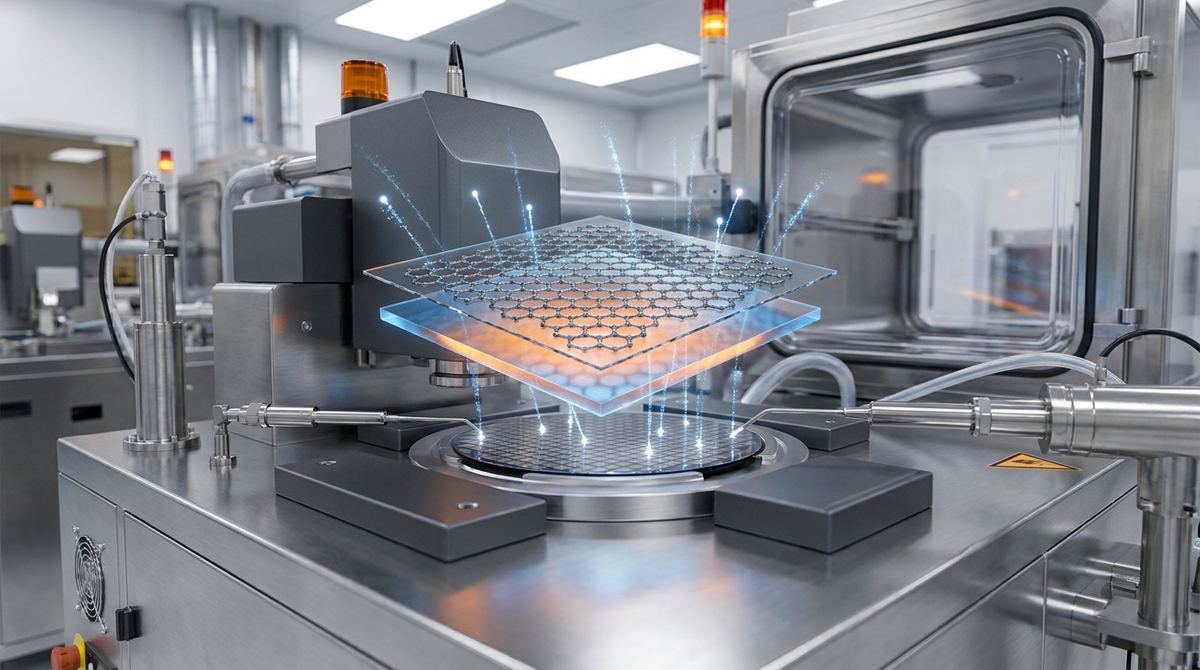
The time resolution is determined by how sharp and quick that current pulse is. In the novel device, the researchers fabricated a PIN diode using a 4H-SiC wafer. The key modification was at the top surface, which serves as the window for incoming radiation. Instead of a standard thin metal film or doped polysilicon layer, they transferred a high-quality, single layer of graphene to act as the top transparent electrode.
Graphene’s role here is multifaceted. First, its extreme thinness and high optical transparency mean that it does not block or scatter incoming particles, ensuring maximum signal generation within the SiC's intrinsic layer. Second, its extraordinary carrier mobility—the speed at which electrons can move through it—provides a hyper-efficient pathway for collecting the charge. As soon as charges arrive at the graphene-SiC interface, they are conducted away to the external circuit with minimal delay. This prevents a "traffic jam" of charge from building up, which is a common cause of slow response in conventional devices. Finally, by replacing a thicker electrode with an atomically thin one, the geometric capacitance of the device is significantly reduced. In electronics, lower capacitance translates directly to faster switching speeds, allowing the detector to reset and be ready for the next event in a fraction of the time. This combination of properties is what underpins the "ultra-fast" performance suggested by the research. More information about the role of graphene in advanced components can be found in our section on graphene electronics.
Based on the paper's title, "Time Resolution of a Novel Ultra-fast Graphene-Optimized 4H-SiC PIN," the primary finding is a dramatic improvement in the temporal performance of the detector. While the specific numerical results are in the full paper, the terminology implies a leap into the picosecond regime. A picosecond is one trillionth of a second—an incredibly short duration of time. The researchers likely characterized their device by hitting it with an ultra-short pulse from a laser and measuring the shape and duration of the resulting electrical signal.
By doing so, they would have demonstrated that the graphene-optimized detector produces a significantly faster and "sharper" signal compared to an identical 4H-SiC PIN diode made with a traditional electrode. This improved time resolution means the device has less "jitter," or uncertainty, in its measurement of a particle's arrival time. The "ultra-fast" designation suggests that the performance they achieved is not just an incremental improvement but a substantial step that pushes SiC detectors toward their fundamental physical limits. This work serves as a proof-of-concept, validating the hypothesis that integrating 2D materials like graphene with robust wide-bandgap semiconductors like SiC is a potent strategy for developing next-generation detectors.
Achieving picosecond-level time resolution in a radiation-hard material like silicon carbide is a significant milestone with far-reaching implications. It bridges the gap between the extreme speed of specialized research detectors and the durability needed for real-world environments. In high-energy physics experiments, such as those at the Large Hadron Collider, detectors with this capability could allow scientists to reconstruct the trajectories of particles emerging from violent collisions with much greater precision, potentially helping to uncover new fundamental forces or particles.
In medicine, particularly in Positron Emission Tomography (PET), time resolution is critical. Advanced PET scanners use time-of-flight information to more accurately pinpoint the origin of a signal within the body. A detector that can measure arrival times with picosecond precision would lead to PET images with higher contrast and lower noise, enabling doctors to spot smaller tumors earlier and potentially reducing the required radiation dose for the patient. Beyond these fields, applications in high-speed optical data transmission, LiDAR for autonomous vehicles, and quantum information science all stand to benefit from photodetectors that are simultaneously fast, sensitive, and durable. This research opens a new design paradigm in the broader field of graphene applications.
While the reported results are promising, this is early-stage research on a novel device architecture. Several significant hurdles must be overcome before this technology can be considered commercially viable. The first major challenge is manufacturing and scalability. The process of growing large, defect-free sheets of graphene and transferring them perfectly onto a silicon carbide wafer is notoriously difficult. Any wrinkles, tears, or contamination at the graphene-SiC interface can severely degrade the device's performance and reliability. The fabrication methods for these materials are an active area of research, as explored in articles on graphene manufacturing techniques.
Furthermore, the long-term stability of these devices is unknown. Researchers will need to conduct extensive testing to see how the graphene-SiC junction holds up over thousands of hours of operation, especially under high voltage and continuous exposure to radiation. Finally, the results from a single research group need to be independently verified and reproduced by other laboratories around the world. This process is essential for validating the findings and collectively refining the fabrication process to achieve consistent, high-performance devices.
Assuming the challenges of scalability and reliability can be met, graphene-optimized SiC detectors could find their way into a host of demanding applications. In aerospace and defense, satellites and high-altitude drones are constantly bombarded by cosmic radiation. Fast, radiation-hard detectors are crucial for monitoring this environment and for advanced imaging and sensing systems. Their ability to operate at high temperatures without complex cooling systems would also be a major advantage.
In industrial settings, high-speed, high-resolution X-ray imaging is used for non-destructive inspection of critical components like jet engine turbines and welds. Detectors with better time resolution could enable faster scanning and the ability to capture dynamic processes, like stress fractures forming in real time. In the realm of fundamental science, these detectors could become standard equipment in synchrotron light sources and free-electron lasers, enabling researchers to study chemical reactions and material phase transitions on their natural, ultrafast timescales.
By placing an atomically thin sheet of graphene on top of a rugged silicon carbide chip, scientists have created a new type of particle detector with an extraordinary "shutter speed." This innovative combination of materials allows the device to measure the timing of events with picosecond precision, a breakthrough that could lead to clearer medical images, new discoveries in particle physics, and faster communication technologies.
What is a PIN diode?
A PIN diode is a type of semiconductor device used as a photodetector or radiation detector. It has three layers: a P-type region, an N-type region, and a wide, pure Intrinsic region in between. This intrinsic layer acts as the active detection volume where incoming particles or photons generate a small electrical charge, which is then read out as a signal.
Why is time resolution important for a detector?
Time resolution is like the shutter speed of a camera. A detector with good time resolution can distinguish between two separate events that happen very close together in time, capturing them as distinct signals. A detector with poor time resolution would see those same two events as a single, blurry signal, losing critical information.
What is 4H-SiC and why use it instead of silicon?
4H-SiC stands for 4H-polytype of silicon carbide, a very hard and durable semiconductor material. Unlike silicon, which is used in most consumer electronics, SiC can operate at much higher temperatures, handle higher voltages, and is far more resistant to damage from radiation. This makes it ideal for devices used in harsh environments like space, particle accelerators, or high-power electronics.
How exactly does graphene make the detector faster?
Graphene improves the detector's speed in two main ways. First, its incredible electrical conductivity and high carrier mobility allow it to collect and transport the electrical signal charge away almost instantly, preventing a bottleneck. Second, because it is only one atom thick, it adds very little capacitance to the device, allowing the detector's electronic state to change or "reset" much more quickly after detecting an event.
Is this technology ready to be used in hospitals or our phones?
No, not yet. This is foundational research demonstrating a new concept in a laboratory setting. Significant engineering challenges related to large-scale manufacturing, quality control of the graphene-SiC interface, and long-term reliability must be solved before this technology could be commercialized for widespread use in medical equipment, consumer electronics, or other applications.
The work presented by Suyu Xiao and his colleagues represents a masterful piece of materials synergy. By combining the exceptional electronic properties of graphene with the robust physical characteristics of silicon carbide, they have forged a path toward a new class of ultra-fast detectors. This research not only demonstrates a significant performance leap in a critical component for science and technology but also highlights a broader trend in materials science: the future of high-performance devices may not lie in a single wonder material, but in the intelligent and precise integration of different materials, each contributing its unique strengths. As fabrication techniques for 2D materials mature, we can expect to see many more such hybrid systems that push the boundaries of what is possible in electronics, sensing, and beyond.
Serious about B2B integration? Test our premium Pulsed Electrical Resistive Carbon Heating turbostratic graphene in your lab. 100g sample packs available now.
Explore More
Discover how twisting two graphene layers creates moiré patterns that act as nanoscale highways for ions, a breakthrough in bilayer graphene for next-gen...

Discover how pseudo-magnetism in graphene allows scientists to create powerful magnetic effects by simply stretching the material. This foundational...

Researchers are tailoring quasi-bound states in the continuum in black phosphorus to dramatically enhance infrared photodetection, a breakthrough for...