
Engineering Light Traps for Superior Infrared Photodetection with 2D Materials
Researchers are tailoring quasi-bound states in the continuum in black phosphorus to dramatically enhance infrared photodetection, a breakthrough for...
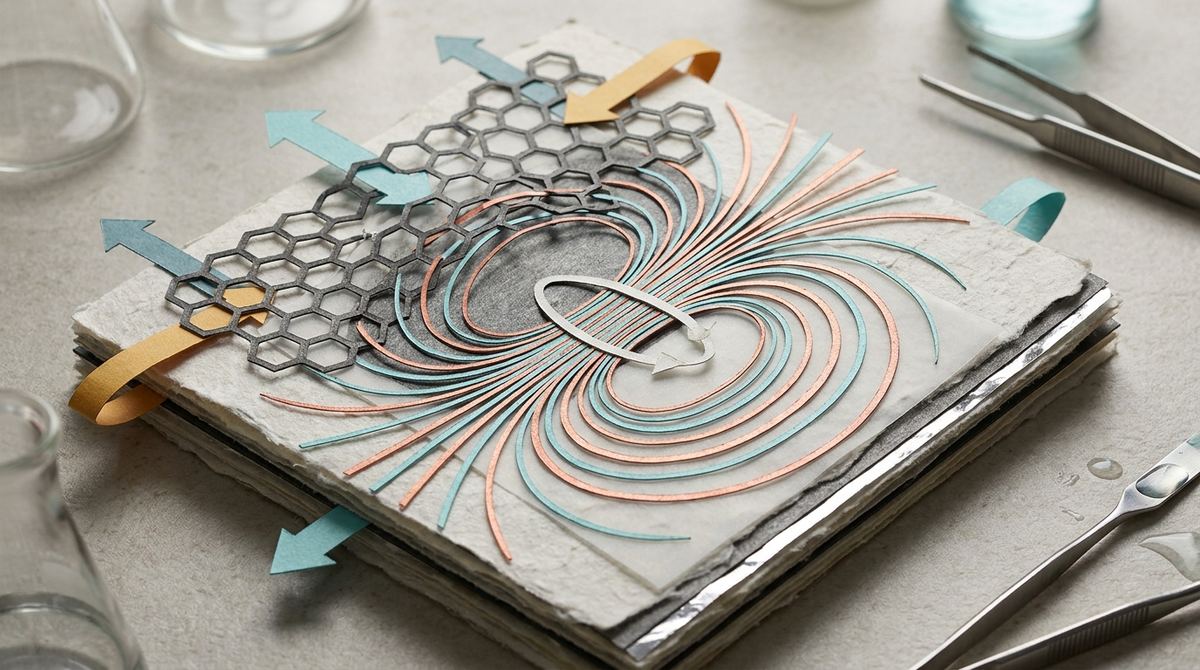
Imagine being able to generate a powerful magnetic field, stronger than those in an MRI machine, simply by stretching a thin sheet of material. This isn't science fiction; it is the core idea behind a fascinating quantum mechanical phenomenon known as pseudo-magnetism. In materials with a specific atomic structure, like graphene, applying precise mechanical strain can force electrons to behave exactly as if they were in an intense magnetic field, even when no magnet is present. This opens up an entirely new way to control electricity at the nanoscale, a field often called "straintronics." A recent theoretical paper provides a crucial mathematical underpinning for this effect, helping to solidify the physics that could one day lead to revolutionary new devices.
At the heart of modern electronics lies our ability to control the flow of electrons. For decades, we have primarily used electric fields, applied via voltages, to guide these charge carriers through silicon transistors. Magnetic fields offer another powerful way to manipulate electron trajectories, but generating and controlling strong magnetic fields at the nanoscale is incredibly difficult. Miniaturizing magnets is challenging, and integrating them seamlessly into microchips is an engineering nightmare. The goal, then, is to find a way to achieve the effects of a magnetic field without the magnet itself. This is the central problem that the concept of pseudo-magnetism addresses. Before engineers can build reliable devices based on this principle, however, they need a robust and precise mathematical description of how it works. The theoretical work by Xuenan Li and Michael I. Weinstein on a "discrete honeycomb lattice" provides exactly this kind of foundational knowledge. It rigorously explores the connection between mechanical strain and emergent magnetic-like phenomena, paving the way for future experimental and engineering efforts.
The key idea is both simple and profound: geometry is physics. In graphene, carbon atoms are arranged in a flat, chicken-wire-like honeycomb pattern. Electrons don't just flow through this structure like water in a pipe; their movement is governed by the quantum mechanical rules of this specific lattice. When you stretch or deform this honeycomb sheet in a very particular way, you alter the distances and angles between the atoms. This geometric change modifies the quantum "hopping" pathways available to the electrons. The genius of pseudo-magnetism is that a specific type of triangular, or triaxial, strain pattern warps these electron pathways in a manner that is mathematically identical to the effect of a uniform magnetic field. To the electron, the strained lattice feels exactly like an unstrained lattice permeated by a powerful magnetic force. There is no actual magnetism; the effect is an illusion, a "pseudo" field, created entirely by the material's physical shape. The researchers in this study explored this concept not on a perfect, continuous sheet of graphene, but on a simplified "discrete" model, which can be thought of as a connect-the-dots version of the lattice. This simplification allows for a more direct and rigorous mathematical proof, confirming that the underlying principle is sound and not just an artifact of more complex models.
The system described in the paper is a mathematical model, not a physical device. It begins with a discrete honeycomb lattice, a set of points and connections that represent the carbon atom locations and bonds in graphene. In this idealized environment, the behavior of electrons is described by a set of equations. The researchers then introduce strain into this model. This isn't a random stretching; it's a carefully defined deformation. Imagine pulling on a sheet of graphene from three equally spaced directions (at 0, 120, and 240 degrees). This triaxial strain causes some atomic bonds to lengthen and others to compress in a repeating pattern. This change in bond length alters a critical parameter in the quantum equations known as the "hopping amplitude," which dictates how easily an electron can jump from one atom to the next. The core of the work involves showing how this spatially varying hopping amplitude modifies the overall quantum behavior of electrons in the lattice. The result is the emergence of a "vector potential," a mathematical construct that in physics is the hallmark of a magnetic field. The consequence of this pseudo-magnetic field is the formation of pseudo-Landau levels. In a real magnetic field, the continuous energy spectrum of electrons collapses into a series of discrete, quantized energy levels called Landau levels. The paper demonstrates mathematically that the right kind of strain on a discrete honeycomb lattice produces an analogous set of quantized energy levels, providing the ultimate proof that the system is successfully mimicking a true magnetic field. This level of electronic control is a key goal for creating new types of graphene electronics.
As this is a mathematical physics paper, the findings are not experimental measurements but rigorous proofs and characterizations. Li and Weinstein successfully demonstrated a precise mathematical correspondence between specific strain configurations on a discrete honeycomb lattice and the emergence of a uniform pseudo-magnetic field. They established the exact form of the strain required to produce this effect and derived an equation that calculates the strength of the resulting pseudo-field based on the magnitude of the applied strain. A key discovery was the robust formation of pseudo-Landau levels within their discrete model. They showed that the energy spectrum of the system exhibited these characteristic quantized levels, including a "zero-energy" Landau level, which is a unique and tell-tale sign of this phenomenon in graphene. By proving that this effect holds true in a simplified, discrete system, they have shown that pseudo-magnetism is a fundamental property of the honeycomb lattice itself, not some quirk of a more complicated continuous model. This makes the theory more general and potentially applicable to other systems that share a similar honeycomb structure, such as certain photonic crystals or arrays of quantum dots.
This research, while highly theoretical, is incredibly important for the future of materials science and electronics. It provides a solid, brick-by-brick mathematical foundation for the entire concept of straintronics. By proving the principles in a clean, discrete model, it gives engineers and experimental physicists greater confidence that the effect is real and predictable. This allows them to design experiments and potential devices knowing the underlying theory is sound. The ability to generate massive pseudo-magnetic fields—calculated to be equivalent to hundreds of Tesla, far beyond what steady-state lab magnets can produce—opens a window into studying extreme quantum physics. More practically, it provides a new "knob" to turn for controlling electrons. Instead of just using voltage, engineers could one day use precise, microscopic strain to create electronic switches, guide electron beams within a chip, or create novel data storage mechanisms. This work helps bridge the gap between abstract quantum theory and the tangible world of device engineering, expanding the toolbox for a vast range of graphene applications. It solidifies the idea that we can engineer a material's quantum properties not just through chemistry, but through mechanics.
The primary limitation of this research is inherent in its theoretical nature. The study was performed on an idealized, discrete lattice model in a perfect vacuum. A real sheet of graphene is a continuous material, not a set of discrete points. It has imperfections, grain boundaries, and wrinkles. It rests on a substrate, which can interfere with its electronic properties and inhibit the application of perfect strain. The model also does not account for complex phenomena like electron-electron interactions or thermal vibrations (phonons), which are always present in a real device. Therefore, the most critical next step is experimental verification. Scientists need to use advanced fabrication techniques to apply the specific triaxial strain patterns to real graphene sheets. Then, using tools like scanning tunneling microscopy (STM), they must attempt to directly measure the predicted pseudo-Landau levels. Proving that these quantized energy states appear as predicted would be a monumental confirmation of the theory. Another major challenge is one of scale and control. Creating and maintaining these precise strain fields over large, uniform areas is a significant hurdle in graphene manufacturing techniques that must be overcome before any practical devices can be realized.
While commercial devices are still far in the future, the validated principles of pseudo-magnetism point toward several revolutionary applications. One of the most exciting is in "valleytronics." Graphene's electronic structure has two distinct energy minimums, or "valleys." A pseudo-magnetic field can act as a "valley filter," effectively separating electrons based on which valley they belong to. This valley state could be used as a new way to encode binary information, much like electron spin is used in spintronics. Another application is in creating graphene transistors. Graphene's lack of an electronic band gap prevents it from being easily "switched off," a major obstacle for digital logic. A periodically strained graphene sheet, creating a repeating pattern of pseudo-magnetic fields, is theoretically capable of opening such a band gap. This could finally unlock graphene's potential as a replacement for silicon. Furthermore, the extreme sensitivity of graphene's electronic state to its mechanical shape makes it a prime candidate for next-generation graphene sensors. Devices could be built to detect minuscule pressures or vibrations with unprecedented accuracy by measuring the resulting changes in pseudo-magnetic effects.
If you remember just one thing from this research, let it be this: by precisely stretching a graphene-like material, we can create the functional equivalent of an enormous magnetic field without any magnets. This principle, grounded in the interplay of geometry and quantum mechanics, provides a powerful new method for controlling electrons at the nanoscale.
What is pseudo-magnetism in graphene?
Pseudo-magnetism is a quantum mechanical effect where applying mechanical strain to the honeycomb lattice of graphene alters the paths of electrons. This alteration is mathematically identical to the effect a very strong magnetic field would have, creating a "pseudo" or fake magnetic field without the need for an actual magnet.
Why is graphene's honeycomb lattice so important for this effect?
Graphene's unique honeycomb structure gives rise to its extraordinary electronic properties, where electrons behave as if they have no mass. The specific symmetry and connectivity of this lattice mean that when it is deformed in a particular triaxial pattern, it systematically and predictably creates the vector potential that mimics a magnetic field, a phenomenon not seen in simple square lattices.
What does it mean that this research used a "discrete" lattice?
A discrete lattice is a simplified mathematical model used by theorists. Instead of treating graphene as a continuous, solid sheet, it is modeled as a finite collection of points (atoms) connected by lines (bonds). This simplification removes complexities and allows for clearer, more rigorous mathematical proofs about the fundamental physics at play.
Is this technology ready for use in my phone or computer?
No, not for a long time. This paper represents fundamental, early-stage theoretical research that validates the mathematical principles. Significant engineering challenges remain in creating and controlling the required strain patterns on real, large-scale graphene sheets before any commercial devices can be built.
What are pseudo-Landau levels and why are they significant?
In a magnetic field, electrons are forced into specific, discrete energy orbits called Landau levels. The discovery of "pseudo-Landau levels"—a similar set of discrete energy states created by strain instead of a magnet—is the key experimental signature that confirms the presence of a pseudo-magnetic field. It's the smoking gun that proves the effect is real.
The work of Xuenan Li and Michael I. Weinstein provides a vital piece of the theoretical puzzle for straintronics. By rigorously demonstrating the principles of pseudo-magnetism on a discrete honeycomb lattice, they have strengthened the foundation upon which future technologies can be built. Their research illuminates a path where the mechanical deformation of a material becomes a primary tool for crafting its electronic and quantum behavior. While the journey from mathematical proof to a functioning device is long and filled with challenges, this kind of fundamental insight is essential. It reaffirms that by understanding and manipulating the very geometry of matter at the atomic scale, we can unlock entirely new physical phenomena and pave the way for an era of electronics governed not just by electricity, but by the subtle art of strain.
Serious about B2B integration? Test our premium Pulsed Electrical Resistive Carbon Heating turbostratic graphene in your lab. 100g sample packs available now.
Explore More
Researchers are tailoring quasi-bound states in the continuum in black phosphorus to dramatically enhance infrared photodetection, a breakthrough for...

Research into sliding ferroelectric tunnel junctions reveals how graphene's mechanical motion can trigger quantum resonance, dramatically enhancing...

Discover how Bogoliubov flat bands in twisted layered materials could reshape our understanding of unconventional superconductivity for future quantum...