Acoustic Waves Map Electron Flow in Graphene for Future Electronics
Discover how acoustic waves can map and control electron flow in graphene, a groundbreaking technique for reconstructing electron dynamics and enabling...
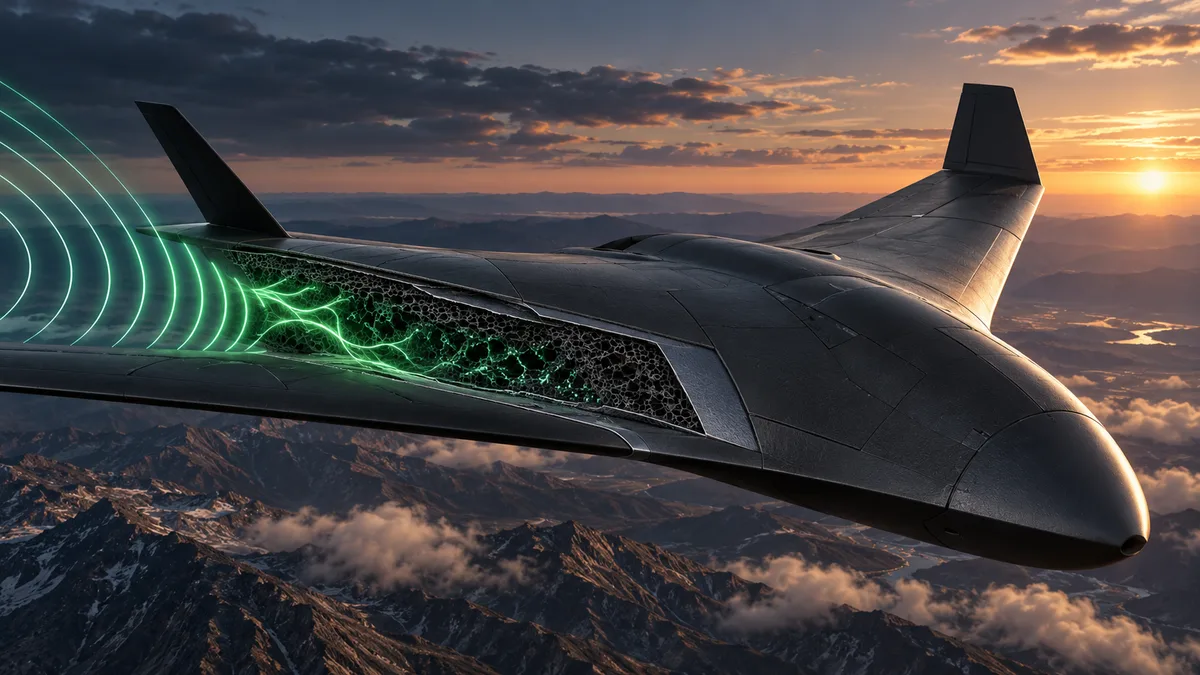
A drone does not need to become invisible to gain an operational advantage. Reducing the energy reflected back toward a radar receiver—even across a limited frequency band—can make detection and classification more difficult. The engineering problem is unforgiving: any radar-absorbing layer must add as little mass and thickness as possible while surviving heat, vibration, weather, and the curved geometry of an airframe.
A 2025 study in Ceramics International points to a materials strategy built around graphene oxide, reduced graphene oxide, an iron-aluminide magnetic phase, and ordinary polyurethane foam. The researchers did not flight-test a military drone. They demonstrated, in the laboratory, a thin porous composite designed to dissipate electromagnetic energy in the C band. That distinction matters—but so does the result.
Conventional low-observable design combines airframe geometry with materials that redirect or absorb electromagnetic waves. Shape remains fundamental, but coatings and structural layers can help manage reflections from surfaces, joints, inlets, payload housings, and other features that cannot be optimized by geometry alone. For unmanned aircraft, mass is especially expensive: every added gram competes with fuel, battery capacity, sensors, communications hardware, or payload.
This is why porous carbon materials are attractive. A foam creates a long, tortuous path through which an incoming wave can scatter repeatedly. Graphene-derived sheets add electrically active interfaces without requiring a solid slab of dense material. The objective is not simply high electrical conductivity. A highly conductive surface can reflect energy rather than absorb it. Effective absorbers need impedance matching at the air-material boundary and several mechanisms that convert electromagnetic energy into small amounts of heat.
The study used polyurethane foam as a lightweight three-dimensional scaffold. The foam was loaded with graphene oxide (GO), reduced graphene oxide (rGO), and Fe₃Al, an iron-aluminide intermetallic. Each component had a different job.
GO and rGO supplied a large population of electrically dissimilar interfaces. Their different conductivity and band-gap characteristics promote dipole and interfacial polarization: charges accumulate and relax at boundaries as the electromagnetic field oscillates. The porous network also encourages multiple internal reflections. Fe₃Al added a magnetic-loss pathway, while its comparatively moderate conductivity helped the composite avoid the impedance mismatch associated with an overly reflective conductive skin.
The result was a hybrid dielectric-magnetic absorber rather than a simple conductive shield. That distinction is important for aircraft: shielding keeps electromagnetic energy out of an enclosure, often by reflection; radar-absorbing material is intended to admit more of the incident wave and dissipate it before it can return to the source.
At a thickness of 1.7 millimeters, the GO/rGO/Fe₃Al foam reached a minimum reflection loss of −30.4 dB at 5.9 GHz and an effective absorption bandwidth of 2.8 GHz in the tested C-band range. Expressed as reflected power at the best-performing frequency, −30.4 dB corresponds to roughly one part in a thousand of the incident power remaining in the reflected signal under the laboratory measurement conditions.
That number should not be translated directly into a drone-level radar-cross-section reduction. Radar signature depends on the complete aircraft: shape, angle, polarization, frequency, edges, apertures, fasteners, surface finish, and material placement all interact. A flat-sample reflection-loss test is a material-screening result, not an operational stealth certification.
The researchers also compared heat flow through the foams. The GO/rGO/Fe₃Al sample cooled to less than half its initial temperature in under a minute, while the untreated polyurethane foam lost only about 20 percent of its energy over the comparison period. For drones, that multifunctionality may be as interesting as radar attenuation.
Electric propulsion, compact power electronics, radar and radio payloads, batteries, and onboard computing all create heat. A material layer that contributes to electromagnetic-wave attenuation while spreading or releasing heat could reduce the need for separate single-purpose components. Fewer layers can mean simpler packaging and lower system mass—provided the composite retains performance after environmental aging.
The most credible near-term role is not a complete graphene stealth airframe. It is selective integration: removable panels, payload fairings, antenna-adjacent structures, access covers, internal cavity treatments, or localized surface regions identified through electromagnetic simulation. A foam-based absorber may also be easier to conform to complex shapes than a brittle ceramic tile.
The same material logic is relevant beyond military signature management. Civil and industrial drones carry multiple radios, high-speed processors, cameras, thermal sensors, and navigation systems in a compact volume. Lightweight absorption-dominant composites could suppress electromagnetic interference between subsystems and help manage heat without relying entirely on metal shielding.
The paper establishes a promising formulation, not a finished aerospace product. A production program would still need to validate adhesion, moisture uptake, ultraviolet stability, freeze-thaw cycling, rain erosion, hydraulic-fluid and fuel exposure, vibration, flame behavior, repairability, and performance over temperature. Engineers would also need measurements across multiple incidence angles and polarizations, followed by component-level and full-airframe radar testing.
Manufacturing repeatability is another central question. The absorber depends on the distribution and reduction state of graphene-derived material, the Fe₃Al loading, pore structure, and final thickness. Small process variations can change conductivity and impedance matching. Scalable deployment therefore requires tight control of feedstock quality, dispersion, impregnation, drying, and quality assurance.
The strategic value of graphene is not that it performs one impossible trick. It is that a small amount of engineered carbon can help a lightweight structure perform several jobs at once. In this experiment, a 1.7-millimeter porous layer combined dielectric loss, magnetic loss, internal scattering, and thermal response. That is exactly the kind of multifunctional design pressure shaping the next generation of unmanned systems.
The practical opportunity is a development path: reproduce the material, tune it for the frequency band and geometry of interest, integrate it into representative drone components, and test the complete system. Graphene does not eliminate the hard work of low-observable engineering. It may give engineers a thinner, lighter, and more adaptable material platform with which to do that work.
Serious about B2B integration? Test our premium Pulsed Electrical Resistive Carbon Heating turbostratic graphene in your lab. 100g sample packs available now.
Explore More
Discover how acoustic waves can map and control electron flow in graphene, a groundbreaking technique for reconstructing electron dynamics and enabling...
New theoretical research shows how controlling graphene's energy gap under periodic driving can generate high-frequency current oscillations, a key step for...
Research on magic-angle twisted bilayer graphene reveals a new geometric component of superfluid stiffness, a key property for robust Kekulé superconductivity.