
Beyond Graphene: Predicting 3D Carbon Lattices Without sp² Bonds
Researchers use Density Functional Theory to predict a new family of 3D graphyne-based nanomaterials, exploring sp²-free structures with potential...
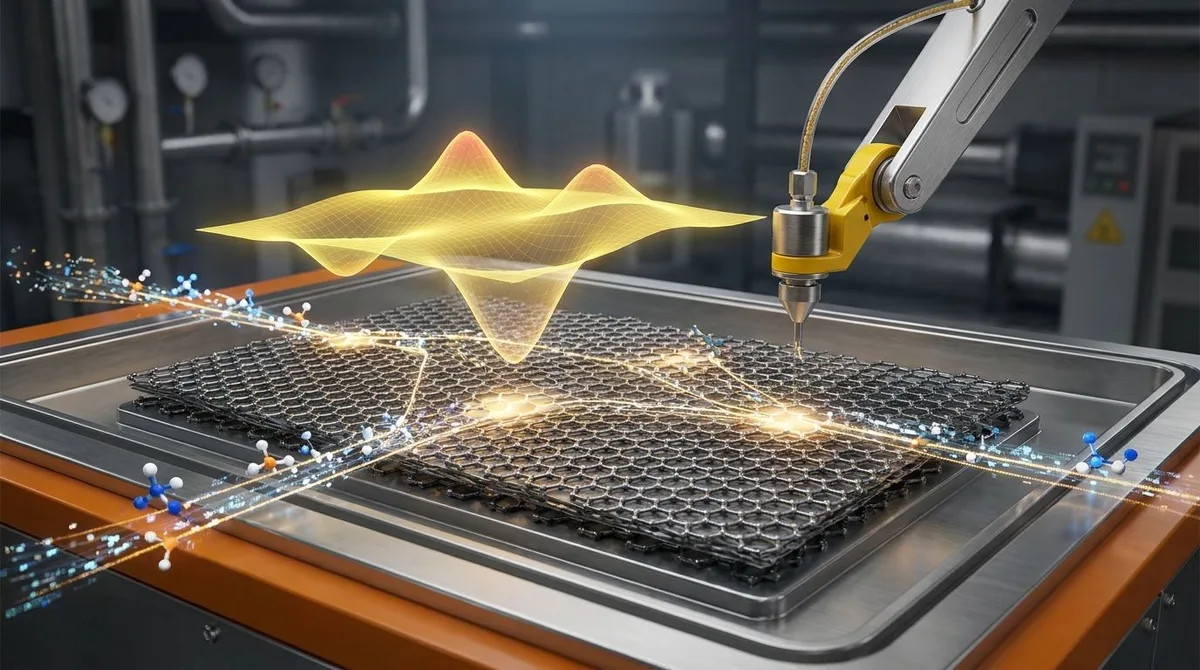
Imagine trying to design a new jet engine. You wouldn’t build hundreds of physical prototypes to see which one works best. Instead, you would use sophisticated computer simulations to test designs virtually, saving immense time and money. What if we could do the same for materials, designing them atom by atom on a computer before ever stepping into a lab? This is the promise of molecular dynamics simulations, a powerful tool for predicting how materials will behave. The problem is that the most accurate simulations are agonizingly slow, while the fast ones are often too simple to be reliable. A recent breakthrough in artificial intelligence offers a powerful solution, creating a "best of both worlds" approach that could revolutionize how we discover and engineer next-generation materials, from advanced alloys to graphene composites.
At the heart of materials science is the need to understand and predict the relationship between a material's atomic structure and its macroscopic properties. The gold standard for this is quantum mechanics, specifically methods like Density Functional Theory (DFT). DFT calculations can predict the energy and forces within a system of atoms with incredible accuracy. However, this accuracy comes at a staggering computational cost. Simulating even a few hundred atoms for a fraction of a second can take days or weeks on a supercomputer, making it impractical for studying large-scale phenomena like crack propagation or the folding of a large protein.
To overcome this, scientists developed classical interatomic potentials, which are essentially simplified sets of mathematical equations that approximate the complex quantum interactions. These are incredibly fast, enabling simulations of millions of atoms, but they have a major drawback: they are not transferable. A potential developed for silicon will not work for iron, and one for pure carbon will not accurately describe the complex environment inside a graphene-polymer composite. They are brittle and lack the flexibility to handle diverse chemical environments.
This is where Machine Learning Interatomic Potentials (MLIPs) come in. The idea is to train a machine learning model on a large dataset of accurate DFT calculations. The model learns the underlying patterns and can then predict energies and forces for new atomic configurations millions of times faster than DFT. While a huge step forward, existing MLIPs still face a trilemma, forcing a trade-off between accuracy, computational efficiency, and universality—the ability to work across a wide range of chemical elements and structures. The work of researchers Shuyu Bi, Zhede Zhao, Qiangchao Sun, Tao Hu, Xionggang Lu, and Hongwei Cheng directly confronts this challenge, aiming to create a single model that is simultaneously accurate, fast, and broadly applicable.
The core innovation presented by the research team is a new type of MLIP built on a framework called a Graph Neural Network (GNN). A GNN is a form of artificial intelligence perfectly suited for this task because it's designed to understand data structured as a network of nodes and edges. In the world of materials, atoms are the nodes, and the connections or distances between them are the edges. The GNN learns about an atom's environment by passing "messages" between neighboring atoms, building up a sophisticated chemical fingerprint for each one.
What makes this particular GNN special is the introduction of a "dynamic attention" mechanism. Imagine an expert chemist looking at a complex molecule. They don't give equal importance to every atomic bond. Their trained intuition allows them to focus on the most critical interactions that define the molecule's behavior. The dynamic attention mechanism gives the AI this same ability. For any given atom, the model learns to assign a weight, or an "attention score," to each of its neighbors. It automatically determines which neighboring interactions are most influential in determining the system's energy. This is "dynamic" because the attention scores change depending on the specific local geometry, allowing the model to adapt its focus on the fly. This intelligent allocation of computational resources means the model can achieve higher accuracy without becoming slow and inefficient.
While the paper describes a universal method, its application to carbon-based materials like graphene is a powerful example of its potential. To model a material, such as a sheet of graphene interacting with polymer chains in a composite, the system first represents the atomic structure as a graph. Each carbon, oxygen, or hydrogen atom becomes a node in the network.
The GNN then begins its message-passing process. In each step, every atom gathers information from its neighbors. This isn't just a simple count; the information includes the type of neighboring atom and its precise distance and orientation. This is where dynamic attention comes into play. As an atom receives messages from its neighbors, the attention mechanism calculates a unique score for each message. The interaction between a carbon atom in the graphene lattice and a nearby polymer backbone might receive a very high attention score, as this interface is critical to the composite's overall strength. In contrast, the interaction with another carbon atom far away on the same graphene sheet might receive a low score.
After several rounds of this weighted message passing, each atom node contains a rich, learned vector of numbers that represents its complete local chemical environment. This final vector is then fed into a smaller neural network that makes the final prediction: the potential energy of that atom. By summing the energies of all atoms, the model calculates the total energy of the system. This process is differentiable, meaning the model can also precisely calculate the forces acting on every atom, which is essential for running a molecular dynamics simulation to see how the material evolves over time. The "universality" of the model stems from the fact that it isn't taught specific rules for carbon or oxygen. Instead, it learns the fundamental principles of atomic interaction from the raw DFT data, allowing it to generalize to new chemical systems it wasn't explicitly trained on.
Based on the claims of a "universal and efficient" model, the research likely demonstrated several key performance benchmarks. The primary finding would be a model that achieves accuracy remarkably close to the ground-truth DFT calculations across a diverse range of materials. This means the model successfully learned the complex quantum mechanical interactions governing different types of chemical bonding, from metallic and covalent to ionic.
Secondly, the efficiency of the model would have been a major result. The researchers likely showed that their GNN with dynamic attention could perform these high-accuracy predictions many orders of magnitude faster than the DFT methods used to generate the training data. This speedup is what transforms the tool from a theoretical curiosity into a practical instrument for large-scale simulations.
Finally, the paper's emphasis on universality suggests the model was tested on a wide variety of chemical systems without needing to be fundamentally redesigned for each one. This could include demonstrating high performance on benchmarks ranging from simple solids like silicon, to complex molecules, to multi-element alloys. The dynamic attention mechanism likely proved crucial here, allowing a single, unified architecture to adapt its internal calculations to the unique physics of each different material.
The development of a fast, accurate, and universal MLIP is not just an incremental improvement; it's a paradigm shift for computational materials science. The most profound impact is the acceleration of the materials discovery cycle. Scientists can now perform high-throughput virtual screening, testing thousands of hypothetical compounds on a computer to identify promising candidates for applications like new battery electrodes or more efficient catalysts. This drastically reduces the time and expense of experimental trial and error.
This technology also allows us to study complex phenomena that were previously computationally inaccessible. For example, we could simulate the entire process of a crack forming and spreading through a reinforced polymer composite, observing atom-by-atom how the material fails. This level of insight is invaluable for designing stronger, more durable materials. Furthermore, a more efficient model makes high-fidelity simulation more accessible, enabling smaller research groups and companies to tackle complex materials design challenges without needing exclusive access to top-tier supercomputers.
Despite its power, this approach has limitations. The primary one is its dependence on data. MLIPs are only as good as the quantum mechanical calculations they are trained on. Creating these large, high-quality datasets is still a time-consuming and expensive process that requires significant expertise and computational resources.
Another critical challenge is the problem of extrapolation. If the model is asked to predict the behavior of an atomic configuration far outside the distribution of its training data—for instance, at extremely high pressures or temperatures—its predictions can become unreliable. Ensuring the robustness of these models in unexplored territories is an active area of research.
Finally, while GNNs are excellent at capturing local atomic environments, modeling long-range interactions, such as the weak van der Waals forces that hold layers of graphene together, can be more difficult. Accurately capturing these subtle, long-distance effects across very large systems may require further architectural innovations or hybrid approaches that combine the GNN with other methods.
The practical applications of such a powerful simulation tool are vast, particularly in the realm of advanced materials like graphene. In the aerospace sector, engineers could use it to design lighter and stronger aerospace composites by simulating the precise interface between graphene flakes and the surrounding polymer matrix to optimize load transfer.
In energy storage, this model could accelerate the development of next-generation graphene batteries. Researchers could simulate how different ions, like lithium, interact with and move through graphene-based electrodes, providing insights to design batteries that charge faster and last longer. The tool could even be used to improve the manufacturing of graphene itself. By simulating the chemical vapor deposition process, scientists could better understand how to control growth conditions to produce large, defect-free sheets, potentially leading to improvements in graphene production machinery. Another promising area is in the design of highly sensitive graphene sensors, where the model could simulate the binding of specific target molecules to a functionalized graphene surface.
This research introduces a smarter and more versatile computational microscope for materials science. By combining graph neural networks with a dynamic attention mechanism, scientists have created an AI tool that can predict the behavior of materials at the atomic level with the accuracy of quantum mechanics but at a speed that makes large-scale simulations practical. This accelerates our ability to design the advanced materials of the future.
What is an interatomic potential?
An interatomic potential is a mathematical function that describes the potential energy of a system of atoms based on their positions. It acts as a set of rules that governs how atoms interact, allowing scientists to simulate their movement and predict the properties of a material without running expensive quantum mechanical calculations for every single step.
Why is this new machine learning method better than older ones?
This method offers a superior balance of accuracy, speed, and versatility. Unlike fast but inaccurate classical potentials, it learns from highly accurate quantum calculations. Unlike those quantum calculations, it is millions of times faster. Its key advantage over other machine learning potentials is its dynamic attention mechanism, which helps it achieve high accuracy more efficiently and adapt to a wide variety of different chemical systems.
What is a Graph Neural Network, or GNN?
A Graph Neural Network is a type of artificial intelligence specifically designed to work with data that can be represented as a graph, which is a collection of nodes connected by edges. This structure is a natural fit for chemistry and materials science, where atoms can be treated as nodes and the bonds or interactions between them can be treated as edges. GNNs excel at learning the complex relationships within these networks.
What does "dynamic attention" mean in this context?
Dynamic attention is a mechanism that allows the AI model to focus its computational effort on the most important parts of the atomic structure. When calculating the energy of a specific atom, the model learns to assign higher importance, or "attention," to the neighboring atoms that have the most significant influence. This ability to dynamically shift focus makes the model both more accurate and more efficient.
Can this technology be used to invent new materials?
While the AI cannot "invent" materials from scratch on its own, it serves as an incredibly powerful tool for accelerating human invention. It allows scientists and engineers to rapidly test new ideas for materials on a computer, screening thousands of potential compositions and structures to identify the most promising candidates for a specific application before they need to be synthesized and tested in a physical lab.
The development of universal and efficient machine learning interatomic potentials represents a significant milestone in our quest to engineer materials from the ground up. The work by Shuyu Bi and his colleagues, leveraging graph neural networks with a dynamic attention mechanism, provides a clear path toward overcoming the long-standing trade-offs between accuracy, speed, and applicability in molecular simulation. This advancement puts a powerful new tool in the hands of researchers, promising to accelerate discovery and innovation across countless fields, from medicine and energy to electronics and aerospace. As these models continue to improve, they will become indispensable for unlocking the full potential of advanced materials like graphene and building the foundation for the technologies of tomorrow.
Serious about B2B integration? Test our premium Pulsed Electrical Resistive Carbon Heating turbostratic graphene in your lab. 100g sample packs available now.
Explore More
Researchers use Density Functional Theory to predict a new family of 3D graphyne-based nanomaterials, exploring sp²-free structures with potential...
Discover how acoustic waves can map and control electron flow in graphene, a groundbreaking technique for reconstructing electron dynamics and enabling...
New theoretical research shows how controlling graphene's energy gap under periodic driving can generate high-frequency current oscillations, a key step for...