
Machine Learning Decodes Graphene Doping for Next-Gen Electronics
Researchers use machine learning and X-ray spectroscopy to map how atomic dopants modulate graphene's electronic properties, a key step for advanced sensors...
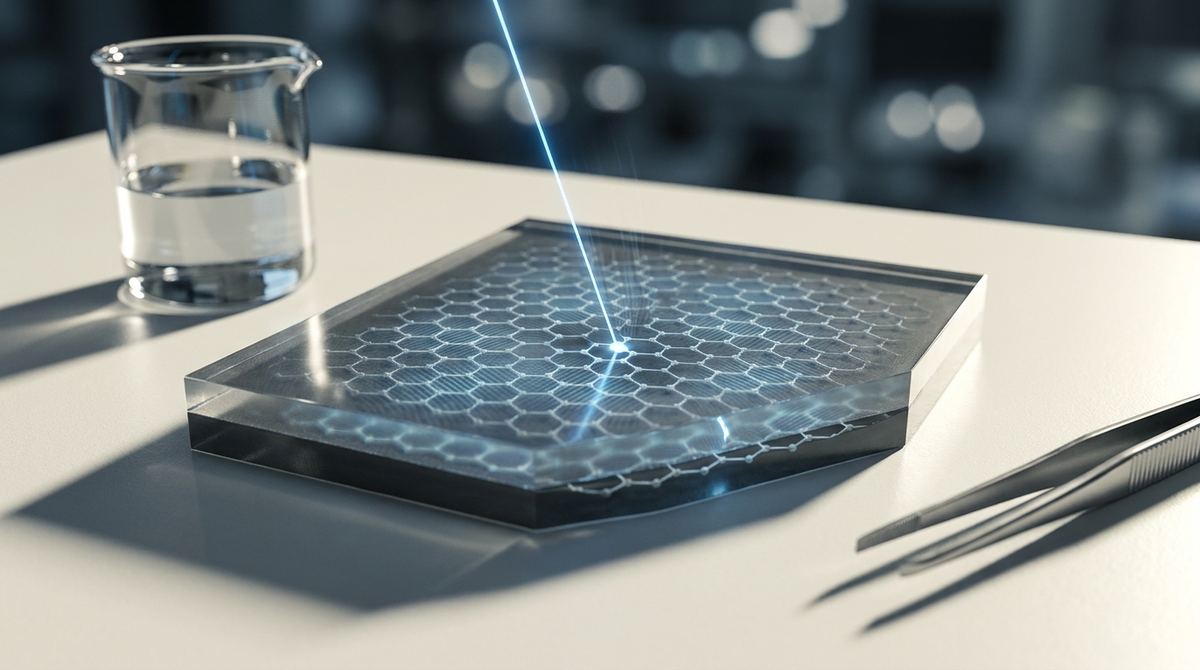
The dream of a hydrogen economy, powered by clean energy and emitting only water, hinges on a single, critical component: a membrane that can expertly shuttle protons. These membranes are the heart of hydrogen fuel cells, acting as atomic gatekeepers that allow protons to pass while blocking everything else. For decades, we have relied on polymer-based solutions, but they come with limitations in efficiency, cost, and operating conditions. A new frontier in materials science is emerging, one that seeks to build better membranes not by mixing chemicals in a vat, but by engineering matter one atomic layer at a time. This is where the unique properties of graphene enter the picture, promising a future of ultra-thin, hyper-efficient materials.
At the core of this challenge is a need for exquisite control. A perfect proton transport membrane must be incredibly thin to reduce resistance, yet mechanically strong. It needs pores just large enough for a single proton (a bare hydrogen nucleus) to pass through, but small enough to block even a tiny hydrogen molecule. Creating such a structure is an immense engineering challenge. Traditional materials are often a compromise, with randomly distributed pores that lead to inefficiencies or a lack of selectivity. While single-layer graphene is a promising candidate due to its single-atom thickness and strength, it is also impermeable. Puncturing it to create pores is difficult to do with atomic precision; the results are often too random or the pores too large, defeating the purpose. The central problem, therefore, is how to controllably introduce proton-conducting pathways into a graphene lattice at the highest possible density without compromising its structural integrity or selectivity. A groundbreaking study by a team of researchers including J. Tong, G. Chen, H. Li, E. Hoenig, M. Alhashmi, X. Zhang, D. Bahamon, G. R. Tainton, S. Sullivan-Allsop, Y. Mayamei, D. R. da Costa, L. F. Vega, and their colleagues, presents a novel and elegant solution to this very problem.
The researchers’ central idea is to use a property of bilayer graphene that is almost like a hidden superpower: the twist angle. Instead of using a single sheet of graphene, they took two and stacked them. Critically, they didn't align them perfectly. They twisted one layer slightly relative to the other. This simple act of twisting creates a beautiful, repeating interference pattern known as a moiré superlattice. This pattern is not just visually interesting; it fundamentally changes the electronic and chemical properties of the material at different locations. Some spots in the pattern behave differently than others. The team hypothesized that these variations could be exploited. They predicted that the most reactive spots in the moiré pattern could serve as targets for a chemical reaction. By exposing this twisted bilayer graphene to hydrogen gas under specific conditions, they aimed to attach hydrogen atoms—a process called hydrogenation—selectively to these reactive sites on only one of the two graphene layers. This process doesn't punch a physical hole but rather creates a chemical gateway. The hydrogenated spot becomes an energetically favorable pathway for protons to hop through, creating a dense, perfectly ordered array of atomic-scale channels for proton transport. The key is that the properties of this channel network are not fixed; they are directly tunable by the initial twist angle.
The foundation of this system is twisted bilayer graphene (tBLG). When two hexagonal graphene lattices are overlaid with a slight rotational misalignment, a larger-scale periodic pattern emerges. Within this moiré pattern, the atomic alignment of the two layers varies continuously. In some regions, the carbon atoms of the top layer sit directly above the carbon atoms of the bottom layer (known as AA stacking). In other regions, the atoms of the top layer sit above the center of the hexagons in the bottom layer (AB/BA stacking). These different stacking configurations create localized variations in strain and electron density. The research leverages the fact that the AA-stacked regions are often more chemically reactive than the AB-stacked regions.
The next step is hydrogenation. Graphene's carbon atoms are typically bonded to three other carbons in a flat plane, a configuration known as sp2 hybridization, which is responsible for its incredible conductivity. Hydrogenation is a chemical process that forces these carbon atoms to bond with a hydrogen atom. This breaks the flat sp2 structure and forces the carbon into a puckered, three-dimensional sp3 configuration, similar to the bonding in diamond. This change is transformative: an sp3-hybridized carbon site in the graphene lattice is no longer a good electrical conductor. It effectively becomes an insulating defect.
The genius of the new research lies in combining these two concepts. The team exposed the tBLG to a hydrogen plasma. Because the AA-stacked regions of the moiré pattern are more reactive, the hydrogen atoms preferentially attach themselves there. Furthermore, the presence of the second graphene layer influences the reaction, allowing the hydrogenation to occur selectively on only one of the two layers. The result is a remarkable heterostructure created within a single material. One layer remains pristine, conductive graphene, acting as an impermeable barrier. The other layer is transformed into a patchwork quilt: a pristine graphene sheet decorated with a perfectly ordered, periodic array of tiny, hydrogenated, insulating spots. These hydrogenated regions act as the proton channels. Protons, being extremely small, can move through the material by hopping between these engineered defect sites. The energy barrier for a proton to pass through a hydrogenated site is significantly lower than passing through the flawless graphene lattice, creating a dedicated highway for proton traffic.
The experimental results confirmed the team's hypothesis with remarkable success. They demonstrated that they could achieve layer-selective hydrogenation, creating a pattern of hydrogenated sites on one graphene sheet while leaving the other untouched. This control is a significant achievement in nanoscale fabrication. The hydrogenation was not random but occurred precisely at the expected locations within the moiré superlattice, confirming that the twist-induced electronic variations were indeed directing the chemical reaction.
Most importantly, they measured the proton transport properties of these engineered membranes. They discovered that the membranes exhibited significant proton conductivity, meaning protons could move through them efficiently. At the same time, they showed high selectivity, effectively blocking the transport of other, larger molecules. This is the ideal behavior for a proton exchange membrane. The pinnacle of their findings was the direct link between the twist angle and the membrane's performance. By fabricating and testing devices with different twist angles, they showed that they could tune the proton conductivity. A smaller twist angle creates a larger moiré pattern with more sparsely spaced reactive sites, while a larger twist angle (up to a point) brings them closer together. This tunability is a powerful tool, allowing for the design of membranes optimized for specific applications, a level of control that is simply not possible with conventional materials. This research moves beyond simply making a graphene membrane and enters the realm of designing its transport properties from first principles.
This work represents a paradigm shift in how we think about designing functional membranes. Instead of relying on bulk materials with inherent porosity, this method allows for the bottom-up construction of transport pathways with atomic precision. It is a powerful demonstration of "moiré engineering," where the properties of a material are dictated not just by its chemical composition but by the geometric arrangement of its layers. The ability to tune proton conductivity by simply adjusting a mechanical parameter—the twist angle—is a breakthrough for materials design.
The implications for energy technology are profound. Hydrogen fuel cells could become significantly more efficient and compact. An atomically thin membrane has much lower internal resistance than a conventional polymer membrane that is thousands of times thicker, which could lead to a substantial boost in power density. This might translate to lighter batteries for drones and electric aircraft, or more powerful and longer-lasting fuel cells for vehicles. The precise control offered by this technique could also enable the creation of membranes with unprecedented selectivity, opening doors to new applications such as efficiently separating isotopes—a notoriously difficult and energy-intensive process. Furthermore, the principles of using moiré patterns to guide chemical reactions could be extended to other 2D materials and other chemical modifications, paving the way for a new class of designer quantum materials. For example, similar techniques could be explored for water desalination membranes, a critical technology for global water security.
While the scientific achievement is immense, it is important to maintain perspective on the path to commercialization. This research was conducted on a laboratory scale, likely with very small, meticulously prepared samples. A major hurdle will be developing scalable graphene manufacturing techniques that can produce large areas of high-quality twisted bilayer graphene with a precise and uniform twist angle. This is a significant challenge for current industrial synthesis equipment.
The long-term durability of these membranes also needs thorough investigation. A fuel cell is a harsh environment, and the hydrogenated sites must remain stable over thousands of hours of operation. Researchers will need to test whether the hydrogen atoms stay bonded to the carbon lattice or if the structure degrades over time under thermal and chemical stress. Finally, the mechanical robustness of a freestanding, two-atom-thick membrane is a practical concern. In any real-world device, such a membrane would need to be supported by a porous substrate, and the integration of these components without introducing defects is another engineering challenge that must be solved. The overall cost-benefit analysis, as detailed in ongoing graphene market research, will ultimately determine its commercial viability.
The most immediate and compelling application for this technology is in the development of next-generation proton exchange membranes for hydrogen fuel cells. This could revolutionize a key component in the graphene batteries and energy storage sector. By creating thinner, more efficient membranes, this work could accelerate the adoption of clean hydrogen energy in transportation and stationary power generation.
Beyond fuel cells, the principle of tunable, atomically precise pores has broad applicability. It could lead to highly selective membranes for gas separation, such as filtering valuable hydrogen from industrial process streams. The ability to pattern insulating regions on a conductive sheet is also a foundational technique for creating next-generation graphene electronics. One could imagine fabricating entire circuits on a single bilayer sheet of carbon, with conductive pathways of pristine graphene separated by insulating lines of hydrogenated graphene. This opens up possibilities for ultra-low-power, flexible, and transparent electronic devices.
If you take away just one concept from this breakthrough, let it be this: by simply twisting two layers of graphene, scientists can create a repeating nanoscale pattern that acts as a chemical blueprint. This blueprint allows them to precisely place atomic-scale gateways on one of the layers, creating a perfect, tunable sieve for protons. This elegant fusion of physics and chemistry unlocks a powerful new method for engineering materials from the atom up, with major implications for clean energy and nanotechnology.
What is twisted bilayer graphene?
Twisted bilayer graphene is a material made of two sheets of single-atom-thick carbon stacked on top of each other with a slight rotational misalignment. This twist creates a large-scale interference effect called a moiré pattern, which causes the material's electronic and chemical properties to vary periodically across its surface.
What does hydrogenation do to graphene?
Hydrogenation is a chemical process that attaches hydrogen atoms to the carbon atoms in the graphene lattice. This changes the carbon atoms' bonding structure from a flat, conductive state (sp2) to a puckered, insulating state (sp3), effectively creating a non-conductive "defect" in the otherwise highly conductive sheet.
Why is proton transport so important?
Proton transport is the fundamental process that makes hydrogen fuel cells work. In a fuel cell, a membrane allows protons (H+ ions) to pass from one side to the other while blocking electrons and fuel molecules. The efficient and selective movement of these protons is directly related to the power and efficiency of the entire energy system.
What makes this research different from other graphene membranes?
While other research has focused on creating pores in graphene, this work is unique because it uses the twist angle as a design tool. This provides a way to tune the membrane's properties. The layer-selective nature of the chemical reaction also provides an unprecedented level of control, creating proton channels on one layer while leaving the other as a perfect barrier.
Is this technology ready to be used in commercial products?
No, this technology is still in the early stages of research and development. While the scientific principles have been successfully demonstrated in the lab, significant engineering challenges remain in scaling up production, ensuring long-term durability, and integrating these atomically thin membranes into practical devices.
The work of J. Tong and the international team of collaborators provides a masterful demonstration of how fundamental physical phenomena can be harnessed for practical materials engineering. By exploiting the subtle interplay of geometry and chemistry in twisted bilayer graphene, they have unlocked a new and powerful method for creating tunable, high-performance proton transport membranes. While the road from the laboratory to industrial application is long, this research lays down a critical milestone. It provides a blueprint for a new class of atomically engineered materials that could one day form the backbone of a cleaner, more efficient energy future and redefine the limits of nano-fabrication.
Serious about B2B integration? Test our premium Pulsed Electrical Resistive Carbon Heating turbostratic graphene in your lab. 100g sample packs available now.
Explore More
Researchers use machine learning and X-ray spectroscopy to map how atomic dopants modulate graphene's electronic properties, a key step for advanced sensors...

New research reveals that the wave-like coherence of phonons, not just their particle-like scattering, governs heat transport in nanostructures. This...

Researchers show deep-UV bleaching of charge disorder in encapsulated graphene, a novel technique that uses light to erase electrical noise and improve...