
Deep-UV Light Cleans Graphene, Boosting Electronic Performance
Researchers show deep-UV bleaching of charge disorder in encapsulated graphene, a novel technique that uses light to erase electrical noise and improve...
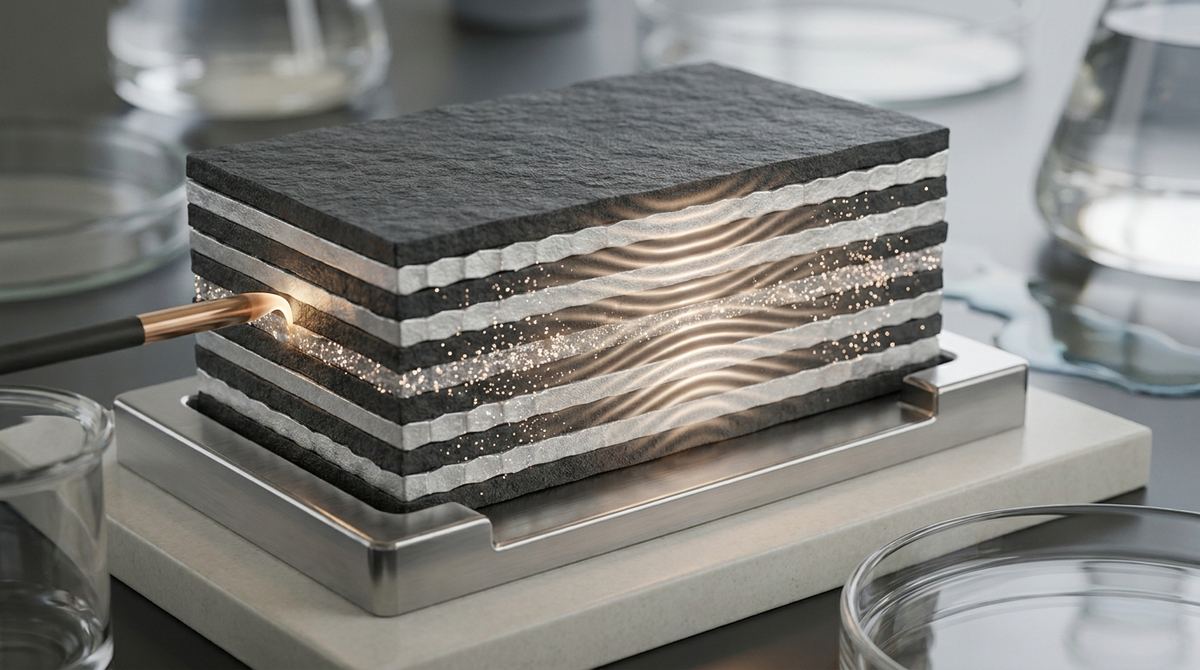
In the relentless quest to make electronics smaller, faster, and more powerful, we are running into a wall of fire. Not literal fire, but its microscopic cousin: waste heat. Every transistor switching, every calculation performed, generates heat that must be whisked away before it throttles performance or damages delicate components. For decades, our approach to managing this heat has been largely based on a simple, intuitive picture: heat is carried by tiny packets of vibrational energy, called phonons, that behave like particles, bouncing and scattering their way through a material's atomic lattice. But what if this picture is incomplete? A groundbreaking new study suggests we have been missing a crucial piece of the puzzle, a piece that treats heat not just as a particle, but as a wave.
The classical model of heat conduction in solids, known as the particle-phonon picture, has served us well. It explains why materials like diamond and graphene are excellent heat conductors—their stiff, orderly atomic lattices allow phonons to travel long distances with few collisions. It also explains why disordered materials like glass are insulators—their chaotic structure scatters phonons aggressively, stopping heat in its tracks. However, this model begins to fail when we enter the truly nanoscale world of advanced materials, particularly in periodic structures known as superlattices. These materials, built from repeating, ultra-thin layers of different substances, exhibit thermal properties that the simple particle-scattering model cannot fully predict. A new theoretical framework was needed to explain these anomalies and unlock the full potential of nanoscale thermal engineering. This is the challenge taken on by a team of researchers including Xiaoyu Huang, Yuxiang Ni, Zhongwei Zhang, Yangyu Guo, Marc Bescond, Masahiro Nomura, and Sebastian Volz. Their work provides a more complete, quantum-mechanical understanding of heat transport that could fundamentally change how we design materials for thermal management.
At its heart, the researchers' new work asks us to reconsider the fundamental nature of heat. In the quantum world, everything exhibits wave-particle duality, and phonons are no exception. While we often think of them as particles, they are, more accurately, quantized waves of atomic vibration. The key insight of the paper is that the *wave-like* nature of phonons is not a minor detail but a dominant factor in nanoscale heat transport. The researchers focus on a property called "intrinsic temporal coherence." In simple terms, this is a measure of how long a phonon wave can maintain its rhythm and phase before being disrupted. A phonon with high temporal coherence acts like a well-defined, predictable wave, similar to a pure musical note. A phonon with low coherence is more like random noise, its wave nature quickly dissolving into chaotic, particle-like behavior. The central argument is that this coherence, a property intrinsic to the phonon itself, determines how it interacts with nanoscale features like the interfaces in a superlattice. High-coherence waves can effectively "tunnel" through barriers, while low-coherence, particle-like phonons are easily scattered. This simple yet profound idea shifts the focus from just counting scattering events to understanding and controlling the fundamental wave character of heat.
To explore these ideas, scientists often use model systems like superlattices made from alternating layers of silicon and germanium. However, the principles uncovered are directly applicable to next-generation systems built from two-dimensional materials, including graphene. A graphene-based superlattice can be created by periodically stacking single-atom-thick sheets of graphene with another 2D material, such as hexagonal boron nitride (h-BN), or by creating periodic patterns directly on a graphene sheet, forming what is known as a nanomesh. These highly ordered, periodic structures have a profound effect on the phonons traveling through them. The periodic potential of the superlattice folds the material's phonon dispersion curve, a process called Brillouin zone folding. This creates new families of higher-frequency phonons, known as zone-folded phonons.
For a long time, these zone-folded phonons were thought to be slow-moving and contribute very little to heat transport, primarily because they were expected to scatter strongly at the frequent interfaces. The new research challenges this assumption. It proposes that the transport of these zone-folded phonons is not governed by their velocity alone, but by their temporal coherence. In a precisely engineered graphene superlattice, it may be possible to create zone-folded phonons with very long coherence times. These coherent phonons would not "see" the interfaces as hard barriers to be scattered by, but rather as a periodic landscape to be navigated in a wave-like manner. They could maintain their phase across multiple layers, effectively tunneling through the structure and carrying heat with surprising efficiency. This opens a new avenue for designing materials where heat flow is controlled not by brute-force scattering, but by subtly tuning the wave properties of phonons, a process that requires incredibly precise graphene manufacturing techniques.
Through sophisticated computational simulations that model heat transport at the quantum level, the research team demonstrated a direct and powerful link between phonon coherence and thermal conductivity. They found that in a nanoscale superlattice, the heat transport is essentially split into two channels: an incoherent, particle-like channel and a coherent, wave-like channel. The incoherent channel consists of phonons with short coherence times. These phonons behave classically, scattering at interfaces and contributing little to overall heat flow. Their behavior is what the old models described. The coherent channel, however, is populated by phonons with long coherence times, including many of the zone-folded phonons previously dismissed as unimportant. These coherent phonons propagate through the superlattice as waves, exhibiting quantum tunneling and contributing significantly to heat transport.
The crucial discovery is that the intrinsic temporal coherence is the deciding factor that determines which channel a phonon will take. The study effectively provides a new "selection rule" for heat transport at the nanoscale. It’s not enough to know a phonon's frequency or velocity; one must also know its coherence to predict its contribution to thermal conductivity. This finding reclassifies zone-folded phonons from being merely slow vibrations to being potential high-performance heat carriers, provided their coherence can be preserved. This fundamentally changes the design rules for thermal materials.
This research represents a paradigm shift in materials science and thermal engineering. For decades, the primary strategy for creating thermal insulators, such as those used in thermoelectric devices that convert heat into electricity, has been to maximize phonon scattering. This is typically achieved by introducing as many interfaces, defects, and nanoparticles as possible into a material, creating a chaotic environment that scatters phonons of all kinds. This approach is effective but lacks precision. This new understanding of coherence allows for a much more elegant and powerful strategy: "coherence-based phonon engineering." Instead of scattering all phonons indiscriminately, we can now envision designing materials and interfaces that selectively scatter low-coherence phonons while allowing high-coherence phonons to pass.
This could revolutionize thermoelectric materials. An ideal thermoelectric needs to be an excellent electrical conductor but a poor thermal conductor. By engineering a superlattice that preserves the coherence of electricity-carrying electrons while destroying the coherence of heat-carrying phonons, we could dramatically increase the efficiency of waste heat recovery systems. Conversely, for applications in graphene electronics, where efficient heat dissipation is critical, we could design structures that enhance and preserve phonon coherence, creating thermal "superhighways" to channel heat away from sensitive components with unprecedented efficiency.
While the theoretical and computational findings of this study are compelling, they represent the first step on a long road. The primary limitation is the gap between idealized computer models and real-world materials. The simulations assume perfect, defect-free superlattice structures. In reality, fabricating such structures, especially with materials like graphene, is incredibly challenging. Any atomic-scale defects, surface roughness between layers, or impurities can act as potent sources of decoherence, destroying the very wave-like properties the theory relies on. The next critical stage of research will involve experimental validation. Scientists will need to develop advanced fabrication techniques to create near-perfect superlattices and use sophisticated measurement tools, like time-resolved optical techniques, to directly probe phonon coherence and its effect on heat transport. Overcoming these experimental hurdles will be essential to translate this beautiful theoretical insight into practical technology.
Assuming the experimental challenges can be met, the long-term applications of this research are vast and transformative. In the field of energy, high-efficiency thermoelectric generators based on coherence-engineered superlattices could be integrated into everything from vehicle exhaust systems to industrial smokestacks, converting a significant portion of the world's waste heat into useful electricity. In computing, this work provides a blueprint for solving the heat crisis in next-generation processors. Instead of bulky fans and complex liquid cooling systems, we might see chip-level thermal metamaterials that guide heat along specific pathways with laser-like precision. This could even pave the way for phononics, a new computing paradigm that uses phonons instead of electrons to process information, potentially leading to devices that operate with far less energy consumption. The principles could also be applied to the development of advanced thermal barrier coatings for jet engines and spacecraft, or even thermal cloaking materials. The ability to precisely control heat flow opens up a portfolio of new graphene applications previously confined to science fiction.
If you take away just one concept from this complex research, let it be this: at the nanoscale, heat is not just a particle; it is a wave. The future of thermal management lies not in simply blocking or scattering these particles, but in precisely engineering materials to control the coherence of these waves, guiding heat with the same finesse that we currently guide light and electricity.
What is a phonon?
A phonon is the quantum mechanical description of a collective atomic vibration in a crystal lattice. While we often visualize them as particles of heat, it is more accurate to think of them as quantized packets of vibrational energy that have both wave-like and particle-like properties. Just as photons are quantized packets of light, phonons are quantized packets of sound and heat.
What does "temporal coherence" mean for a phonon?
Temporal coherence describes how long a phonon wave can maintain a predictable phase and frequency. A highly coherent phonon behaves like a pure, continuous wave, while a phonon with low coherence quickly loses its phase relationship, behaving more like random noise or a particle. This property is crucial for determining whether it will tunnel through or scatter from nanoscale interfaces.
What is a superlattice?
A superlattice is an artificial material made from a repeating sequence of ultra-thin layers of two or more different materials. This periodic structure, with layer thicknesses on the order of nanometers, creates a new, larger unit cell that modifies the material's electronic and vibrational properties, leading to unique behaviors not found in the constituent bulk materials.
Why is controlling heat flow so important in electronics?
As electronic components like transistors become smaller and more densely packed, the amount of waste heat they generate in a small area increases dramatically. This excess heat can cause performance to degrade, lead to computational errors, and ultimately cause physical damage to the device. Efficiently removing this heat is the primary limiting factor in advancing the speed and power of modern computing.
How does this research relate to graphene?
The fundamental principles of coherence-governed heat transport discovered in this study are universally applicable to any material system with periodic nanostructuring. Graphene, with its unique 2D nature and exceptional intrinsic thermal conductivity, is an ideal building block for creating the superlattices and patterned structures needed to exploit these quantum effects for advanced thermal control.
The work by Huang and his collaborators provides a profound update to our century-old understanding of heat transport. By demonstrating that intrinsic temporal coherence governs the behavior of phonons in nanostructures, they have shifted the scientific focus from a particle-centric view of scattering to a wave-centric view of quantum coherence. This research doesn't just offer an explanation for previously puzzling experimental data; it hands materials scientists a completely new set of design rules. It transforms heat from a passive byproduct to be managed into an active phenomenon to be engineered. The journey from this fundamental insight to commercial technology will be challenging, but it illuminates a clear path toward a future where we can control the flow of heat with unprecedented precision, paving the way for breakthroughs in computing, energy, and beyond.
Serious about B2B integration? Test our premium Pulsed Electrical Resistive Carbon Heating turbostratic graphene in your lab. 100g sample packs available now.
Explore More
Researchers show deep-UV bleaching of charge disorder in encapsulated graphene, a novel technique that uses light to erase electrical noise and improve...

Scientists have found evidence of a metallic Wigner crystal in rhombohedral graphene, a paradoxical state where electrons freeze into a solid but can still...

Researchers predict a new state of matter in rhombohedral graphene: the metallic Wigner crystal. This paradoxical phase, where electrons are both frozen and...