
Practical Guide: Build a Pressure-Tunable Graphene Spintronic Converter
Learn to build a prototype graphene spintronic converter based on new research. This guide details how to use pressure to tune spin-to-charge conversion.
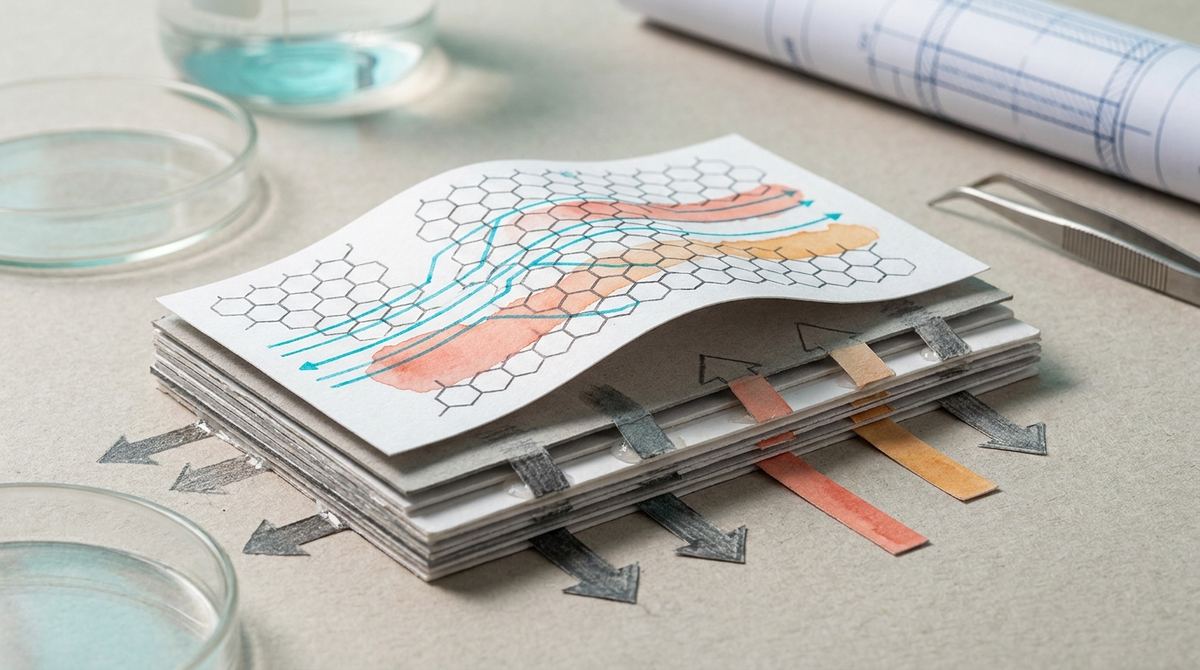
Imagine taking a perfectly flat, impossibly thin sheet of paper and gently bending it. The paper is still the same material, but its shape has changed. Now, imagine that sheet is just one atom thick and that the simple act of bending it fundamentally alters its ability to conduct electricity and heat. This is the world of monolayer graphene, where mechanical shape and quantum properties are deeply intertwined. For engineers and scientists working to harness graphene's extraordinary capabilities, understanding this connection is not just an academic curiosity; it is the key to designing the next generation of flexible electronics, ultra-sensitive sensors, and advanced composite materials.
Graphene is often described in its ideal form: a pristine, perfectly flat hexagonal lattice of carbon atoms. In this state, it exhibits record-breaking thermal conductivity, incredible strength, and unique electronic properties stemming from its famous gapless "Dirac cone" structure. However, in the real world, graphene rarely stays perfectly flat. When it is grown on a substrate, mixed into a polymer matrix, or incorporated into a flexible device, it inevitably develops ripples, wrinkles, and curves. These imperfections, collectively known as strain-induced curvature, present a major challenge. We know they affect performance, but the precise rules governing these changes have remained elusive. This knowledge gap makes it difficult to predict, control, and optimize the behavior of graphene in practical applications. A team of researchers, M. C. Santos, E. Lora da Silva, D. S. Baptista, T. Santos, M. Molinari, F. J. Manjón, Yin Cui, Xidong Lin, and Tao Yang, conducted a detailed theoretical investigation to map out exactly how bending a graphene sheet changes its fundamental electronic and thermal character.
At its core, the research uses powerful computer simulations to perform a kind of "digital origami" with a sheet of graphene. The scientists created a highly accurate model of the atomic lattice and then systematically introduced curvature, essentially bending the virtual sheet over cylinders of varying radii. By doing this in a controlled digital environment, they could isolate the effect of curvature from other real-world defects and measure the consequences with incredible precision. The central idea was to track two key phenomena. First, how does the bending stretch and compress the bonds between carbon atoms, and how does this distortion affect the pathways available for electrons to travel? Second, how does this same atomic distortion disrupt the organized vibrations of the lattice, which are responsible for transporting heat? In essence, the study provides a foundational rulebook that connects a mechanical action, bending, to its quantum-level consequences for electricity and heat flow.
To understand the findings, we must first visualize monolayer graphene. It is a single layer of carbon atoms arranged in a honeycomb pattern. In its flat, relaxed state, the bonds between the atoms are all of equal length and the structure is perfectly symmetrical. This symmetry is the source of many of its remarkable properties. The researchers used a computational method, likely Density Functional Theory (DFT), which can accurately calculate the behavior of electrons and the forces between atoms from first principles.
The simulation begins with a model of this perfect, flat sheet. Then, a mathematical transformation is applied to the coordinates of each atom to induce a smooth, uniform curve, as if the sheet were wrapped around a tube. The radius of this imaginary tube determines the severity of the curvature. A large radius results in a gentle bend, while a small radius creates a sharp curve.
This curvature creates a non-uniform strain field. The atoms on the outer face of the curve are pulled apart slightly (tensile strain), increasing the bond lengths between them. Conversely, the atoms on the inner face are pushed closer together (compressive strain). This subtle rearrangement of the atomic lattice is the direct cause of all the subsequent changes. The simulation then recalculates the system's properties in this new, curved state, specifically focusing on the electronic band structure and the phonon dispersion relations, which govern electron and heat transport, respectively. By repeating this process for many different radii of curvature, the researchers could build a comprehensive picture of how these properties evolve with increasing mechanical deformation.
The computational experiments yielded several critical insights. First, they examined the electronic structure. In its flat state, graphene has no bandgap, meaning it takes no energy to excite its electrons into a conducting state. This makes it a superb conductor but difficult to use in transistors, which require an "off" state provided by a bandgap. The researchers found that introducing curvature can open a small but significant bandgap. The physical reason is that the strain breaks the symmetry of the lattice, altering the quantum mechanical environment that the electrons experience. The size of this induced bandgap was found to be directly proportional to the severity of the curve; the tighter the bend, the larger the bandgap.
Second, the study investigated phonon dynamics. Phonons are quantized lattice vibrations, the primary carriers of heat in graphene. In flat graphene, certain phonon modes can travel long distances without being scattered, which is why it is such an excellent thermal conductor. The simulations showed that curvature has a dramatic effect on these vibrations. It introduces anharmonicity into the lattice, meaning the forces between atoms no longer respond in a simple, linear fashion. This leads to a significant increase in phonon-phonon scattering; the heat-carrying waves start to collide with each other and the distorted lattice more frequently. This disruption reduces the average distance a phonon can travel before being scattered, a quantity known as the phonon mean free path.
The direct consequence of this increased scattering was the third major finding: a significant reduction in lattice thermal conductivity. The researchers demonstrated a clear trend where the thermal conductivity of the graphene sheet decreased as the curvature increased. This means that while a flat sheet of graphene is a heat superhighway, a wrinkled or crumpled sheet behaves more like a network of bumpy local roads, impeding the flow of thermal energy. This has profound implications for thermal management in devices that use graphene-based materials and coatings.
These findings are crucial because they transform our understanding of strain in graphene from a parasitic effect to be avoided into a powerful engineering tool. For applications where maximum performance is needed, such as in high-frequency electronics or thermal interface materials, this work underscores the absolute necessity of producing and integrating graphene with minimal wrinkles and strain. It provides a quantitative basis for understanding how much performance is lost for a given amount of structural imperfection.
Even more compelling is the concept of "straintronics," or strain engineering. This research suggests that we can purposefully introduce specific patterns of curvature to tune graphene's properties on demand. By creating a device with regions of high and low curvature, one could effectively design electronic circuits directly into a graphene sheet without chemical doping. For example, a curved section could act as a transistor channel with a bandgap, while flat sections could serve as highly conductive interconnects. Similarly, one could pattern thermal pathways, creating regions that efficiently conduct heat next to regions that act as thermal insulators, all within the same monolithic sheet of graphene. This opens up a new paradigm for device design based on mechanical shaping rather than complex multi-material fabrication.
It is important to recognize that this research is based on theoretical models and computational simulations. While these methods are highly sophisticated and reliable, they represent an idealized system. The simulations focused solely on the effects of pure curvature on a perfect monolayer of graphene. In reality, a graphene sample used in an application will also contain other features that affect its properties, such as point defects (missing atoms), grain boundaries (where different crystal domains meet), contamination from the environment, and interactions with the underlying substrate.
The next essential step is to validate these theoretical predictions through careful and precise physical experiments. This is a formidable challenge, as it requires fabricating graphene samples with a well-defined and controllable curvature and then developing techniques to measure their local electronic and thermal properties at the nanoscale. Experimental verification would confirm the accuracy of the models and help scientists understand how the effects of curvature interact with other types of real-world imperfections. Further research is also needed to explore more complex geometries beyond a simple cylindrical curve, such as spherical bending or random wrinkling, which more closely mimic the state of graphene in composites and other practical systems.
The insights from this study have direct relevance to several emerging technology areas. In the field of flexible and wearable graphene electronics, this work provides a fundamental design guide. Engineers can now better predict how the performance of a graphene-based transistor or conductor will change as a device is bent or flexed, allowing for the creation of more robust and reliable products.
For sensor technology, the findings are particularly exciting. Because graphene’s electronic properties are so sensitive to mechanical deformation, it can be used to create exceptional strain and pressure sensors. This research provides the underlying physics to translate a measured change in electrical resistance directly into a precise value of mechanical strain, paving the way for more accurate and sensitive devices for structural health monitoring, soft robotics, and human-machine interfaces.
Furthermore, the ability to tune thermal conductivity through curvature opens up possibilities in thermal management and energy harvesting. One could design materials that act as "thermal diodes," allowing heat to flow easily in one direction (along a flat path) but not another (across a wrinkled path). This could also be beneficial for thermoelectric devices, which convert heat gradients into electricity. By using curvature to suppress thermal conductivity while preserving electrical conductivity, the efficiency of graphene-based thermoelectric generators could be significantly enhanced.
The most important takeaway from this research is that mechanically bending a sheet of graphene is not a passive change; it is an active method for engineering its fundamental quantum properties. Curvature is a powerful knob that can be turned to open an electronic bandgap, control electron flow, and suppress heat transport, transforming a simple mechanical stress into a sophisticated tool for designing next-generation materials and devices.
What is strain-induced curvature in graphene?
Strain-induced curvature refers to the physical bending or wrinkling of a graphene sheet at the atomic scale. Unlike simple tensile strain, which just stretches the material uniformly, curvature involves both stretching on the outer surface of the bend and compression on the inner surface. This non-uniform deformation breaks the perfect symmetry of the graphene lattice, leading to significant changes in its properties.
Why does bending graphene change its properties?
Bending graphene alters the precise distances and angles between its carbon atoms. These geometric changes modify the quantum mechanical wavefunctions of the electrons, which in turn changes the electronic band structure. Similarly, the altered atomic forces affect the way vibrations travel through the lattice, disrupting the phonon pathways that are responsible for conducting heat.
What is an electronic bandgap and why is it important?
An electronic bandgap is a range of energy levels that electrons within a material are forbidden from occupying. Materials with a large bandgap are insulators, while those with no bandgap are conductors. Semiconductors, the basis of all modern electronics, have a small, controllable bandgap. The ability to create a bandgap in graphene is critical for building transistors, as it allows the device to be switched into a non-conducting "off" state, which is essential for digital logic.
What are phonons and how do they relate to heat?
Phonons are collective, quantized vibrations of atoms in a crystal lattice. You can think of them as particles of sound or heat. In a material like graphene, thermal energy is primarily transported by these lattice vibrations. The efficiency of heat conduction depends on how far these phonons can travel before they are scattered by imperfections, other phonons, or, as this study shows, by the curvature of the lattice itself.
Is this research ready for commercial products?
This research provides foundational scientific understanding, but it is not a blueprint for an immediate commercial product. It is a theoretical study that lays the groundwork for future engineering efforts. Before these principles can be widely commercialized, the findings must be validated by physical experiments, and scalable manufacturing techniques must be developed to create graphene with precisely controlled curvature.
The work by Santos and his colleagues provides a crucial bridge between the mechanical world of shape and the quantum world of electrons and phonons. By demonstrating that curvature is a predictable and powerful tool for tuning the properties of graphene, this research moves the material science community beyond the paradigm of the "perfectly flat sheet." It shows that the wrinkles and ripples often seen as unavoidable flaws can instead be re-imagined as deliberate design features. This fundamental understanding is essential for overcoming the remaining hurdles in translating graphene's incredible potential from laboratory curiosities into the reliable, high-performance applications that will define the next wave of technological innovation.
Serious about B2B integration? Test our premium Pulsed Electrical Resistive Carbon Heating turbostratic graphene in your lab. 100g sample packs available now.
Explore More
Learn to build a prototype graphene spintronic converter based on new research. This guide details how to use pressure to tune spin-to-charge conversion.

Research reveals how rhombohedral graphene's unique chiral electron states enable highly efficient high-harmonic generation, paving the way for on-chip UV...

Researchers have developed a light-driven Tesla engine using a magnetically levitated graphene disk. This breakthrough in frictionless motion converts light...