
Light-Driven Graphene Tesla Engine Levitates on Magnetic Fields
Researchers have developed a light-driven Tesla engine using a magnetically levitated graphene disk. This breakthrough in frictionless motion converts light...
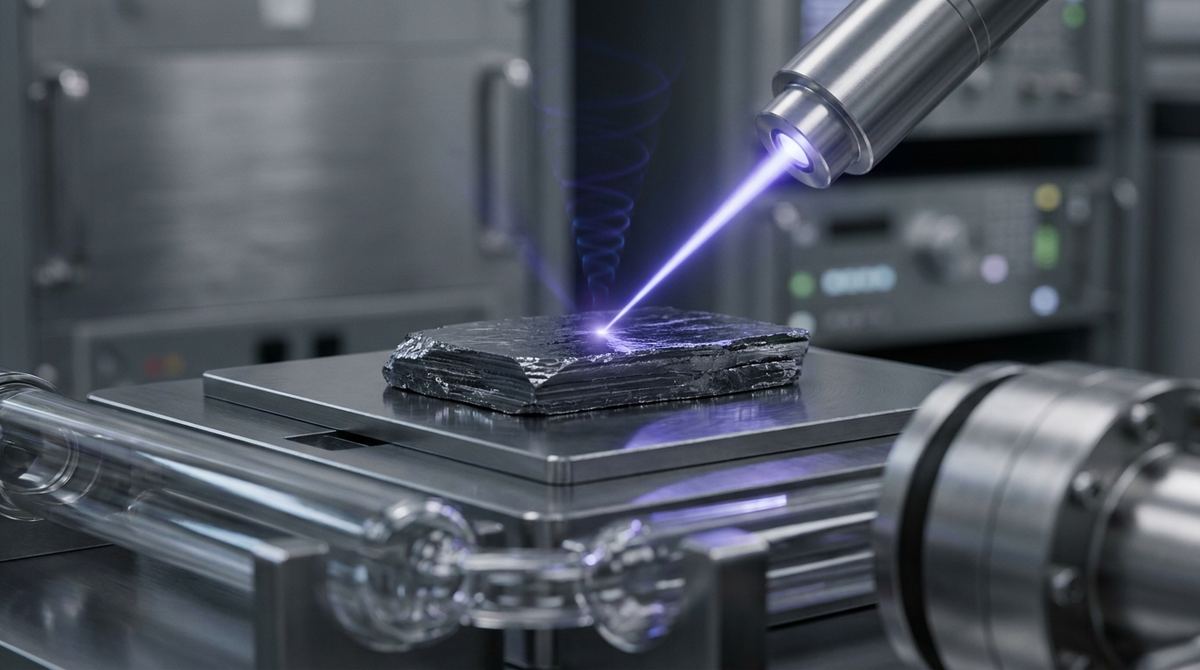
Imagine being able to take the light from a common laser and transform it, changing its color from invisible infrared to deep ultraviolet or even soft X-rays. This process, a cornerstone of nonlinear optics, is fundamental to technologies ranging from manufacturing the next generation of microchips to imaging the intricate dance of molecules in a living cell. The challenge has always been to make this frequency conversion process efficient, compact, and controllable. A new theoretical breakthrough now points to a unique form of graphene as a near-perfect platform for achieving this, promising to shrink powerful light-altering systems down to the size of a computer chip.
The goal of converting light from a low frequency to a much higher one is known as high-harmonic generation (HHG). For decades, scientists have primarily relied on shooting powerful lasers through noble gases or specialized crystals to achieve this effect. While effective, these methods often require large, complex equipment and immense power, making them unsuitable for integrated, on-chip applications. The search has been on for a solid-state material that can perform this conversion efficiently at the nanoscale. Graphene, with its extraordinary electronic properties, has long been a candidate. However, its common hexagonal structure possesses a high degree of symmetry, which inherently forbids or suppresses certain valuable nonlinear optical processes. To unlock graphene's full potential for HHG, a way to strategically break this symmetry was needed. This is the challenge addressed by a recent theoretical study from Jessica O. de Almeida, Wilton J. M. Kort-Kamp, and Mathias S. Scheurer, who identified a specific stacking arrangement of graphene that creates the ideal electronic conditions for powerful and controllable light conversion.
The core concept behind this work is the marriage of two complex ideas: high-harmonic generation and chiral quantum states. Think of HHG like playing a guitar. When you pluck a string, you hear the main, fundamental note. But you also hear a series of fainter, higher-pitched overtones called harmonics, which are integer multiples of the fundamental frequency. In optics, HHG is similar: an intense laser of one frequency (one color) hits a material, and the material’s electrons are shaken so violently and nonlinearly that they re-emit light not just at the original frequency, but also at many multiples—the second harmonic, third harmonic, and so on.
The researchers proposed that the key to efficient HHG lies in the quantum behavior of electrons in a special material: rhombohedral graphene. Unlike standard graphene where layers are stacked directly on top of each other or in a simple AB pattern, rhombohedral graphene has its layers stacked in a shifted ABC sequence. This specific arrangement creates what are known as "chiral Bloch states." In this context, "chiral" means the quantum state of the electron has a "handedness," much like your left and right hands are mirror images but cannot be perfectly superimposed. These chiral electrons, when driven by a laser, behave in a unique, asymmetric way that makes them exceptionally good at radiating high-frequency light.
The research presents a theoretical model of what happens when intense, circularly polarized light interacts with rhombohedral trilayer graphene. The choice of this specific material and light is deliberate and crucial. The ABC stacking of the three graphene layers breaks a fundamental property called inversion symmetry. In simpler terms, the crystal structure looks different if you view it upside down, a feature absent in single-layer or more common Bernal-stacked bilayer graphene. This broken symmetry is the first critical ingredient, as it opens up pathways for new optical phenomena.
The second ingredient is the circularly polarized light, where the electric field of the light wave spirals in a corkscrew pattern, either clockwise or counter-clockwise. This light itself has a handedness, or chirality. When this chiral light interacts with the chiral electrons in the rhombohedral graphene, a unique coupling occurs. The model developed by the researchers shows that the laser's spiraling electric field drives the electrons along complex, looping paths within the crystal lattice. Because of the material's broken symmetry and the electrons' intrinsic chirality, this motion is highly nonlinear. Instead of just oscillating back and forth, the electrons accelerate and decelerate asymmetrically, causing them to emit radiation in a burst of high-frequency harmonics. The process is exquisitely sensitive; using left-handed light selectively excites electrons with one type of handedness, producing a different harmonic signature than right-handed light would. This provides an unprecedented level of control over the output.
The theoretical calculations performed by de Almeida, Kort-Kamp, and Scheurer yielded several profound insights. They established a direct and powerful link between the efficiency of the HHG process and a fundamental quantum property of the material’s electronic bands known as the Berry curvature. The Berry curvature can be thought of as an intrinsic magnetic field generated by the quantum geometry of the crystal itself, which steers the electrons as they move. In rhombohedral graphene, this property is particularly strong and is directly tied to the chirality of the electron states.
Their model predicted that rhombohedral graphene should exhibit an exceptionally strong and controllable HHG signal. By tuning the polarization of the incoming laser from linear to left- or right-circular, it is possible to selectively enhance or completely suppress certain harmonics in the emitted light. This "chiral selectivity" is a direct consequence of matching the chirality of the light with the chirality of the material's electrons. Furthermore, they showed that the intensity of even-order harmonics, such as the second harmonic, which are forbidden in more symmetric forms of graphene, should be particularly strong in this system. This finding elevates rhombohedral graphene from a scientific curiosity to a prime candidate for practical nonlinear photonic devices.
This research provides a new and powerful design principle for the field of nonlinear optics. It suggests that engineers can move beyond simply searching for materials with high nonlinear coefficients and instead design materials from the ground up by engineering their quantum geometry. By controlling atomic-scale features like crystal stacking, it becomes possible to create specific electronic properties like chirality and strong Berry curvature to achieve a desired optical response.
On a practical level, this work lays the theoretical foundation for creating compact, efficient, on-chip frequency converters. Such devices could take the light from cheap and reliable infrared lasers and convert it into the ultraviolet (UV) or extreme ultraviolet (EUV) part of the spectrum. These high-frequency light sources are desperately needed for a host of advanced technologies. They could enable tabletop lithography systems for patterning smaller and more powerful computer chips, drive new forms of high-resolution microscopy for biological research, and form the basis of ultrafast spectroscopy tools for watching chemical reactions unfold in real time.
It is essential to recognize that this work is a theoretical prediction based on sophisticated modeling. The immediate and most critical next step is experimental verification. Scientists must first fabricate exceptionally clean, high-quality samples of rhombohedral trilayer graphene, a task that is significantly more challenging than producing its more common Bernal-stacked cousin. Any progress in this area will depend heavily on advancements in graphene manufacturing techniques.
Furthermore, the model makes certain idealizations. Real-world materials contain defects, impurities, and grain boundaries, and they must be placed on a substrate, all of which can influence the electronic and optical properties. The effects of temperature and electron scattering, which can dampen the harmonic signal, must also be investigated experimentally. Engineering a functional device will introduce further challenges, such as efficiently coupling light into and out of the nanometer-thin graphene sheet and managing the heat generated by the intense laser field. This study provides the map, but the journey toward a working device is just beginning.
Should these theoretical predictions be confirmed by experiment, the potential applications are transformative. The primary impact would be in the field of integrated photonics, where the goal is to build entire optical systems on a single chip. A rhombohedral graphene-based frequency converter could become a standard component in graphene electronics, enabling on-chip data communication using light of different colors to increase bandwidth.
In scientific instrumentation, this technology could lead to miniaturized light sources for spectroscopy and sensing. A compact device capable of generating tunable UV light could revolutionize environmental monitoring or medical diagnostics, allowing for highly sensitive graphene sensors that can detect trace chemicals with high specificity. For manufacturing, developing a solid-state EUV source could democratize nano-fabrication, moving it out of large, specialized facilities and into standard research labs. This work provides a clear pathway from fundamental quantum physics to tangible engineering solutions that could redefine the limits of light-based technologies.
The special ABC stacking of rhombohedral graphene creates "handed" electron states. This unique quantum property allows the material to interact with polarized laser light in a way that efficiently converts it into controllable, high-frequency harmonics, paving the way for new on-chip UV and X-ray light sources.
What is high-harmonic generation in simple terms? High-harmonic generation is an optical process where a material, when illuminated by an intense laser of a single color, emits new light at multiples of the original laser's frequency. It is analogous to the overtones produced by a musical instrument, but it happens with light, effectively converting a low-frequency color into a spectrum of higher-frequency ones.
What makes rhombohedral graphene different from normal graphene for this purpose? The key difference is the stacking of the carbon layers. Normal graphene often has an AB stacking, which is highly symmetric. Rhombohedral graphene uses an ABC stacking sequence that breaks this symmetry, creating unique electronic states with a property called chirality, or "handedness," which is essential for the highly efficient harmonic generation described in this research.
What does "chiral" mean for an electron? In this context, chirality means the electron's quantum state is not identical to its mirror image. Much like your left and right hands are mirror images but cannot be perfectly overlapped, these electron states have a distinct handedness. This property dictates how they interact with circularly polarized light, which also has a handedness, leading to highly selective and controllable optical effects.
Is this a commercially ready technology? No, not yet. This research presents a theoretical framework and computational predictions. It provides a crucial scientific roadmap, but significant experimental work is required to fabricate the necessary materials, verify the predictions, and overcome the engineering challenges of building a practical device.
What are the most exciting potential uses for this discovery? The most exciting applications are those that require compact, high-frequency light sources. This includes creating next-generation tools for nanolithography to make smaller computer chips, developing advanced microscopes to see biological processes in unprecedented detail, and building on-chip photonic circuits for ultra-fast data processing and communication.
The research by Jessica O. de Almeida, Wilton J. M. Kort-Kamp, and Mathias S. Scheurer provides a compelling theoretical blueprint for the future of nonlinear optics. By connecting the abstract quantum-mechanical concepts of chiral Bloch states and Berry curvature to the tangible application of high-harmonic generation, they have identified rhombohedral graphene as a uniquely powerful platform material. This work not only highlights the remarkable potential of atomically thin materials but also illustrates a sophisticated new paradigm in materials design, where quantum geometry is engineered to control light. While experimental validation remains a critical next step, this study illuminates a promising path toward a new generation of miniature, on-chip devices that can manipulate light in ways previously thought impossible.
Serious about B2B integration? Test our premium Pulsed Electrical Resistive Carbon Heating turbostratic graphene in your lab. 100g sample packs available now.
Explore More
Researchers have developed a light-driven Tesla engine using a magnetically levitated graphene disk. This breakthrough in frictionless motion converts light...

Explore how to build a graphene nano-actuator prototype that leverages the tunable Casimir force in water, a new frontier in NEMS and nanofluidics.

Researchers demonstrate precise control over the magnetic and structural properties of the 2D ferromagnet Fe3GeTe2 by introducing nickel atoms, a key step...