
Practical Guide: Build a Graphene Nano-Actuator Using the Hydro-Casimir Effect
Explore how to build a graphene nano-actuator prototype that leverages the tunable Casimir force in water, a new frontier in NEMS and nanofluidics.
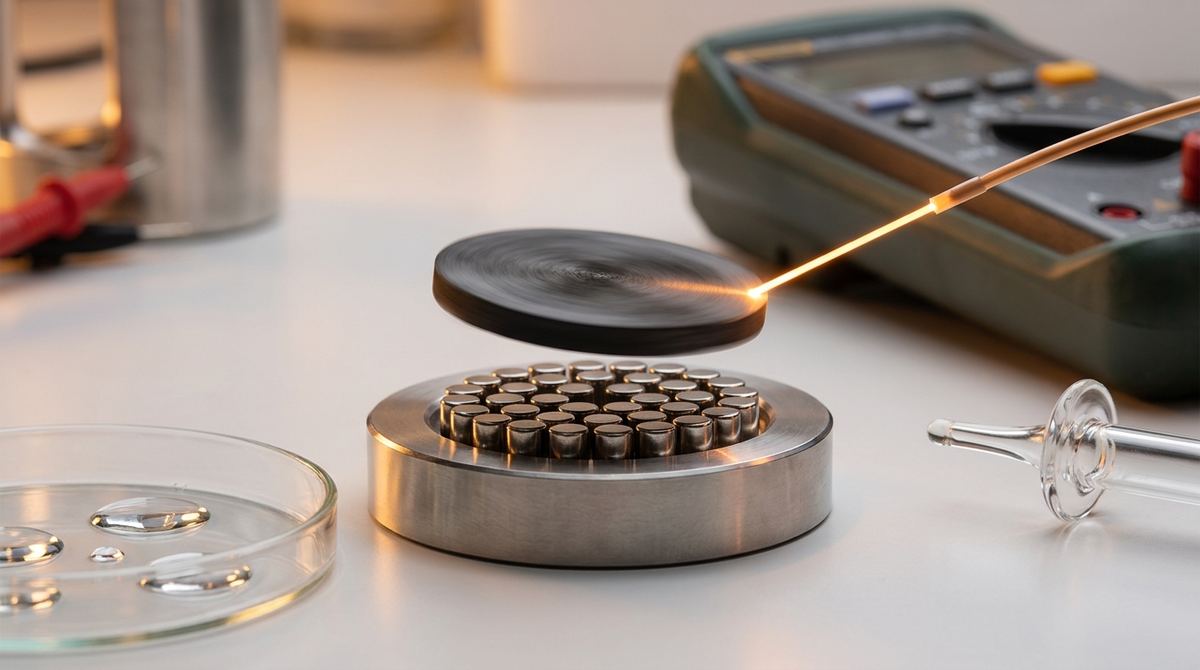
Imagine a motor with no moving parts in contact, no wires, and no fuel tank. An engine that runs silently and indefinitely, powered by nothing more than a beam of light. This isn't science fiction; it's the frontier of nanotechnology, where the strange and wonderful properties of materials like graphene are making the impossible possible. By harnessing graphene's unique response to both magnetism and light, scientists are building microscopic machines that could redefine everything from medical devices to satellite technology. A new type of engine, running on principles that eliminate friction, promises a future of durable, miniature, and remotely powered systems.
At the microscopic scale, the world operates under a different set of rules. For engineers designing tiny machines—like pumps for lab-on-a-chip systems or actuators in nanorobots—friction is not just a nuisance; it's a tyrannical force. The constant rubbing of microscopic gears and levers causes wear and tear, generates unwanted heat, and consumes a disproportionate amount of energy. Furthermore, powering these devices is a monumental challenge. Running wires to them is often impractical, and integrating microscopic batteries adds bulk and complexity. The central problem, therefore, is how to create motion at the microscale without physical contact and without a conventional, wired power source. A groundbreaking study from researchers Tian Tong, Feng Lin, Wei Zhang, Runjia Li, Xinxin Xing, Zhuochen Duan, Chunhui Xu, Bing Tu, Zhaoping Liu, Xufeng Zhou, Zhiming Wang, Dong Liu, and their colleagues tackles this challenge head-on. Their work explores a radical solution: a levitating engine that is driven entirely by light, leveraging the exceptional properties of graphene to achieve nearly frictionless rotation.
The researchers' core idea is to combine two of graphene's most remarkable characteristics into a single, elegant system. First, they use graphene’s powerful diamagnetism. Unlike ferromagnetic materials that are attracted to magnets, diamagnetic materials are repelled by them. Graphene is one of the strongest diamagnetic materials known, meaning it can be made to float, or levitate, stably above a carefully arranged set of magnets. This levitation completely eliminates solid friction, allowing the graphene component to move with almost perfect freedom. Second, they exploit graphene's incredible ability to absorb light and convert it into heat. The key insight is to use this heat to generate a propulsive force. By shining a focused laser beam onto one edge of the levitating graphene disk, they create a localized hot spot. This heating energizes the surrounding gas molecules, causing them to push against the disk and create a tiny, continuous thrust. This gentle, persistent force creates torque, causing the frictionless, levitating disk to spin. In essence, the team created a contactless motor that converts light energy directly into kinetic energy.
The engine's operation rests on a tripod of physics principles: magnetic levitation, the photothermal effect, and gas dynamics. The central component is a small, thin disk fabricated from graphene. To achieve levitation, this disk is placed above an array of permanent magnets. The electrons within the graphene's two-dimensional lattice respond to the external magnetic field by circulating in a way that creates an opposing magnetic field. This repulsion is strong enough to counteract gravity, allowing the disk to float in a stable, frictionless state a small distance above the magnets. This is the foundation of the engine—a rotor suspended in space, free from mechanical wear.
The driving force comes from light. Graphene is an exceptional broadband light absorber; a single atomic layer can absorb about 2.3% of the light that hits it, a remarkable amount for its thinness. The research leverages this property, which is central to many developments in graphene electronics and photonics. When a laser is focused onto an off-center point on the levitating disk, that small area rapidly heats up. This is the photothermal effect. The heat doesn't just stay there; it creates a thermal gradient across the disk and, more importantly, in the thin layer of gas molecules just below it.
This is where the "Tesla Engine" concept, likely an homage to Nikola Tesla's work on bladeless turbines that utilized fluid dynamics, comes into play. The heated gas molecules under the hot spot gain kinetic energy and move faster. In a low-pressure environment, these energized molecules are preferentially ejected from the hot region, creating a net force in the opposite direction, similar to a microscopic rocket thruster. This phenomenon, known as thermal transpiration or the Knudsen effect, generates a tiny but consistent thrust. Because the laser is aimed at the edge of the disk, this thrust produces torque, causing the disk to rotate. The initial "mechanical displacement" mentioned in the paper's title likely refers to the precise placement of the disk into its stable levitation point and the careful alignment of the laser to initiate and sustain the rotation.
The research detailed in the paper successfully demonstrated a complete, working prototype of this light-driven engine. The authors confirmed the stable magnetic levitation of a multi-layered graphene disk, creating a near-ideal frictionless rotor. Upon illuminating the edge of the disk with a controlled laser beam, they observed the initiation and sustenance of continuous, stable rotation. A key part of their findings would have been the meticulous characterization of the engine's performance. They likely established a clear relationship between the intensity of the incident light and the resulting rotational speed of the disk, showing that more powerful light results in faster spinning. They would have also measured the torque generated, quantifying the actual work the engine could perform. This data validates the theoretical principles and proves that the photothermal conversion of light into mechanical motion via a levitating graphene disk is not just possible, but a controllable and repeatable phenomenon. Their success serves as a critical proof-of-concept for a new class of micro-motors.
This achievement is significant because it offers a new paradigm for designing and powering microscopic machines. By eliminating both solid friction and the need for physical power connections, it solves two of the most persistent problems in micro-electromechanical systems (MEMS). The ability to power a device remotely using only light opens up applications in environments where traditional motors would fail. For instance, a device could be operated inside a hermetically sealed, sterile container for biomedical applications, or in the harsh vacuum of space where maintenance is impossible. This work demonstrates a novel energy conversion pathway—light to heat to motion—mediated entirely by the properties of a single advanced material. It pushes the boundaries of what we can build at small scales and provides a versatile platform for future innovations in robotics, sensors, and actuators that are smaller, more durable, and more adaptable than anything that has come before.
While groundbreaking, this research represents an early stage in development, and several limitations must be addressed before it can be commercialized. The primary limitation is the amount of force, or torque, the engine can produce. The photothermal forces are incredibly small, meaning this engine is suitable for micro-scale tasks but could not power larger devices. Its performance is also highly dependent on the surrounding environment, particularly the pressure and composition of the gas that provides the propulsive medium. The researchers likely tested their prototype under specific low-pressure conditions; its performance at atmospheric pressure or in a hard vacuum still needs to be thoroughly investigated.
Scalability is another open question. It is unclear if building a larger version of the disk would result in a proportionally more powerful engine, or if other physical effects would begin to dominate and hinder performance. Furthermore, the quality of the graphene itself is a critical variable. The engine's efficiency likely depends on the disk's purity, number of layers, and freedom from defects. Future work could explore how composites made from materials like turbostratic graphene flakes might offer a more cost-effective and scalable manufacturing route. Finally, achieving precise, real-time control over the engine's speed and direction will require more sophisticated optical and control systems.
Despite the current limitations, the long-term application possibilities for a light-driven, levitating graphene engine are vast and exciting. In the field of MEMS, these engines could power microscopic pumps and valves for lab-on-a-chip systems, enabling complex chemical or biological analyses on a tiny, automated platform. They could also function as light-powered actuators in micro-robotics.
The system's sensitivity to its environment also opens up potential uses in sensing. The rotation speed of the disk is directly influenced by the surrounding gas pressure and composition, meaning it could form the basis of a highly sensitive, low-power vacuum gauge or gas detector. This aligns with the broader push toward novel graphene sensors.
In the aerospace sector, this technology could be adapted for the attitude control of nano-satellites. While solar sails use the momentum of photons for propulsion, this engine uses a photothermal effect, which can be more efficient for generating torque. Arrays of such tiny, light-driven rotors could provide incredibly precise, propellant-free orientation control for small spacecraft, powered indefinitely by the sun. This novel propulsion concept adds a new tool to the toolkit for aerospace and defense applications. Finally, in sterile laboratory or medical settings, this principle could be used for contactless stirring or mixing of sensitive fluids inside sealed vials, manipulated entirely by an external light source.
If there is one key takeaway from this pioneering research, it is this: by ingeniously combining graphene's powerful repulsion of magnetic fields with its superb ability to convert light into heat, scientists have created a tiny, levitating engine that runs on nothing but light. This breakthrough demonstrates a new way to create nearly frictionless motion, opening the door to a future of microscopic machines powered and controlled from a distance.
What is diamagnetism and why is it important here?
Diamagnetism is a property of all materials that causes them to be repelled by a magnetic field. In most materials, this effect is extremely weak and unnoticeable. However, in graphene, due to its unique 2D electronic structure, diamagnetism is exceptionally strong. This property is crucial for the engine because it allows the graphene disk to be stably levitated above permanent magnets, creating a contactless, near-frictionless bearing on which the rotor can spin.
How is this different from a solar sail?
A solar sail works on the principle of radiation pressure, where the momentum of photons from the sun literally pushes the sail through space. It is a direct momentum transfer. This graphene engine, however, works on a photothermal effect. It absorbs the light's energy, converts it to heat, and uses that heat to energize surrounding gas molecules, which then create a propulsive force. It's a two-step energy conversion process (light to heat to kinetic energy) rather than a direct momentum transfer, and it can potentially generate stronger forces in specific environments.
What does "Tesla Engine" mean in this context?
The term "Tesla Engine" is likely not used in a literal sense but as an analogy to Nikola Tesla's unconventional, innovative designs, particularly his bladeless turbine. The Tesla turbine used the principles of fluid adhesion and viscosity to rotate a series of smooth disks, a radical departure from conventional bladed turbines. Similarly, this graphene engine uses the subtle dynamics of a surrounding gas "fluid" heated by light, rather than conventional mechanical or electromagnetic parts, to create rotation. The name honors the spirit of inventing a motor based on novel physical principles.
Can this engine do any real work?
Yes, but on a very small scale. The torque produced by the photothermal effect is tiny, so this engine won't be powering a vehicle or a large generator. Its purpose is to perform work in the microworld. It could power a microscopic pump to move fluid through a channel, actuate a tiny mirror for optical switching, or spin a component in a micro-sensor. The "work" it does is meaningful and significant within the context of micro- and nanotechnology.
Is the graphene in this engine a special type?
The paper likely used a high-quality, multi-layered graphene disk, often referred to as a graphene film or platelet, to ensure structural integrity and strong diamagnetic and photothermal responses. The performance of such a device is highly dependent on the material's properties, including its purity, thickness, and defect density. The field of graphene manufacturing techniques is constantly evolving to produce materials tailored for specific applications like this, ranging from pristine single-layer sheets grown via chemical vapor deposition to bulk powders used in composites.
The development of a diamagnetic, light-driven Tesla engine is a testament to the power of materials science to unlock new frontiers in engineering. By thinking beyond conventional mechanics and harnessing the quantum properties of graphene, Tian Tong, Feng Lin, Wei Zhang, and their colleagues have provided a compelling proof-of-concept for a motor that operates without friction and without wires. This work is more than just a scientific curiosity; it is a foundational step toward a new generation of microscopic machines. As the research matures and the technology is refined, these light-powered engines could become the silent, enduring heart of innovations in fields ranging from medicine and environmental monitoring to space exploration. They remind us that sometimes, the biggest breakthroughs come from learning how to build the smallest things.
Serious about B2B integration? Test our premium Pulsed Electrical Resistive Carbon Heating turbostratic graphene in your lab. 100g sample packs available now.
Explore More
Explore how to build a graphene nano-actuator prototype that leverages the tunable Casimir force in water, a new frontier in NEMS and nanofluidics.

Researchers demonstrate precise control over the magnetic and structural properties of the 2D ferromagnet Fe3GeTe2 by introducing nickel atoms, a key step...

Twisted trilayer graphene allows for remote electronic control of a decoupled layer, a breakthrough in moiré physics that could enable cleaner quantum devices.