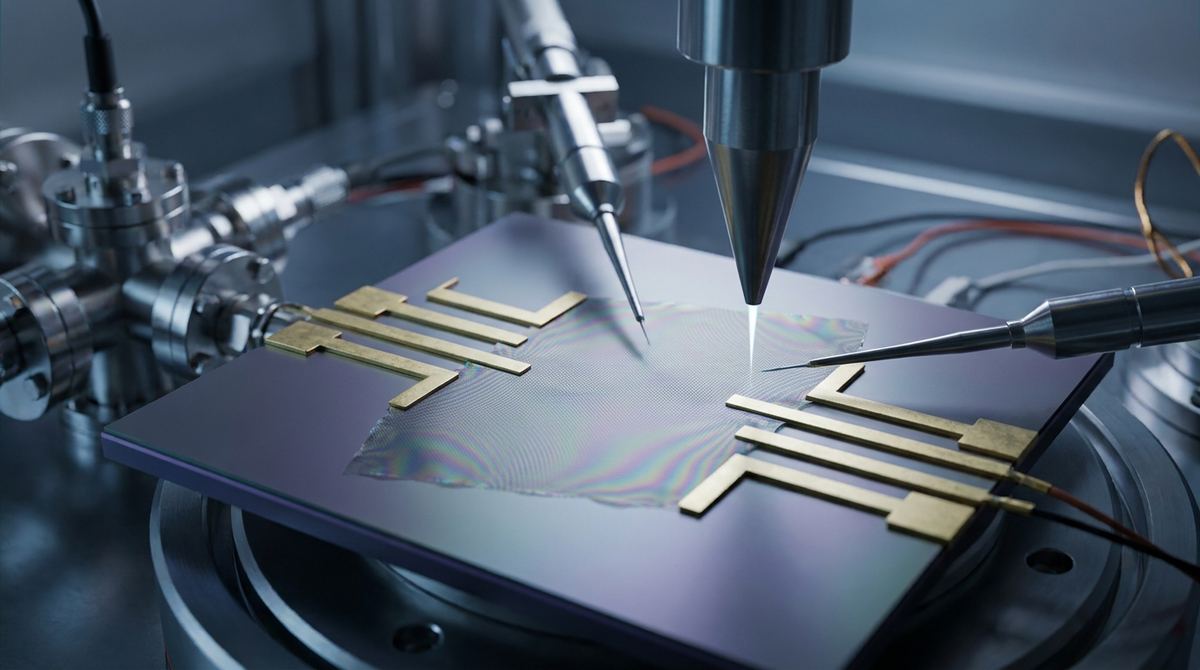
The Engineering Opportunity: Nonlinear Hall Effects in Moiré Materials
Standard Hall effect sensors rely on an external magnetic field to deflect charge carriers, creating a transverse voltage. While effective, these sensors are often bulky and lack the ability to be tuned electronically. Recent research into twisted bilayer graphene (TBG) has revealed a much more sophisticated mechanism for generating transverse signals: the Berry curvature dipole.
In specific moiré systems, such as twisted bilayer graphene, the electronic structure is highly sensitive to the geometry of the lattice. When you introduce a controlled texture—such as a slight variation in the twist angle or a small amount of heterostrain—you break the symmetry of the electronic bands. This symmetry breaking creates a Berry curvature dipole. The result is a nonlinear Hall response, where a longitudinal current generates a transverse voltage even in the absence of a magnetic field.
For an engineer or a startup, this represents a path toward a new class of ultra-sensitive, gate-tunable strain sensors. Because the response is tied to the Berry curvature, which is highly sensitive to the local electronic environment, these devices could theoretically detect mechanical deformations far below the limits of conventional resistive strain gauges.
The Engineering Principle: From Strain to Signal
The research by Tohid Farajollahpour demonstrates that a specific type of texture—a projected textured mini-Dirac cone—is required to generate this mixed phase-space curvature. Crucially, the study shows that a very small amount of heterostrain, specifically between 0.03% and 0.2%, is sufficient to induce the necessary tilt in the electronic structure to trigger the nonlinear Hall response.
In a practical device, this means you are not looking for massive mechanical deformation. Instead, you are looking for the subtle "tilt" in the electronic bands caused by minute strain. This tilt creates a valley-odd component that allows the nonlinear Hall effect to manifest. The most significant advantage for an engineer is that this response is gate-tunable. By adjusting the carrier density (the filling factor) via a gate electrode, you can move the system to the exact point where the Berry curvature dipole is maximized, providing a high-signal-to-noise ratio for your sensor.
Required Materials and Equipment
To prototype this sensor, you will need high-precision fabrication tools and specific materials to maintain the integrity of the moiré pattern.
1. Graphene: High-quality, large-area CVD graphene or high-mobility exfoliated graphene is required. The quality of the moiré pattern depends entirely on the crystalline perfection of the flakes.
2. Hexagonal Boron Nitride (hBN): This is essential for encapsulation. hBN provides an atomically smooth environment that protects the graphene from substrate impurities and maintains high carrier mobility.
3. Substrate: A piezoelectric substrate (such as PMN-PT) is recommended for the prototype. This allows you to apply the required 0.03% to 0.2% strain electrically and with high precision. Alternatively, a flexible polyimide substrate can be used for mechanical strain testing.
4. Electrodes: Gold or Titanium/Gold contacts for the Hall bar geometry.
5. Fabrication Tools: An electron-beam lithography (EBL) system for patterning the Hall bar and electrodes, and a dry-transfer setup for the hBN/graphene stack.
6. Measurement Electronics: A high-precision lock-in amplifier (e.g., SR865) and a low-noise DC current source are necessary to detect the small nonlinear voltages.
Fabrication and Assembly Workflow
Building a prototype requires extreme care to ensure the twist angle remains consistent across the device.
1. Substrate Preparation: Mount your piezoelectric substrate or flexible polyimide onto a sample holder. If using a piezo, ensure the electrical connections for the actuator are already established.
2. Graphene Twisting: This is the most critical step. You must create a twisted bilayer stack. Using a dry-transfer method, pick up a graphene flake and rotate it by exactly 1.3 degrees (as suggested by the source model) before placing it onto a second graphene flake or an hBN layer. This angle is chosen because it sits in the regime where the moiré mini-Dirac cones are well-defined.
3. Encapsulation: Sandwich the twisted bilayer graphene between two layers of hBN. This protects the moiré pattern from environmental degradation and minimizes scattering.
4. Electrode Patterning: Use electron-beam lithography to define a Hall bar geometry on the top hBN layer. The Hall bar should be long and narrow to maximize the transverse voltage signal.
5. Contact Metallization: Deposit gold electrodes through the lithography mask. Ensure the contacts are made directly to the graphene or through a thin layer of hBN to maintain high contact transparency.
6. Gate Integration: Implement a back-gate (using the silicon substrate) or a top-gate (using a thin hBN layer and a metal electrode) to allow for tuning of the carrier density.
Calibration and Testing Protocol
The goal of the test is to verify that the transverse voltage follows the nonlinear Hall effect and peaks at the predicted filling factor.
1. Baseline Characterization: Before applying strain, measure the longitudinal resistance (Rv) and the longitudinal conductivity (sigma_xx) as a function of the gate voltage. This establishes the baseline electronic state of your TBG device.
2. Strain Application: Apply a controlled, minute strain using the piezoelectric substrate. Start at the lower bound of 0.03% and gradually increase toward 0.2%.
3. Nonlinear Voltage Measurement: Apply a small AC current (to avoid heating) and measure the transverse voltage (Vy) using a lock-in amplifier. Because this is a nonlinear Hall effect, the voltage should scale with the square of the input current (Vy ∝ Ix^2) rather than linearly.
4. Gate-Tunability Mapping: Sweep the gate voltage while keeping the strain constant. According to the research, the response should peak at a specific local filling factor ($\mu_{\rm loc}=\sqrt{2}\,m$). While the exact value of $m$ is a model parameter, you will observe a distinct peak in the nonlinear Hall signal at a specific carrier density. This peak is your sensor's "operating point."
5. Sensitivity Analysis: Determine the minimum detectable strain by observing the smallest change in Vy that can be distinguished from the noise floor.
Engineering Risks and Mitigation
1. Twist Angle Deviation: The most significant risk is that the twist angle deviates from the target (e.g., 1.3 degrees). Even a 0.1-degree error can drastically change the electronic properties.
Mitigation: Use Raman spectroscopy or electron diffraction to verify the twist angle of your flakes before completing the encapsulation process.
2. Strain Non-uniformity: If the strain is not uniform across the Hall bar, the Berry curvature dipole will be smeared out, reducing the signal.
Mitigation: Use a piezoelectric actuator rather than mechanical bending to ensure a more uniform strain field across the moiré lattice.
3. Contact Resistance: High contact resistance can drown out the small nonlinear Hall voltage.
Mitigation: Use advanced contact cleaning techniques (such as Ar+ plasma cleaning) before metal deposition and ensure the use of high-purity gold electrodes.
4. Thermal Noise: At the scales required for these measurements, thermal fluctuations can interfere with the signal.
Mitigation: Perform measurements in a cryostat or a highly temperature-controlled environment to ensure the stability of the carrier density and the moiré structure.
Source Basis: This guide is based on the theoretical framework provided by Tohid Farajollahpour (2026) regarding the generation of mixed phase-space curvature in textured twisted bilayer graphene. The specific implementation of a piezoelectric-driven Hall bar sensor is an engineering assumption for prototyping purposes.