Imagine you are an architect tasked with designing a massive, lightweight skyscraper. In a perfect world, every single steel beam is identical, every bolt is tightened to the exact same torque, and every glass pane is perfectly flat. However, as you move from the blueprints to the actual construction site, reality sets in. Some beams arrive slightly bent, some bolts are missing, and some glass panels have tiny scratches. If you want to know if that building will withstand a massive earthquake or a hurricane, you cannot simply rely on your perfect blueprints. You need to understand how these real-world imperfections—these defects—will change the way the building handles stress and vibration.
This is the exact challenge facing modern materials scientists today as they move from the laboratory bench to industrial application. In a recent groundbreaking study, Aleksander Szewczyk, Leonardo Medrano Sandonas, David Bodesheim, Bohayra Mortazavi, and Gianaurelio Cuniberti have applied this exact logic to the world of advanced molecular architecture. Their research focuses on Covalent Organic Frameworks, or COFs, which are highly engineered, porous materials that behave much like a molecular scaffolding. While theoretical models often assume these frameworks are perfect, the researchers recognize that the real world is messy. By using sophisticated data-driven modeling, they are bridging the gap between the perfect crystal and the actual, imperfect material, providing a roadmap for how structural defects influence the thermal and mechanical stability of these next-generation substances.
The Problem This Research Is Solving
The primary hurdle in advanced materials science is the discrepancy between theory and reality. For decades, computational chemists have used high-fidelity simulations to predict how a material will behave. These simulations are incredibly accurate, but they usually assume a perfect, repeating lattice where every atom is exactly where it should be. These perfect crystals are known as ideal lattices. In such an environment, heat moves smoothly through vibrations, and mechanical stress is distributed evenly across every bond.
However, when these materials are actually synthesized in a laboratory, they are rarely perfect. During the chemical reaction that builds a Covalent Organic Framework, certain building blocks might fail to connect, or a molecule might be missing entirely, creating a vacancy. This creates a defect. These defects are not just minor nuisances; they fundamentally change how the material interacts with its environment. A single missing link in a molecular chain can act as a bottleneck for heat conduction or as a focal point where mechanical stress concentrates, potentially leading to the failure of the entire structure.
Before this research, engineers had to rely on trial and error. They would synthesize a material, test it, find it failed prematurely due to defects, and then try to adjust the chemistry. This process is incredibly slow, expensive, and inefficient. There was no way to efficiently predict how a specific pattern of defects would alter the thermal conductivity or the structural strength of a COF without building it first. The industry lacked a way to calculate the cost of imperfection.
The Key Idea in Plain English
The researchers proposed a way to bypass the slow process of trial and error by using data-driven modeling. Instead of trying to simulate every single atom in a massive, imperfect structure—which would require a supercomputer running for months—they used machine learning to learn the relationship between defects and properties.
Think of it like learning to drive a car. You don't need to understand the fluid dynamics of the engine oil or the specific chemical reaction of the combustion to be a great driver; you just need to understand how certain inputs, like how hard you press the pedal, lead to certain outputs, like acceleration. The researchers used high-quality, small-scale data to train a model that could then predict how large-scale, complex defects would influence the material. This allowed them to jump straight from the "design" phase to the "prediction" phase, identifying how various types of structural errors affect the way a material handles heat and physical pressure without needing to physically build every possible variation.
How the Graphene-Based System Works
To understand the mechanics, we must first look at the nature of the materials themselves. Covalent Organic Frameworks are built from organic molecules held together by strong covalent bonds. These bonds are the same types of connections found in graphene, a single layer of carbon atoms that is famous for its incredible strength and conductivity. Like graphene, COFs are characterized by their highly ordered, repeating structures and their immense surface area.
When heat moves through these structures, it does so via phonons. Phonons are not physical particles, but rather quantized vibrations that travel through the lattice. In a perfect COF, these vibrations move through the interconnected network with very little resistance, leading to high thermal conductivity. However, when a defect is introduced, such as a missing molecular link, it creates a disruption in the lattice. This disruption acts as a scattering center for phonons. Imagine a wave traveling across a calm lake; if you suddenly drop a large rock into the water, the wave hits the rock and scatters in multiple directions. In a COF, when a phonon hits a defect, it scatters, which significantly reduces the material's ability to conduct heat.
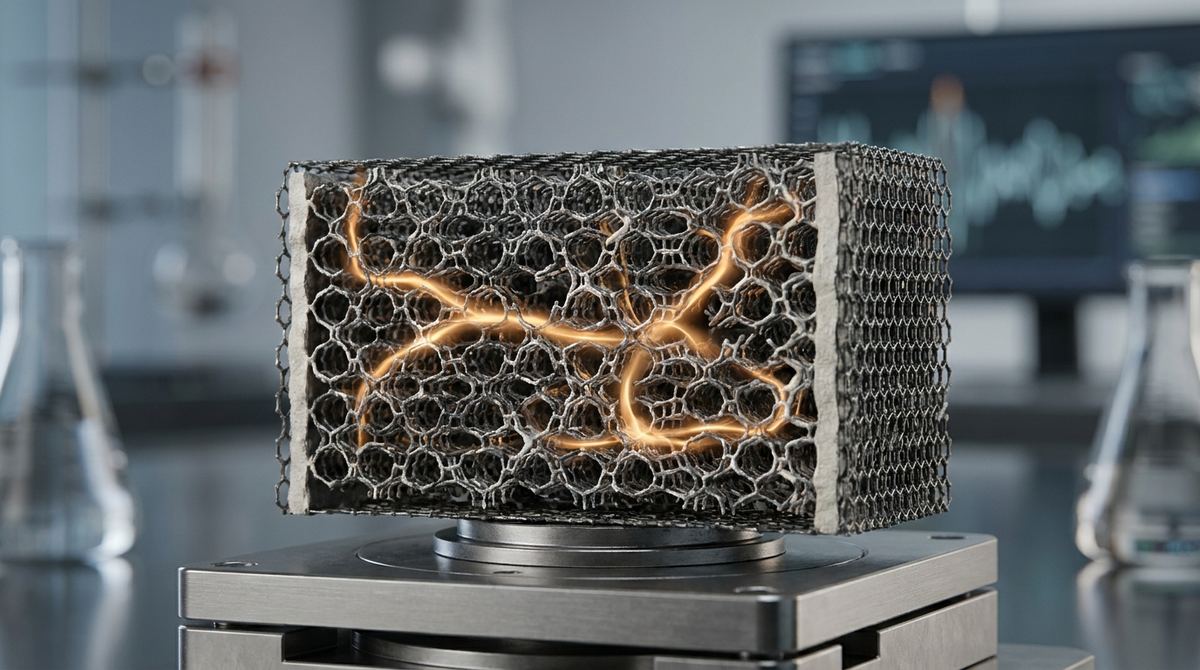
Mechanical properties work through a similar principle of connectivity. When you apply force to a material, that force is transmitted through the covalent bonds. In a perfect framework, the stress is distributed evenly across the entire network. But when a defect is present, the stress cannot pass through the empty space where the molecule should be. Instead, the stress "bunches up" around the edges of the defect. This is known as stress concentration. If the stress at that specific point becomes too high, the chemical bonds will snap, leading to a crack that can propagate through the entire material, causing it to break.
What the Researchers Found
The study by Szewczyk, Medrano Sandonas, David Bodesheim, Mortazavi, and Cuniberti demonstrated that the impact of defects is not uniform. The researchers found that the specific type and density of defects play a decisive role in determining whether a material remains functional or fails. By using their data-driven approach, they were able to map out how different configurations of vacancies and misalignments affect the thermal and mechanical properties.
One of the key findings was the ability to quantify the degradation of properties. The model showed that as the density of defects increases, there is a predictable, non-linear decline in both thermal conductivity and mechanical stiffness. This is critical because it tells engineers exactly how much "imperfection" a material can tolerate before it becomes useless for its intended purpose. For example, a material intended for heat dissipation in microelectronics might be able to tolerate a certain percentage of defects, but once that threshold is crossed, the material's ability to move heat away from sensitive components drops off sharply.
Furthermore, the research highlighted how the geometry of the defect matters as much as the presence of the defect itself. A small, isolated vacancy might only scatter a few phonons, but a cluster of defects can create a massive barrier to heat and a significant weak point for mechanical stress. The data-driven model was able to distinguish between these scenarios, providing a level of detail that traditional, uniform models could never achieve.
Why the Result Matters
This research represents a major shift in how we approach the design of carbon-based and organic materials. For a long time, the goal was to achieve "perfect" synthesis. This research suggests that we should instead aim for "predictable" synthesis. If we know exactly how defects will affect the material, we don't need to waste time trying to eliminate every single imperfection; we can instead design materials that are robust enough to perform well even when they are imperfect.
This has profound implications for the scalability of manufacturing. Producing perfect, defect-free crystals at an industrial scale is nearly impossible and prohibitively expensive. By understanding the tolerance limits of COFs, manufacturers can optimize their production processes to be more cost-effective. They can determine the acceptable level of error in a production line, ensuring that every batch of material meets the necessary thermal and mechanical requirements without over-investing in impossible levels of purity.
Limitations and What Still Needs Testing
While this work is a significant leap forward, it is important to recognize that it is a modeling-based study. The results are based on computational simulations and data-driven inferences. While these models are highly sophisticated, they are only as good as the data used to train them. There is always a risk that a model might struggle with a type of defect that was not represented in the original training set.
Furthermore, there is a difference between a simulated defect and a real-world defect. In a computer, a vacancy is a clean, empty space. In a real-world chemical reaction, a defect might be accompanied by a "stray" molecule that is partially attached or a different chemical byproduct that partially blocks the pore. These types of "messy" defects are much harder to model and may behave differently than the idealized vacancies studied in this paper. Future research will need to bridge the gap between these simplified computational models and the complex, chaotic reality of chemical manufacturing.
Real-World Applications
The ability to predict the behavior of defective COFs opens the door to several high-stakes engineering applications. In the field of energy storage, specifically for next-generation batteries and supercapacitors, COFs are being explored as electrodes. These materials need to be both mechanically stable to withstand the physical swelling and shrinking that occurs during charging, and thermally conductive to prevent overheating. This research provides the tools to design COFs that can maintain their integrity even after thousands of cycles of use.
In the realm of gas separation and carbon capture, COFs are prized for their porosity. These materials act like molecular sieves, allowing certain gases to pass through while trapping others. The efficiency of these sieves depends on the size and shape of the pores. If defects change the pore structure, the separation efficiency changes. The models developed by this research team can help engineers design frameworks that remain effective even when the manufacturing process produces structural irregularities.
Finally, in microelectronics, as devices become smaller and more powerful, they generate more heat in smaller areas. Managing this heat is one of the greatest challenges in computer engineering. Using the predictive models from this study, researchers can design organic, carbon-based thermal management materials that are specifically tuned to handle the heat loads of modern processors, even when the materials are produced using standard, non-perfect industrial methods.
If You Remember One Thing
If you take only one takeaway from this research, let it be this: the future of material science is not about achieving perfection, but about mastering imperfection. By using data-driven models to understand how defects affect heat and strength, we are moving toward a world where we can reliably design high-performance materials that are both easier and cheaper to manufacture.
FAQ
What exactly are Covalent Organic Frameworks?
Covalent Organic Frameworks are a class of highly ordered, porous crystalline materials. They are constructed from organic building blocks that are linked together by strong covalent bonds. Because they are lightweight and can be custom-designed to have specific pore sizes, they are incredibly useful for tasks like storing gases, filtering water, or acting as catalysts in chemical reactions.
Why do defects change how a material works?
Defects change a material's properties because they disrupt the continuity of the structure. In terms of heat, defects act as obstacles that scatter the vibrations that carry thermal energy. In terms of strength, defects act as points where physical stress concentrates, making it much more likely that a crack will start and spread through the material.
How does machine learning help in this research?
Machine learning allows scientists to skip the slow and expensive process of simulating every single atom in a complex material. By training a model on a smaller set of highly accurate data, the model can learn the patterns of how defects affect properties. Once trained, the model can instantly predict the behavior of thousands of different, much larger and more complex configurations.
Is it possible to make these materials without any defects?
In a laboratory setting, creating a mathematically perfect crystal is extremely difficult and often impossible at a large scale. In industrial manufacturing, there will always be some level of imperfection. This research is important because it helps us understand how to work with those inevitable imperfections rather than being defeated by them.
How does this research relate to graphene?
While Covalent Organic Frameworks are distinct from graphene, they share many fundamental characteristics. Both are carbon-based materials that rely on strong covalent bonding and periodic structures to achieve their unique properties. The principles used to study the thermal and mechanical stability of COFs are very similar to the principles used to study graphene and other two-dimensional carbon materials.
Conclusion
The journey from a theoretical material to a commercial product is paved with imperfections. The research conducted by Aleksander Szewczyk, Leonardo Medrano Sandonas, David Bodesheim, Bohayra Mortazavi, and Gianaurelio Cuniberti provides the essential mathematical and computational tools needed to navigate this journey. By turning the study of defects from a source of uncertainty into a source of predictable data, they have provided a vital bridge between the pristine world of theory and the complex, imperfect reality of advanced material engineering.