
Practical Guide: Developing a Nanoscale Electrochemical Sensor via Graphene Nanogaps
A practical engineering guide to using electrochemical impedance spectroscopy to transform graphene nanogaps into high-sensitivity pH and ion sensors.
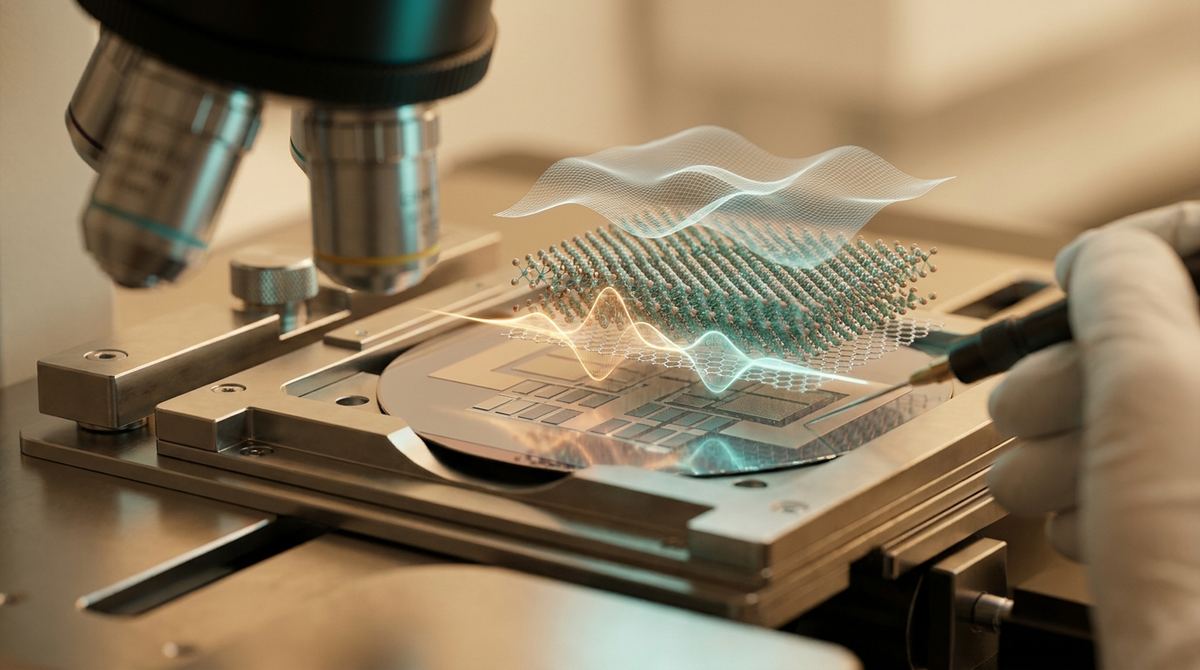
Imagine a computer that is fundamentally immune to the errors that plague current technology. Modern computers, from the smartphone in your pocket to the massive servers running the internet, rely on bits that can be easily flipped by heat or electromagnetic noise. This fragility is the single greatest hurdle in building a functional quantum computer. To solve this, physicists are looking toward exotic states of matter where information is not stored in a single particle, but in the collective, topological patterns of an entire system. This research moves us one step closer to that future by demonstrating that we can actually detect and measure these individual quantum vibrations inside a working transistor.
The fundamental challenge in quantum information science is decoherence. In a classical system, a bit is either a zero or a one. In a quantum system, we use qubits, which can exist in a superposition of states. However, qubits are incredibly sensitive. Even a tiny amount of thermal energy or a stray magnetic field can cause a qubit to lose its quantum information, a process called decoherence. This is why most quantum computers must be kept at temperatures colder than outer space.
To combat this, scientists are searching for a specific type of material known as a Kitaev quantum spin liquid. In a standard magnet, the magnetic spins of the atoms line up in an orderly pattern. In a quantum spin liquid, the spins are constantly fluctuating and never settle into a static order, even at absolute zero. This creates a state of matter that is "topologically protected." Because the information is stored in the overall pattern rather than a single spin, it is much harder for local noise to disrupt it.
While the theory behind these materials is well-established, there is a massive gap between theoretical physics and practical engineering. It is one thing to predict that a material like alpha-RuCl3 should exhibit these exotic quantum properties in a large, bulk crystal. It is quite another to build a microscopic device using that material and prove that we can observe its individual magnetic excitations. Without the ability to probe these excitations at the device level, we cannot verify if a material is actually capable of being used in a quantum transistor. The inability to see these "magnons"—the waves of magnetic energy—within a device has been a major roadblock in moving from laboratory curiosities to functional quantum components.
To understand this research, we have to change how we think about magnetism. Instead of thinking of a magnet as a static object, think of it as a sea of energy. In this sea, the magnetic energy doesn't just sit still; it moves in waves, much like ripples on the surface of a pond. These magnetic ripples are called magnons. In a standard magnet, these ripples are predictable and well-behaved. In a quantum spin liquid, these ripples behave in much stranger ways, often breaking apart into even smaller, more exotic particles.
The researchers wanted to see if they could "hear" these individual ripples using a tiny electronic gate. By building a transistor that allows electrons to tunnel through a layer of alpha-RuCl3, they created a way to listen to the magnetic vibrations. When an electron tunnels through the material, it can sometimes give up a little bit of its energy to create one of these magnetic ripples. By measuring the electrical current, the researchers can detect exactly when an electron has lost energy to a magnon. If they see a distinct spike in the signal at a specific energy level, they have successfully detected a single magnetic mode. This is like listening to a single note played on a violin in the middle of a crowded room; it proves that the instrument is working exactly as the theory predicts.
The architecture used in this study relies on the principles of two-dimensional (2D) material engineering, a field that has been transformed by the discovery of graphene. While the primary subject here is alpha-RuCl3, the device functions through the same low-dimensional physics that governs graphene-based electronics. The system is constructed as a tunneling transistor, which consists of a thin sandwich of materials. At the heart of this sandwich is a monolayer of alpha-RuCl3, which acts as the barrier through which electrons must pass.
The mechanism of action is rooted in inelastic tunneling spectroscopy. In a standard transistor, electrons flow through a channel based on an applied voltage. In a tunneling transistor, the barrier is so thin that electrons can "tunnel" through it, even if they do not have enough energy to jump over the barrier classically. This is a quantum mechanical phenomenon where an electron exists on both sides of the barrier simultaneously.
When a voltage is applied to the transistor, electrons are pushed toward the alpha-RuCl3 layer. As these electrons tunnel through, they interact with the magnetic spins of the ruthenium atoms. If the energy provided by the voltage matches the energy required to create a magnetic excitation—a magnon—the electron will lose that specific amount of energy to the lattice. This loss of energy is called an inelastic process. Because the electron loses energy to the magnetic system, it changes the total current flowing through the device. By measuring how the conductance changes as a function of the voltage, the researchers can map out the energy spectrum of the magnetic excitations. This direct link between electrical conductance and magnetic energy is what allows for such precise measurement of the quantum state.
The study, conducted by Servet Ozdemir, Mikhail Kashchenko, and Kostya S. Novoselov, yielded a significant result: the observation of single antiferromagnetic magnon modes within the tunneling transistor. This is a much more precise observation than what has been achieved in previous bulk studies. In bulk materials, the magnetic signals are often smeared together, making it difficult to distinguish individual excitations from the general background noise.
By using the tunneling transistor, the researchers were able to isolate specific, discrete energy levels. They found that the conductance of the device changed in a way that corresponded exactly to the expected energy of a single antiferromagnonic mode. Specifically, they observed that the electron's interaction with the antiferromagnetic order produced a distinct signature in the tunneling current. This confirmed that the magnetic excitations in alpha-RuCl3 are not just theoretical mathematical constructs but are physical realities that can be manipulated and measured within a micro-scale electronic device. This discovery proves that the device architecture is capable of acting as a high-resolution probe for the complex, frustrated magnetism that defines the Kitaev spin liquid candidate.
This research represents a vital bridge between fundamental condensed matter physics and practical quantum engineering. For decades, the Kitaev spin liquid was a beautiful mathematical theory—a perfect model for a quantum state that could protect information. However, a theory is only useful for technology if we can verify it in a working device. By successfully observing these magnon modes in a transistor, the researchers have demonstrated a "proof of concept" for a new type of quantum measurement tool.
Furthermore, this finding suggests that the properties of alpha-RuCl3 can be integrated into electronic components. If we can precisely detect and control the energy of magnons, we can eventually use those magnons to carry information. This is the basis of spintronics, a field where the spin of an electron, rather than just its charge, is used to process information. Because spin-based processes generate much less heat than charge-based processes, they offer a path toward much more efficient and powerful computing. This research confirms that the magnetic excitations of a 2D material can be coupled to electronic transport, a necessary requirement for any future quantum-spintronic device.
While these results are groundbreaking, it is important to distinguish between a laboratory observation and a commercial technology. The study was conducted under extremely controlled, cryogenic conditions. Currently, the phenomena observed are only visible at temperatures near absolute zero, where thermal noise does not drown out the delicate quantum signals. For these materials to be useful in everyday technology, researchers must find ways to maintain these quantum states at higher, more manageable temperatures.
Additionally, the fabrication of these tunneling transistors is incredibly complex. Creating a perfect, defect-free monolayer of alpha-RuCl3 and integrating it into a transistor architecture without introducing impurities is a monumental engineering challenge. Any defect in the crystal lattice can scatter electrons or create "fake" magnetic signals, making it difficult to isolate the true quantum behavior. Future research must focus on scalable manufacturing processes that can produce these 2D devices with the high degree of precision required for reliable operation.
The long-term implications of this research extend into several high-tech industries. The most prominent application is in quantum computing. If we can master the use of Kitaev spin liquids in topological quantum computers, we could create qubits that are naturally protected from the environment. This would drastically reduce the error rates in quantum calculations, making large-scale, practical quantum computers a reality.
Another application lies in ultra-low-power electronics. As transistors in modern chips become smaller, they suffer from significant heat generation due to electrical resistance. Spintronic devices, which utilize the magnetic excitations discovered in this study, could allow for information processing with minimal energy loss. This would be revolutionary for everything from high-performance supercomputers to the battery life of mobile devices. Finally, the ability to probe single magnons opens new doors in precision sensing, where highly sensitive magnetic detectors could be used in medical imaging or mineral exploration.
If you take away only one concept from this research, let it be this: we have successfully moved from observing quantum magnetism in large chunks of material to observing it as individual, controllable waves within a microscopic transistor, bringing us one step closer to the era of topologically protected quantum computing.
What exactly is a magnon?
A magnon is a type of quasiparticle that represents a collective excitation of the magnetic spins in a material. Instead of one single atom's spin flipping, a magnon is a wave of spin-flips that moves through the crystal lattice. You can think of it like a wave traveling through a stadium crowd where people stand up and sit down in a sequence, creating a ripple that moves across the stands.
Why is alpha-RuCl3 considered special?
Alpha-RuCl3 is highly valued because its crystal structure and the behavior of its electrons make it a prime candidate for a Kitaev quantum spin liquid. In this state, the magnetic spins are highly "frustrated," meaning they cannot settle into a simple pattern. This frustration is what leads to the exotic, protected quantum states that are so useful for computing.
What is a tunneling transistor?
A tunneling transistor is a device that uses quantum mechanics to control the flow of electricity. In a normal transistor, electrons need enough energy to climb over a barrier. In a tunneling transistor, the barrier is so thin that the electron can "tunnel" through it, effectively appearing on the other side. This allows for extremely sensitive measurements of the energy states within the barrier material.
Why do we need quantum computers if we have supercomputers?
Supercomputers are excellent at calculating many tasks, but they struggle with certain types of problems, such as simulating complex molecules or cracking certain types of encryption. Quantum computers use the principles of quantum mechanics to perform certain calculations exponentially faster than even the most powerful classical supercomputers, potentially solving problems that would otherwise take billions of years.
How does this research help with the "noise" problem in computers?
The research focuses on materials that are "topologically protected." In these materials, information is stored in global properties of the system rather than in a single particle. Because a local disturbance—like a bit of heat or a stray magnetic field—only affects a tiny area, it is much less likely to disrupt the overall pattern, making the information much more stable and reliable.
The work performed by Servet Ozdemir, Mikhail Kashchenko, and Kostya S. Novoselov marks a significant milestone in the study of two-dimensional quantum materials. By successfully observing single antiferromagnetic magnon modes within a tunneling transistor, they have demonstrated that the elusive properties of Kitaev spin liquids can be probed and measured at the device level. While challenges remain in terms of temperature and manufacturing, this research provides the essential experimental foundation required to turn the theoretical promise of topological quantum computing into a functional, engineering reality.
Serious about B2B integration? Test our premium Pulsed Electrical Resistive Carbon Heating turbostratic graphene in your lab. 100g sample packs available now.
Explore More
A practical engineering guide to using electrochemical impedance spectroscopy to transform graphene nanogaps into high-sensitivity pH and ion sensors.

Researchers Mingrui Yuan and Nikolay V. Golubev have developed a mathematical framework that unifies X-ray and electron diffraction imaging, allowing scientists to observe atomic movements with unprecedented consistency across different imaging modalities.

Discover how advanced coordination engineering and machine learning are revolutionizing water splitting by using dual-atom catalysts to break the efficiency barriers of traditional hydrogen production.