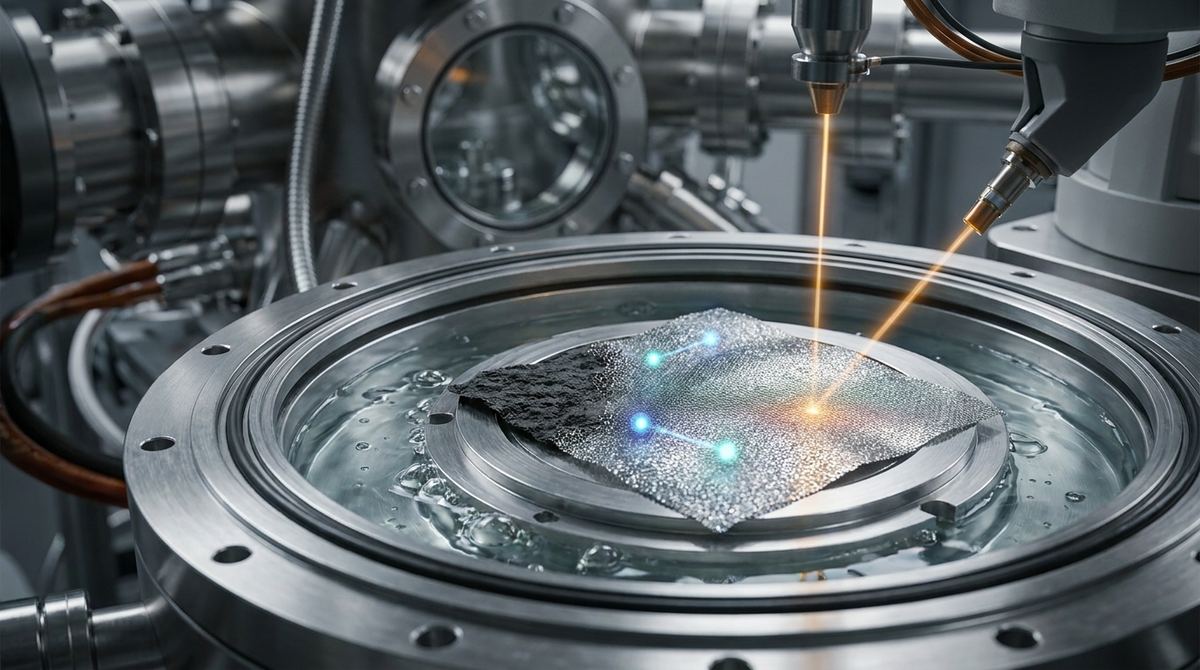
The transition to a green economy depends heavily on our ability to produce hydrogen efficiently and cheaply. Currently, most hydrogen is produced from natural gas through a process that releases significant amounts of carbon dioxide. To truly decarbonize, we need a way to split water into hydrogen and oxygen using only renewable electricity, such as wind or solar. This process, known as water splitting, requires a catalyst to lower the energy required for the reaction to occur. While platinum is the gold standard for these reactions, it is far too expensive for the massive scale required by global energy needs. This research represents a major leap toward finding cheaper, more efficient alternatives by moving beyond single-atom catalysts and into the sophisticated world of dual-atom coordination.
The Problem This Research Is Solving
The primary obstacle in the hydrogen economy is the sheer energy cost of the electrochemical reactions involved in water splitting. There are two distinct halves to this process: the Hydrogen Evolution Reaction, which produces the fuel, and the Oxygen Evolution Reaction, which releases the byproduct. Both reactions require an "overpotential," which is essentially a tax paid in energy that makes the process less efficient. In the chemical world, there is a frustrating phenomenon known as the scaling relationship. This occurs because the chemical species involved in the reaction tend to bind to the catalyst surface in a predictable, fixed way. When you try to make the catalyst bind one intermediate more weakly to speed up one step of the reaction, it inevitably binds another intermediate more strongly, which slows down a different step. This creates a fundamental ceiling on how efficient a single-atom catalyst can be.
For decades, scientists have tried to bypass this ceiling by using single-atom catalysts, where individual metal atoms are dispersed on a carbon support. While these are much more efficient than large chunks of expensive precious metals, they are still limited by the chemistry of that single site. They cannot easily break the scaling relationship because there is only one point of contact for the chemical interaction. There is a massive demand for a catalyst that can manipulate these binding energies independently, allowing us to optimize every step of the reaction simultaneously. Without a breakthrough in how we design these active sites, green hydrogen will remain too expensive to compete with fossil fuels.
The Key Idea in Plain English
The researchers have proposed a solution through a method called coordination engineering. If a single-atom catalyst is like a lone worker trying to assemble a complex machine, a dual-atom catalyst is like a two-person team working in perfect synchronization. By placing two metal atoms close together on a support material, we create a new kind of chemical environment. The atoms are not just sitting there; they are surrounded by a specific arrangement of other atoms, such as nitrogen or carbon, which act as a scaffold. This scaffold is the coordination environment.
By precisely engineering the "neighborhood" around these two metal atoms, scientists can change the way electrons are distributed across the site. This electronic tuning allows the two atoms to work together to split the chemical bonds of water. One atom might grab onto a part of the water molecule while the other stabilizes another part, effectively breaking the scaling relationship that plagues single-atom catalysts. This coordination engineering allows us to fine-tune the energy barriers of the reaction, making the whole process much smoother and requiring less electricity. To navigate the nearly infinite combinations of metal pairs and coordination patterns, the researchers utilized machine learning to act as a high-speed scout, predicting which combinations would work before they ever had to be tested in a physical laboratory.
How the Graphene-Based System Works
To understand how this works at a molecular level, we must look at the physics of the interface. The research relies on a highly advanced computational approach known as constant-potential first-principles modeling. In traditional simulations, scientists often hold the number of electrons constant, which does not accurately reflect what happens in a real-world battery or electrolyzer where the voltage is held constant. By using constant-potential modeling, the researchers can more accurately simulate the electrical pressure applied to the catalyst during water splitting. This provides a much more realistic view of how the electrons move between the metal atoms and the water molecules.
The system typically involves two metal atoms anchored into a carbon-based structure, such as graphene or nitrogen-doped carbon. The carbon lattice acts as an incredibly conductive highway, allowing electrons to flow rapidly to the active sites. When a water molecule approaches the dual-atom site, the electronic structure of the two metals is specifically tuned by their surrounding coordination atoms. This tuning alters the d-band center of the metals, which is a critical factor in determining how strongly a reactant will stick to the surface. As the metal atoms interact with each other, they create a synergistic electronic effect. This synergy ensures that the intermediates of the water-splitting reaction, such as hydrogen or hydroxyl groups, are held just tightly enough to react, but loosely enough to be released quickly once the reaction is complete. This precise balance is what prevents the energy tax of overpotential from becoming too high.
What the Researchers Found
The study conducted by Jiahang Li, Suhang Li, Chong Yan, Jiajun Yu, Qinzhuang Liu, Ruo-Ya Wang, and Dongwei Ma yielded significant insights into how these dual-atom sites behave under real-world conditions. By combining high-level physics simulations with machine learning, the team was able to map out the complex relationship between the coordination environment and catalytic performance. They discovered that the specific arrangement of atoms surrounding the dual-metal center is the most critical factor in determining whether the catalyst will be successful.
The researchers found that by carefully selecting the two metal atoms and the atoms that support them, it is possible to "break" the scaling relationships that have historically limited catalyst efficiency. The machine learning models identified specific combinations of metals and coordination patterns that could significantly lower the energy barriers for both the hydrogen and oxygen evolution reactions simultaneously. This is a major achievement because it shows that we are no longer limited to the chemistry of a single metal atom. Instead, we can design complex, multi-metal sites that act as highly specialized chemical machines, optimized for the specific energetic demands of water splitting.
Why the Result Matters
This research is a vital stepping stone toward the widespread adoption of hydrogen fuel technology. If we can design catalysts that operate at much lower overpotentials, the cost of producing green hydrogen drops significantly. This has a massive ripple effect across multiple industries. It makes large-scale electrolyzers, the machines that turn water into hydrogen, much more efficient and cheaper to build and operate. This, in turn, makes renewable energy storage more viable, as excess wind and solar power can be stored as hydrogen gas for use when the sun isn't shining or the wind isn't blowing.
Furthermore, the ability to use dual-atom catalysts allows us to move away from the total reliance on precious metals like platinum and iridium. By using a combination of more abundant metals and precise coordination engineering, we can create catalysts that are both high-performing and economically sustainable. The shift from relying on brute-force material scarcity to using sophisticated electronic engineering represents a fundamental change in how we approach materials science for the energy transition.
Limitations and What Still Needs Testing
While the findings are incredibly promising, it is important to distinguish between computational predictions and physical reality. This research was conducted using first-principles modeling and machine learning, which are powerful tools but are still simulations of an ideal environment. In a real-world industrial electrolyzer, the catalyst must survive for thousands of hours under harsh, acidic, or alkaline conditions without the metal atoms leaching out or the carbon support degrading. This stability is a major hurdle that remains to be fully addressed in a laboratory setting.
Additionally, while machine learning can predict high-performing candidates, the actual synthesis of these dual-atom catalysts is a complex chemical task. Creating exactly two metal atoms in a specific coordination pattern on a carbon lattice requires extreme precision in chemical manufacturing. Future research must focus on bridging the gap between these highly accurate digital models and the physical ability to manufacture these catalysts at a scale that can support a global hydrogen economy.
Real-World Applications
The implications of this research extend far beyond the laboratory. The most immediate application is in the design of next-generation electrolyzers for green hydrogen production. As nations commit to net-zero targets, the demand for industrial-scale hydrogen production will skyrocket, requiring new types of electrochemical cells that are more durable and efficient than current models.
Beyond hydrogen production, these dual-atom catalysts could find applications in various other electrochemical processes, including carbon dioxide reduction and fuel cells. The ability to tune the electronic environment of a dual-atom site provides a blueprint for designing highly specific catalysts for a wide range of chemical transformations. This could lead to new ways of manufacturing chemicals, converting waste products into valuable fuels, and improving the efficiency of various energy storage devices.
If You Remember One Thing
If you remember nothing else, remember that the key to a green hydrogen future lies in coordination engineering. By moving from single-atom to dual-atom catalysts and using machine learning to design their exact atomic neighborhoods, scientists are learning how to bypass the fundamental efficiency limits that have hindered water splitting for decades.
FAQ
What exactly is a dual-atom catalyst?
A dual-atom catalyst consists of two metal atoms that are held in a specific arrangement on a support material, like carbon. Unlike traditional catalysts that use large chunks of metal, or single-atom catalysts that use one atom at a time, these dual-atom sites work together. This teamwork allows them to handle chemical reactions more effectively by splitting the work and managing the energy of the reaction more precisely.
Why is water splitting so difficult to do efficiently?
The main difficulty is the scaling relationship, which is a chemical rule that makes it hard to optimize all steps of a reaction at once. When you try to make a catalyst better at one part of the reaction, it often becomes worse at another part. This creates an energy barrier called overpotential, which means you have to use more electricity than theoretically necessary to get the reaction to happen.
How does machine learning help in this research?
There are millions of possible combinations of metal atoms and supporting atoms. Testing every single one in a lab would take hundreds of years. Machine learning acts as a shortcut by looking at the data from a few thousand simulations and learning the patterns. It can then quickly predict which combinations are most likely to be highly efficient, allowing scientists to focus their experiments on the best candidates.
What is coordination engineering?
Coordination engineering is the process of precisely designing the atoms that surround an active metal site. Think of it like adjusting the environment around a worker to make them more productive. By changing the atoms that hold the metal atoms in place, researchers can change the electronic properties of the metal, which directly affects how well it can split water molecules.
Is this research ready for commercial use right now?
No, this research is currently in the computational and foundational stage. While the models provide a roadmap for what works, we still need to prove that these catalysts can be manufactured cheaply and that they will remain stable for thousands of hours in real-world industrial machines. It is a vital step toward commercialization, but it is not a finished product yet.
Conclusion
The work by Jiahang Li and the research team marks a significant evolution in the field of electrocatalysis. By leveraging the power of dual-atom synergy and the predictive capabilities of machine learning, they have provided a new framework for overcoming the energy barriers that have long plagued water splitting. As we move toward a world powered by green hydrogen, the ability to engineer the atomic-scale coordination of catalysts will be the difference between a costly energy transition and a sustainable, efficient one. The journey from computational discovery to industrial application is long, but the roadmap provided by this research is clearer than ever.