Imagine a material so strong it could replace steel, so conductive it could outpace copper, and so thin it is practically invisible. This is graphene, the superstar of the nanotechnology world. However, there is a major practical hurdle: the most common way to create graphene for industrial use involves a "dirty" precursor called graphene oxide. While graphene oxide is easy to work with because it dissolves in water, it is an electrical insulator. To make it useful for electronics or batteries, we have to strip away the oxygen atoms to restore its legendary conductivity. This process, known as reduction, has traditionally been slow, chemically messy, or energetically expensive. Now, a new research breakthrough suggests we can perform this transformation with unprecedented speed and precision using a combination of electron beams and infrared lasers.
The Problem This Research Is Solving
To understand why this research matters, one must understand the fundamental chemistry of carbon. In its pure form, graphene consists of a single layer of carbon atoms arranged in a perfect hexagonal lattice. This structure allows electrons to move across the surface with almost no resistance, a phenomenon known as high electron mobility. However, manufacturers typically produce graphene by oxidizing graphite, which introduces various oxygen-containing functional groups like epoxy, hydroxyl, and carboxyl groups.
This chemical modification changes the carbon atoms from a state known as sp2 hybridization to sp3 hybridization. In the sp3 state, the carbon atoms are bonded to oxygen instead of being part of the continuous, interconnected pi-electron cloud that allows electricity to flow. These oxygen groups act like massive roadblocks on a high-speed highway, scattering electrons and turning a conductive material into an insulator.
Current methods to fix this problem are far from perfect. Chemical reduction often requires toxic substances like hydrazine, which is dangerous to handle and leaves behind chemical residues that can interfere with the material's performance. Thermal reduction requires heating the material to very high temperatures for extended periods, which is energy-intensive and can accidentally damage the carbon structure if not perfectly controlled. Electrochemical reduction is an alternative, but it can be difficult to achieve uniformity across different shapes and sizes of material. There is a pressing need for a method that is fast, clean, and highly controlled to bridge the gap between raw graphene oxide and high-performance reduced graphene oxide.
The Key Idea in Plain English
The researchers have proposed a clever two-step "one-two punch" to solve this problem. Instead of trying to force the oxygen out all at once using brute force heat or harsh chemicals, they use a two-stage process that primes the material for change.
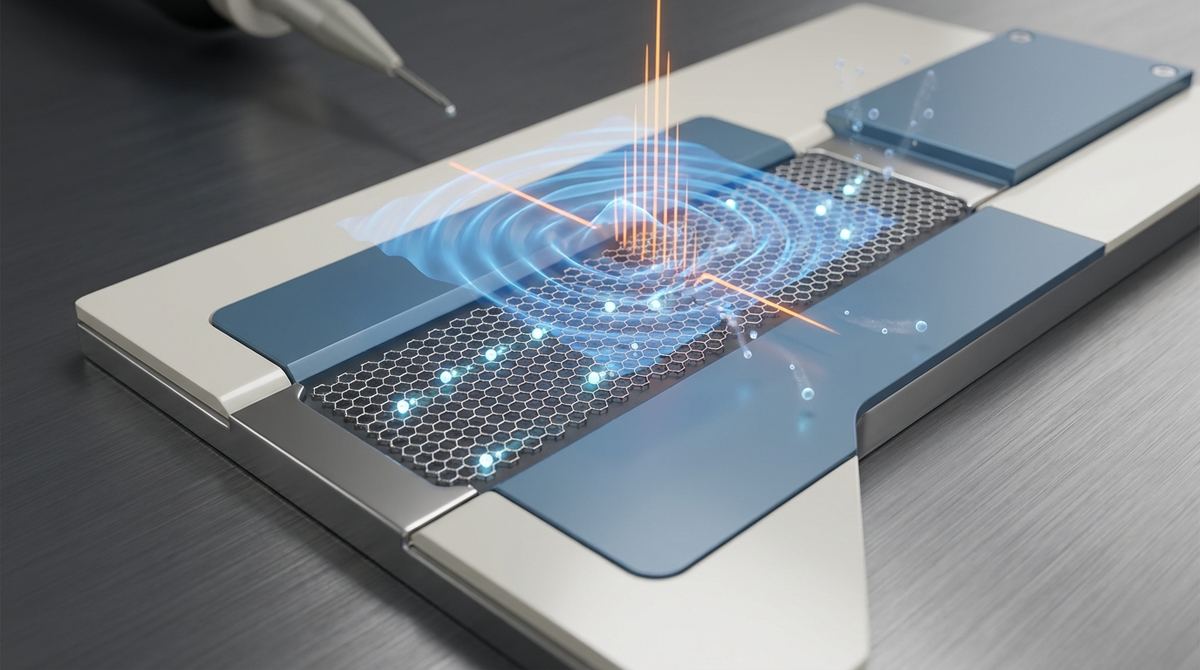
First, they use an electron beam to "activate" the graphene oxide. Think of this as using a tiny, high-energy hammer to strike the material, creating weak points or "reactive sites" where the oxygen is no longer firmly held in place. This doesn't complete the reduction, but it prepares the chemical bonds for easy removal. Second, they hit the material with a pulse of infrared laser light. This laser provides a quick, intense burst of energy that acts like a sudden nudge, shaking the loosened oxygen atoms free from the carbon lattice. By splitting the process into an activation phase and a reduction phase, the researchers can achieve a speed and level of control that a single-method approach simply cannot match.
How the Graphene-Based System Works
The physics behind this process involves a sophisticated interplay between high-energy particle physics and photonics. The process begins when the graphene oxide is subjected to an electron beam. As these high-energy electrons collide with the graphene oxide lattice, they transfer significant kinetic energy to the target. This interaction can result in the breaking of carbon-oxygen bonds or the displacement of oxygen atoms, creating what scientists call "defects" or "active sites."
Crucially, these defects are not necessarily damage; they are specific, controlled modifications to the local electronic structure. By creating these sites, the researchers change the chemical landscape of the graphene oxide, making the remaining oxygen atoms much more unstable and easier to remove. The material is now in a state of heightened reactivity, essentially waiting for a catalyst to finish the job.
The second stage involves the application of an infrared laser pulse. Infrared light is particularly effective here because its frequency corresponds well to the vibrational modes of the chemical bonds in the material. When the laser pulse hits the activated graphene oxide, the energy is absorbed by the lattice, causing the atoms to vibrate intensely. Because the carbon-oxygen bonds were already weakened or "activated" by the electron beam, this vibrational energy is sufficient to break the remaining bonds and allow the oxygen to desorb from the surface. This rapid removal of oxygen allows the carbon atoms to reorganize themselves back into the preferred sp2 hexagonal configuration, restoring the delocalized electron cloud and, consequently, the material's electrical conductivity.
What the Researchers Found
In their investigation, the team—comprising Israt Ali, Hilaire Mba, Matthieu Picher, Shruti Verma, Florian Banhart, and Kenneth R. Beyerlein—demonstrated that this dual-stage approach significantly accelerates the reduction process. The primary finding is that the synergy between the electron beam and the infrared laser creates a much more efficient pathway for reduction than either method could achieve alone.
The researchers observed that the electron beam acts as a precision tool for surface modification. It allows for a controlled introduction of defects that act as the catalyst for the subsequent laser-driven reduction. The use of a pulsed infrared laser is critical because it provides the necessary energy in an extremely short timeframe. This prevents the bulk of the material from absorbing too much heat, which could lead to unwanted structural degradation or the formation of excessive carbon defects that would also lower conductivity. The result is a much faster transition from the insulating state of graphene oxide to the conductive state of reduced graphene oxide, achieved with a level of precision that suggests a way to fine-tune the electronic properties of the resulting material.
Why the Result Matters
This research is significant because it addresses the "speed and precision" bottleneck in graphene manufacturing. In the world of advanced manufacturing, the ability to transform a material quickly and predictably is essential for scaling up production. If we can reduce graphene oxide rapidly and cleanly, we can move toward more efficient production lines for next-generation technologies.
Furthermore, the precision of this method allows for the potential "tuning" of the graphene. By controlling the intensity of the electron beam or the duration of the laser pulse, engineers might eventually be able to control exactly how many oxygen atoms are removed. This would allow them to create materials with specific, predetermined levels of conductivity, which is vital for creating specialized sensors or highly specific electronic components. The ability to achieve high conductivity without the baggage of toxic chemicals or prolonged heating cycles makes this a highly attractive pathway for the high-tech industry.
Limitations and What Still Needs Testing
While the results are promising, it is important to distinguish these laboratory successes from commercially ready technology. One primary limitation is the complexity and cost of the equipment required. Electron beams and high-precision infrared lasers are sophisticated, expensive tools that require highly controlled environments to operate. Translating this from a laboratory setting to a continuous, high-volume industrial manufacturing line presents significant engineering challenges.
Additionally, while the method is fast, researchers must still investigate the long-term structural integrity of the reduced graphene oxide produced this way. There is a delicate balance between removing oxygen and accidentally destroying the carbon lattice itself. If the electron beam or laser is too intense, it might create too many defects, leading to a material that is conductive but lacks the mechanical strength or electron mobility of pure graphene. Future studies will need to focus on optimizing these parameters to ensure that the speed of the process does not come at the expense of the material's ultimate quality. Finally, testing the scalability of this method—moving from thin films in a lab to large-scale sheets or powders—remains a critical next step.
Real-World Applications
The implications for real-world technology are vast. In the realm of electronics, the ability to rapidly and precisely produce conductive graphene could lead to faster, smaller, and more flexible microchips and transparent conductive electrodes for touchscreens and displays. Because the process is highly controlled, it could enable a new generation of flexible sensors capable of detecting specific molecules in medical or environmental monitoring.
In the energy sector, the reduction of graphene oxide is a key step in creating high-performance battery electrodes and supercapacitors. Faster, cleaner reduction methods could lead to batteries that charge more quickly and have a longer lifecycle. Moreover, the ability to control the degree of reduction could allow for the creation of specialized graphene-based coatings that provide specific electrical or thermal properties to various industrial surfaces. As graphene moves from a laboratory curiosity to a backbone of modern industry, methods like this will be essential for its widespread adoption.
If You Remember One Thing
If you remember only one thing from this research, let it be this: the combination of electron-beam activation and infrared laser pulses provides a high-speed, precise "one-two punch" that can transform insulating graphene oxide into conductive graphene much more efficiently than traditional chemical or thermal methods.
FAQ
What is the difference between graphene and graphene oxide?
Graphene is a single layer of carbon atoms in a perfect hexagonal lattice that conducts electricity exceptionally well. Graphene oxide is a chemically modified version of graphene that contains oxygen groups. These oxygen groups break up the perfect lattice, making the material an electrical insulator instead of a conductor.
Why do we need to reduce graphene oxide?
We need to remove the oxygen atoms from graphene oxide to restore its electrical conductivity. The goal is to turn the insulating graphene oxide back into a conductive form, known as reduced graphene oxide, which can then be used in electronics and energy storage.
How does the electron beam help in this process?
The electron beam acts as an activation tool. By hitting the graphene oxide with high-energy electrons, it breaks some of the chemical bonds and creates reactive sites on the carbon lattice. This prepares the material for the next step by making it much easier for the oxygen to be removed.
What role does the infrared laser play?
The infrared laser provides a quick burst of energy that causes the atoms in the graphene lattice to vibrate. Because the electron beam has already weakened the bonds, this vibrational energy is enough to shake the oxygen atoms loose, completing the reduction process very quickly.
Is this method better than using chemicals like hydrazine?
One of the main advantages is that this method is much cleaner and more precise. Chemical reduction often uses toxic substances that can leave harmful residues in the material. The electron-laser method avoids these chemicals and allows for much tighter control over the final properties of the graphene.
Conclusion
The research conducted by Israt Ali, Hilaire Mba, Matthieu Picher, Shruti Verma, Florian Banhart, and Kenneth R. Beyerlein marks an important step forward in the field of graphene science. By moving away from slow, chemical-heavy reduction methods and toward a dual-stage physical process using electron beams and lasers, they have demonstrated a path toward faster and more precise graphene production. While engineering challenges regarding scalability and equipment cost remain, the ability to "tune" the reduction process offers a tantalizing glimpse into a future where high-performance graphene is more accessible and easier to manufacture for the next generation of technology.