Imagine a high-tech medical scanner or a satellite orbiting deep space. These machines rely on incredibly sensitive sensors to detect X-rays. However, these sensors face a constant battle against radiation. Every time a high-energy particle or X-ray hits the sensor, it causes microscopic damage to the material's internal structure. Over time, this damage accumulates, making the sensor less sensitive, less accurate, and eventually, useless. This phenomenon, known as radiation-induced degradation, is one of the most significant hurdles in modern detector engineering. Researchers are now looking to the world of nanotechnology to solve this, specifically by using a single layer of carbon atoms known as graphene to shield and stabilize these critical components.
The Problem This Research Is Solving
To understand why this research is so vital, we must first understand how a semiconductor detector works. Most radiation detectors are made of materials like silicon or silicon carbide. When an X-ray photon enters the material, it interacts with the atoms in the crystal lattice, knocking electrons loose and creating what physicists call electron-hole pairs. These charge carriers are then pulled by an electric field toward electrodes, creating a measurable electrical signal. The "strength" of this signal is what tells us the intensity and energy of the X-ray.
The problem arises because radiation does not just create charge carriers; it also creates damage. When high-energy X-rays strike the silicon carbide lattice, they can knock atoms out of their designated positions in the crystal structure. This creates "vacancies" or "interstitials"—basically holes or extra atoms where they do not belong. These structural defects act as "traps." Instead of flowing smoothly to the electrode to create a signal, the charge carriers get stuck in these traps. When a charge carrier is trapped, it is effectively lost to the signal. This loss is measured as a decrease in Charge Collection Efficiency, or CCE. As radiation exposure increases, the density of these traps increases, the signal weakens, and the detector's performance drifts, making it unreliable for precision measurements. For industries requiring long-term stability, such as medical imaging or space exploration, this loss of efficiency is a catastrophic failure point.
The Key Idea in Plain English
The core concept being explored by Yingjie Huang, Congcong Wang, Jingxuan He, Yi Zhan, Zhenyu Jiang, Xiyuan Zhang, and Xin Shi is to use graphene as an optimization layer to keep these detectors working reliably, even when the underlying material is being damaged. Instead of relying on standard metal contacts that might not interact well with the semiconductor under stress, the researchers are integrating graphene into the silicon carbide system.
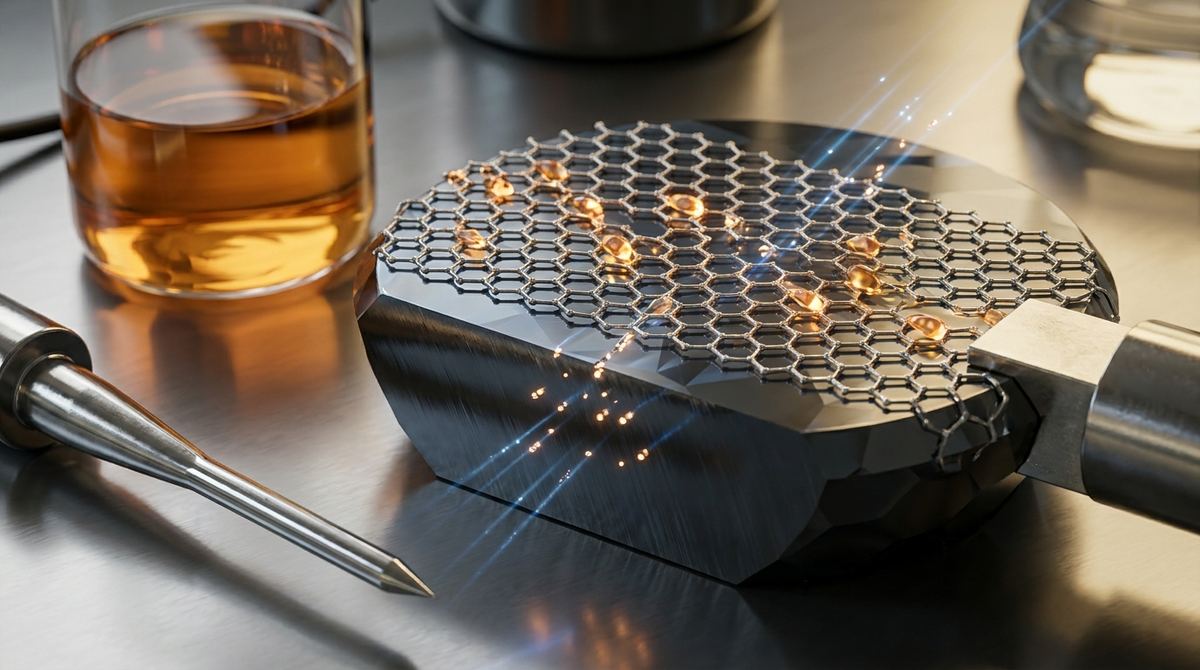
Graphene is a single layer of carbon atoms arranged in a hexagonal lattice. It is famous for its incredible electrical conductivity and high carrier mobility, meaning electrons can move through it with very little resistance. By introducing graphene into the detector architecture, the researchers aim to create a more robust interface that helps manage the flow of charges and mitigates the impact of the defects created by X-ray irradiation. The goal is to ensure that even as the silicon carbide lattice suffers damage, the ability of the detector to collect charge remains stable and predictable over time.
How the Graphene-Based System Works
To appreciate how this works, we have to look at the chemistry and physics of the silicon carbide (SiC) and graphene interface. Silicon carbide is a wide-bandgap semiconductor. This means it requires more energy to move an electron from the valence band to the conduction band than it does in silicon. This property is exactly why SiC is used in radiation-hard environments; it is naturally more resistant to being disrupted by high-energy particles. However, even SiC is not immune to the displacement damage mentioned earlier.
When graphene is applied to the surface or as an interface in a SiC detector, it changes the electrical landscape of the device. In a standard detector, the contact between the semiconductor and the metal electrode can be a source of high resistance or "dead layers" where charges are lost before they can be counted. Graphene, due to its unique electronic structure and high surface-to-volume ratio, creates a highly conductive, transparent, and chemically stable interface.
When an X-ray hits the SiC, the resulting electron-hole pairs move through the crystal toward the electrode. The presence of the graphene layer helps optimize the extraction of these charges. Because graphene has such high carrier mobility, it can act as a highly efficient collector that minimizes the time charges spend lingering near the surface where they might otherwise be trapped by surface defects. Furthermore, the graphene layer can help passivate the surface of the silicon carbide, essentially "plugging" some of the chemical instabilities that occur when the crystal lattice is disrupted by radiation. This combination of high-speed charge transport and surface stabilization is what allows the Charge Collection Efficiency to remain consistent even as the internal lattice of the SiC undergoes radiation-induced changes.
What the Researchers Found
In this specific study, the research team investigated the performance of this optimized SiC detector under 160 keV X-ray irradiation. The choice of 160 keV is significant because it represents a high-energy regime that is capable of inducing meaningful displacement damage in the semiconductor lattice. The researchers focused on the stability of the Charge Collection Efficiency (CCE), which is the primary metric for a detector's health.
The findings indicated that the graphene-optimized SiC detector exhibited a remarkable level of stability in its charge collection. While any semiconductor will show some level of change under intense radiation, the graphene-enhanced version managed to maintain its CCE much more effectively than traditional configurations. The data suggests that the graphene layer plays a crucial role in ensuring that the electrical response of the detector remains predictable. By minimizing the impact of the defects created by the 160 keV X-rays, the researchers demonstrated that graphene can act as a buffer, protecting the functional integrity of the charge collection process. This stability is a critical metric, as it means the detector's sensitivity remains constant, allowing for much more accurate and reproducible measurements in high-radiation environments.
Why the Result Matters
The implications of this research are profound for several high-stakes industries. First, in the field of medical imaging, such as CT scans, precision is paramount. If a detector's efficiency drifts during a procedure or over the lifespan of the machine, the resulting images could be inaccurate, potentially leading to misdiagnosis. A detector that remains stable under the constant flux of X-rays ensures consistent diagnostic quality.
Second, in space exploration, reliability is a matter of mission success. Satellites and deep-space probes are subjected to constant bombardment by high-energy particles and X-rays. Every gram of weight and every component must be able to withstand these conditions for years without failing. A radiation-hardened detector that uses graphene to maintain efficiency could significantly extend the operational lifespan of space missions.
Finally, in industrial non-destructive testing, X-rays are used to inspect the internal integrity of aircraft turbines, pipelines, and structural components. These environments can be harsh, and the detectors used must be capable of providing high-resolution, consistent data over thousands of hours of operation. The stability provided by graphene optimization offers a pathway toward more robust and dependable industrial inspection tools.
Limitations and What Still Needs Testing
While these results are highly encouraging, it is important to approach them with scientific caution. The study focused on a specific energy level of 160 keV. While this is a useful benchmark, it does not tell us how the detector will behave across the entire X-ray spectrum. X-rays can range from very low energies to extremely high energies, and the type of damage caused (photoelectric effect versus Compton scattering) changes depending on the energy level.
Furthermore, the research was conducted in a controlled laboratory setting. Real-world applications often involve complex variables, such as temperature fluctuations, varying humidity, and mixed radiation fields (where X-rays are accompanied by neutrons or protons). While the graphene-SiC system shows great promise, further testing is required to see how this stability holds up in these multifaceted environments. Additionally, the scalability of the graphene application—meaning the ability to manufacture large-scale, uniform graphene layers over SiC wafers in a cost-effective way—remains a significant engineering challenge that must be addressed before commercial deployment.
Real-World Applications
The potential applications for graphene-optimized SiC detectors are vast. In the medical sector, we can envision next-generation X-ray imaging systems that require less frequent calibration and offer higher precision in high-dose environments. This could lead to better imaging of dense tissues or more efficient scans.
In the aerospace sector, these detectors could be integrated into the next generation of orbital observatories, allowing for longer and more accurate observations of high-energy cosmic phenomena. They could also serve as critical components in the radiation monitoring systems of spacecraft, providing real-time, stable data on the radiation environment.
In the industrial sector, the technology could be used in high-energy X-ray inspection lines for manufacturing. As industries move toward more automated and precise quality control, the demand for detectors that do not degrade over time will only increase. Graphene-optimized SiC could become the standard for high-reliability, high-sensitivity industrial sensing.
If You Remember One Thing
If you take away only one point from this research, let it be this: graphene is not just a "magic material" for electronics; it is a powerful tool for stabilizing semiconductor performance in the most punishing environments. By using graphene to optimize silicon carbide, scientists are finding a way to make X-ray detectors that remain accurate and reliable even when they are being bombarded by high-energy radiation.
FAQ
What is the primary benefit of using silicon carbide over standard silicon in radiation environments?
Silicon carbide is a wide-bandgap semiconductor, which means it can withstand higher temperatures and is naturally more resistant to the displacement damage caused by high-energy particles. This makes it much more robust for use in high-radiation environments where standard silicon would fail quickly.
How does graphene actually help the detector stay stable?
Graphene helps in two main ways: it provides a highly conductive interface that improves the collection of charges, and it helps stabilize the surface of the semiconductor. This prevents the charge carriers from getting stuck in "traps" created by radiation damage, thereby maintaining a consistent signal.
What exactly is Charge Collection Efficiency (CCE)?
Charge Collection Efficiency is a measurement of how many charge carriers (electrons and holes) created by an incoming X-ray actually reach the detector's electrodes. If the CCE is high, the detector is performing well. If it is low, it means many charges are being lost, usually because they are getting stuck in defects in the material.
Why was 160 keV X-ray radiation used in this study?
The 160 keV energy level was chosen because it is high enough to cause significant displacement damage to the silicon carbide crystal lattice. This allows researchers to simulate the kind of radiation stress that a detector would face in a real-world, high-radiation environment, providing a rigorous test of the graphene's stabilizing effects.
Is this technology ready to be used in hospitals or spacecraft today?
Not quite yet. While the research shows excellent stability in a laboratory setting, there are still many hurdles to clear. These include testing the detector across a wider range of radiation energies, ensuring it works in diverse environmental conditions like extreme heat or vacuum, and developing efficient ways to mass-produce these graphene-SiC components.
Conclusion
The research conducted by Yingjie Huang and their team represents a significant step forward in the field of radiation-hardened instrumentation. By merging the inherent toughness of silicon carbide with the extraordinary electrical properties of graphene, they have demonstrated a method to stabilize charge collection efficiency under intense X-ray irradiation. As we push the boundaries of medical imaging, space exploration, and industrial inspection, the ability to create sensors that can withstand and adapt to harsh radiation environments will be essential. The marriage of wide-bandgap semiconductors and 2D materials like graphene may well be the key to the next generation of high-precision, high-reliability sensing technology.