
Dynamically Characterizing the Structures of Dirac Points via Wave Packets
Researchers use localized wave packets to dynamically map the complex topological structures of Dirac points, paving the way for next-generation quantum electronics.
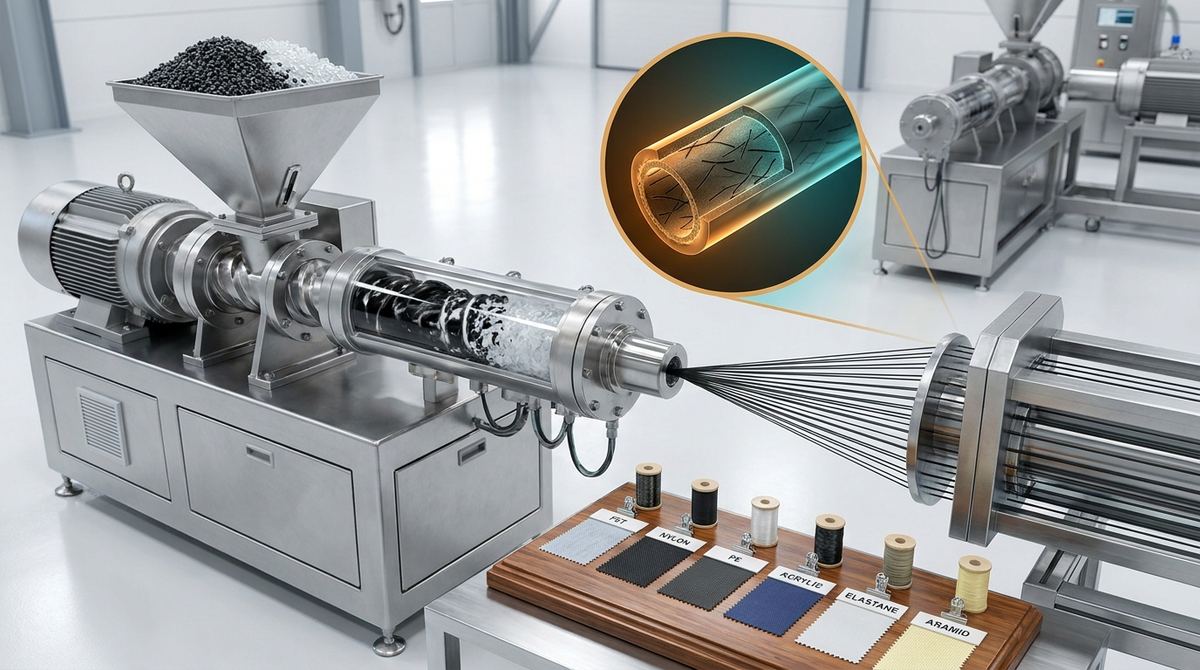
Graphene-enhanced synthetic fibers are often described as if the graphene can simply be sprinkled into any polymer and turned into a better yarn. In real manufacturing, the value comes from the masterbatch process. A graphene masterbatch is a concentrated pellet, chip, or compound in which graphene nanoplatelets, graphene oxide, reduced graphene oxide, or another graphene-family material is dispersed into a carrier polymer before it reaches the spinning line.
That intermediate step matters because fiber spinning is unforgiving. A spinneret hole may be only tens or hundreds of microns wide. A small agglomerate can raise filter pressure, break filaments, create weak points, or produce uneven dyeing and handle. Graphene also changes melt viscosity, crystallization, color, thermal behavior, and electrical behavior. The goal is not to add as much graphene as possible. The goal is to add the right graphene grade, at the right loading, in the right carrier, with dispersion good enough that the yarn still spins, draws, textures, knits, weaves, and finishes reliably.
Synthetic fibers are a major industrial target because they dominate modern textile volume. Textile Exchange describes synthetics as fibers made through chemical processes and notes that synthetic fibers represented 64 percent of global fiber production in 2021, with polyester as the largest individual fiber category. SONGWON, writing from the textile-additives side, identifies polyester, polyamide or nylon, acrylic, and polyolefin fibers as the four dominant synthetic groups, with uses across apparel, home furnishings, automotive, filtration, medical, marine, construction, electronics, and protective products.
For graphene suppliers and textile manufacturers, that creates a practical question: which fiber families are realistic candidates for graphene masterbatch, and what benefit should the buyer expect? The answer depends heavily on polymer chemistry and end use.
The usual route begins with graphene selection. Few-layer graphene nanoplatelets may be preferred when the goal is mechanical reinforcement, thermal conductivity, antistatic behavior, or a darker conductive yarn. Graphene oxide can disperse more easily in polar systems, but its oxygen content, thermal stability, moisture behavior, and reduction requirements must be matched to the polymer and processing temperature. Reduced graphene oxide can improve conductivity compared with graphene oxide, but it still needs careful dispersion and compatibility work. In textiles, the best material is rarely the most exotic sheet. It is the grade that survives compounding, feeds consistently, and produces repeatable fiber properties.
The next step is compounding. Graphene is usually mixed with a compatible carrier polymer in a twin-screw extruder. The compounder controls feed rate, screw design, residence time, temperature profile, venting, melt filtration, and pelletizing. The carrier is normally the same polymer as the final fiber, such as PET masterbatch for polyester, PA6 masterbatch for nylon 6, or PP masterbatch for polypropylene. In some systems, compatibilizers are used to improve wetting and interfacial adhesion. Examples include maleic-anhydride-grafted polyolefins for PP or PE, functionalized graphene for polyamides and polyesters, and elastomer-compatible carriers for TPU or spandex-related systems.
The masterbatch is then diluted, or let down, on the fiber spinning line. Instead of feeding dry graphene powder directly into the spinning extruder, the operator doses a measured amount of graphene masterbatch into virgin or recycled polymer chips. This is easier to meter, cleaner to handle, and more compatible with existing production controls. The melt passes through filtration and a spin pack, exits the spinneret, is quenched, drawn, sometimes heat-set, and then wound, textured, cut into staple, or converted into nonwoven web.
A useful research benchmark is melt-spun polyamide 6 yarn with graphene. In an open-access study on melt- and wet-spinning graphene-polymer nanocomposite fibers, researchers reported polyamide 6 yarn containing 1 wt% graphene prepared through graphene-polyamide masterbatch and melt spinning, with pilot-scale winding velocities up to 1,400 m/min. That does not mean every nylon plant can copy the result directly. It does show why masterbatch is industrially relevant: the graphene is introduced through a process family already familiar to fiber producers.
The quality checks should be treated as part of the product, not as paperwork at the end. A serious graphene-fiber program should track graphene grade, moisture, ash, surface chemistry, particle-size distribution, masterbatch loading, pellet uniformity, melt-flow behavior, filter pressure rise, filament breaks, tenacity, elongation, modulus, denier variation, wash durability, abrasion, color, hand feel, and any claimed functional property. If the benefit is antistatic behavior, measure surface or volume resistivity under relevant humidity. If the benefit is UV shielding, run accelerated exposure. If the benefit is thermal comfort, define the test method before the sales claim is written.
Graphene can contribute several useful functions to synthetic fibers, but the improvement is not automatic. The most common target benefits are electrical conductivity or antistatic performance, thermal management, UV shielding, infrared absorption or emission behavior, mechanical reinforcement, dimensional stability, abrasion resistance, barrier behavior, flame-retardant synergy, and sometimes antimicrobial surface effects when graphene is combined with the right chemistry and test conditions.
Electrical behavior is the clearest functional story. A connected graphene or hybrid carbon network can reduce resistivity and make a polymer fiber useful for antistatic textiles, sensing yarns, heating elements, shielding layers, or smart-fabric electrodes. The difficult part is percolation. Below the percolation threshold, the material may remain effectively insulating. Above it, conductivity improves but viscosity, color, brittleness, spinning stability, and yarn handle may suffer.
Thermal behavior is also important. Graphene can help spread heat through a polymer matrix, alter infrared response, and improve thermal stability in selected systems. That can support heated textiles, cooling-touch yarns, thermal-interface fabrics, protective layers, and outdoor materials. But thermal comfort in a garment is not the same as thermal conductivity in a pellet. Fabric construction, fiber fineness, moisture transport, coating, finish, air permeability, and wearer conditions all matter.
Mechanical reinforcement is plausible but not guaranteed. Graphene has excellent intrinsic mechanical properties, yet those properties only help the fiber if the sheets are dispersed, oriented, bonded to the polymer, and present at a loading that does not damage drawability. Poor dispersion can reduce tenacity even when modulus improves. This is especially important for apparel yarns where softness, elongation, dyeability, and processing speed matter as much as headline strength.
Antimicrobial and odor-control claims deserve caution. Graphene-family materials have been studied for antimicrobial effects, and commercial graphene textiles sometimes market antibacterial or deodorizing performance. In a finished synthetic fiber, however, the actual result depends on graphene chemistry, surface exposure, additives, wash durability, test organism, fabric construction, and regulatory claims. Manufacturers should test to the relevant textile and medical standards rather than relying on a generic graphene label.
Polyester is the largest target for graphene masterbatch because PET is the most widely used synthetic fiber and is already produced through high-volume melt spinning. PET fibers are used in apparel, fleece, sewing thread, fiberfill, carpets, seat belts, tire cord, industrial yarn, nonwovens, geotextiles, filtration media, and packaging-related textile structures. PET is also well suited to additive masterbatch systems because dope dyeing, delustering, flame retardants, UV stabilizers, and other modifiers are already part of the industrial toolkit.
Graphene-PET masterbatch is attractive for antistatic apparel, dark technical yarns, UV-blocking outdoor fabrics, heated textiles, automotive interiors, EMI shielding layers, filtration supports, and industrial belts or reinforcement fabrics. The main benefits to pursue are conductivity, thermal spreading, UV resistance, abrasion improvement, and possible modulus gains. The biggest processing risks are moisture control, intrinsic-viscosity loss, agglomeration, spinneret pressure, color limitation, and loss of elongation at higher loading.
PBT and PTT are smaller polyester-family opportunities. PBT fibers and monofilaments appear in technical textiles, brushes, filtration, and specialty applications where resilience and chemical resistance matter. PTT is valued for elastic recovery and soft hand in carpets and apparel. Graphene may be useful when the target is antistatic behavior, thermal response, or dimensional stability, but these polymers need separate trials because their crystallization and drawing behavior differ from PET.
Nylon, or polyamide, includes PA6, PA66, PA11, PA12, and specialty copolyamides. Nylon fibers are used in hosiery, activewear, swimwear, lingerie, upholstery, carpets, ropes, nets, parachutes, fishing line, tire reinforcement, airbags, seat belts, brushes, and sutures. Polyamides are tougher and more moisture-sensitive than polyester, and their amide chemistry gives them a different interaction profile with graphene-family materials.
Graphene masterbatch in PA6 or PA66 is a strong candidate for conductive yarns, wearable electrodes, antistatic carpets, heated textiles, abrasion-resistant performance fabrics, technical ropes, filtration supports, and smart textiles. The PA6 supercapacitor-yarn study shows that graphene-polyamide melt spinning can be technically feasible at pilot scale. That makes nylon one of the most credible families for functional graphene fibers.
The engineering challenge is balancing conductivity and yarn strength. Polyamide absorbs moisture, and moisture affects both processing and end-use properties. Drying, masterbatch storage, melt temperature, residence time, and draw ratio all need control. If the application is a smart textile, the designer must also consider connector durability, bending fatigue, laundering, skin contact, and whether conductivity remains stable after repeated mechanical cycling.
Polyolefin fibers include polypropylene, polyethylene, and high-performance ultra-high-molecular-weight polyethylene. PP is used in carpets, upholstery, ropes, nets, geotextiles, disposable nonwovens, hygiene products, filtration, automotive textiles, concrete reinforcement fibers, packaging, and outdoor fabrics. PE is used in cordage, webbing, nonwovens, protective textiles, and specialty fibers. UHMWPE fibers are used in high-strength ropes, cut-resistant gloves, ballistic textiles, fishing line, medical devices, and lightweight composites.
Polypropylene is a good graphene-masterbatch target because it is inexpensive, low density, chemically resistant, and widely melt processed. Graphene can be pursued for antistatic nonwovens, conductive geotextiles, filtration media, thermal management, odor-control concepts, automotive interiors, concrete fibers, and packaging textiles. Research on graphene nanoplatelet PP fibers has reported that low graphene loadings can be incorporated by melt spinning, with thermal-stability benefits and changes in crystallization and mechanical behavior. The practical message is that PP can accept graphene, but loading and dispersion must be tuned carefully.
Polyethylene and UHMWPE are more specialized. Conventional PE can use graphene for antistatic and thermal functions, but adhesion and dispersion are difficult because the polymer is nonpolar. UHMWPE is often gel-spun rather than ordinary melt-spun, so the integration route is different. In high-strength protective fibers, even a small loss of drawability or molecular orientation can erase the value of the additive. Graphene may still be useful in coatings, hybrid yarns, sheath-core structures, or composite laminates, but it should not be treated as a simple drop-in masterbatch case.
Acrylic fiber is made primarily from acrylonitrile and is used as a wool-like fiber in sweaters, fleece, blankets, socks, pile fabrics, upholstery, and filters. Modacrylic is used in flame-resistant clothing, artificial fur, children’s sleepwear, wigs, tents, and protective blends. These fibers are usually solution-spun rather than melt-spun, so the word masterbatch must be used carefully. The equivalent concept is often a dispersion concentrate or dope additive rather than a pelletized melt-spinning masterbatch.
Graphene can be relevant for acrylic and modacrylic when the target is antistatic behavior, heat absorption, UV protection, filtration, flame-retardant synergy, or electrically active fabrics. In acrylic-like systems, graphene dispersion in the spinning dope and compatibility with solvent, coagulation, washing, stretching, and drying steps become central. For modacrylic, the flame-resistant baseline chemistry is already valuable; graphene should be evaluated as part of a full flame, smoke, toxicity, hand-feel, and durability package rather than as a standalone upgrade.
Elastane, also known as spandex or Lycra-type fiber, is a segmented polyurethane fiber used in stretch apparel, compression garments, swimwear, socks, waistbands, intimate apparel, medical compression, sportswear, and elastic tapes. TPU fibers and films are also used in laminates, footwear, inflatable structures, coated fabrics, wearable devices, and flexible industrial textiles.
Graphene can add value here when stretch and electrical function must coexist. Potential applications include strain-sensing yarns, heated compression garments, flexible electrodes, antistatic elastic bands, thermal-management sportswear, and wearable medical textiles. The key problem is not initial conductivity. It is conductivity under repeated strain. A graphene network that looks good at rest may crack, slide, or lose percolation after stretching, laundering, sweat exposure, and abrasion. For elastane systems, test cycling is more important than a single tensile or resistivity measurement.
Vinyl-family fibers include PVC/vinyon, PVDC/saran-type fibers, and PVA/vinal or vinylon. Their markets are smaller than polyester and nylon but still relevant in rainwear, awnings, tarps, industrial fabrics, filters, ropes, fishing nets, protective textiles, artificial leather structures, and specialty chemical-resistant fabrics. Some are chosen because of flame behavior, chemical resistance, weatherability, or low moisture uptake.
Graphene may be useful in these fibers for antistatic behavior, barrier improvement, thermal response, UV shielding, and reinforcement. The compatibility issues vary widely. PVC processing is sensitive to heat stability and plasticizer systems. PVDC has barrier advantages but processing and sustainability concerns. PVA-based fibers are more polar and may interact differently with graphene oxide. For these materials, the additive package must be engineered with stabilizers, plasticizers, flame retardants, and processing aids rather than treated as a simple graphene-only formula.
High-performance fibers include meta-aramid, para-aramid, PBI, PBO, PPS, polyimide, PEEK, PEI, liquid-crystal polyester, PTFE, PVDF, and related engineering polymers. These materials are used in protective clothing, hot-gas filtration, aerospace composites, ballistic fabrics, cut-resistant products, belts, hoses, cables, electrical insulation, membranes, chemical filtration, battery separators, medical devices, and extreme-temperature fabrics.
Graphene can be considered for electrical conductivity, heat spreading, EMI shielding, flame-retardant synergy, wear resistance, sensing, and composite interlaminar performance. But these are not the easiest masterbatch targets. Many high-performance fibers are solution-spun, gel-spun, dry-jet wet-spun, or processed at temperatures where graphene chemistry, polymer degradation, and equipment wear become serious concerns. In aramids, PBI, PBO, and similar fibers, surface coating, interfacial treatment, hybrid yarn construction, or resin-matrix reinforcement may be more practical than trying to force graphene into the original spinning dope.
Engineering thermoplastics such as PPS, PEEK, PEI, PVDF, and some liquid-crystal polymers are more plausible for masterbatch-style compounding because they can be melt processed, but the processing window is narrow and the cost of trial failure is higher. These are best pursued for high-value technical textiles, not commodity apparel.
Biosynthetics and biodegradable polymers include PLA, PHA, PBS, PCL, PGA, and bio-based versions of familiar polymers such as bio-PET or bio-PA. Textile Exchange separates biosynthetics as wholly or partly derived from renewable sources, while melt-spinning literature includes several biodegradable polymers that can form fibers under the right conditions.
Graphene can be explored in PLA and related fibers for antistatic packaging textiles, filtration, agricultural textiles, medical scaffolds, thermal stability, UV response, and mechanical tuning. However, sustainability claims need discipline. Adding graphene to a biodegradable polymer may change compostability, recyclability, color, toxicity profile, sorting behavior, and certification options. A graphene-PLA fiber may be technically useful, but it should not be marketed as automatically greener without end-of-life testing.
Rayon, viscose, modal, lyocell, acetate, triacetate, cupro, and alginate are often grouped with man-made fibers, but they are not synthetic in the same sense as PET, nylon, or PP. They are chemically processed from cellulose or other natural feedstocks. They matter commercially because they are major textile materials and can be combined with graphene, but the integration route is usually solution chemistry, coating, padding, printing, or dope modification rather than a standard thermoplastic masterbatch.
Graphene can support conductive viscose blends, antimicrobial finishes, UV-blocking cellulosics, filtration media, thermal fabrics, and smart textiles. The main concern is durability. A graphene coating that performs before laundering may not perform after repeated wash cycles unless it is chemically anchored or protected by the fabric construction. For these fibers, the buyer should ask whether graphene is inside the filament, on the surface, in a binder, or simply applied as a finish.
Polyester/PET: best for high-volume graphene masterbatch, antistatic apparel, UV-blocking outdoor fabrics, heated textiles, automotive interiors, filtration, geotextiles, industrial yarns, and reinforcement fabrics.
PBT/PTT/PEN: best for specialty polyester fibers where resilience, chemical resistance, elastic recovery, or higher thermal performance matters. Graphene targets include antistatic behavior, dimensional stability, and thermal management.
Nylon/PA6/PA66/PA11/PA12: best for smart textiles, conductive yarns, wear-resistant fabrics, carpets, ropes, nets, technical apparel, and flexible electrodes. Graphene targets include conductivity, abrasion resistance, thermal response, and sensing.
Polypropylene: best for nonwovens, carpets, geotextiles, automotive fabrics, concrete fibers, filtration, ropes, and packaging textiles. Graphene targets include antistatic performance, thermal stability, modulus tuning, UV shielding, and conductive technical fabrics.
Polyethylene and UHMWPE: best for ropes, ballistic textiles, cut-resistant gloves, fishing line, medical devices, and lightweight composites. Graphene is more likely to succeed through hybrid structures, coatings, or carefully engineered concentrates than ordinary commodity masterbatch.
Acrylic and modacrylic: best for wool-like garments, blankets, pile fabrics, filters, flame-resistant clothing, artificial fur, and tents. Graphene targets include antistatic behavior, heat response, filtration, UV protection, and flame-retardant synergy.
Elastane and TPU: best for stretch fabrics, compression garments, wearable sensors, flexible electrodes, coated fabrics, footwear, and laminates. Graphene targets include stretchable conductivity, heating, sensing, and thermal comfort.
PVC, PVDC, PVA, and related vinyl fibers: best for awnings, rainwear, tarps, nets, chemical-resistant fabrics, artificial leather structures, and barrier textiles. Graphene targets include antistatic behavior, barrier performance, UV shielding, and durability.
Aramids, PBI, PBO, PPS, PI, PEEK, PEI, LCP, PTFE, and PVDF: best for protective clothing, filtration, aerospace, electrical insulation, membranes, batteries, cables, composites, and extreme-service textiles. Graphene targets include EMI shielding, sensing, heat spreading, wear resistance, and interfacial reinforcement.
PLA, PHA, PBS, PCL, PGA, and bio-based synthetic fibers: best for packaging, agricultural textiles, medical scaffolds, absorbable sutures, filters, and lower-impact textile concepts. Graphene targets include antistatic behavior, mechanical tuning, UV response, and thermal stability, with end-of-life testing required.
Manufacturers should start with the application, not the additive. A polyester T-shirt, a nylon sensor yarn, a PP concrete fiber, a UHMWPE cut-resistant glove, and a PEEK hot-gas filtration fabric do not need the same graphene, loading, carrier, or test plan. The masterbatch route is strongest when the polymer is melt-spun at scale and the target property can survive dilution, spinning, drawing, finishing, and real use.
For commodity fibers, the commercial question is whether graphene creates enough permanent functionality to justify extra material cost, compounding cost, darker color, quality control, and production risk. Antistatic performance, heating, sensing, filtration, and technical durability are better targets than vague “stronger fabric” claims. For specialty fibers, the question is whether graphene can add a function that the high-performance polymer does not already provide.
The best development sequence is simple. Define one target property. Choose a compatible graphene grade and carrier polymer. Compound a high-quality masterbatch. Run let-down trials at several low loadings. Measure spin stability before celebrating lab properties. Test the finished yarn and fabric, not just the pellet. Then repeat after dyeing, finishing, washing, abrasion, UV exposure, and flexing.
Graphene can make synthetic fibers more functional, but the winning product will not be sold by the word graphene alone. It will be sold by a repeatable masterbatch, a stable spinning window, a measurable property improvement, and a clear end-use case.
Serious about B2B integration? Test our premium Pulsed Electrical Resistive Carbon Heating turbostratic graphene in your lab. 100g sample packs available now.
Explore More
Researchers use localized wave packets to dynamically map the complex topological structures of Dirac points, paving the way for next-generation quantum electronics.

Learn how to use MoOx and ZnOx overlayers to stabilize and tune graphene plasmonic responses for infrared nanophotonic applications.

TITLE: Decoding Graphene's High-Frequency Vibrations: Bernstein Modes and Harmonic Saturation EXCEPTED: An exploration of Miguel Tierz's research into the complex wave patterns and energy limits of el