TITLE: Decoding Graphene's High-Frequency Vibrations: Bernstein Modes and Harmonic Saturation
EXCEPTED: An exploration of Miguel Tierz's research into the complex wave patterns and energy limits of electron oscillations in graphene under magnetic fields.
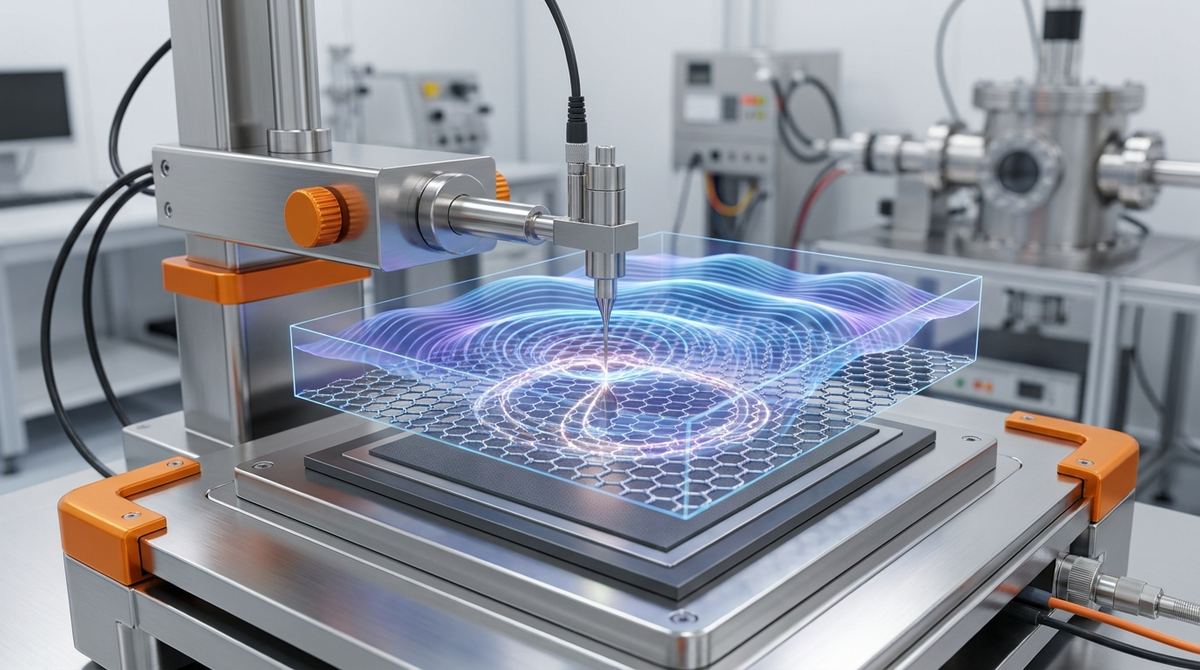
IMAGE_PROMPT: A cinematic, high-resolution scientific visualization of a graphene lattice structure. Glowing blue and purple electrons are moving in intricate, swirling circular and wavy patterns within a hexagonal grid. The background is a dark, deep-space aesthetic with subtle light refractions to represent electromagnetic waves and magnetic field lines. 16:9 aspect ratio, hyper-realistic, scientific illustration style.
The future of high-speed communication and ultra-sensitive detection depends on our ability to master the movement of electrons at the most fundamental level. As we move beyond the limitations of silicon-based transistors, scientists are turning to graphene, a single layer of carbon atoms, to unlock new ways of processing information. However, to use graphene effectively, we must understand the complex ways electrons dance when they are subjected to magnetic fields and light. This research dives into the physics of these dances, specifically a phenomenon known as Bernstein modes, which could dictate the speed and efficiency of the next generation of electronic devices.
The Problem This Research Is Solving
Current semiconductor technology is facing a physical wall. As we attempt to make electronic components faster and smaller, the signals we use to transmit information begin to encounter significant interference and energy loss. In traditional silicon, electrons behave like a heavy gas, and managing their high-frequency responses is a constant struggle for engineers. When we move into the realm of extremely high frequencies, such as the terahertz range, the traditional way we think about electronic signals breaks down. We need materials that can operate at these speeds without losing control of the electron movement.
This is where graphene becomes essential, but it brings its own set of complex problems. Because graphene is a two-dimensional material, its electrons behave very differently than those in three-dimensional silicon. When you apply a magnetic field to graphene, the electrons do not simply flow in a straight line; they are forced into circular orbits known as cyclotron motion. This motion is the basis for many advanced electronic functions, but it is not a simple, smooth circle. As the frequency of the electromagnetic waves interacting with the graphene increases, the electrons begin to exhibit complex, non-linear oscillations. These oscillations can cause signal noise, unexpected harmonic interference, and energy saturation, where increasing the power does not result in a proportional increase in signal strength. Without a mathematical and physical understanding of these patterns, engineers cannot design reliable graphene-based high-frequency devices.
The Key Idea in Plain English
To understand this research, imagine a playground merry-go-round. If you push it at a steady pace, it spins predictably. This steady spin is like the regular movement of electrons in a magnetic field. However, if you start pushing it in a rhythm that matches or is a multiple of its spinning speed, the whole machine might start to wobble or vibrate in strange, rhythmic ways. These wobbles are what physicists call Bernstein modes. They are essentially extra waves that appear because the electron's circular motion is being interrupted by external forces.
Miguel Tierz's research focuses on these wobbles. Specifically, the study looks at how these vibrations interact with one another—what happens when one wobble triggers another, creating a complex structure of different frequencies, or harmonics. The research also looks at saturation. Using the merry-go-round analogy, saturation is the point where you keep pushing harder and harder, but the wobbles stop getting larger because the system has reached a limit. Understanding exactly when this limit occurs and how the different rhythms interact is the key to making sure that a future graphene device, like a super-fast computer chip, doesn't just vibrate uncontrollably when it receives a signal.
How the Graphene-Based System Works
The physics of graphene is unique because its electrons behave as if they have no mass. In a standard conductor, electrons have a certain inertia that dictates how they react to forces. In graphene, the unique hexagonal lattice structure creates a phenomenon where electrons move at incredibly high speeds, following a linear relationship between their energy and their momentum. This is often described using the Dirac equation, the same equation used to describe particles moving near the speed of light.
When a magnetic field is applied to this graphene sheet, the Lorentz force acts on these massless electrons, forcing them into a circular path. This is the cyclotron resonance. However, the interaction becomes much more interesting when an external electromagnetic field is introduced. These fields provide energy to the electrons, and if the frequency of the external field relates to the frequency of the circular motion in a specific way—specifically in integer ratios—the electrons enter into resonance.
This resonance triggers the Bernstein modes. These are longitudinal plasma oscillations that occur when the electron's motion is driven strongly. Unlike simple circular motion, these modes are complex waves that propagate through the electron gas. The interaction is driven by the non-linear nature of the electron movement. Because the electrons are being pushed both by the magnetic field and the external wave, they don't just follow one single path; they create a series of harmonics. These harmonics are essentially "echoes" of the original frequency, occurring at multiples of the fundamental cyclotron frequency. The interplay between these harmonics and the original motion creates the inter-harmonic ratio structure that the research explores.
What the Researchers Found
The research conducted by Miguel Tierz provides a deep dive into the mathematical and physical structure of these inter-harmonic ratios. The study demonstrates that the way these Bernstein modes are distributed is not random but follows a specific, predictable structure based on the intensity of the driving force and the strength of the magnetic field. This is a critical finding because it proves that the complex "wobbles" of electrons are not just chaotic noise, but structured phenomena that can be modeled and eventually controlled.
One of the most significant findings involves the concept of saturation. The research shows that as the intensity of the external driving field increases, the amplitude of the Bernstein modes does not grow infinitely. Instead, the modes reach a state of saturation. This means that there is a fundamental limit to how much energy can be absorbed or converted by these specific oscillations. The study details how the structure of the harmonics changes as the system approaches this saturation point. Understanding this threshold is vital for anyone trying to design devices that operate in the high-frequency or high-power regime. By knowing the saturation point, engineers can determine the optimal operating range for a device to ensure maximum signal clarity and minimal energy loss.
Why the Result Matters
The implications of this research are profound for the field of high-speed electronics. As we move toward the Terahertz gap—the frequency range between traditional radio waves and infrared light—graphene stands out as a premier candidate for device materials. Current technology struggles to bridge this gap, but graphene's ability to support high-frequency oscillations makes it a potential game-changer for ultra-fast wireless communication, advanced radar systems, and incredibly fast signal processing.
Understanding the inter-harmonic structure allows for the design of more precise filters and oscillators. If we know exactly which frequencies the electrons will "wobble" at, we can design circuits that avoid those specific frequencies to prevent interference, or we can design circuits that specifically exploit those frequencies to create new types of signals. Furthermore, the knowledge of saturation limits allows for the development of more efficient power amplifiers. In high-frequency communication, knowing when a signal will saturate is the difference between a clear, high-speed connection and a distorted, useless one. This research provides the theoretical roadmap needed to turn graphene from a laboratory curiosity into a reliable component in the global electronics supply chain.
Limitations and What Still Needs Testing
While this research is a significant step forward, it is important to recognize that these findings are primarily theoretical and mathematical. The study provides a high-level understanding of the physics, but it does not involve a physical, manufactured graphene device that has been tested in a commercial laboratory setting. There is a significant gap between modeling the behavior of electrons in a perfect theoretical lattice and managing them in a real-world device that contains defects, impurities, and thermal noise.
Future testing will be essential to see how these Bernstein modes behave in practical applications. Real-world graphene is rarely "perfect." It often contains structural defects, such as vacancies or grain boundaries, which can scatter electrons and dampen the oscillations described in the research. Additionally, temperature plays a massive role; these quantum effects are often most visible at extremely low temperatures, but for practical use, we need to know how these Bernstein modes behave at room temperature. Scientists will need to conduct extensive experimental work to validate these theoretical models in various physical environments before any commercial application can be realized.
Real-World Applications
The practical applications of understanding Bernstein modes in graphene are vast. One primary area is in the development of Terahertz technology. Terahertz waves are used in non-destructive testing, such as scanning through packaging to find defects without opening it, and in high-resolution medical imaging. Graphene-based sensors that can precisely manage these oscillations could lead to much faster and more accurate imaging tools.
Another critical application is in the field of ultra-high-speed communication. As we move toward 6G and beyond, the demand for higher frequency bands increases. Graphene-based transistors and oscillators that are designed with an understanding of harmonic saturation could enable data transfer speeds that are orders of magnitude faster than current 5G technology. Additionally, the precision offered by controlling these electron modes could lead to much more sensitive detectors for astrophysical research or deep-space communication, where detecting extremely faint signals is paramount.
If You Remember One Thing
If you take away only one concept from this research, let it be this: the movement of electrons in graphene is not just a simple flow of current; it is a complex, rhythmic dance of waves that can be precisely modeled and controlled. Understanding the limits and the patterns of these waves is the key to unlocking the next era of ultra-fast, high-frequency technology.
FAQ
What exactly is a Bernstein mode in the context of graphene?
A Bernstein mode is a type of plasma oscillation that occurs when electrons are moving in a magnetic field and are also being pushed by an external electromagnetic wave. This happens specifically when the frequency of that external wave is a multiple of the electron's natural circular motion, known as the cyclotron frequency. Instead of just spinning in a circle, the electrons begin to oscillate in more complex ways.
Why is graphene better than silicon for high-frequency electronics?
Graphene's electrons behave as if they have no mass, which allows them to move much faster than electrons in traditional silicon. This high mobility is essential for devices that need to operate at extremely high frequencies, such as in the terahertz range. While silicon hits a physical limit in terms of how fast it can process signals, graphene offers a much wider playground for high-speed operation.
What does it mean when a signal "saturates"?
Saturation occurs when you increase the input power or the intensity of a signal, but the output or the response from the system stops increasing proportionally. In the case of graphene's Bernstein modes, it means the intensity of the electron's vibration reaches a maximum limit. For engineers, knowing this limit is vital so they don't try to push a device beyond its functional capacity.
How does the magnetic field affect the electrons in graphene?
When a magnetic field is applied to graphene, it exerts a Lorentz force on the moving electrons. This force pushes the electrons into a circular path, a movement called cyclotron motion. This circular movement is the foundation for many quantum effects and is what allows the Bernstein modes to exist when external waves interact with the system.
Is this research ready to be used in making new smartphones?
Not yet. This research is a fundamental scientific study that explains the underlying physics of how electrons behave. While these findings are essential for the engineers who will eventually build next-generation components, there is still a long road of experimental testing, material perfection, and device manufacturing required before these concepts can be used in consumer electronics.
Conclusion
The study by Miguel Tierz provides a crucial piece of the puzzle in the quest to master graphene. By uncovering the structured nature of Bernstein modes and the mechanics of their saturation, the research moves us closer to a world where high-frequency, high-speed electronics are no longer limited by the chaotic behavior of electrons. As we transition from theoretical physics to practical engineering, the ability to predict and control these complex electron oscillations will be the cornerstone of a new era in communication and sensing technology.