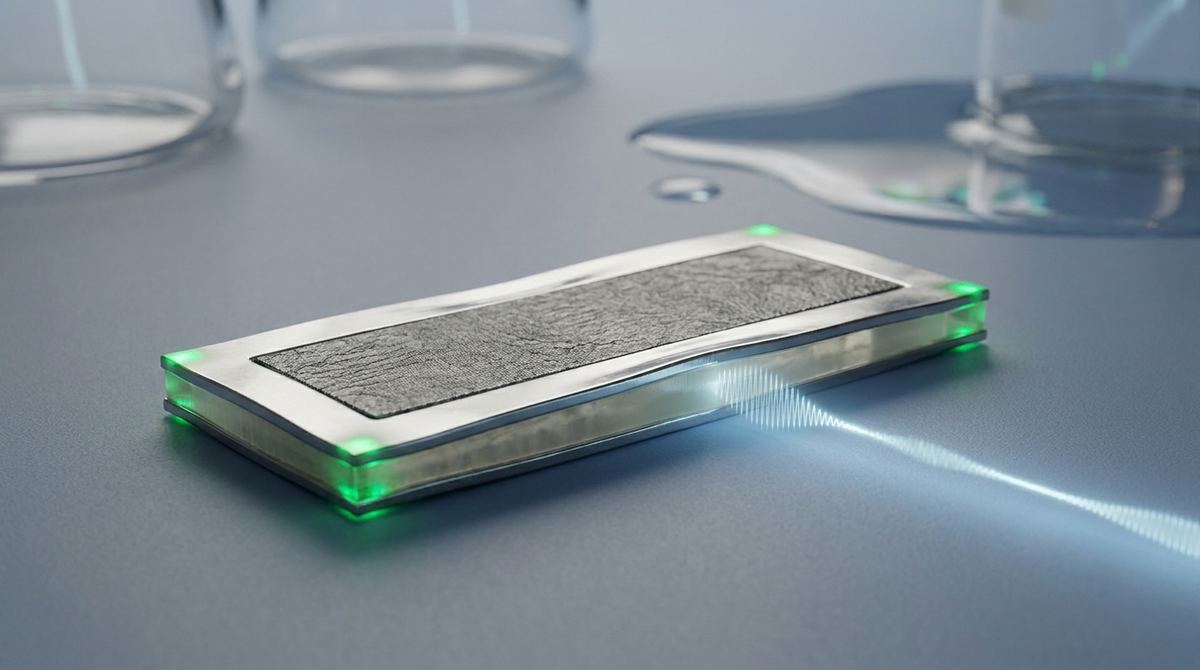
Imagine a material where electricity flows perfectly, but only along specific corners, while the rest of the surface remains a complete insulator. In standard electronics, as electrons move through a wire, they bump into atoms and impurities, creating heat and wasting energy. This resistance is the fundamental barrier to creating ultra-efficient computers. However, researchers are finding ways to use the laws of topology to create "protected" pathways for electrons, where the very shape of the electron's wave function prevents it from being scattered. This research, conducted by Yu-Wen Xu, Xiaolin Wan, Zi-Ming Wang, Rui Wang, and Dong-Hui Xu, explores a cutting-edge method to achieve this using a combination of mechanical stretching and light-driven pulses. By precisely controlling how graphene is strained and how it interacts with light, these scientists are opening a new door to a class of materials known as second-order topological insulators.
The Problem This Research Is Solving
The primary challenge in modern microelectronics is the heat wall. As transistors become smaller and more densely packed, the energy lost to electrical resistance increases significantly. This happens because electrons in traditional conductors are subject to scattering. When an electron encounters a defect in the crystal lattice or a vibrating atom, it changes direction and loses kinetic energy, which is released as heat. This heat limits how fast a processor can run and how small it can become without melting itself.
To solve this, scientists are looking toward topological insulators. A standard topological insulator is a material that acts as an insulator in its bulk—meaning electrons cannot move through the middle—but acts as a perfect conductor along its edges. This edge conduction is "topologically protected," meaning the electrons are essentially guided by the symmetry of the material, making them immune to the scattering that causes heat. However, traditional topological insulators usually only have these conductive paths on the edges (1D). This limits their utility for certain types of nano-scale circuit designs that require even more localized, zero-dimensional pathways.
The Key Idea in Plain English
The research focuses on a specific, more advanced version of this phenomenon called a second-order topological insulator. While a regular topological insulator has conductive edges, a second-order topological insulator is even more specialized. In these materials, both the bulk and the edges are insulators, meaning no electricity can flow through the middle or along the sides. Instead, the conduction is restricted entirely to the corners of the material. This provides an incredibly high degree of control over where electricity can and cannot go.
To create this specific state in graphene, the researchers utilize two distinct "tuning knobs." The first is mechanical strain, which involves physically stretching the graphene lattice. The second is Floquet engineering, which involves hitting the material with periodic light waves, such as laser pulses. By combining these two forces, the researchers can manipulate the electronic structure of graphene to force it into this unique, corner-conducting state.
How The Graphene-Based System Works
To understand how this works, we must first look at the structure of graphene. Graphene is a single layer of carbon atoms arranged in a perfect honeycomb lattice. The electrons in graphene behave like particles with no mass, moving according to the Dirac equation. These electrons exist in a state where their energy levels meet at specific points called Dirac points.
The researchers first apply mechanical strain to this lattice. When graphene is stretched, the distance between the carbon atoms changes. This change in distance affects the hopping integral, which is the mathematical probability of an electron jumping from one atom to the next. Because the stretching is not uniform, it creates an effective "pseudo-magnetic field." This field does not use actual magnets but instead mimics their effect by shifting the positions of the Dirac points in the momentum space.
The second layer of control is the Floquet drive. When a material is subjected to a periodic external force, such as an oscillating electromagnetic field from a laser, its electronic properties are redefined. This is known as Floquet engineering. The periodic light waves do not just add energy; they fundamentally reshape the Hamiltonian, which is the mathematical description of the system's energy. This "shaking" of the electrons allows us to create energy gaps in the electronic structure where they did not previously exist.
The magic happens when the strain and the Floquet drive work together. The strain breaks the original symmetry of the graphene lattice, while the Floquet drive breaks the time-reversal symmetry. When these two types of symmetry-breaking occur in a specific way, the electronic band structure undergoes a topological transition. The bulk of the graphene becomes an insulator because a gap is opened at the Dirac points. The edges also become insulating because the combined influence of strain and light prevents electron flow along the boundaries. However, due to the specific mathematical properties of the resulting state, a "topological charge" is concentrated at the corners. This forces the existence of highly localized, protected electronic states at those exact points.
What The Researchers Found
The study demonstrates that it is theoretically possible to transform ordinary graphene into a second-order topological insulator through the synergistic application of strain and Floquet driving. The researchers found that the specific pattern of the strain and the frequency/intensity of the light waves can be used to precisely dictate where the corner states appear.
Crucially, the research shows that the second-order topological phase is robust. This means that the corner-conducting states are not easily destroyed by minor imperfections in the graphene or slight fluctuations in the light frequency. The interplay between the pseudo-magnetic field created by the strain and the time-periodic modulation of the light creates a stable environment for these corner states to exist. This provides a theoretical roadmap for creating "tunable" topological materials, where the conductivity can be switched on or off or moved to different locations simply by adjusting the light or the tension applied to the material.
Why The Result Matters
This research is significant because it provides a level of control over electrons that was previously difficult to achieve in carbon-based materials. In most materials, electronic properties are "fixed" by the chemical composition. If you want to change how a material conducts, you usually have to change its chemical structure through doping or complex manufacturing.
By using Floquet engineering and strain, we move into the realm of "dynamic" material properties. We can change how a material behaves in real-time using light. The ability to create second-order topological insulators means we can design circuits that operate with almost zero energy loss at the corners, creating incredibly precise electrical switches or interconnects. This could lead to a paradigm shift in how we design nano-electronics, moving away from bulk conduction toward highly localized, corner-based conduction.
Limitations and What Still Needs Testing
While the theoretical foundations are robust, several hurdles remain before this can be used in a smartphone or a computer. First, implementing precise, controlled strain at the atomic scale is an immense engineering challenge. Maintaining a constant, uniform strain across a large-scale sheet of graphene is much harder than doing so in a controlled laboratory setting.
Second, Floquet engineering requires highly controlled, periodic external stimuli, often in the form of specialized lasers. Integrating a laser-driven mechanism into a compact electronic device is currently impractical. Furthermore, many topological effects are most clearly observed at extremely low temperatures, where thermal vibrations do not wash out the delicate quantum effects. Research is needed to determine if these second-order topological states can survive at room temperature, which is a requirement for any consumer-grade technology.
Real-World Applications
Despite the current limitations, the potential applications are vast. In the field of quantum computing, topological protection is essential. Quantum bits, or qubits, are notoriously fragile and easily disturbed by their environment. Using topological states to house information could create "topologically protected qubits" that are much more stable and less prone to errors.
In the realm of sensing, the extreme sensitivity of these corner states to external forces or light could be used to develop ultra-sensitive detectors. A sensor could detect a single molecule or a minute mechanical vibration by observing how it shifts the corner conduction in a graphene-based topological device. Additionally, the ability to control electron flow with light could lead to new types of optoelectronic devices, where light is used not just to provide energy, but to directly control the electrical logic of a circuit.
If You Remember One Thing
If you remember only one thing from this research, let it be this: we are learning how to use light and physical tension to "sculpt" the paths that electrons take through graphene, creating specialized corner-based highways that are nearly immune to energy loss.
FAQ
How does strain affect graphene?
When graphene is stretched, the physical distance between the carbon atoms changes. This change in distance alters how electrons move from one atom to another, effectively creating a pseudo-magnetic field that changes the electronic properties of the material without needing an actual magnet.
What is a Floquet insulator?
A Floquet insulator is a material whose electronic properties are changed by a periodic external force, like a laser. Instead of having static properties, the material's behavior is redefined by the rhythm and frequency of the light hitting it, allowing for new states of matter to emerge.
What is the difference between a regular and a second-order topological insulator?
A regular topological insulator has conductive paths along its edges, while a second-order topological insulator is an insulator on both its bulk and its edges, only allowing conduction at specific points, such as the corners.
Why is graphene such a good candidate for this?
Graphene is ideal because its electronic structure is highly sensitive to its environment. Its unique honeycomb lattice and the way its electrons behave like massless particles make it incredibly responsive to mechanical strain and light-driven modulation.
Can we use this in computers today?
Currently, no. This research is primarily in the theoretical and experimental physics stage. The technology requires highly precise control of strain and light, often at very low temperatures, which is not yet feasible for commercial consumer electronics.
Conclusion
This research points toward a practical lesson: graphene-based materials are most powerful when their nanoscale properties are connected to a clear engineering problem. The result is not a finished commercial product by itself, but it gives researchers and manufacturers a better map for designing lighter, more sensitive, or more durable systems. Future work still needs testing under real operating conditions, but the direction is promising because it joins materials science with application-driven design.