The Concept: Topological Strain Transduction
In standard sensor engineering, strain is measured by changes in electrical resistance (piezoresistivity) or changes in capacitance. While effective, these methods often suffer from signal noise and limited sensitivity in the micro-strain regime. This guide explores a more advanced approach: using a topological phase transition to create a digital-like sensor response.
Based on recent research by Liu, Wang, and Wu, we can exploit a specific phenomenon in AB-stacked bilayer graphene. When one layer of the bilayer is stretched uniaxially, the system undergoes a topological phase transition at a critical strain level of approximately 1.8 percent (s = 1.018). At this precise point, the electronic bands touch, the Chern number flips from 1 to -1, and the Berry-curvature dipole changes sign.
For an engineer, this means that instead of looking for a tiny change in resistance, you are looking for a massive, qualitative change in the nonlinear Hall effect. By applying a current to the graphene, the change in the Berry-curvature dipole will produce a measurable voltage that flips sign exactly when the critical strain is reached. This provides a highly sensitive, non-linear transduction mechanism that can be used for ultra-precise displacement or strain sensing.
What to Build: The Topological Strain Transducer
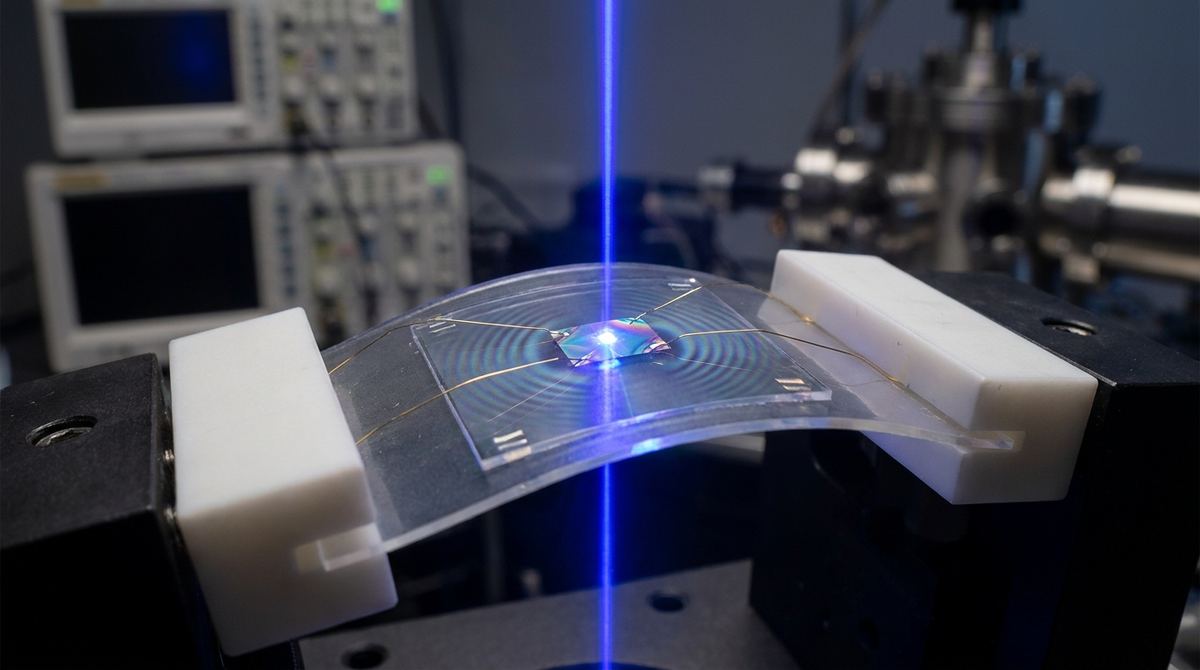
The goal is to build a prototype device consisting of a bilayer graphene heterostructure encapsulated in hexagonal Boron Nitride (hBN) and mounted on a flexible, stretchable substrate. This device will act as a transducer that converts mechanical uniaxial strain into a measurable nonlinear Hall voltage.
The device architecture will be a sandwich:
1. A flexible, stretchable substrate (the actuator).
2. A bottom layer of hBN for dielectric isolation.
3. The AB-stacked bilayer graphene (the active sensing element).
4. A top layer of hBN for protection and capacitance control.
5. Gold or Palladium electrodes for electrical contact.
Required Materials and Equipment
To build this prototype, you will need access to a cleanroom environment capable of micro-fabrication.
1. Bilayer Graphene: High-quality AB-stacked bilayer graphene. While exfoliated flakes are best for initial lab testing, CVD-grown bilayer graphene is necessary for any scalable startup application.
2. Hexagonal Boron Nitride (hBN): High-purity flakes for encapsulation. This is critical to maintain high carrier mobility and prevent environmental degradation.
3. Flexible Substrate: Polyimide (Kapton) is recommended for its thermal stability and mechanical toughness. For more extreme flexibility, PET (Polyethylene terephthalate) can be used.
4. Electrodes: Gold (Au) or Palladium (Pd) for low-resistance ohmic contacts.
5. Actuation System: A piezoelectric actuator or a precision micro-mechanical stretching stage capable of applying controlled uniaxial strain.
6. Measurement Equipment: A high-precision lock-in amplifier (essential for detecting the nonlinear Hall effect) and a low-noise source meter.
Prototype Fabrication Steps
The following steps assume a standard van der Waals heterostructure assembly process.
1. Substrate Preparation: Clean the polyimide substrate using oxygen plasma to improve the adhesion of the hBN layer.
2. Bottom Encapsulation: Transfer a thin layer of hBN onto the substrate using a dry-transfer method. This layer should be approximately 20 to 30 nanometers thick.
3. Graphene Deposition: Carefully transfer the AB-stacked bilayer graphene onto the hBN. This is the most critical step. The layers must be perfectly aligned in AB-stacking to ensure the topological properties described in the continuum model are preserved.
4. Electrode Patterning: Use electron-beam lithography (EBL) to define the contact areas. Deposit the gold/palladium electrodes via thermal evaporation.
5. Top Encapsulation: Transfer a final layer of hBN over the graphene to seal the device. This protects the graphene from atmospheric moisture and provides a uniform dielectric environment.
6. Actuator Integration: Mount the entire stack onto a uniaxial stretching device. The device must be capable of applying strain in a single direction (the x-direction) to match the model requirements.
Test Plan and Signal Detection
Testing this device requires moving beyond standard DC measurements. The nonlinear Hall effect is a second-order response.
1. Baseline Characterization: Apply a small AC current to the device at zero strain. Measure the standard Hall voltage to ensure the device is electrically sound and the carrier density is within the expected range (typically 10^11 to 10^12 cm^-2).
2. Incremental Strain Application: Slowly increase the uniaxial strain in increments of 0.1 percent.
3. Nonlinear Hall Detection: Use a lock-in amplifier to measure the second-harmonic voltage (2f) in response to an AC current (f). The nonlinear Hall voltage is proportional to the Berry-curvature dipole.
4. Identifying the Transition: Monitor the 2f signal as you approach the 1.8 percent strain mark. According to the research, you should observe a dramatic change in the magnitude and, most importantly, a sign flip in the voltage as the Chern number transitions from 1 to -1.
5. Hysteresis Check: Repeat the strain cycles (stretching and relaxing) to ensure the device returns to its original state without mechanical degradation or permanent lattice dislocation.
Engineering Assumptions and Risks
It is vital to distinguish between the theoretical model and the physical prototype.
Assumption 1: The research assumes a perfect continuum model where strain is perfectly uniaxial and uniform across the entire flake. In a real-world prototype, strain gradients will exist. This is an engineering assumption that the device will still function, though the transition may be "smeared" over a range of strain values rather than occurring at a single point.
Assumption 2: The research assumes the AB-stacking is maintained. In practice, applying 1.8 percent strain can cause the graphene layers to slip or undergo a structural phase transition to a different stacking order.
Risk 1: Mechanical Failure. 1.8 percent strain is significant for a multilayer heterostructure. There is a high risk of the hBN/graphene/hBN stack delaminating from the polyimide substrate or the graphene itself tearing.
Risk 2: Thermal Noise. Topological effects are often sensitive to temperature. While the research does not specify a temperature, many topological phenomena are most pronounced at cryogenic temperatures. For a practical sensor, you must determine if the signal-to-noise ratio is sufficient at room temperature.
Risk 3: Fabrication Complexity. The requirement for hBN encapsulation and precise EBL patterning makes this a high-cost prototype. This is not a device for a hobbyist maker but rather a specialized component for high-end metrology or quantum sensing startups.
Summary of Source Basis
This guide is based on the theoretical findings of Liu, Wang, and Wu (2026) regarding the continuum model for uniaxially strained bilayer graphene. The core physics—specifically the link between uniaxial strain, the Berry-curvature dipole, and the topological phase transition—is taken directly from their research. The practical implementation steps, material choices, and testing methodologies are engineering projections intended to translate these theoretical physics findings into a functional device architecture.