
Practical Guide: Engineering Tunable Infrared Plasmonic Modulators using Oxide-Graphene Heterostructures
Learn how to use MoOx and ZnOx overlayers to stabilize and tune graphene plasmonic responses for infrared nanophotonic applications.
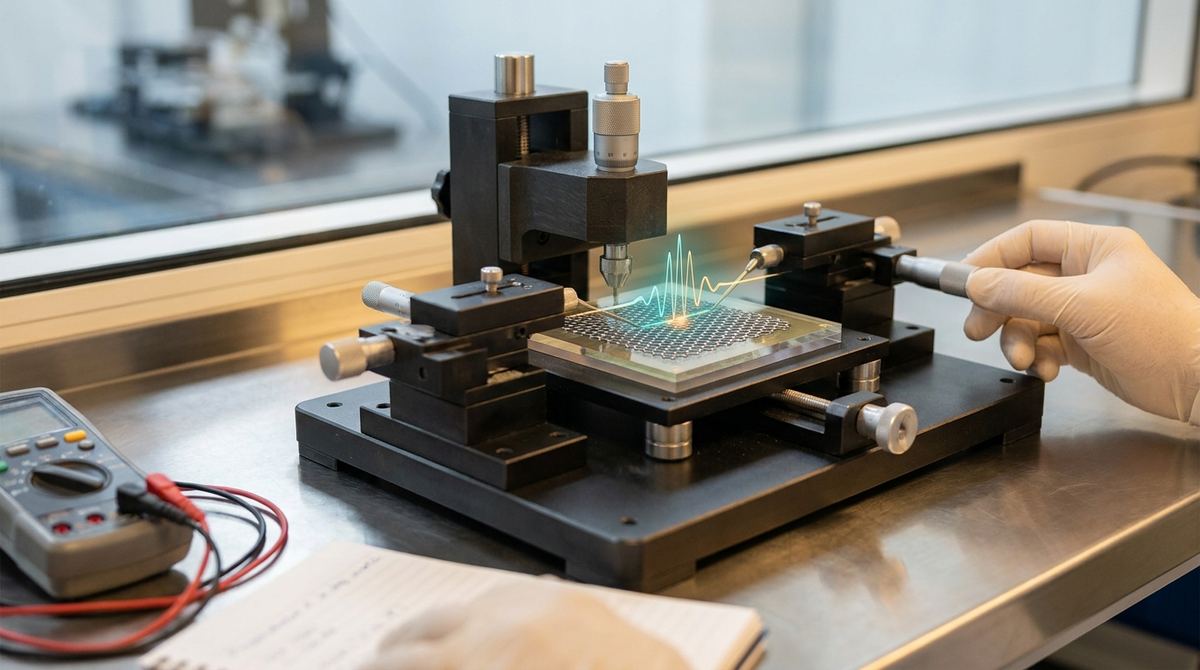
Imagine a world where electricity does not flow like water through a pipe, prone to splashing against the sides and losing energy through friction. Instead, imagine electrons moving like beams of light, gliding through a material with incredible speed and zero resistance, seemingly ignoring the imperfections that would stop a normal particle. This is the extraordinary reality found in certain advanced materials like graphene. At the heart of this phenomenon are special regions known as Dirac points, where the very rules of classical physics seem to bend. For years, scientists have struggled to truly see what happens inside these points as they move. In a groundbreaking theoretical study, Dan-Dan Liang, Xin Shen, and Zhi Li have proposed a way to use quantum wave packets to finally capture the dynamic behavior of these critical points, offering a new lens through which to view the fundamental nature of electronic motion.
In the realm of condensed matter physics, particularly within the subfield of mesoscopic physics, researchers are obsessed with how electrons behave in two-dimensional structures. In materials like graphene, the electrons do not behave like standard particles with mass. Instead, they behave like massless Dirac fermions. This means their energy is directly proportional to their momentum, a relationship that creates a distinctive cone-shaped structure in momentum space. At the very tip of these cones are the Dirac points.
The problem is that these Dirac points are not just static coordinates. They possess a complex mathematical property known as Berry curvature, which acts like a synthetic magnetic field in momentum space. This curvature dictates how electrons turn, accelerate, and move through the lattice. Traditionally, scientists have approached these points using static measurements. They take a snapshot of the energy levels, essentially a still photograph of a moving target. While these snapshots are useful, they fail to capture the "twist" or the geometric phase that an electron acquires as it moves through a Dirac point. If we want to build the next generation of quantum computers or ultra-fast transistors, we cannot rely on still photographs; we need to understand the complete, dynamic motion of the electron as it navigates these topological landscapes.
To solve this, the researchers turned to a concept from quantum mechanics called the wave packet. In the standard view of physics, we often treat particles as points or waves that extend infinitely through space. However, a wave packet is a localized bundle of waves. Think of it like a single, concentrated pulse of energy moving through a medium. Because a wave packet is localized, it has a specific position and a specific momentum.
By using a wave packet instead of a single, infinite wave, researchers can simulate how a "real" particle would experience the environment of a Dirac point. As this packet travels through the material, it interacts with the Berry curvature—the "twist" mentioned earlier. This interaction causes the wave packet to behave in very specific, measurable ways. By observing how the packet's path bends or how its internal phase changes, we can work backward to map out the exact structure of the Dirac point. It is much like dropping a small, floating cork into a swirling whirlpool; by watching how the cork wobbles and circles, you can determine the shape and strength of the underwater currents without ever seeing the currents themselves.
To understand how this works, we have to look at the relationship between the structure of the material and the movement of the electron. In graphene, the carbon atoms are arranged in a perfect hexagonal lattice. This lattice creates a periodic potential that dictates where an electron can and cannot exist. This is where the concept of the Brillouin zone comes in. The Brillouin zone is a mathematical tool used to describe the patterns of these electrons in momentum space.
The research explores the semiclassical equations of motion for these electrons. In a normal material, an electron moves based on the forces applied to it by an electric or magnetic field. However, in a material with Dirac points, a new term appears in the equations. This term is the Berry curvature. The Berry curvature exerts a force on the wave packet that is perpendicular to its velocity, much like a magnetic field exerts a Lorentz force on a moving charge.
The researchers' method involves calculating how the center of the wave packet evolves over time as it passes through the region of high Berry curvature. This evolution is not just a simple straight line. The Berry curvature causes a transverse shift in the packet's trajectory, often referred to as the anomalous velocity. Furthermore, the internal structure of the wave packet—its phase and its width—also changes. By mathematically modeling the interaction between the packet's momentum and the Berry curvature at the Dirac point, the researchers established a way to link the observed motion directly to the underlying topological structure of the material.
The study by Liang, Shen, and Li provides a rigorous framework for this dynamic characterization. They demonstrated that the evolution of a wave packet is not just a byproduct of the material's structure, but a direct carrier of its topological information. Specifically, they found that the way a wave packet responds to the Dirac point allows for the extraction of the Berry curvature's properties without requiring the complex, static calculations that have historically been necessary.
One of the most significant findings is that the dynamic approach can distinguish between different types of Dirac points. Not all Dirac points are created equal; some may have different topological "charges" or twists. The research shows that a wave packet's motion is sensitive enough to identify these differences. This means that if a material has a slight defect or a specific chemical doping that alters the Dirac point, the wave packet's path will change in a predictable, quantifiable way. This transforms the wave packet from a simple particle into a high-precision probe for quantum geometry.
This research is vital because it bridges the gap between abstract mathematical theory and practical material science. The ability to characterize Dirac points dynamically has profound implications for the development of "topological electronics." In traditional electronics, as you make components smaller and faster, electrons collide with defects and impurities, creating heat and signal loss. This is the "bottleneck" of modern computing.
However, materials that possess topological protection—driven by the physics of Dirac points—allow electrons to flow in ways that are mathematically forbidden from scattering backward. This is known as "topological protection." If we can use the methods proposed by Liang, Shen, and Li to perfectly map and engineer these points, we can design materials where electrons move with nearly perfect efficiency. This would lead to a revolution in power consumption, allowing for devices that stay cool even at extremely high processing speeds. Furthermore, it provides a roadmap for the development of topological insulators, which are materials that are insulators on their surface but conductors in their interior, a property entirely dependent on the precise structure of their Dirac points.
While the theoretical framework provided by the researchers is robust, it is important to note that this work is largely computational and theoretical. Moving from a mathematical model to a laboratory setting is a massive leap. Currently, it is extremely difficult to create an experimental setup that can probe a single, localized wave packet in momentum space with enough precision to verify these findings.
Most current measurement techniques, such as Angle-Resolved Photoemission Spectroscopy (ARPES), provide excellent data but still primarily focus on the static energy-momentum relationship rather than the real-time dynamic evolution of a single wave packet. Additionally, real-world materials are never perfect; they contain thermal noise, lattice vibrations (phonons), and unintended impurities. Future research will need to determine how much "noise" these systems can tolerate before the wave packet's signal is lost. The next step for the scientific community is to develop ultra-fast, high-resolution spectroscopic techniques that can actually "track" these packets in a way that matches the predictions made by Liang, Shen, and Li.
The long-term implications of this research extend into several high-tech industries. In the field of quantum computing, the ability to manipulate and understand the Berry curvature is essential for creating "topological qubits." These qubits would be significantly more stable than current versions, as their quantum information would be protected by the very geometry of the material, making them immune to the decoherence that plagues current systems.
In the consumer electronics sector, this research could eventually lead to the development of "zero-heat" processors. As transistors reach the limits of silicon-based physics, graphene and other 2D materials become the primary candidates for future computing. A processor that utilizes the lossless motion of electrons near Dirac points would drastically reduce the energy requirements of data centers, which currently consume a significant portion of the world's electricity. Finally, in the realm of sensing, the sensitivity of wave packets to local topological changes could enable a new generation of sensors capable of detecting incredibly minute changes in electromagnetic fields or chemical concentrations at the atomic scale.
If you take away only one concept from this research, let it be this: the shape and "twist" of a material's electronic landscape, known as the Berry curvature, dictates how electrons move, and by using localized wave packets, we can finally begin to map that landscape in motion, unlocking the potential for incredibly fast and efficient quantum electronics.
What is a Dirac point? A Dirac point is a specific location in a material like graphene where the electronic energy levels meet in a way that makes electrons behave as if they have no mass. This allows them to travel at very high speeds, which is essential for high-performance electronics.
Why is it hard to study these points? It is difficult because these points are not just static locations; they have a complex geometric "twist" called Berry curvature. Standard methods often only provide a still image of the material, whereas we need to see how electrons move through the twist in real-time.
What is a wave packet in this context? A wave packet is a small, concentrated bundle of quantum energy. Instead of looking at a single, infinite wave, scientists use these bundles to act like tiny probes that can travel through a material to reveal its hidden structures.
How does this affect everyday technology? While this research is currently theoretical, it provides the blueprint for future technologies. This includes faster computers that do not get hot and more stable quantum computers that can perform complex calculations without errors.
What is Berry curvature? Berry curvature is a mathematical property that describes how the quantum state of an electron changes as it moves through a crystal lattice. In practical terms, it acts like an invisible magnetic force that pushes electrons in specific directions.
The work of Dan-Dan Liang, Xin Shen, and Zhi Li represents a significant step forward in our quest to master the quantum world. By shifting the focus from static snapshots to the dynamic evolution of wave packets, they have provided a powerful new way to characterize the topological heart of materials like graphene. As we move toward an era defined by quantum technologies and ultra-efficient electronics, understanding the intricate dance of electrons at Dirac points will be the key to unlocking the next great leap in human engineering.
Serious about B2B integration? Test our premium Pulsed Electrical Resistive Carbon Heating turbostratic graphene in your lab. 100g sample packs available now.
Explore More
Learn how to use MoOx and ZnOx overlayers to stabilize and tune graphene plasmonic responses for infrared nanophotonic applications.

TITLE: Decoding Graphene's High-Frequency Vibrations: Bernstein Modes and Harmonic Saturation EXCEPTED: An exploration of Miguel Tierz's research into the complex wave patterns and energy limits of el

Discover how scientists are using geometric engineering to create photonic graphene, a breakthrough that allows us to manipulate light with the same precision used in advanced electronics.