
Graphene-Silicon Modulator Unlocks High-Speed Data at New Wavelengths
Explore a breakthrough graphene-silicon slot-waveguide modulator. This high-speed device operates at both 1.5 μm and 2 μm, promising next-gen optical networks.
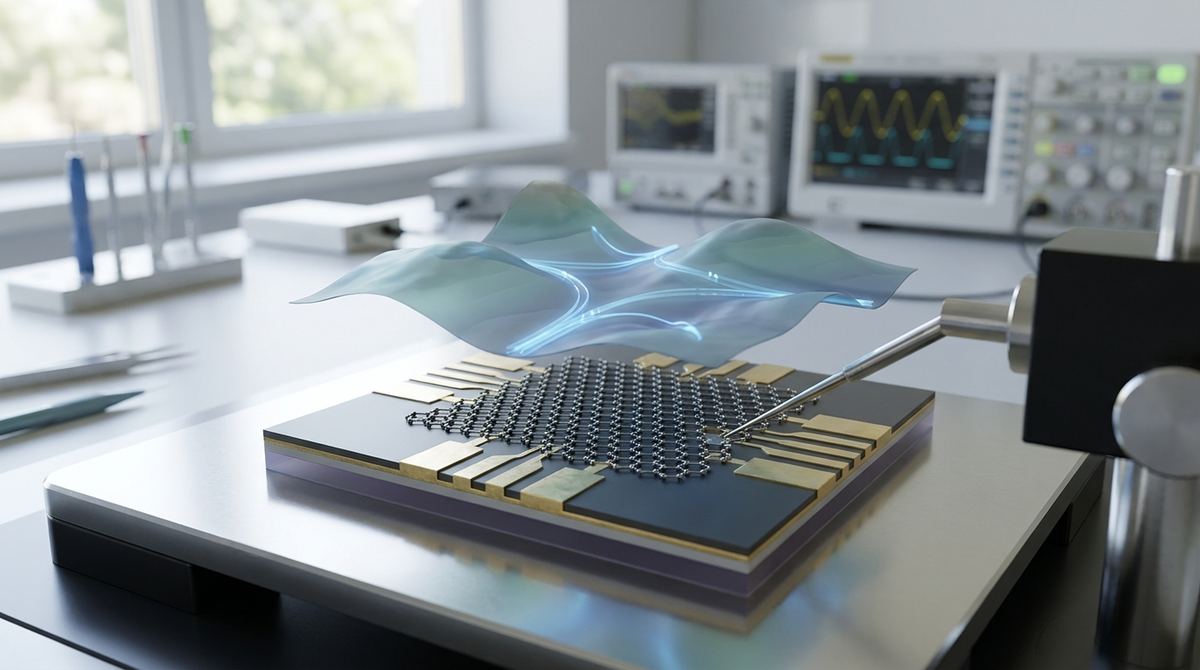
Imagine a material that does not just conduct electricity without resistance, but one that possesses a controllable internal "handedness." In the world of quantum physics, certain materials can enter a state where the electrons do not just flow, but they swirl in a specific direction, much like a whirlpool in a stream. This is known as chiral superconductivity. For decades, scientists have searched for ways to control these exotic quantum states, as they hold the key to creating incredibly stable quantum computers. Recent breakthroughs have moved us closer to this goal by demonstrating that we can reconfigure these states using external controls. This groundbreaking work, conducted by Surajit Dutta, Nadav Auerbach, Tonghang Han, Yaozhang Zhou, Gal Shavit, Niladri-Sekhar Kander, Yuri Myasoedov, Martin E. Huber, Kenji Watanabe, Takashi Taniguchi, Long Ju, and Eli Zeldov, has opened a new door into the realm of tunable quantum matter.
The pursuit of practical quantum computing faces a massive obstacle known as decoherence. In a standard quantum computer, information is stored in quantum bits, or qubits. These qubits are notoriously fragile; even the slightest vibration, temperature change, or electromagnetic interference can cause the quantum information to leak away into the environment. This process destroys the calculation before it can be completed. To solve this, physicists are looking toward topological superconductivity.
Topological states of matter are special because their properties are protected by the fundamental geometry and symmetry of the material's electronic structure. If you store information in a topological state, the information is "braided" into the very fabric of the system, making it much harder for local noise to disrupt it. However, a major problem has always been that most superconducting materials are static. Once a material is cooled to a certain temperature and enters a superconducting state, its fundamental properties are fixed by its chemical composition. If the material is a standard superconductor, it stays a standard superconductor. If it is a topological superconductor, it stays topological. Engineers have lacked a "knob" to turn to switch between these states or to tune the specific properties of the quantum state once the material is inside a device. Without this ability to reconfigure the superconductivity, building a scalable, flexible quantum architecture remains a monumental challenge.
To understand this research, we must first understand what makes a superconductor "chiral." In a normal superconductor, electrons pair up to move through a lattice without friction. These pairs, called Cooper pairs, are usually symmetric. However, in a chiral superconductor, the electrons pair up in a way that breaks time-reversal symmetry. This means the material essentially has a preferred direction of rotation—it has a "handedness" like a screw or a spiral.
The revolutionary idea presented in this research is reconfigurability. Instead of being stuck with one type of superconductivity, the researchers have explored how to use external forces to change the very nature of these electron pairs. By applying an external stimulus, such as an electric field or a magnetic field, they can force the material to transition from a simple, non-chiral superconducting state into a sophisticated, chiral state. This is akin to having a material that can switch from being a simple conductor to a complex, swirling quantum engine simply by adjusting a voltage. This level of control is the "holy grail" for quantum engineers who need to create and manipulate specific quantum states on demand within a circuit.
The mechanism behind this reconfigurability lies in the unique architecture of van der Waals heterostructures. These are layered materials, often including graphene or other two-dimensional crystals, that are stacked like sheets of paper. Because these layers are held together by weak forces rather than strong chemical bonds, they allow for incredible control over the electronic environment.
The researchers utilize the field-effect principle, which is the same principle used in modern transistors. By placing a thin insulating layer above a conducting layer and applying a voltage to a nearby electrode, an electric field is created. In bulk metals, this field can only penetrate a tiny distance into the surface. However, in the ultra-thin, two-dimensional layers used in these studies, the electric field can penetrate the entire thickness of the material.
This field effect allows for precise control over the carrier density—the number of electrons or "holes" available to form Cooper pairs. When the density of these charge carriers is tuned, the Fermi level of the material shifts. The Fermi level is essentially the energy level up to which electrons are filled. The specific energy level at which electrons are moving determines how they interact and pair up. By shifting this level, the researchers can change the symmetry of the superconducting order parameter. As the density changes, the energy landscape of the electrons shifts from one that favors standard, symmetric pairing to one that favors a winding, chiral phase. This transition is a direct cause-and-effect relationship: the electrical input changes the charge density, which changes the electronic structure, which ultimately reconfigures the fundamental symmetry of the superconductivity.
The study provides evidence that the superconducting state is not a static destination but a tunable landscape. The researchers observed that by manipulating the external parameters, they could drive the system through a phase transition. This transition is marked by the emergence of chirality.
Specifically, the research highlights how the system can be pushed into a state where the superconducting wavefunction carries a non-zero angular momentum. In simpler terms, the electrons begin to exhibit a collective, swirling motion that breaks time-reversal symmetry. This discovery is significant because it proves that the topological nature of the superconductivity is not a fixed property of the material's chemistry alone, but a property that can be engineered through external electrical or magnetic means. The findings suggest that we can create a system where the "topology" of the superconductivity—the way the electrons are mathematically and physically organized—can be switched on or off at will. This confirms that the topological protection required for quantum computing is not just a theoretical possibility but a controllable reality in layered material systems.
The implications of reconfigurable chiral superconductivity are profound for the future of information technology. First, it provides a pathway toward fault-tolerant quantum computing. If we can create topological superconductors on demand, we can create Majorana zero modes. These are quasiparticles that act as their own anti-particles and can be used to store quantum information in a way that is immune to the local noise and thermal fluctuations that plague current systems.
Second, this research paves the way for a new class of "quantum electronic" devices. Traditional electronics rely on the presence or absence of charge to represent bits. A reconfigurable superconductor could use the "handedness" or the "phase" of the superconducting state to represent information. This could lead to ultra-fast, ultra-low-power switches and logic gates that operate at much higher speeds than current silicon-based technology.
Finally, this research advances our fundamental understanding of condensed matter physics. It demonstrates that the distinction between different states of matter is more fluid than previously thought. By showing that we can bridge the gap between trivial and topological states through external tuning, we gain a deeper understanding of how symmetry, topology, and electron interaction compete and cooperate in the quantum realm.
While these results are a major step forward, there are significant hurdles to overcome before this technology reaches a commercial product. The most prominent limitation is the extreme environment required for these effects to manifest. Currently, these phenomena are observed at temperatures near absolute zero, typically in the millikelvin range. At these temperatures, the thermal energy is low enough that it does not wash out the delicate quantum effects. For practical, large-scale applications, particularly in consumer electronics, we need to find ways to achieve similar reconfigurability at much higher temperatures, perhaps even near room temperature.
Additionally, the precision required to tune these materials is immense. The ability to control the carrier density via a gate voltage requires extremely high-quality, defect-free materials. Any impurities or structural defects in the crystal lattice can act as "pinning centers" that disrupt the swirling motion of the chiral electrons, effectively destroying the very state the researchers are trying to create. Finally, the scalability of van der Waals heterostructures remains a challenge. While we can make small, perfect samples in a laboratory using specialized equipment, manufacturing large-area, uniform sheets of these complex stacks for industrial use is a massive engineering feat that has yet to be mastered.
The potential real-world applications of this research are transformative. In the realm of computing, we anticipate the development of topological quantum processors. These would be the backbone of a new era of supercomputing, capable of simulating complex molecular structures for drug discovery, optimizing global logistics, and cracking encryption codes that are currently impossible for classical computers to solve.
In the field of sensing, reconfigurable chiral superconductors could lead to a new generation of magnetometers. Because these materials are extremely sensitive to the magnetic environment and the phase of their superconducting state, they could be used to detect the tiniest fluctuations in magnetic fields. This could revolutionize medical imaging, allowing for much higher resolution brain scans via magnetoencephalography, or improve the detection of mineral deposits and subterranean structures.
Furthermore, the ability to switch superconducting states could lead to highly efficient power management components in specialized scientific instruments. As we move toward a world of hyper-connected quantum sensors, the ability to tune material properties on the fly will be essential for creating adaptive, intelligent hardware.
If you remember only one thing from this research, let it be this: we have discovered that the fundamental symmetry of superconductivity can be controlled by an external stimulus, allowing us to switch between standard and topological states.
How does chirality relate to superconductivity?
In a standard superconductor, electrons form pairs that move through a material without resistance, and these pairs are typically symmetric. In chiral superconductivity, the electron pairs possess a specific rotational direction or "handedness." This means the superconducting state itself has a sense of direction, which breaks the fundamental symmetry known as time-reversal symmetry.
Why is reconfigurability important for quantum computers?
Quantum computers require very specific quantum states to perform calculations reliably. Currently, many materials are static, meaning their quantum properties are locked in once the material is made. Reconfigurability allows engineers to use an external control, like a voltage, to turn on or tune the specific quantum properties needed for a calculation, making the system much more flexible and capable.
What is a van der Waals heterostructure?
A van der Waals heterostructure is a man-made material created by stacking different layers of two-dimensional materials, like graphene or hexagonal boron nitride, on top of one another. Because these layers are held together by weak forces rather than strong chemical bonds, they can be precisely controlled and stacked to create entirely new properties that do not exist in any single material.
Can this technology work at room temperature?
Currently, the research is conducted at extremely low temperatures, close to absolute zero, to prevent thermal energy from disrupting the delicate quantum states. While the potential for high-temperature applications is a major goal for the future, we are currently a long way from seeing these specific chiral effects in room-temperature devices.
What is the role of the electric field in this process?
The electric field is used as a tuning tool. By applying a voltage to a gate electrode, an electric field is generated that penetrates the thin, two-dimensional layers of the material. This field changes the density of the electrons in the material. Changing the electron density shifts the material's energy levels, which can trigger a transition from a simple superconducting state to a complex, chiral one.
The research conducted by the team, including Surajit Dutta, Nadav Auerbach, and Eli Zeldov, represents a landmark shift in how we perceive and control quantum matter. By proving that chiral superconductivity can be reconfigured, they have provided a vital blueprint for the development of topological quantum technologies. While the path from laboratory discovery to commercial quantum processors is filled with engineering challenges—such as temperature requirements and material purity—the ability to control the fundamental symmetry of a superconductor marks a defining moment in the evolution of condensed matter physics and the future of quantum information science.
Serious about B2B integration? Test our premium Pulsed Electrical Resistive Carbon Heating turbostratic graphene in your lab. 100g sample packs available now.
Explore More
Explore a breakthrough graphene-silicon slot-waveguide modulator. This high-speed device operates at both 1.5 μm and 2 μm, promising next-gen optical networks.

New research reveals that mechanical strain doesn't just reduce but fundamentally reshapes heat flow in graphene, a critical insight for flexible...

Learn to build a gate reflectometry sensor using bilayer graphene. This practical guide details a non-contact method for material characterization.