
Interaction-driven transport in a non-degenerate mixture of Dirac and massive
Researchers explore interaction-driven transport in graphene, where massless Dirac fermions can drag massive particles, creating a current without direct...
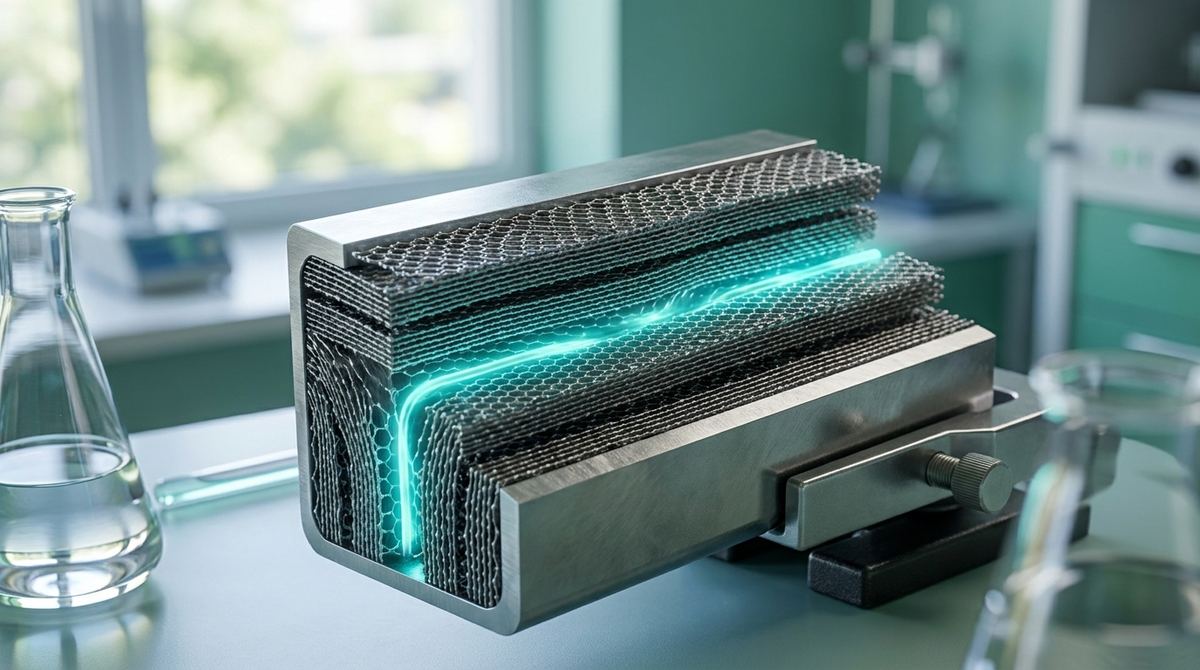
Imagine a crowded ballroom where everyone is dancing at different speeds. It is difficult to coordinate a complex, synchronized movement when some dancers are sprinting and others are barely shuffling. In the world of quantum physics, electrons act much like these dancers. To create stable, predictable quantum computers or incredibly efficient electronic circuits, scientists want these electrons to move in a very specific, synchronized way. Currently, one of the most promising ways to achieve this is by using special arrangements of graphene, a single layer of carbon atoms, stacked on top of one another. However, there is a catch. The way these atoms settle into their resting positions can fundamentally change how the electrons behave. Recent research has revealed that a subtle process called lattice relaxation—the way atoms shift slightly to find a more stable energy state—is actually the secret ingredient that flattens the energy bands of these materials, potentially unlocking the next generation of quantum technologies.
In the pursuit of advanced quantum technologies, scientists have turned their attention to a specific type of carbon structure known as rhombohedral graphene. Unlike the standard stacking pattern found in most natural graphite, rhombohedral stacking involves layers arranged in an A-B-C sequence. This specific geometry creates unique electronic states that are highly sensitive to the exact position of every single atom. For years, many theoretical models used by physicists assumed an idealized, perfectly rigid lattice. These models assumed that every carbon atom sat exactly where it was expected to be, without any deviation.
The problem with these idealized models is that they often fail to capture the true physical reality of the material. In a real-world laboratory setting, atoms are not static; they are dynamic. They experience electrical and mechanical forces that cause them to shift slightly from their theoretical positions to reach a lower energy state. This movement is known as lattice relaxation. If scientists ignore this relaxation, they might predict electronic behaviors that simply do not exist in reality. This discrepancy creates a significant hurdle: if we cannot accurately predict how the electronic energy bands behave, we cannot reliably design the materials needed for quantum computing or advanced superconductors. The research by Luca Nashabeh and Héctor Ochoa addresses this critical gap by incorporating these real-world atomic shifts into their complex mathematical models.
To understand the key idea here, we must understand what an energy band is. You can think of an energy band as a series of "highways" that electrons travel along within a material. In most materials, these highways are sloped, meaning an electron gains or loses speed as it moves, much like a car on a hilly road. When the highway is sloped, electrons move quickly and easily, which is great for standard electricity but bad for quantum effects.
The "Chern bands" discussed in this research are special, highly twisted highways that possess unique topological properties. These properties allow electrons to move in ways that are protected from interference, which is essential for quantum information. However, for the most interesting quantum phenomena to occur, these highways need to be "flat." A flat band is like a perfectly level highway where the electron's kinetic energy is minimized. When the highway is flat, the electrons are forced to slow down and interact intensely with one another. This intense interaction is where the magic happens, leading to phenomena like superconductivity or the fractional quantum Hall effect. The breakthrough idea presented by Nashabeh and Ochoa is that the very act of the atoms relaxing—moving to find their most comfortable positions—is what causes these highways to flatten out.
The system at the heart of this research is a multi-layer stack of graphene sheets arranged in a rhombohedral pattern. In a standard Bernal stack, the atoms are aligned in a way that allows electrons to move relatively freely between layers. In the rhombohedral A-B-C stack, the symmetry is different, creating a specialized electronic landscape. The electrons in these stacks exist in a state where their behavior is governed by the overlap of their atomic orbitals across the different layers.
As the layers are stacked, the carbon atoms in one layer interact with the carbon atoms in the layers above and below. This interaction, known as interlayer coupling, determines the shape and slope of the energy bands. Because the rhombohedral arrangement is inherently more sensitive to structural changes, even a tiny displacement of an atom can drastically change how the electronic orbitals overlap. This overlap is what dictates the energy levels available to the electrons. When the atoms are allowed to relax into their most stable configuration, they shift the balance of these interactions. This shift alters the electronic dispersion, which is a fancy way of saying it changes how much the energy of an electron changes with its momentum. By reducing this change, the lattice relaxation effectively "flattens" the Chern bands, creating the low-energy, high-interaction environment that physicists are searching for.
The investigation conducted by Luca Nashabeh and Héctor Ochoa provides a detailed look at how these atomic shifts dictate the electronic properties of the material. By using advanced computational simulations that account for the energetic stability of the lattice, they discovered that the inclusion of lattice relaxation is not a minor correction but a fundamental requirement for describing the material correctly. They found that without accounting for these shifts, the predicted Chern bands would remain too steep, meaning the electrons would move too quickly to exhibit the desired quantum effects.
Specifically, the researchers demonstrated that the relaxation of the lattice directly leads to a significant flattening of the Chern bands. This flattening increases the density of states, which is a measure of how many electronic states are available at a specific energy level. When the density of states is high in a flat band, the electrons are essentially "traing" in a high-traffic area, making their mutual interactions much more prominent. This finding provides a crucial link between the physical structure of the graphene stack and its topological electronic properties, proving that the structural relaxation is a driving force behind the material's most interesting quantum characteristics.
This finding is significant because it provides a roadmap for material scientists. For a long time, the community has been searching for the perfect conditions to observe and utilize strongly correlated quantum states. Knowing that lattice relaxation plays such a pivotal role means that engineers do not have to rely on luck to find flat bands. Instead, they can potentially engineer the relaxation itself. By controlling the pressure, the substrate, or the specific chemical environment in which the graphene is grown, researchers might be able to "tune" the lattice relaxation to achieve the exact degree of band flattening required for a specific application.
Furthermore, the ability to create stable, flat Chern bands is a holy grail for topological quantum computing. In such a computer, information is stored in topological states that are naturally resistant to the "noise" or heat that typically destroys quantum information. If we can use lattice relaxation to create these states more reliably, we move one step closer to building a scalable quantum computer. Additionally, for the field of superconductivity, these flat bands offer a new way to explore high-temperature superconducting states, where electron-electron interactions are the primary driver of the phenomenon.
While these findings are profound, it is important to distinguish between theoretical discovery and commercial readiness. The work presented by Nashabeh and Ochoa is largely based on sophisticated computational modeling. While these models are highly advanced, they are still approximations of reality. Translating these findings into a physical device requires overcoming significant experimental hurdles. Currently, creating perfectly ordered rhombohedral graphene stacks with controlled lattice relaxation is extremely difficult in a laboratory setting.
One major challenge is the presence of defects and impurities. In a theoretical model, the atoms are neatly arranged, but in a real-world sample, there are always dislocations, vacancies, or unintended chemical residues. These defects can disrupt the lattice relaxation and destroy the delicate flatness of the Chern bands. Furthermore, the substrate—the material upon which the graphene is placed—can exert its own forces on the graphene, potentially overwhelming the subtle effects of lattice relaxation. Future research must focus on how to maintain these precious quantum states in practical, device-oriented environments where these external influences are unavoidable.
The practical implications of this research, once the experimental challenges are met, are vast. In the realm of information technology, the most direct application is in the development of topological quantum computers. These machines could solve problems in chemistry, cryptography, and complex system modeling that are currently impossible for classical supercomputers to handle. This would revolutionize industries ranging from drug discovery to financial modeling.
Beyond computing, the ability to manipulate Chern bands could lead to the development of next-generation electronics. We could see the rise of dissipationless electronic components—circuits that do not generate heat because the electrons move through topological states that are protected from scattering. This could lead to much more efficient power grids, faster microprocessors, and longer-lasting battery-powered devices. Finally, in the field of sensor technology, the high sensitivity of these electronic states to external fields could lead to a new class of ultra-sensitive quantum sensors for medical imaging or geophysical exploration.
If you take away only one concept from this research, let it be this: the subtle, invisible movements of atoms within a crystal lattice can fundamentally redefine the electronic landscape, turning a simple stack of carbon into a highly potent playground for quantum physics.
What is the difference between Bernal and rhombohedral graphene stacking? Bernal stacking is the most common way graphene layers are arranged in nature, where the atoms of one layer sit directly over the atoms of the layer below. Rhombohedral stacking follows an A-B-C sequence, which creates a much more sensitive electronic environment that is highly responsive to the exact position of the atoms.
Why are "flat bands" so important in quantum physics? In most materials, electrons move quickly along sloped energy bands. However, when a band is "flat," it means the electrons have very little kinetic energy. This forces the electrons to interact much more strongly with each other, which is the essential requirement for observing exotic states of matter like superconductivity or topological quantum effects.
What exactly is lattice relaxation? Lattice relaxation is the process where atoms in a crystal shift slightly from their ideal positions to reach a state of lower potential energy. It is the material's way of finding a more stable, comfortable arrangement, and in graphene, this movement can drastically change how electricity flows.
What are Chern bands? Chern bands are special electronic energy bands that possess topological properties. These properties are determined by a mathematical value called a Chern number. When an electron moves in a material with these bands, its path is "twisted" in a way that protects it from being scattered by defects, making it an ideal candidate for quantum information processing.
Is this research ready to be used in commercial products today? No, this research is currently at the fundamental science stage. While it provides a vital theoretical blueprint for what is possible, building actual devices requires overcoming significant challenges in material manufacturing, such as eliminating defects and controlling the environment of the graphene stacks with extreme precision.
The work of Luca Nashabeh and Héctor Ochoa highlights a beautiful truth in condensed matter physics: the most profound properties of a material often emerge from its most subtle movements. By demonstrating that lattice relaxation is the key mechanism that flattens Chern bands in rhombohedral graphene, they have provided a crucial piece of the puzzle for the future of quantum science. As we move from theoretical models to experimental mastery, the ability to manipulate these atomic shifts may well be the key that unlocks the door to a new era of quantum technology and ultra-efficient electronics.
Serious about B2B integration? Test our premium Pulsed Electrical Resistive Carbon Heating turbostratic graphene in your lab. 100g sample packs available now.
Explore More
Researchers explore interaction-driven transport in graphene, where massless Dirac fermions can drag massive particles, creating a current without direct...

Researchers have developed a high-efficiency graphene-silicon microring modulator, a critical step toward faster, lower-power optical communications and...

Build a near-infrared photodetector with nitrogen-doped porous graphene nanoribbons. This guide details the materials, fabrication steps, and test plan.