
Graphene-Silicon Modulator Unlocks High-Efficiency Optical Switching at Key
Researchers have developed a high-efficiency graphene-silicon microring modulator, a critical step toward faster, lower-power optical communications and...
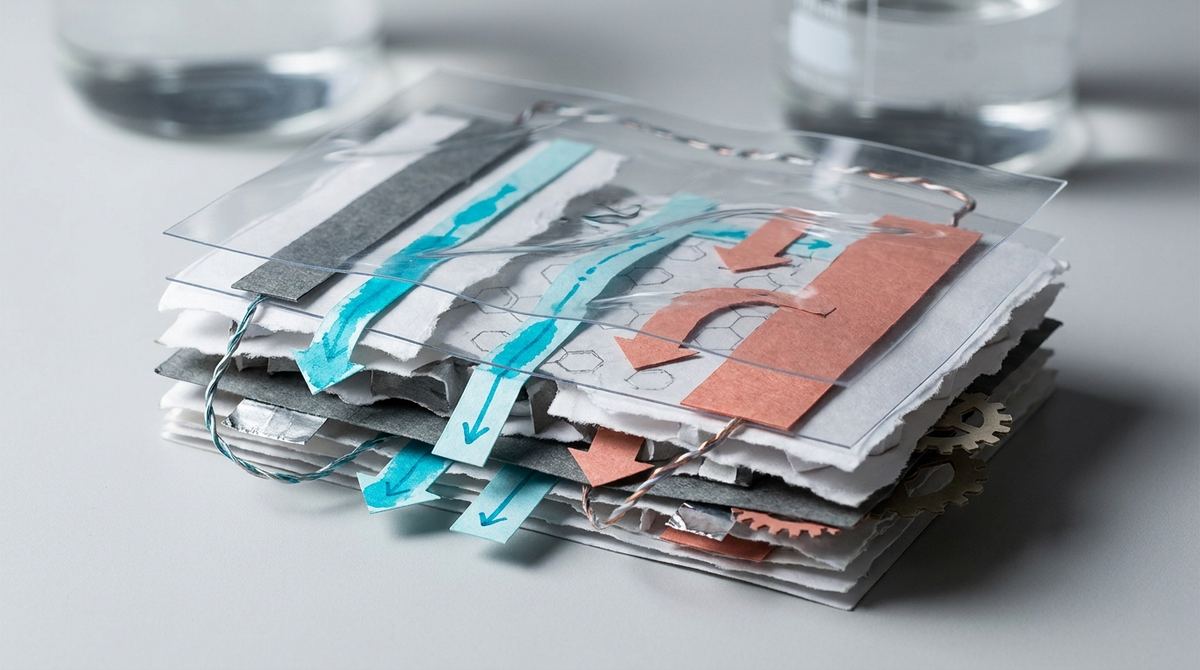
Imagine two parallel lanes of traffic on a highway. In one lane, a convoy of heavy trucks rumbles along. In the other lane, a fleet of lightweight sports cars sits with their engines off. Intuitively, we know the sports cars will stay put. But what if this wasn't a normal highway? What if the air itself was thick, and the passing trucks created such a powerful gust of wind that it started pushing the idle sports cars forward? This is a rough analogy for a fascinating quantum phenomenon known as Coulomb drag, where the movement of charge carriers in one material can literally drag carriers along in a nearby, electrically isolated material, just through their mutual electrical repulsion. This effect moves beyond the simple "push" of a voltage and into a more subtle, interaction-driven world. It is this world that a team of theoretical physicists has recently explored, predicting a new and powerful form of this effect in a hybrid system combining the unique physics of graphene with those of conventional materials.
In the world of electronics, our control over electricity is almost entirely based on applying an electric field, or voltage, to make electrons move. This is the fundamental principle behind everything from a light bulb to a supercomputer. While this method is incredibly successful, it has limitations, especially as we shrink devices to the nanoscale. At these tiny scales, new physical effects emerge, and the old rules don't always provide the best solutions. One of the most challenging environments to control is a material at its "charge neutrality point." This is a special state of electronic equilibrium, found in materials like graphene, where there are no excess charge carriers available to move and create a current. The material becomes highly resistive, acting like a closed gate. The central problem, then, is how to generate and manipulate a current in a material that is fundamentally disinclined to conduct one. This is not just an academic puzzle; solving it could unlock entirely new types of electronic switches and sensors. A recent theoretical paper by Yuping Huang, O. V. Kibis, V. M. Kovalev, and I. G. Savenko proposes a novel solution, not by forcing a current through the resistive material, but by using a neighboring conductor to drag a current into existence.
The researchers' core idea is to create a composite system with two distinct populations of charge carriers living side-by-side but in separate layers. One population consists of the exotic charge carriers found in graphene, known as massless Dirac fermions. These particles are remarkable because they behave as if they have no mass, moving at a constant speed regardless of their energy. The second population consists of conventional charge carriers with mass, known as massive fermions, the kind you would find in a typical semiconductor like silicon.
The key insight is to set the graphene layer precisely at its charge neutrality point, where it resists conducting electricity. The other layer, with massive fermions, is set up to conduct normally. The researchers then asked: what happens if we apply a voltage to only the conventional, massive-fermion layer? As expected, a current flows through it. The truly novel prediction is what happens next. The moving massive fermions, through their fundamental electrical repulsion (the Coulomb force), will start to push and pull on the stationary Dirac fermions in the adjacent graphene layer. This interaction is strong enough to "drag" the massless particles along, inducing a measurable electrical current in the graphene layer, even though no direct voltage was applied to it. This "ghost current" is driven entirely by the interactions between the two particle types, turning the highly resistive graphene into a conductor through a kind of quantum sympathy.
To understand this prediction, we must look at the theoretical model the scientists developed. The system is a two-dimensional heterostructure, essentially two atomically thin sheets stacked very close to each other. One sheet is pristine graphene, whose electronic properties are governed by massless Dirac fermions. Their energy is directly proportional to their momentum, which is visualized as a "Dirac cone" and is a hallmark of relativistic quantum mechanics. The second sheet is a generic two-dimensional electron gas (2DEG), which could be a layer of a semiconductor like gallium arsenide. In this layer, the electrons are massive fermions, and their energy is proportional to the square of their momentum, following the rules of classical and non-relativistic quantum mechanics.
The entire hybrid system is tuned to the charge neutrality point. For the graphene layer, this means the energy level for conduction is exactly at the tip of the Dirac cone, the point of minimum conductivity. For the 2DEG layer, it means the energy level is at the very bottom of its conduction band. In this state, both systems are in a low-energy configuration and are not easily coaxed into conducting a current with a small voltage.
The central mechanism is the interlayer Coulomb interaction. Each electron, whether massless or massive, carries a negative charge and creates an electric field around it. When an electron in the "active" 2DEG layer is pushed by an external voltage, it moves. As it moves, its electric field also moves, interacting with and exerting a force on the electrons in the "passive" graphene layer. This collective pushing and pulling from billions of moving electrons in the active layer creates a net directional force on the electrons in the passive layer, forcing them to move and thus creating the drag current. The researchers used the sophisticated framework of the Boltzmann transport equation to calculate the strength of this effect, which they quantified as "drag resistivity."
The theoretical calculations revealed several striking results. First and foremost, they confirmed that the Coulomb drag effect in this hybrid system is not only present but remarkably potent, especially given that the graphene layer is at its most resistive point. The interaction is strong enough to overcome graphene's intrinsic reluctance to conduct at the charge neutrality point.
More intriguingly, the strength of the drag effect shows a unique and complex dependence on temperature. It is non-monotonic, meaning it doesn't simply get stronger or weaker as the system heats up. Instead, as the temperature rises from near absolute zero, the drag effect first increases in strength, reaches a distinct peak, and then begins to decrease at higher temperatures. This signature peak provides a clear experimental fingerprint to look for when trying to verify the theory. The model predicts this peak occurs when the thermal energy of the system becomes comparable to the characteristic energy (the Fermi energy) of the massive fermions.
The researchers also found, as one might expect, that the drag effect is highly dependent on the density of charge carriers in the 2DEG layer. A higher density of massive fermions leads to a stronger drag on the graphene layer because there are more particles available to push their neighbors. This tunability is crucial, as it suggests the strength of the "ghost current" can be precisely controlled by adjusting the properties of the active layer. This work provides a theoretical foundation for a new class of graphene electronics based on interaction-driven phenomena.
This theoretical work is significant because it proposes a fundamentally new way to control electrical current at the nanoscale. Instead of relying solely on electric fields to push electrons, we could harness the interactions between different types of electrons to pull them. This opens the door to designing novel electronic components that operate on principles different from today's transistors. For example, one could envision a "drag transistor" where the current in a primary channel is not switched off directly but is used to induce or suppress a drag current in a secondary, isolated channel. This could lead to devices with lower power consumption and potentially new logic capabilities.
Furthermore, the extreme sensitivity of the drag effect to temperature and charge density makes it a powerful tool for scientific measurement. The predicted non-monotonic temperature dependence could be exploited to create highly sensitive, nanoscale thermometers for cryogenic applications. The drag measurement itself could serve as an incredibly delicate probe of the electronic properties of the material in the passive layer. By measuring the drag current, scientists could deduce information about the other material without directly contacting it, which is invaluable for studying fragile quantum states. This deepens our understanding of the fundamental physics governing many-body systems, where the collective behavior of particles leads to emergent phenomena not seen in individual particles.
It is crucial to emphasize that this research is, at present, a theoretical prediction. The calculations were performed on an idealized model that assumes perfectly clean materials with no defects or impurities. Real-world materials, even the highest-quality turbostratic graphene flakes, will have some degree of disorder, which could scatter electrons and potentially weaken the predicted drag effect. The next critical step is experimental verification.
Building a physical device to test this theory is a significant engineering challenge. It would require advanced nanofabrication techniques to create a heterostructure of graphene and a 2DEG material, ensuring the layers are close enough for strong Coulomb interaction but remain electrically isolated. It would also demand separate, pristine electrical contacts for each layer to drive a current in one and measure the faint drag current in the other. Experimental physicists will need to replicate the precise conditions of the model, particularly the ability to tune both layers to the charge neutrality point, to see if the predicted non-monotonic temperature dependence and other signatures appear in the lab.
While direct commercialization is distant, the concepts outlined in this paper point toward several exciting future graphene applications. The most direct application would be in novel switching devices. A drag-based transistor could offer superior isolation between the control gate and the signal channel, potentially leading to higher efficiency and less signal noise in high-frequency circuits. This could be particularly relevant for developing next-generation communication technologies operating in the terahertz range.
The system's high sensitivity also suggests applications in the sensor domain. A device based on this principle could detect minute changes in the charge environment of a nearby material. This could lead to ultra-sensitive chemical or biological graphene sensors, where the binding of a single molecule to the active layer could cause a detectable change in the drag current of the passive graphene layer. In quantum computing, where precise temperature control is paramount, the unique temperature signature of the drag effect could be harnessed to build integrated, on-chip thermometers with unprecedented resolution at cryogenic temperatures.
In a specially designed system combining graphene with a conventional semiconductor, a current flowing in the semiconductor can create a "ghost current" in the graphene purely through electrical repulsion. This interaction-driven transport offers a new way to control electricity at the nanoscale, moving beyond traditional voltage-based switches and opening the door to novel electronic devices.
What are Dirac and massive fermions? In simple terms, they are two different types of electrons. Massive fermions are the "normal" electrons found in most materials, like copper or silicon; they have mass and their energy increases with the square of their speed. Dirac fermions are exotic particles found in materials like graphene; they behave as if they have zero mass and always travel at a fixed speed, with their energy depending only on their direction of travel.
What is the charge neutrality point? The charge neutrality point, or Dirac point in graphene, is a specific energy state where the material has an equal balance of positive and negative charge carriers, resulting in no net charge. At this point, the material has the fewest available carriers to move, causing its electrical conductivity to drop to a minimum. It essentially behaves like an insulator or a turned-off switch.
What is Coulomb drag? Coulomb drag is a quantum mechanical effect where charge carriers moving in one electrical conductor can transfer momentum to charge carriers in a nearby, electrically isolated conductor. This momentum transfer happens via the long-range Coulomb force—the fundamental repulsion between like charges—and results in a "dragged" current in the second conductor without any direct voltage being applied to it.
Is this technology ready to be used in products? No, not yet. The research is purely theoretical, providing a mathematical model and a set of predictions. Significant experimental work is required to first build a device that can test these predictions and then to overcome the many engineering challenges before it could be considered for commercial products. This is fundamental research that lays the groundwork for future technologies.
Why is graphene a good material for this research? Graphene is ideal for this research for two main reasons. First, it is the most well-known and accessible material that naturally hosts massless Dirac fermions, making it a perfect candidate for one half of the hybrid system. Second, as an atomically thin, two-dimensional material, it can be placed extremely close to other 2D materials, which is essential for maximizing the strength of the Coulomb interaction that drives the drag effect.
The theoretical work by Huang, Kibis, Kovalev, and Savenko provides a compelling glimpse into the future of electronics, one where the intricate dance of particle-particle interactions becomes a tool for computation and sensing. By predicting a robust and tunable drag current in a hybrid system of massless and massive fermions, they have charted a new path for exploring transport phenomena at the charge neutrality point, a regime that has long been challenging to navigate. While the journey from a theoretical equation to a functional device is fraught with challenges, this research provides a vital roadmap. It illuminates a new physical principle that could one day lead to ultra-efficient transistors, hyper-sensitive detectors, and a deeper, more fundamental understanding of the quantum world that underpins all modern technology.
Serious about B2B integration? Test our premium Pulsed Electrical Resistive Carbon Heating turbostratic graphene in your lab. 100g sample packs available now.
Explore More
Researchers have developed a high-efficiency graphene-silicon microring modulator, a critical step toward faster, lower-power optical communications and...

Build a near-infrared photodetector with nitrogen-doped porous graphene nanoribbons. This guide details the materials, fabrication steps, and test plan.

Discover how preempted band-inversion transitions in graphene-based systems create a self-doped crystal, a revolutionary material for ultra-clean electronics.