
Practical Guide: Prototyping a Graphene Nanoribbon Photodetector
Build a near-infrared photodetector with nitrogen-doped porous graphene nanoribbons. This guide details the materials, fabrication steps, and test plan.
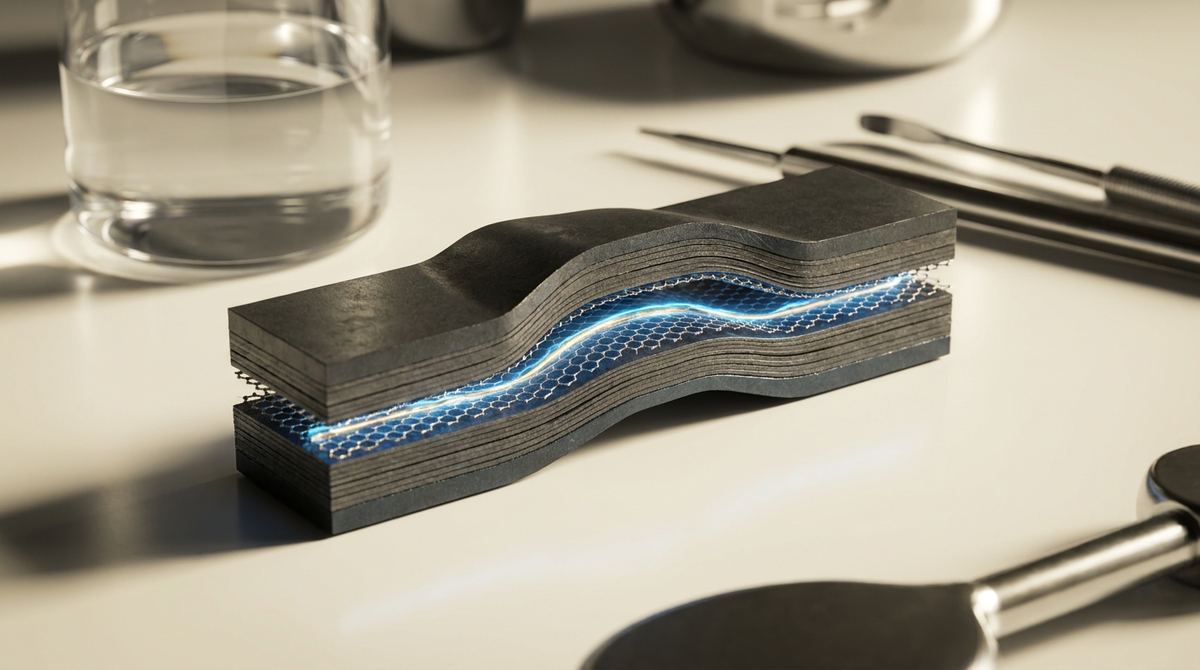
Imagine a material so thin that it is only one atom thick, yet so responsive that simply stretching it can change the fundamental rules of how electricity flows through it. This is the world of graphene, a wonder-material that has captivated physicists for decades. While most materials respond to physical stress by simply changing their resistance, graphene offers something much more profound. When it is deformed, it creates a phantom environment that tricks electrons into behaving like particles of light. This capability opens a door to a new era of technology where we can control electrical signals not just with switches and wires, but with high-speed mechanical vibrations. This unique intersection of motion and electricity is what researchers are currently unraveling to build the future of ultra-fast sensors and quantum devices.
As the world moves toward faster processing speeds and more sensitive sensors, the limits of traditional silicon-based technology are becoming increasingly apparent. Silicon has served the electronics industry well for decades, but it faces a fundamental physical wall. In silicon, the movement of electrons is governed by their mass and the rigid structure of the crystal lattice. As we try to make devices smaller and faster, we run into issues with heat, energy leakage, and the physical speed at which an electron can be moved through a circuit. We are reaching a point where the mechanical properties of our materials are disconnected from their electronic properties; if you want to change how a silicon chip works, you generally have to change the material composition or the voltage applied to it.
Furthermore, the modern push for terahertz electronics—technology that operates at frequencies much higher than current microprocessors—requires materials that can respond to rapid changes in electromagnetic fields. Traditional materials struggle to bridge the gap between mechanical energy, such as sound or vibration, and high-frequency electrical signals. There is a desperate need for a "transducer"—a material that can convert mechanical deformation into a precise, high-speed electrical output. This is where the limitations of standard semiconductors become a bottleneck for the next generation of nano-electromechanical systems (NEMS).
The core breakthrough discussed in recent theoretical work involves a concept called the chiral anomaly, manifested through the behavior of Dirac fermions. To understand this, we first have to look at the electrons in graphene. In most materials, electrons act like tiny, heavy balls rolling through a crowded room. In graphene, however, these electrons act like "Dirac fermions." This means they behave as if they have no mass at all, moving through the carbon lattice at incredibly high speeds, much like photons move through a vacuum.
When you take a sheet of graphene and stretch or bend it, you are performing what is known as strain engineering. This stretching doesn't just change the shape of the sheet; it changes the way the carbon atoms are spaced. Because the electrons in graphene are so sensitive to the spacing of the atoms, this deformation creates what physicists call a pseudomagnetic field. Even though there is no actual magnet nearby, the electrons "feel" a magnetic force because the path they travel has been warped. The research explores how this "fake" magnetic field, combined with high-frequency oscillations, triggers a quantum anomaly—a sudden, unexpected change in electrical behavior that can be harnessed for advanced technology.
To grasp how this system works, we must look at the molecular architecture of graphene. Graphene is composed of carbon atoms arranged in a perfect honeycomb lattice. This geometry is responsible for the unique way electrons move. In a standard conductor, electrons experience resistance because they collide with the atoms in the lattice. In graphene, the hexagonal symmetry and the way the carbon atoms are bonded create a unique energy landscape where the relationship between an electron's momentum and its energy is linear. This linearity is the mathematical hallmark of a Dirac fermion.
When mechanical stress is applied to the graphene sheet, the honeycomb lattice is distorted. The bond lengths between the carbon atoms change depending on whether the sheet is being pulled, compressed, or twisted. This distortion modifies the "hopping" probability of the electrons—the ease with which an electron jumps from one carbon atom to the next. In the mathematical framework used to describe these particles, this change in hopping probability is represented as a vector potential. In the world of electromagnetism, a vector potential is what generates a magnetic field. Therefore, the mechanical strain effectively "tricks" the Dirac fermions into reacting to a magnetic field that does not physically exist.
The complexity increases when we introduce "finite frequencies." In many experiments, researchers look at how a material behaves under static, constant pressure. However, this research investigates what happens when the deformation is not constant, but is instead oscillating at extremely high frequencies. When the frequency of these mechanical vibrations matches the energy scales of the Dirac fermions, a quantum anomaly occurs. This anomaly breaks certain symmetries within the material, leading to a specific, measurable electromechanical response. This response is an electrical current that is directly driven by the rapid mechanical deformation of the lattice.
The research, including the theoretical contributions of scientists like Ara Sedrakyan, focuses on the specific way these anomalies manifest when the system is subjected to high-frequency electromagnetic and mechanical inputs. The findings suggest that the electromechanical response in deformed graphene is not just a simple correlation, but is deeply tied to the quantum nature of the Dirac fermions.
The study reveals that at certain finite frequencies, the interplay between the mechanical strain and the electronic structure leads to a unique signature in the material's conductivity. This is a significant finding because it proves that one can use mechanical waves to manipulate quantum properties. The research demonstrates that the deformation-induced pseudomagnetic fields do not just shift the electrical properties slightly; they can trigger a fundamental change in how the material handles energy. This means that by carefully controlling the frequency of a mechanical vibration, one could potentially "tune" the electrical output of a graphene device with extreme precision. This is a level of control that is simply not possible with standard materials where the response is often linear and predictable.
This research is significant because it provides a theoretical blueprint for a new class of devices. The ability to couple mechanical motion and electrical signals at high frequencies via quantum anomalies could revolutionize how we build sensors. Current sensors often rely on moving physical parts that are limited by friction and inertia. A graphene-based sensor that relies on quantum anomalies would be incredibly fast, as it operates based on the movement of massless-like particles rather than the movement of heavy ions or bulk material.
Furthermore, this work provides a bridge between the field of acoustics (the study of mechanical waves) and the field of quantum electronics. By understanding how finite-frequency anomalies work, engineers can begin to design materials that can "sense" sound or vibration at the molecular level and convert it into high-speed digital signals. This has massive implications for the development of terahertz-frequency electronics, which are necessary for the next generation of wireless communications, such as 6G and beyond, where signals are processed at much higher frequencies than current 5G networks.
While these theoretical findings are groundbreaking, it is important to distinguish between a mathematical model and a commercial product. The research described is a deep dive into the physics of the system, and there are significant hurdles before this can be seen in your smartphone. First, the "Dirac fermion" model assumes a very high degree of perfection in the graphene lattice. In a real-world manufacturing environment, graphene often contains defects, such as missing carbon atoms or ripples caused by the surface it is resting on. These defects can scatter electrons and disrupt the delicate quantum anomalies that the research describes.
Second, many of these quantum effects are most prominent at extremely low temperatures. In a laboratory setting, it is easier to observe these anomalies when the thermal noise of the environment is minimized. For this technology to be useful in consumer electronics, the electromechanical response must be robust enough to function at room temperature, where thermal vibrations might drown out the specific signal created by the strain-induced anomaly. Finally, scaling the production of perfectly uniform, deformed graphene sheets remains a significant engineering challenge in the field of nanotechnology.
The practical implications of this research, once the engineering challenges are solved, are vast. One of the most immediate applications is in the field of Nano-Electro-Mechanical Systems (NEMS). We could see the development of ultra-sensitive accelerometers and gyroscopes for autonomous vehicles and drones. These sensors would be much smaller and more responsive than current MEMS technology, allowing for much more precise navigation and stability control.
Another application lies in high-speed telecommunications. As we move toward higher frequency bands for data transmission, we need components that can operate in the terahertz range. Graphene devices that exploit finite-frequency anomalies could serve as the building blocks for ultra-fast modulators and detectors, enabling data transfer speeds that are orders of magnitude faster than what we use today. Additionally, in the realm of medical technology, these highly sensitive strain-based sensors could be used to create microscopic diagnostic tools capable of detecting minute vibrations or pressure changes within biological tissues at the cellular level.
If you remember only one thing from this research, let it be this: by stretching and vibrating graphene, we can create "phantom" magnetic fields that trigger quantum anomalies, potentially allowing us to control electricity with unprecedented speed and precision.
What exactly is a Dirac fermion?
A Dirac fermion is a type of quasi-particle that emerges in certain materials like graphene. While electrons in standard materials have mass and follow traditional rules of motion, electrons in graphene behave as if they are massless. This makes them move much faster and respond differently to external forces, behaving more like particles of light than traditional matter.
How does stretching graphene create a magnetic field if there is no magnet?
When you deform the honeycomb lattice of graphene, you change the distance between the carbon atoms. This change in spacing alters the path that electrons must take as they move through the material. Mathematically, this change is identical to the way a real magnetic field affects an electron, so we call it a pseudomagnetic field.
What is the "anomaly" mentioned in the research?
In physics, an anomaly occurs when a symmetry that exists in classical physics is broken when we apply the laws of quantum mechanics. In the context of this research, the anomaly refers to a specific quantum effect that occurs when the material is subjected to rapid, high-frequency changes, resulting in a unique electrical response that wouldn't exist in a static material.
Why is this better than the silicon used in current computers?
Silicon is a reliable material, but its electrons have mass and are limited by the physical structure of the silicon crystal. Graphene's electrons are much faster due to their massless-like behavior, and the ability to use mechanical strain to manipulate them opens up new ways to control signals, especially at the extremely high frequencies required for future technologies.
Is this technology ready for commercial use?
No, this research is currently in the theoretical and computational stage. Scientists are working to understand the fundamental physics to see if these effects can be harnessed. Turning these mathematical discoveries into a stable, room-temperature, mass-produced commercial product is a major engineering task that will take years of development.
This research points toward a practical lesson: graphene-based materials are most powerful when their nanoscale properties are connected to a clear engineering problem. The result is not a finished commercial product by itself, but it gives researchers and manufacturers a better map for designing lighter, more sensitive, or more durable systems. Future work still needs testing under real operating conditions, but the direction is promising because it joins materials science with application-driven design.
Serious about B2B integration? Test our premium Pulsed Electrical Resistive Carbon Heating turbostratic graphene in your lab. 100g sample packs available now.
Explore More
Build a near-infrared photodetector with nitrogen-doped porous graphene nanoribbons. This guide details the materials, fabrication steps, and test plan.

Discover how preempted band-inversion transitions in graphene-based systems create a self-doped crystal, a revolutionary material for ultra-clean electronics.

Discover how strain-induced curvature in monolayer graphene can engineer its electronic bandgap and thermal conductivity for next-generation flexible...