
How Bending Graphene Unlocks New Electronic and Thermal Properties
Discover how strain-induced curvature in monolayer graphene can engineer its electronic bandgap and thermal conductivity for next-generation flexible...
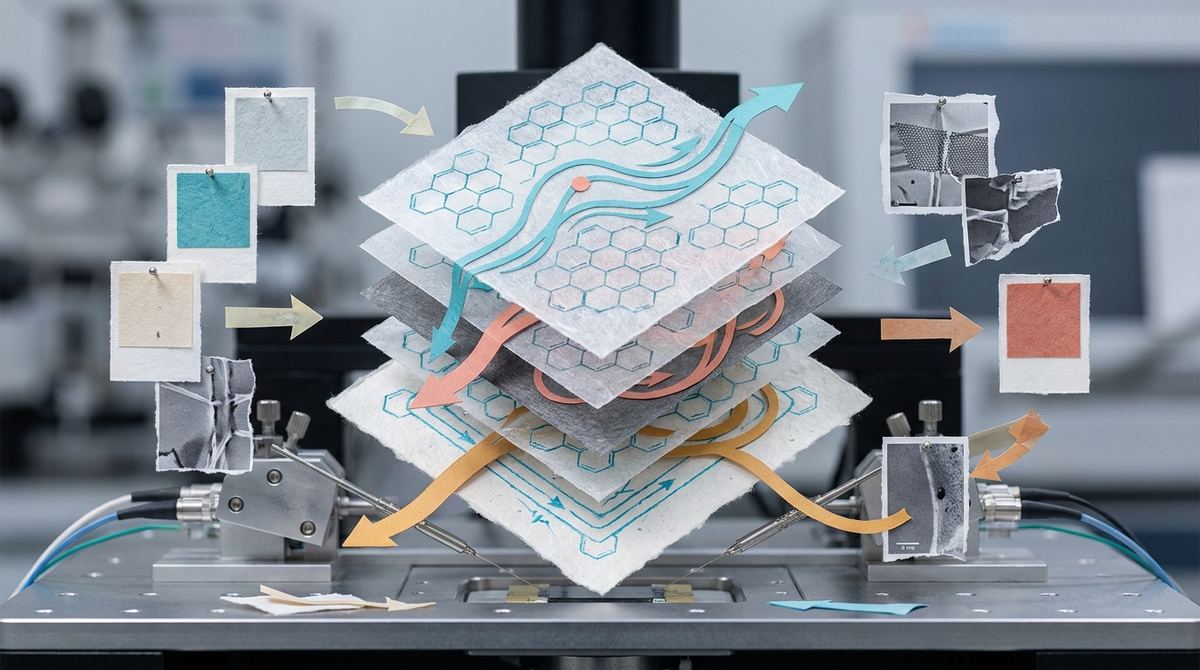
Imagine a material that does not just act as a simple highway for electricity, but as a complex landscape of quantum possibilities. In most materials, electricity behaves in a predictable, singular way. But in the emerging world of two-dimensional quantum materials, scientists are discovering that by simply stacking layers of carbon atoms in specific patterns, they can create "chameleon-like" substances. These materials can switch between different quantum states, such as superconductivity, which allows electricity to flow with zero resistance. The discovery that a specific seven-layer arrangement of graphene can host multiple different superconducting phases is a monumental leap forward. This means we are moving from studying materials that simply "are" superconductors to materials that can be "tuned" to behave as different types of superconductors, potentially acting as the fundamental building blocks for a new era of quantum information technology.
For decades, the primary obstacle in condensed matter physics has been the search for materials that exhibit highly controllable quantum properties. Standard superconductors, such as those made of niobium or various cuprates, are often "fixed" in their behavior. Once a material enters a superconducting state, its properties are largely determined by its chemical composition and crystal structure. While this is excellent for creating efficient power lines or powerful magnets, it is less useful for the burgeoning field of quantum computing. Quantum computers require materials where individual quantum states can be manipulated, toggled, and controlled with extreme precision.
Furthermore, the physics of how superconductivity emerges is often tied to the specific "electronic landscape" of a material. In many traditional materials, the electrons move through the lattice with a certain amount of kinetic energy, making them difficult to "correlate" or force into the paired states required for superconductivity. To solve the problem of creating tunable quantum systems, scientists have turned to graphene. While single-layer graphene is a fascinating conductor, it is not a superconductor. The challenge becomes finding the exact "sweet spot" in stacking, layer thickness, and electronic density that allows for the emergence of complex, controllable quantum phases that can be navigated like a map.
The breakthrough relies on a concept called layer engineering. Graphene is a single sheet of carbon atoms arranged in a hexagonal lattice. If you take one sheet, it is very thin and conducts electricity well, but it lacks the "heaviness" in its electronic structure to facilitate superconductivity. However, when you stack these sheets on top of one another, the way they are oriented—the "stacking order"—dramatically changes how the electrons behave.
In this research, the focus is on rhombohedral stacking. In a rhombohedral arrangement, each layer is shifted slightly relative to the one below it in a specific, repeating pattern. This specific geometry forces the electrons into a state where they move much more slowly than they would in a single layer. In physics terms, we say the "energy bands" become "flat." When electron bands are flat, the electrons spend more time interacting with each other because they aren't racing through the material at high speeds. This increased interaction time is the primary driver that allows electrons to pair up and enter a superconducting state. By using seven layers, the researchers have created a system where these flat bands are particularly sensitive to external changes, allowing for the existence of multiple distinct superconducting regimes.
To understand why heptalayer graphene behaves this way, we must look at the relationship between the lattice structure and the electron's energy. In a standard metal, the electrons have high kinetic energy, meaning they move very fast through the crystal lattice. This movement is characterized by a high "group velocity." However, as you add layers of graphene in a rhombohedral sequence—often referred to as ABC stacking—the electronic wavefunctions begin to interfere with one another in a way that cancels out much of their kinetic energy.
In a heptalayer (seven-layer) system, this effect is amplified. The stacking creates a unique electronic density of states. Because the electrons are essentially "sluggish" due to the flat bands, the energy required to create an electron-electron interaction is much lower relative to their kinetic energy. This makes the system highly susceptible to many-body effects. When an external electric field is applied via a gate voltage, it shifts the "Fermi level"—the highest energy state occupied by electrons—through these flat bands.
Because the electronic landscape in a heptalayer rhombohedral system is so complex, this shift in the Fermi level doesn't just produce one single type of superconductivity. Instead, as the density of the electrons changes, the system passes through different "phases." Each phase might have a different superconducting transition temperature or a different way that electrons pair up. The cause-and-effect relationship here is direct: the rhombohedral geometry causes the formation of flat bands, the flat bands cause an increase in electron interaction, and the controlled tuning of electron density allows the user to navigate through multiple different superconducting phases.
In this groundbreaking study, Chuanqi Zheng, Chushan Li, Chenyu Zhang, Kenji Watanabe, Takashi Taniguchi, Hao Yang, Dandan Guan, Liang Liu, Shiyong Wang, Yaoyi Li, Hao Zheng, Canhua Liu, et al., explored the limits of this layer-dependent physics. By meticulously constructing heptalayer graphene devices, the team was able to observe how the superconducting state responds to changes in carrier density.
The researchers discovered that the material does not exhibit a single, uniform superconducting transition. Instead, they observed multiple superconducting phases. As the charge density in the graphene was tuned using an external electric field, the system transitioned through different regimes of superconductivity. This suggests that the superconductivity in heptalayer graphene is not a monolithic phenomenon but a complex landscape of competing or overlapping quantum orders.
This discovery is significant because it proves that the number of layers and the stacking order can be used to "program" the quantum behavior of a material. The research provides a detailed look at how the transition temperature and the electronic properties evolve, offering a roadmap for how to manipulate the many-body physics inherent in multi-layer graphene systems. This moves the field away from simply observing superconductivity toward actively designing it through structural control.
The implications of discovering multiple superconducting phases are profound for both fundamental physics and practical engineering. Firstly, it provides a new playground for testing theories of "strong correlation." Most of our understanding of materials comes from "weakly correlated" systems, where electrons move relatively independently. Heptalayer graphene is a "strongly correlated" system, meaning the electrons are deeply intertwined in their behavior. Understanding how multiple phases emerge in such a system helps physicists refine the mathematical models used to describe all matter.
Secondly, the ability to switch between different superconducting phases is a holy grail for quantum information science. In a quantum computer, the ability to move a system from one state to another without losing information (decoherence) is vital. If a material can host multiple quantum phases that are tunable via a simple voltage, it could potentially be used to create "topological qubits." These qubits would be inherently protected from the noise and interference that currently plague quantum computers, making them far more stable and reliable.
While these results are revolutionary, it is important to maintain a realistic perspective on their current application. The research conducted by Chuanqi Zheng and the team is fundamental in nature. The phenomena were observed at extremely low temperatures, requiring sophisticated dilution refrigerators to reach the millikelvin range. For any practical application in power grids or consumer electronics, we would need to find a way to achieve these effects at much higher temperatures, ideally near room temperature.
Furthermore, the fabrication process used in these experiments is incredibly delicate. Creating perfectly stacked heptalayer graphene requires specialized techniques, such as van der Waals assembly, where layers are picked up and placed with atomic precision. This process is currently slow, expensive, and difficult to scale to an industrial level. Before this can move from a laboratory curiosity to a commercial product, engineers must find ways to manufacture these precise multi-layer structures at scale using more conventional semiconductor fabrication methods.
Despite the current limitations, the long-term potential for heptalayer graphene is vast. One of the most immediate areas of interest is in the field of ultra-sensitive sensing. Superconducting Quantum Interference Devices (SQUIDs) are used to detect incredibly faint magnetic fields, such as those produced by the human brain. A material that can be tuned through multiple superconducting phases could lead to a new generation of SQUIDs that are far more sensitive and versatile than current technology.
In the realm of computing, the "tunable" nature of these phases could revolutionize high-speed, low-power electronics. As we reach the physical limits of silicon-based transistors, the industry will need new ways to process information. Quantum-based electronics, utilizing the unique properties of layered graphene, could provide the next leap in computational power, enabling everything from advanced artificial intelligence to complex molecular simulations that are currently impossible for even the fastest supercomputers.
If there is one single takeaway from this research, it is that the complexity of a material is not just about what it is made of, but how its layers are arranged. By controlling the stacking and thickness of graphene, we are no longer limited to the properties nature gave us; we can engineer entirely new quantum states and multiple superconducting phases, paving the way for a future of programmable quantum matter.
What exactly is graphene?
Graphene is a single layer of carbon atoms arranged in a two-dimensional hexagonal lattice. It is incredibly thin, yet it is one of the strongest and most conductive materials known to science.
Why does stacking layers change how it works?
When you stack layers, the electrons in each layer interact with the electrons in the layers above and below them. This interaction can change the speed at which electrons move and the way they interact with one another, which can create entirely new electrical properties.
What is superconductivity?
Superconductivity is a phenomenon where certain materials allow electricity to flow through them with zero resistance when they are cooled to very low temperatures. This means no energy is lost as heat during the conduction of electricity.
What does "multiple superconducting phases" mean?
It means that the material doesn't just have one way of being a superconductor. Depending on how you change the electron density, the material can exhibit different types of superconducting behavior, almost like a substance changing from solid to liquid, but within the quantum realm.
Is this technology ready for use in my smartphone?
Not yet. The research is currently in the fundamental science stage. The materials must be produced at much higher temperatures and through more scalable manufacturing processes before they can be used in everyday consumer electronics.
The work of Chuanqi Zheng, Chushan Li, Chenyu Zhang, and their colleagues represents a significant milestone in the study of two-dimensional materials. By demonstrating that heptalayer rhombohedral graphene can host multiple superconducting phases, they have shown that the "layering" of carbon is a powerful tool for creating complex quantum landscapes. While challenges in temperature and scalability remain, the ability to tune multiple quantum states within a single material provides a compelling roadmap for the future of quantum computing and high-precision sensing. As our ability to manipulate matter at the atomic level improves, the "chameleon" properties of layered graphene will likely play a central role in the next technological revolution.
Serious about B2B integration? Test our premium Pulsed Electrical Resistive Carbon Heating turbostratic graphene in your lab. 100g sample packs available now.
Explore More
Discover how strain-induced curvature in monolayer graphene can engineer its electronic bandgap and thermal conductivity for next-generation flexible...

Learn to build a prototype graphene spintronic converter based on new research. This guide details how to use pressure to tune spin-to-charge conversion.

Research reveals how rhombohedral graphene's unique chiral electron states enable highly efficient high-harmonic generation, paving the way for on-chip UV...