
Rhombohedral Graphene and the Future of High-Frequency Light Generation
Research reveals how rhombohedral graphene's unique chiral electron states enable highly efficient high-harmonic generation, paving the way for on-chip UV...
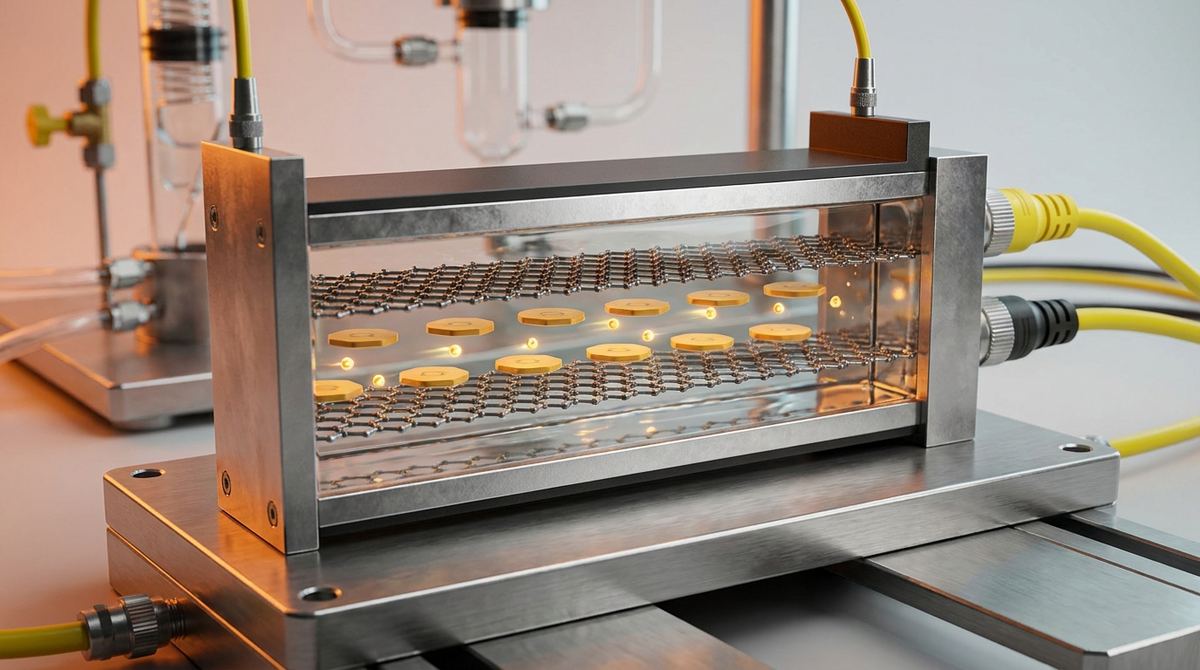
Imagine a solar cell or a high-tech display that works significantly better simply because its internal molecular components were "cooked" at the perfect temperature to ensure they were standing in perfect formation. In the world of advanced materials, order is everything. If the molecules that carry electricity are scattered randomly like a crowd of people rushing through a hallway, the flow of energy is blocked by collisions and chaos. However, if those same molecules are lined up like soldiers in a parade, the energy can glide through with almost no resistance. This is the fundamental challenge in organic electronics, and recent research has focused on using heat to solve it. By studying how heat affects the way specific organic molecules sit on a sheet of graphene, scientists are uncovering the secrets to much more efficient electronic devices.
The pursuit of efficient organic electronics, such as flexible solar cells and organic light-emitting diodes, is often hindered by the chaotic nature of molecular assembly. Unlike silicon-based electronics, which are grown in highly controlled, crystalline environments, organic molecules are typically deposited onto surfaces in a disordered, or amorphous, state. When molecules like zinc phthalocyanine are placed onto a substrate, they do not always land in the most stable or efficient configuration. Instead, they may land at odd angles, with gaps between them, or in irregular clusters.
This disorder creates a significant problem known as energetic disorder or charge trapping. In an electronic device, a charge carrier—which can be an electron or a "hole"—must move from one molecule to the next to create a current. When the molecules are disorganized, the charge carrier often gets stuck in a "trap," a localized area of high energy caused by a structural defect or a poorly aligned molecule. Once a charge is trapped, it is much harder for it to move through the material, which leads to a massive loss of energy as heat. This inefficiency limits the performance of organic semiconductors, making them less competitive than their traditional inorganic counterparts. Therefore, the core problem being addressed is how to transform a disordered layer of molecules into a highly ordered, efficient layer that can move charge carriers without loss.
The solution explored in this research is a process called annealing. In simple terms, annealing is the application of controlled heat to a material to change its physical or chemical properties. In the context of these molecular layers, think of annealing as a way to give the molecules the "energy" they need to move around and find their proper place. When the molecules are cold, they are essentially frozen in whatever messy position they landed in during manufacturing. By carefully increasing the temperature, we provide them with enough thermal kinetic energy to wiggle, rotate, and slide across the surface.
The goal is to reach a state of thermodynamic equilibrium, where the molecules naturally settle into their most stable and organized arrangement. This reorganization is not just about making things look neat; it is about maximizing the electronic communication between the molecules and the substrate. By using heat to drive this structural reorganization, we can theoretically bridge the gap between the messy reality of organic deposition and the perfect order required for high-performance electronics.
To understand why this works, we must look at the specific interaction between zinc phthalocyanine and graphene. Zinc phthalocyanine is a macrocyclic compound, meaning it has a large, flat, ring-shaped structure with a central zinc atom. This flat shape is crucial because it allows the molecule to interact with other flat surfaces through a phenomenon known as pi-pi stacking. In this interaction, the clouds of electrons orbiting the carbon atoms in the phthalocyanine ring overlap with the clouds of electrons in the graphene sheet.
Graphene is a single layer of carbon atoms arranged in a hexagonal lattice. It is famous for its extraordinary electrical conductivity and its massive surface area. When zinc phthalocyanine is adsorbed onto graphene, it does not just sit on top; it becomes part of a complex electronic interface. The graphene acts as both a template for the molecules and a high-speed highway for the electrons. The efficiency of this "highway" depends entirely on how well the molecules are oriented. If the phthalocyanine ring is tilted or distorted, the overlap of the electron clouds is weakened, making it difficult for an electron to jump from the molecule onto the graphene. However, when the molecules are perfectly flat and aligned with the graphene lattice, the electronic coupling is maximized. The heat from annealing provides the necessary energy for the molecules to overcome the friction of their initial placement, allowing them to align themselves with the graphene’s atomic structure through these Van der Waals forces.
The research conducted by the Graphene Research Team investigated how different levels of thermal treatment impact both the physical structure and the light-interacting properties of these systems. The study focused on how the structural transition—from a disordered state to an ordered state—directly dictates the photophysical behavior of the material. One of the most critical observations in such systems is the phenomenon of fluorescence quenching.
When zinc phthalocyanine is excited by light, it typically emits a glow, known as fluorescence. However, when it is placed in close contact with graphene, this glow often disappears or is significantly reduced. This happens because the energy that would have been emitted as light is instead transferred to the graphene as an electron. The efficiency of this transfer is a direct indicator of how well the molecules are coupled to the graphene. The researchers found that as the annealing temperature increases, there is a measurable shift in the structural organization of the molecules. As the molecules become more ordered and sit more flatly against the graphene, the efficiency of this electron transfer increases. This is because the improved structural alignment enhances the electronic overlap between the phthalocyanine's molecular orbitals and the graphene's electronic states. Essentially, the research confirms that the thermal reorganization of the molecules directly enables a more efficient "handshake" between the organic molecule and the carbon substrate, facilitating much faster and more reliable charge transfer.
These findings are significant because they provide a roadmap for optimizing the next generation of organic electronic devices. If we can precisely control the temperature and duration of the annealing process, we can engineer materials with specific, predictable electrical properties. This is vital for the development of organic photovoltaics, or organic solar cells. In a solar cell, the goal is to absorb a photon and immediately separate the resulting electron and hole to create electricity. If the interface between the organic absorber and the graphene electrode is optimized through annealing, the efficiency of the entire cell increases because fewer charges are lost to traps.
Furthermore, this research has implications for organic light-emitting diodes (OLEDs) and organic field-effect transistors (OFETs). In OLEDs, controlling the molecular orientation is essential for the color purity and brightness of the display. In OFETs, which are the building blocks of flexible computer chips, the speed of the device depends on how fast charges can move through the organic layer. By understanding how heat can be used to eliminate structural defects and optimize the interface, engineers can design much faster and more responsive flexible electronics that could eventually be used in wearable technology, foldable smartphones, and smart skin.
While these results are promising, it is important to distinguish between fundamental laboratory success and commercial readiness. This research is currently focused on the fundamental physics of the molecule-substrate interface, often using highly controlled environments that may be difficult to replicate in a mass-production factory. One of the primary limitations is the thermal stability of the organic molecules themselves. While heat can help organize the molecules, too much heat can cause the zinc phthalocyanine to decompose or chemically react with the surface, destroying the very properties we are trying to optimize. Finding the "Goldilocks zone"—the temperature that provides order without causing degradation—remains a complex challenge.
Additionally, there is the issue of scalability. Achieving a uniform, perfectly annealed layer across a large-scale silicon wafer or a long roll of flexible plastic is much harder than doing so on a tiny laboratory sample. Future research must address how these thermal processes can be integrated into existing manufacturing pipelines without introducing new defects. Finally, the long-term stability of these annealed layers under real-world conditions, such as exposure to oxygen, moisture, and constant light, needs extensive testing to ensure that the organized molecular structure does not revert to a disordered state over time.
The practical implications of optimizing these molecular interfaces are vast and reach into several multi-billion-dollar industries. In the renewable energy sector, more efficient organic solar cells could lead to transparent or flexible solar windows that can be integrated into skyscrapers, turning entire buildings into power generators. Because organic materials can be processed using low-cost printing methods, the ability to optimize them through annealing could drastically reduce the cost of solar energy.
In the consumer electronics industry, the ability to create highly ordered organic layers will lead to more vibrant and energy-efficient displays. This is particularly relevant for the development of foldable and rollable screens, where the electronic layers must remain functional even when subjected to mechanical stress. Finally, in the field of chemical sensing, the sensitivity of the photophysical properties to the molecular arrangement can be exploited. A sensor could be designed where the presence of a specific gas or toxin slightly disturbs the ordered structure of the phthalocyanine layer, causing a detectable change in its light emission, providing a highly sensitive and rapid way to detect environmental pollutants or medical markers.
If there is one takeaway from this research, it is that the arrangement of molecules is just as important as the molecules themselves. In the world of nano-electronics, the ability to use heat to transform a chaotic, disordered layer of organic molecules into a highly organized, efficient electronic highway is a key step toward a future of highly efficient, flexible, and low-cost electronic technology.
What exactly is zinc phthalocyanine? Zinc phthalocyanine is a specialized organic molecule that contains a central zinc atom surrounded by a large, flat ring of carbon and nitrogen atoms. Because of its flat, stable structure, it is widely used in dyes, pigments, and most importantly, in organic electronics due to its ability to absorb light and transport charge.
Why is graphene used in this research? Graphene is a single layer of carbon atoms that is incredibly thin, incredibly strong, and an excellent conductor of electricity. In these systems, it serves as a perfect platform for organic molecules to sit on, providing a way to move electrons away from the molecules once they have been excited by light.
What does annealing mean in a scientific context? Annealing is a process where a material is heated to a specific temperature and then cooled in a controlled manner. This process allows the atoms or molecules within the material to move around and rearrange themselves into a more stable, lower-energy, and more organized configuration.
Why does the arrangement of molecules change their light properties? When molecules are disorganized, they interact with light in a random way, often resulting in scattered or weak signals. When they are organized into a neat, repeating pattern, their electron clouds overlap in a predictable way, which can change how they absorb light and how effectively they release energy as light or electricity.
Is this research ready for use in my smartphone? Not quite yet. While this research provides critical insights into how to make organic electronics better, there is still significant work to be done in making these processes reliable, stable, and scalable for mass manufacturing. It is a foundational step that paves the way for future commercial products.
The study of zinc phthalocyanine on graphene highlights a fundamental truth in material science: the interface is where the magic happens. By using thermal annealing to bridge the gap between disordered organic molecules and the highly conductive world of graphene, researchers are unlocking new ways to manipulate light and electricity. As we continue to master the art of molecular organization, the boundary between organic and inorganic electronics will continue to blur, leading to a new era of flexible, efficient, and ubiquitous electronic devices.
Serious about B2B integration? Test our premium Pulsed Electrical Resistive Carbon Heating turbostratic graphene in your lab. 100g sample packs available now.
Explore More
Research reveals how rhombohedral graphene's unique chiral electron states enable highly efficient high-harmonic generation, paving the way for on-chip UV...

Researchers have developed a light-driven Tesla engine using a magnetically levitated graphene disk. This breakthrough in frictionless motion converts light...

Explore how to build a graphene nano-actuator prototype that leverages the tunable Casimir force in water, a new frontier in NEMS and nanofluidics.