
Nickel Doping Unlocks Tunable Magnetism in Large-Scale 2D Ferromagnet Fe3GeTe2
Researchers demonstrate precise control over the magnetic and structural properties of the 2D ferromagnet Fe3GeTe2 by introducing nickel atoms, a key step...
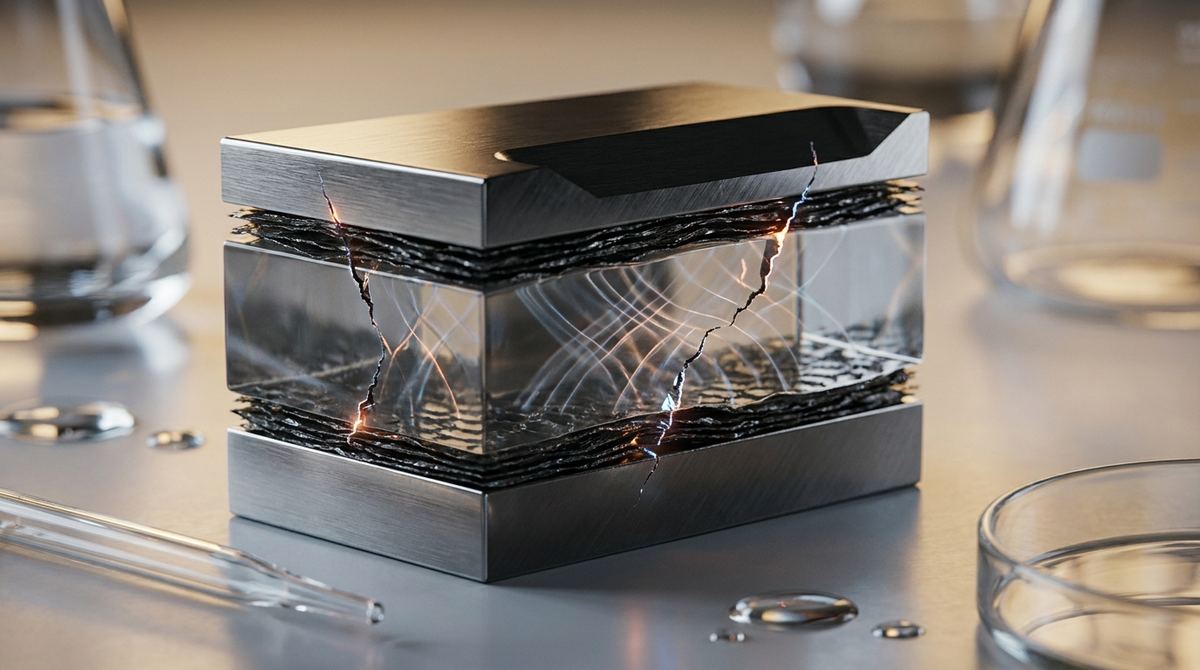
Imagine a material so strong that it is nearly impossible to tear, yet so delicate that a single microscopic scratch could cause the entire structure to shatter like glass. This is the fundamental paradox of graphene. As a single layer of carbon atoms arranged in a hexagonal lattice, graphene possesses extraordinary mechanical properties, making it a candidate for the next generation of aerospace components, flexible electronics, and ultra-strong composites. However, the real-world utility of graphene is constantly threatened by its inherent brittleness. In a perfect world, graphene is invincible, but in the real world, defects and cracks are inevitable. If we want to use graphene in critical engineering applications, we cannot just hope for perfection; we must learn how to manage failure. We must understand how cracks behave when they encounter one another, because the way cracks interact can either lead to sudden, catastrophic destruction or provide a mechanism that actually makes the material tougher.
The primary obstacle in utilizing carbon-based nanomaterials like graphene in structural roles is the phenomenon of brittle fracture. In most traditional materials, such as metals, when a crack begins to form, the material often undergoes some level of plastic deformation. This means the material bends or stretches slightly at the tip of the crack, absorbing energy and slowing the crack's progress. Graphene, however, is essentially a two-dimensional crystal with very little capacity for this kind of deformation. When a crack forms in a graphene sheet, the stress at the very tip of that crack becomes incredibly concentrated. This concentration of stress acts like a wedge, driving the crack through the material at high speeds.
The presence of even a single defect can act as a nucleation point for a crack that travels across the entire sheet, leading to total structural failure. This is a nightmare for engineers. If you are building a flexible screen for a smartphone or a weight-bearing component for a satellite, you cannot have a material that fails completely because of one microscopic flaw. Current materials science focuses heavily on preventing cracks from forming in the first place, through extreme purification and perfect manufacturing. But as we scale up graphene production to industrial levels, achieving perfect, defect-free sheets is economically and physically impossible. The challenge, therefore, shifts from avoiding cracks to understanding how to control them. We need to know how different configurations of cracks affect the overall integrity of the material so that we can design systems that are resilient to damage rather than just being theoretically strong.
The research conducted by Suyeong Jin, Jung-Wuk Hong, and Alexandre F. Fonseca proposes a shift in how we think about material failure. Instead of viewing cracks as purely destructive forces that must be eliminated, this work investigates how the geometry of these cracks can be used to change how they interact. The key idea is that when two cracks are near each other, they do not act independently. Each crack creates a "stress field" around itself—a zone where the internal tension of the material is heightened. When these two zones overlap, they begin to influence each other.
Depending on the geometry—the distance, the angle, and the orientation—of these cracks, they can interact in two very different ways. They might interact in a way that pulls them together, causing them to merge and accelerate the material's failure. Or, they might interact in a way that pushes them apart or forces them to change direction. If the geometry of the cracks forces them to bend, twist, or deflect, the crack has to travel a longer path and must expend more energy to move forward. This extra energy requirement is what we call toughening. Essentially, the researchers are looking for the geometric "sweet spot" where cracks stop being simple paths to destruction and start becoming mechanisms that dissipate energy and protect the material.
To understand how this works, we have to look at the physics of the crack tip. In a 2D lattice like graphene, the atoms are held together by incredibly strong covalent bonds. When a load is applied to the sheet, the tension is distributed across these bonds. A crack is essentially a break in this continuity. At the very tip of a crack, the stress is not distributed evenly; it is concentrated at a single point, known as a stress singularity. This is where the energy released by the external load is focused.
When a second crack is introduced into the system, its own stress field begins to interfere with the first one. In a 2D plane, these stress fields are highly sensitive to the spatial arrangement of the cracks. If two cracks are positioned perfectly opposite each other, their stress fields merge into one massive zone of tension, making it very easy for the crack to jump the gap and combine with the other. However, if the cracks are oriented at an angle, or if they are separated by a specific distance, the stress field of one crack can actually create a zone of compression or a redirected stress path for the other.
This interaction is fundamentally a geometric problem. The physics is governed by how the stress field of one crack modifies the energy release rate at the tip of the second crack. If the geometry is such that the stress field of the neighboring crack effectively "shields" the tip of the first crack, the crack becomes much harder to move. This phenomenon is a form of geometric toughening. The lattice structure of graphene provides a unique playground for this because the two-dimensional nature of the material limits the directions in which a crack can travel, making the geometric influence of crack interaction much more pronounced than it would be in a three-dimensional bulk material.
Through their investigation, Jin, Hong, and Fonseca demonstrated that the toughness of graphene is not a static property but a dynamic one that depends heavily on the spatial configuration of its defects. Their work suggests that the interaction between cracks is highly sensitive to the geometric parameters of the system. Specifically, they explored how the angle of approach and the distance between crack tips determine whether the interaction leads to crack coalescence (merging) or crack deflection (turning).
The researchers found that the way cracks interact is a delicate balance of forces. When the geometry of the cracks is arranged in certain ways, the stress fields do not simply add up to create more tension; instead, they can create complex interference patterns. These patterns can force a crack to deviate from its straight-line path. A deviating crack is a much less efficient way to break a material because it must constantly fight against the grain of the lattice to change direction, which requires significantly more mechanical energy. This means that by controlling the geometry of defects, it is theoretically possible to engineer graphene that is much tougher than its individual parts would suggest. The findings highlight that "toughness" in a 2D material is a collective property of the defect landscape, not just a property of the carbon bonds themselves.
This research is significant because it provides a theoretical framework for "damage-tolerant" material design. For decades, the goal in materials science has been to create materials that are as perfect as possible. However, as we move toward the mass production of graphene-based technologies, we must accept that there will always be flaws. This research tells us that we don't necessarily need to eliminate every flaw; instead, we might need to learn how to arrange or manage those flaws.
If we can understand the exact geometric conditions that lead to toughening rather than failure, we can design graphene-based composites that are inherently resistant to catastrophic fracture. This has massive implications for the reliability of new technologies. For example, in flexible electronics, a micro-crack caused by repeated bending could lead to a sudden failure of a circuit. If the material is engineered such that those micro-cracks interact in a toughening manner, the device could survive much longer and withstand much more physical stress. This shifts the paradigm from "preventing damage" to "engineering resilience," a concept that is vital for the long-term commercial viability of 2D materials.
While the findings are groundbreaking, it is important to distinguish these theoretical insights from practical, ready-to-use manufacturing techniques. The research provided by Jin, Hong, and Fonseca is a fundamental study of the physics of crack interaction. It operates on the mathematical and theoretical models of how cracks behave in a controlled environment. In a real-world laboratory or factory, graphene is rarely a perfect, single-layer hexagonal lattice. It often contains chemical impurities, grain boundaries where different flakes meet, and varying levels of oxidation.
These real-world factors add layers of complexity that a pure geometric model may not fully capture. For instance, an impurity might act as a "pinning" site that stops a crack regardless of the geometry, or it might create a secondary stress field that complicates the interaction. Furthermore, the study focuses on the geometric interaction of the cracks themselves, but in a real material, the interaction between cracks and the surrounding matrix (if the graphene is part of a composite) is equally important. More empirical, experimental work is needed to see how these geometric principles hold up when the graphene is embedded in polymers or other structural materials. We need to bridge the gap between the idealized geometry of the model and the messy, imperfect reality of industrial-grade graphene.
The ability to manipulate crack interaction through geometry opens up several high-stakes engineering avenues. In the aerospace industry, graphene is being investigated for use in lightweight, high-strength composite materials. If engineers can design these composites such that any inevitable micro-cracks are forced into toughening interactions, they could create aircraft components that are both lighter and safer than current carbon-fiber alternatives.
In the realm of flexible electronics, the application is equally vital. We are moving toward a world of foldable phones, wearable sensors, and even "electronic skin." These devices will undergo constant mechanical strain and bending. Understanding how cracks interact in a 2D lattice will allow manufacturers to create more durable membranes that can withstand millions of bending cycles without the risk of a sudden, total failure of the conductive paths. Additionally, in the field of energy storage, such as graphene-based supercapacitors, the structural integrity of the electrode material is crucial. Managing the defect density and the geometry of those defects can ensure that the electrodes remain functional even under the mechanical stresses of repeated charging and discharging cycles.
If you take away only one concept from this research, let it be this: the way a crack behaves is not just about the crack itself, but about the geometry of the environment surrounding it. By understanding how cracks interact with one another, we can transform them from agents of destruction into tools for toughening, allowing us to build much more resilient and reliable materials.
How does a crack actually make a material tougher?
Toughness is essentially a measure of how much energy a material can absorb before it breaks. When a crack is forced to change its direction or follow a longer, more winding path because of the presence of other cracks, it has to work much harder to move through the material. This "deflection" consumes more energy, which effectively increases the toughness of the material and makes it more resistant to sudden failure.
Why is graphene considered brittle?
Graphene is made of very strong, rigid covalent bonds in a flat, two-dimensional plane. Unlike metals, which can slide their atoms past one another to absorb energy (a process called dislocation motion), the atoms in a graphene sheet are locked into a very specific hexagonal pattern. This means that when stress is applied, the material is more likely to snap rather than bend, which is the definition of brittle behavior.
What is a stress field?
A stress field is the area around a crack where the internal forces within the material are significantly higher than they are in the rest of the material. You can think of it like the wake created by a boat moving through water; the boat is the crack, and the turbulent water around it is the stress field. When two cracks are close together, their "wakes" overlap and influence each other.
Does this research mean we can manufacture perfect graphene?
No, this research is actually a response to the fact that perfect graphene is nearly impossible to manufacture at scale. Instead of trying to solve the impossible problem of creating a material without any defects, this research suggests that we should focus on understanding how to manage the defects that will inevitably be there.
Is this research applicable to all materials?
While the principles of crack interaction are universal in fracture mechanics, the specific geometric dependencies discussed here are particularly important for 2D materials like graphene. In 3D materials, cracks have many more directions in which they can move, which changes the way they interact. The 2D nature of graphene makes the geometric control of cracks much more direct and significant.
The journey of graphene from a laboratory curiosity to a cornerstone of modern engineering depends on our ability to master its mechanical vulnerabilities. The work of Suyeong Jin, Jung-Wuk Hong, and Alexandre F. Fonseca provides a crucial piece of this puzzle. By shifting the focus from the prevention of cracks to the geometric management of crack interactions, they have opened a new pathway for creating ultra-tough, damage-tolerant nanomaterials. As we continue to explore the frontiers of 2D materials, the ability to turn a material's inherent flaws into a source of strength will be the key to unlocking the full potential of the graphene revolution.
Serious about B2B integration? Test our premium Pulsed Electrical Resistive Carbon Heating turbostratic graphene in your lab. 100g sample packs available now.
Explore More
Researchers demonstrate precise control over the magnetic and structural properties of the 2D ferromagnet Fe3GeTe2 by introducing nickel atoms, a key step...

Twisted trilayer graphene allows for remote electronic control of a decoupled layer, a breakthrough in moiré physics that could enable cleaner quantum devices.

Learn a practical, polymer-free method for building a graphene FET using muscovite mica for clean transfer, assembly, and contact patterning.