
Graphene Systems Show Apparent Ideal Diamagnetism at Room Temperature
Researchers revisit a graphene, n-heptane, and permalloy system, observing apparent ideal diamagnetism at ambient conditions, a key property of superconductors.
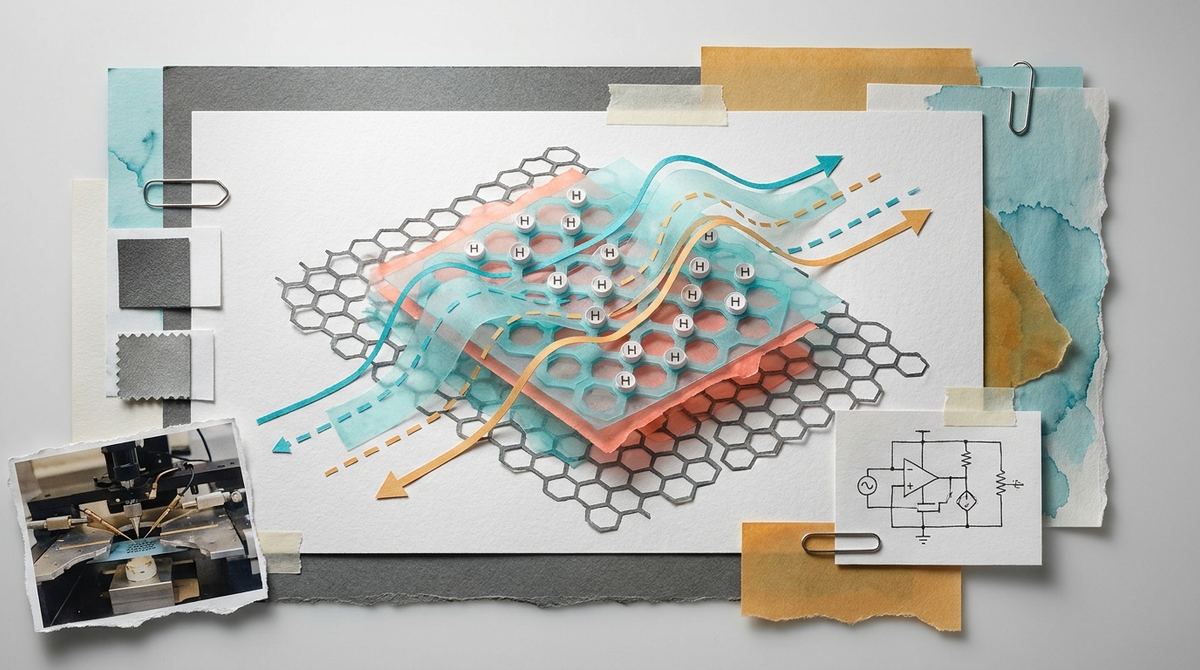
Imagine a world where technology can sense the subtle vibrations of molecules or communicate at speeds far beyond our current limits. This future relies on the terahertz portion of the electromagnetic spectrum, a range of frequencies that sits between microwaves and infrared light. While this spectrum is incredibly useful, controlling it has proven difficult because traditional materials lack the necessary responsiveness. The solution may lie in the precise manipulation of graphene, a single layer of carbon atoms, by turning it into a highly engineered landscape of hydrogen atoms.
The fundamental challenge in using graphene for high-speed optoelectronics lies in its unique electronic structure. In its natural state, graphene is a semimetal, meaning its conduction and valence bands meet at a single point known as the Dirac point. Because there is no energy gap between these bands, electrons move through graphene with incredible speed and minimal resistance. While this makes graphene an excellent conductor for traditional electronics, it presents a major hurdle for creating excitons.
An exciton is a quasiparticle formed when an electron becomes separated from the hole it left behind, and the two remain bound together by electrostatic forces. For many advanced technologies, particularly those involving light-matter interaction, we need these excitons to stay together long enough to do useful work. In standard graphene, however, the high density of mobile electrons creates a phenomenon called electrical screening. This screening effectively masks the attraction between the electron and the hole, causing the exciton to fall apart almost immediately. Without stable excitons, the ability to use graphene for sophisticated light-based technologies in the terahertz range remains out of reach.
The researchers propose a way to "tame" these electrons by changing the surface of the graphene. By attaching hydrogen atoms to specific spots on the carbon lattice, they can transform the electrical properties of the sheet. This process, known as hydrogenation, changes the carbon atoms from a flat, highly conductive state into a more insulating state.
The real breakthrough comes from not just adding hydrogen randomly, but arranging it in a perfectly repeating pattern. This pattern creates what is known as a superlattice. Think of it like a flat, smooth highway that suddenly has a series of perfectly spaced hills and valleys. These hills and valleys create a new set of rules for how electrons can move. By carefully designing the pattern of these hills and valleys, we can create areas where electrons and holes are forced to stay near each other, effectively preventing the screening effect and allowing stable excitons to exist.
To understand the mechanics of this system, we must look at the chemistry of carbon bonding. In pristine graphene, each carbon atom is sp2 hybridized, meaning it forms three strong bonds within a flat, hexagonal plane. This configuration is responsible for the highly conductive, massless nature of the charge carriers. When hydrogen is introduced, the carbon atoms undergo a transition to sp3 hybridization. This change shifts the geometry from a flat plane to a tetrahedral structure, which significantly alters the electronic landscape by opening up a bandgap.
The research focuses on creating a superlattice by alternating these sp2 and sp3 regions in a periodic arrangement. This periodicity introduces a new scale of physics. When a periodic potential is applied to a material, it creates a new Brillouin zone, which is a way of mapping the momentum of electrons. In these graphene superlattices, the new periodic potential from the hydrogen atoms "folds" the electronic bands. This folding can create "flat bands," where the velocity of the electrons is significantly reduced.
When electrons are slowed down in these flat bands, their kinetic energy decreases, making them much more susceptible to the electrostatic pull of a hole. This reduction in kinetic energy counteracts the screening effect that usually destroys excitons in graphene. Because the energy required to excite these electrons into the newly formed gaps corresponds to the terahertz frequency range, these superlattices become ideal candidates for generating and manipulating terahertz excitons.
In the theoretical framework explored by Vasil A. Saroka, Olivia Pulci, and Marco D'Alessandro, the research demonstrates that the periodic potential of a hydrogenated superlattice is capable of supporting stable excitonic states. The study focuses on the mathematical and physical feasibility of these states existing within the terahertz energy regime.
The findings suggest that by tuning the geometry and the periodicity of the hydrogenated pattern, one can precisely control the energy of the resulting excitons. This is a significant theoretical step forward because it proves that the electronic structure of graphene can be engineered to facilitate light-matter interactions that were previously thought to be impossible in such a highly conductive material. The research provides a roadmap for how to design the specific patterns required to achieve these results, moving the concept from a theoretical possibility toward a practical engineering goal.
The ability to control excitons in the terahertz range would be a transformative development for multiple scientific and industrial sectors. Currently, the terahertz "gap" is a major bottleneck in spectroscopy and imaging. Terahertz radiation is non-ionizing, meaning it is safe for biological tissues, and it is highly sensitive to the molecular structure of various substances. If we can develop graphene-based devices that interact efficiently with these waves, we could create ultra-sensitive sensors.
Furthermore, the ability to manipulate these quasiparticles opens the door to a new generation of high-speed communications. As we move toward 6G and beyond, the demand for hardware that can process signals at terahertz frequencies will grow exponentially. Graphene superlattices offer a way to bridge the gap between traditional semiconductor technology and the ultra-fast requirements of future networks.
While the theoretical results are promising, there is a significant gap between mathematical models and physical reality. One of the primary limitations is the precision required for fabrication. To achieve the predicted effects, the hydrogen atoms must be placed with atomic-scale accuracy in a perfectly repeating pattern. Current manufacturing techniques, such as chemical vapor deposition or ion implantation, often introduce defects or random variations that could disrupt the superlattice structure.
Additionally, the stability of the hydrogenated layer must be addressed. Hydrogen can sometimes detach from the carbon lattice or react with other environmental factors, which would change the material's properties over time. Future research will need to focus on finding ways to stabilize these patterns and ensuring that the device remains functional under various operating temperatures and pressures. Experimental verification through advanced scanning tunneling microscopy and spectroscopic techniques will be essential to confirm these theoretical predictions.
The practical utility of hydrogenated graphene superlattices spans several high-tech industries. In the field of security and defense, terahertz-based scanners can identify concealed materials or explosive residues by analyzing how they interact with terahertz waves. A device based on these graphene superlattices could provide much higher resolution and sensitivity than current technologies.
In the medical field, terahertz imaging offers a way to inspect skin tissue or biological samples without the harmful radiation associated with X-rays. This could lead to new diagnostic tools that are safer for repeated use. Additionally, in the realm of computing, the transition to terahertz-speed electronics could lead to a massive leap in processing power, enabling more complex artificial intelligence tasks to be performed directly on hardware with minimal energy consumption.
If you take away only one concept from this research, let it be this: by using hydrogen to create a repeating pattern on graphene, we can overcome the material's natural tendency to hide electrical charges, allowing us to control light and information at the incredible speeds of the terahertz spectrum.
What exactly is a superlattice in this context? A superlattice is a structure that is created when a material is modified with a new, much larger periodic pattern. In this case, instead of looking at just the individual carbon atoms, we look at the pattern created by the arrangement of hydrogen atoms across the graphene sheet. This new pattern changes how the electrons move through the material.
Why is graphene's conductivity a problem for excitons? In normal graphene, electrons are so mobile and there are so many of them that they act like a crowd of people blocking a doorway. When an electron and a hole try to bond to form an exciton, the surrounding electrons rush in to shield them from each other's electrical pull. This screening makes the bond too weak to hold, causing the exciton to break apart almost instantly.
How does adding hydrogen help? When hydrogen is attached to graphene, it changes the bonding of the carbon atoms. Instead of the flat, conductive structure, the carbon takes on a different shape called tetrahedral. This changes the electronic properties of the material, creating gaps in the energy levels. When we arrange these hydrogenated spots in a pattern, we create a landscape that can trap and control electrons.
What is the terahertz frequency range? Terahertz radiation refers to electromagnetic waves with frequencies between 0.1 and 10 trillion hertz. This is a very specific part of the spectrum that sits between the microwave frequencies used for Wi-Fi and the infrared light we feel as heat. It is uniquely useful because it can "see" through many materials without damaging them.
Is this technology ready for consumer electronics? Not yet. The research discussed here is currently in the theoretical and computational modeling stage. While the physics suggests that these excitons can exist, engineers still need to find ways to manufacture these specific patterns with perfect precision and ensure they are stable enough for long-term use in real-world devices.
The work conducted by Vasil A. Saroka, Olivia Pulci, and Marco D'Alessandro represents a sophisticated approach to materials engineering. By moving beyond the limitations of pristine graphene and embracing the complexity of hydrogenated superlattices, scientists are finding new ways to manipulate the fundamental building blocks of electricity. While the path to commercial terahertz devices remains filled with engineering challenges, the theoretical foundation laid here provides a crucial guide for the next generation of ultra-fast, light-sensitive technology.
Serious about B2B integration? Test our premium Pulsed Electrical Resistive Carbon Heating turbostratic graphene in your lab. 100g sample packs available now.
Explore More
Researchers revisit a graphene, n-heptane, and permalloy system, observing apparent ideal diamagnetism at ambient conditions, a key property of superconductors.

Researchers are using artificial intelligence to autonomously discover optimal recipes for growing graphene, a breakthrough in AI-driven graphene synthesis...

Explore how environment-dependent tight-binding models, derived from ab initio principles, are revolutionizing materials simulation for graphene applications.