
AI-Powered Characterization of Twisted Bilayer Graphene and 2D Materials
Learn how deep learning is revolutionizing the structural characterization of twisted bilayer materials, accelerating the development of next-generation...
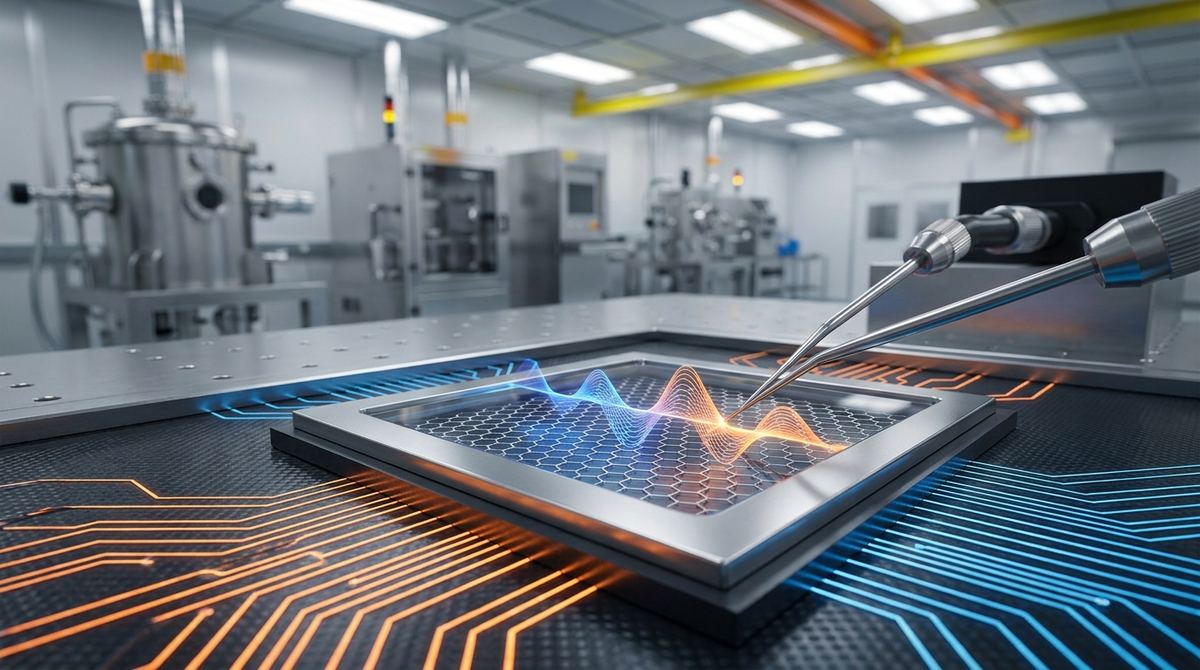
Imagine a mirror that does not just reflect light, but actually changes the color of that light the moment it hits the surface. In our current technology, if we want to change the frequency of a signal, we usually rely on bulky components or complex circuitry that converts one signal into another through heavy energy consumption. However, a new frontier in physics suggests that we can achieve this much more elegantly by using a material that can change its very identity in real-time. By using graphene—a single layer of carbon atoms—scientists are finding ways to create "smart" cavities that can manipulate light and radio waves with unprecedented precision. This research, led by Ioannis M. Koutzoglou, Stamatios Amanatiadis, Nikolaos V. Kantartzis, and Theodosios D. Karamanos, explores the mathematical and physical frameworks required to turn these theoretical possibilities into predictable engineering tools.
Modern communication systems and photonic devices are currently facing a significant bottleneck. Most traditional resonators and cavities, which are used to trap and manage electromagnetic waves, are static. Once a device is manufactured, its physical dimensions and its material properties are fixed. If you want a resonator that operates at a specific frequency, you must build it to that exact size and with a specific material. This lack of flexibility makes it difficult to create highly integrated, agile devices that can jump between different frequencies or perform complex signal processing on a single chip.
Furthermore, when we attempt to change frequencies in existing systems—a process known as frequency conversion—we often face significant efficiency losses. Traditional methods for generating new frequencies, such as using non-linear crystals, can be difficult to scale down to the microchip level and often require high power to achieve effective results. As we move toward the era of 6G and ultra-fast optical computing, the industry needs a way to control light and radio waves dynamically and selectively. We need a system where the material itself responds to an external command, changing how it handles waves without the need for moving parts or massive energy inputs.
The solution lies in a concept called time-modulation. Imagine you are playing a note on a guitar, but while the note is ringing, you rapidly change the tension of the strings. The pitch of the note would shift or create new tones. This is essentially what researchers are proposing to do with light and radio waves, but instead of changing the tension of a string, they are changing the electrical conductivity of a graphene sheet.
Graphene is a "miracle material" because its electrical properties are highly tunable. By applying a small voltage, you can change how many electrons are moving through the graphene, which in turn changes how much the material resists or conducts electricity. If you pulse this voltage at a very high frequency, you are effectively "modulating" the conductivity of the material over time. When an electromagnetic wave enters a cavity lined with this time-modulated graphene, it no longer sees a static wall. Instead, it sees a boundary that is constantly changing. This temporal change forces the wave to exchange energy with the modulation source, resulting in the creation of new frequencies, or harmonics, which can be precisely controlled.
To understand how this works at a technical level, we have to look at the relationship between graphene's structure and its conductivity. Graphene consists of a single layer of carbon atoms arranged in a hexagonal lattice. The electrons in this lattice behave like massless particles, moving through the material in a way that makes their conductivity highly sensitive to their environment. The conductivity of graphene is not just a fixed number; it is a function of the carrier density, which is the concentration of electrons or "holes" available to move.
When researchers apply a time-varying electrical signal to the graphene, they are effectively oscillating the carrier density. This oscillation causes the complex conductivity of the graphene to become time-dependent. In the context of electromagnetic theory, the conductivity of a material is what dictates how it interacts with an electric field. If the conductivity changes in time, the boundary conditions for the electromagnetic waves inside the cavity also change in time.
This creates a phenomenon known as parametric interaction. When a wave with a frequency of $\omega$ hits a boundary that is vibrating at a frequency of $\Omega$, the wave can undergo frequency mixing. This results in the emergence of new frequencies, known as sidebands or harmonics, located at $\omega \pm n\Omega$, where $n$ is an integer. Because the researchers can control both the strength and the frequency of the modulation ($\Omega$), they can essentially "program" the cavity to produce specific frequencies. The "generalized conductivity model" developed in this research provides the mathematical roadmap for calculating exactly how these waves will behave, ensuring that the energy from the modulation is transferred to the desired frequency rather than being lost to heat or unwanted noise.
The work of Koutzoglou, Amanatiadis, Kantartzis, and Karamanos provides a rigorous mathematical framework for understanding these interactions. One of the most significant findings is the ability to achieve selective harmonic amplification. In many previous models, modulating a material simply created a messy spectrum of many different frequencies, most of which were useless for practical communication. This research shows that by carefully designing the conductivity profile and the modulation parameters, it is possible to direct the energy into a single, specific harmonic.
This selectivity is crucial. It means the device can act as a highly efficient frequency converter that produces a clean, predictable signal. The researchers demonstrated that the generalized model can account for various scenarios, including different types of graphene-based cavities and different modulation schemes. Their modeling shows that by tuning the modulation parameters, one can control the amplitude and the phase of the generated harmonics. This level of control is what transforms a chaotic phenomenon into a precise engineering tool. They have essentially moved the field from observing a phenomenon to being able to model and predict it with high accuracy.
This research is significant because it bridges the gap between fundamental physics and practical device engineering. By providing a generalized model, the researchers have given engineers a blueprint for designing next-generation photonic and electronic components. If we can accurately predict how a time-modulated graphene cavity will behave, we can design integrated circuits that are much more powerful and much smaller than anything currently available.
The ability to selectively amplify specific frequencies means we can create "on-chip" signal processors. Currently, signal processing often requires multiple stages of components to change, clean, and route signals. A single graphene-based cavity could theoretically perform several of these tasks simultaneously by using different modulation frequencies. This would lead to a massive reduction in the physical footprint of communication hardware and a significant improvement in energy efficiency, as the energy used for modulation can be used to actually boost the signal strength.
While these theoretical and mathematical advancements are profound, it is important to distinguish between a successful mathematical model and a commercially ready product. This research is currently in the modeling and theoretical verification stage. There are several significant engineering hurdles that must be overcome before these cavities can be used in your smartphone or computer.
First, the speed of the modulation is a critical factor. To manipulate high-frequency waves, such as those used in millimeter-wave or terahertz communications, the electronics used to modulate the graphene must be incredibly fast and extremely precise. Developing these ultra-fast control circuits is a significant challenge in itself. Second, material quality and manufacturing consistency remain issues. Graphene is notoriously sensitive to its environment; any impurities, defects, or substrate interactions can change its conductivity in ways that are difficult to control. Finally, there is the issue of thermal management. The process of modulating conductivity involves moving charge carriers, which generates heat. In a high-speed, high-frequency device, managing this heat is essential to prevent the device from degrading or losing efficiency.
The potential real-world applications for time-modulated graphene cavities are vast and span several industries. In the realm of telecommunications, this technology could be a cornerstone of 6G networks. As we move into higher frequency bands like the Terahertz spectrum, the ability to manipulate signals on-chip without massive losses will be essential for ultra-high-speed data transmission.
In the field of optical computing, these cavities could act as high-speed switches or frequency converters for light-based signals. This would allow for much faster processing speeds than current silicon-based electronic computers. Furthermore, in the world of sensing and spectroscopy, these devices could be used to create highly sensitive detectors. By modulating the cavity, researchers could create signals that are very easy to distinguish from background noise, allowing for the detection of extremely minute chemical or physical changes in an environment. Finally, the concept of non-reciprocal devices—components that allow waves to travel in only one direction—could be implemented using these cavities, potentially replacing large, bulky magnets with tiny, efficient graphene-based components.
If you take away only one concept from this research, let it be this: the ability to change a material's properties in time allows us to control light and radio waves in ways that static materials never could, turning a simple sheet of carbon into a highly sophisticated, programmable tool for the next generation of electronics.
What exactly is a graphene cavity? A graphene cavity is a microscopic structure that traps electromagnetic waves, such as light or radio signals, within a confined space. This trapping allows the waves to interact repeatedly with the surfaces of the cavity, which can be used to strengthen a signal or change its frequency. By using graphene as the lining for these walls, we can make the cavity's properties change instantly through electrical control.
Why is time-modulation so important for this technology? Traditional materials are static, meaning their properties do not change once the device is built. Time-modulation allows us to break this limitation by changing the material's conductivity while a wave is passing through it. This dynamic interaction allows us to transfer energy from the modulation source to the wave, which can change its frequency or amplify its strength in a very controlled manner.
How does graphene enable this frequency change? Graphene is unique because its electrical conductivity is highly sensitive to the number of charge carriers present in its lattice. By applying an external voltage, we can precisely control how many electrons are moving through the graphene. When this voltage is pulsed rapidly, the material's conductivity fluctuates, which forces the electromagnetic waves inside the cavity to shift their frequencies to maintain the laws of physics.
What is the difference between a messy signal and selective harmonic amplification? When you modulate a material, you don't just get one new frequency; you often get a whole series of them, which can look like noise. Selective harmonic amplification is the ability to tune the system so that the energy goes into one specific, useful frequency while suppressing all the other unnecessary ones. This is what makes the technology practical for real-world communication.
Is this technology ready to be used in everyday electronics like smartphones? Currently, no. This research is highly advanced in terms of theoretical modeling and mathematical proof, but it is still in the scientific research phase. Engineers still need to solve significant challenges regarding the speed of the control electronics, the manufacturing consistency of the graphene, and the management of heat generated during high-speed operation.
The research conducted by Koutzoglou, Amanatiadis, Kantartzis, and Karamanos represents a significant step forward in the field of condensed matter physics and applied optics. By developing a generalized conductivity model for time-modulated graphene cavities, they have provided the mathematical foundation necessary to move toward a new class of dynamic, programmable photonic and electronic devices. While the path from theoretical modeling to a commercial microchip is filled with engineering challenges, the potential to revolutionize communication, computing, and sensing through the precise control of light and radio waves is immense. As we continue to master the ability to manipulate materials in time, we move closer to a future where our electronic devices are as agile and responsive as the signals they process.
Serious about B2B integration? Test our premium Pulsed Electrical Resistive Carbon Heating turbostratic graphene in your lab. 100g sample packs available now.
Explore More
Learn how deep learning is revolutionizing the structural characterization of twisted bilayer materials, accelerating the development of next-generation...

Learn to build a prototype graphene FET biosensor for sensitive DNA detection. This guide covers materials, fabrication, and testing for point-of-care...

Discover how hopping-mediated charge transport explains graphene's electrical behavior beyond the ideal ballistic regime, a key insight for creating...