
A New Era of Graphene Engineering: Pre-Designing Twist Angles on Demand
Researchers have developed a breakthrough method for growing twisted bilayer graphene with pre-designed angles, a key step toward manufacturable quantum...
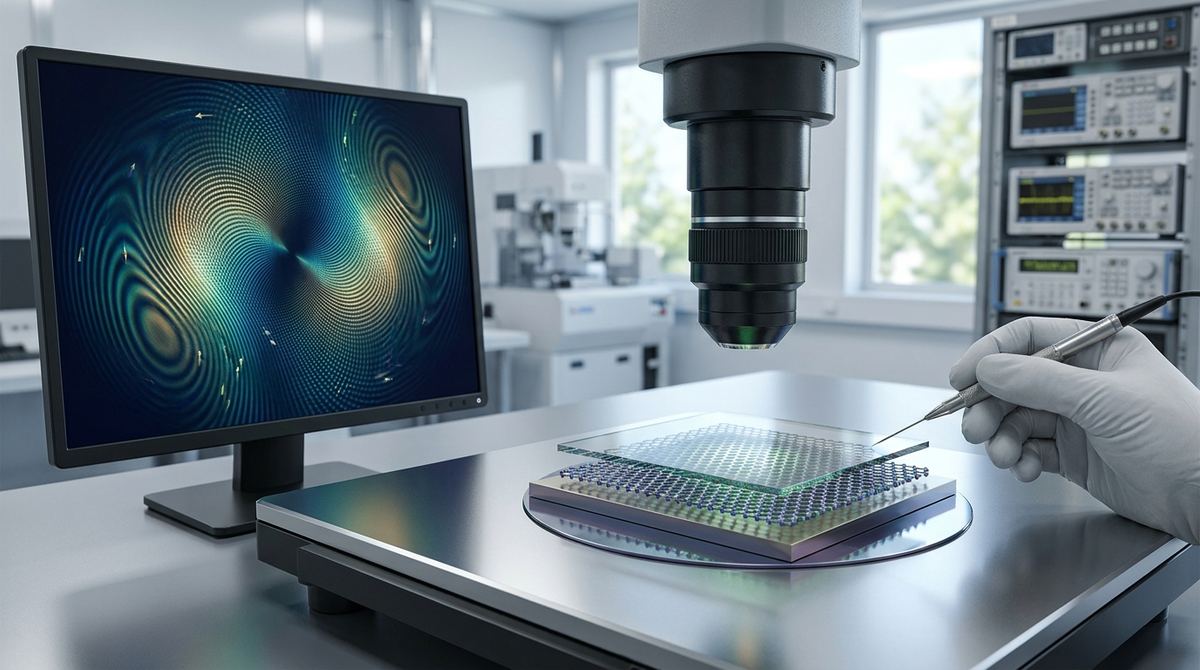
Imagine a world where the fundamental properties of a material—its ability to conduct electricity or its magnetic behavior—are not fixed by its chemical makeup, but can be tuned simply by rotating it. In the traditional world of silicon chips, we change how a material behaves by adding impurities, a process called doping. But in the emerging realm of twistronics, we achieve this control through pure geometry. By slightly misaligning the crystal lattices of two-dimensional materials, we create beautiful, repeating interference patterns known as moiré patterns. These patterns act as a new, much larger landscape for electrons to inhabit. Recent research has taken this concept a step further by exploring what happens when we stack more than two layers, creating a complex hierarchy of patterns that can actually exert physical force on the material itself.
For decades, the semiconductor industry has relied on the chemical modification of materials to dictate their electrical performance. While highly effective, this method is inherently limited by the atomic structure of the material itself. Once a crystal is doped with specific atoms, its properties are largely set. As we move toward the limits of miniaturization in quantum computing and high-speed electronics, we require a level of precision that chemical doping struggle to provide. We need a way to manipulate electronic states with surgical accuracy without introducing the structural defects and chemical irregularities that often come with traditional doping.
Furthermore, the field of two-dimensional materials has moved beyond simple single-layer graphene. While a single sheet of graphene is a spectacular conductor, its properties are mostly fixed. When we stack multiple layers, the physics becomes exponentially more complex. In a bilayer system, you have one moiré pattern. But as soon as you add a third layer, you introduce a second interface, creating a secondary layer of interference. Managing the interaction between these multiple periodicities has been a significant challenge for physicists. We have lacked a precise way to understand how these multiple overlapping patterns—the double-moiré effect—interact with one another and how they can be used to control the movement of electrons.
The core concept driving this research is the idea of commensuration. In geometry, two patterns are commensurate if they can be aligned perfectly so that their repeating units match up in a predictable, rational ratio. Think of it like two different mesh screens being laid over one another. If the holes in both screens line up perfectly every few inches, the patterns are commensurate. If they never quite line up perfectly, they are incommensurate.
In the quantum world, when these atomic patterns reach a commensurate state, the energy of the electrons moving through them changes drastically. This change in energy is not just an abstract mathematical concept; it has physical consequences. The researchers have found that when these layers are rotated toward a commensurate angle, the system experiences a "commensuration torque." This is essentially a mechanical force that tries to pull the layers into the most energetically favorable alignment. By understanding and measuring this torque, we gain a direct way to observe and manipulate the quantum states of these complex, layered systems.
To understand how this works, we must look at the specific components of the heterostructure. The system described by Youngju Park, Nicolas Leconte, Prathap Kumar Jharapla, Md Shaifullah, E. H. Hwang, and Jeil Jung consists of a trilayer stack involving graphene and hexagonal boron nitride (hBN). Graphene is a single layer of carbon atoms arranged in a hexagonal lattice, famous for its exceptional conductivity. Hexagonal boron nitride is its insulating cousin; it has a similar hexagonal structure, but because the atoms are different, it does not conduct electricity.
When we stack these materials, we create a heterostructure. In a trilayer setup, we might have a layer of graphene sandwiched between two layers of hBN, or an hBN layer on top of a twisted graphene bilayer. This creates two distinct interfaces. Each interface generates its own moiré pattern based on the relative twist angle between the two specific layers. Because the two patterns have different periodicities, they create a "double-moiré" superlattice. This is a much larger, more complex periodic landscape than what is found in a simple bilayer.
As electrons move through the graphene layer, they do not just see the individual atoms of carbon. Instead, they see the periodic potential created by the moiré patterns of the surrounding hBN layers. This periodic potential acts as a landscape of hills and valleys for the electrons. If the twist angle is changed, the spacing and shape of these hills and valleys change. When the twist angle reaches a specific value where the two moiré patterns align in a mathematically consistent way, the electronic landscape becomes highly ordered and stable. At this precise moment, the electronic energy of the system drops, creating a mechanical pull—the commensuration torque—that acts on the physical structure of the stack.
The researchers discovered that the commensuration torque is a direct, measurable signature of the electronic state of the system. By precisely rotating the layers using specialized mechanical tools, the team observed that the system responds to the changes in its own electronic energy. As the twist angle approaches a commensurate value, the electronic properties of the graphene undergo significant shifts, such as changes in conductivity or the appearance of new quantum states.
Crucially, the research demonstrates that the mechanical torque is not just a side effect but a fundamental way to probe the underlying physics. The torque is the physical manifestation of the system seeking its lowest energy state. When the layers are in an incommensurate state, the energy landscape is messy and unpredictable. But as the rotation brings the layers into a commensurate state, the sudden drop in electronic energy creates a measurable mechanical moment. This means that the mechanical movement of the crystal is intimately and directly linked to the quantum behavior of the electrons, providing a bridge between the world of classical mechanics and quantum electronics.
This discovery is significant because it provides a new tool for the field of twistronics. In previous studies, researchers often had to rely solely on electrical measurements to infer what was happening to the electrons. However, electrical measurements can sometimes be noisy or difficult to interpret in complex multi-layer systems. The ability to measure a physical torque provides a much cleaner, more direct way to determine exactly when a material has reached a specific quantum state.
Furthermore, it suggests that we can use mechanical rotation as a control knob for quantum matter. If we can precisely control the torque or the angle of these layers, we can switch the material between different electronic states. This level of control is essential for developing next-generation technologies that rely on quantum interference and highly specific electronic configurations. It moves the field from simply observing moiré patterns to actively engineering and manipulating the mechanical-quantum interface.
While this research is a breakthrough, it is important to recognize that these effects are currently observed under very controlled laboratory conditions. These heterostructures must be fabricated with atomic-scale precision, a process that is incredibly slow, expensive, and difficult to scale for mass production. Currently, we can only create these perfectly aligned stacks through specialized methods like mechanical exfoliation and dry transfer, which are not suitable for large-scale industrial manufacturing.
Additionally, much of this behavior is most pronounced at extremely low temperatures. In the quantum regime, thermal energy can disrupt the delicate moiré patterns and the electronic states they create. For these "commensuration torques" to be useful in everyday consumer electronics, we would need to find ways to stabilize these states at room temperature. The research currently provides a proof of concept in the fundamental physics realm, but the path to commercial application requires overcoming significant engineering hurdles in fabrication and thermal stability.
The implications for future technology are vast. In the realm of quantum computing, the ability to tune electronic states through geometry could lead to the creation of new types of qubits. If we can use the commensuration of moiré patterns to stabilize specific quantum states, we might create more robust and error-resistant quantum processors.
In the field of sensing, these materials could lead to ultra-sensitive rotation and strain sensors. Because the electronic properties are so sensitive to the twist angle, a device could detect incredibly minute mechanical changes, making it useful in everything from navigation systems to advanced medical imaging.
Finally, the principles of twistronics could revolutionize the semiconductor industry. We may eventually see "twistronic transistors" that operate not by shifting charge through a doped semiconductor, but by subtly altering the geometry of the layers to switch the current on or off. This would allow for much higher speeds and much lower power consumption than current silicon-based technology, as the switching mechanism is based on structural alignment rather than moving large amounts of charge through a medium.
If you remember only one thing from this research, let it be this: geometry is the new chemistry. In the future of advanced materials, we will not just change what a material is made of; we will change how it behaves by changing how its atoms are aligned.
What is a moiré pattern in these materials? A moiré pattern is an interference effect that occurs when two periodic structures, such as the crystal lattices of graphene and boron nitride, are placed on top of each other at a slight angle. This creates a new, much larger periodic pattern that is not present in either of the individual materials alone.
Why is hexagonal boron nitride used in this research? Hexagonal boron nitride is used because it is an ideal substrate for graphene. It is an atomically flat insulator that does not have the same electronic properties as graphene, meaning it provides a pristine, clean environment that allows the unique properties of the graphene to emerge without interference from the substrate itself.
What does "commensurate" actually mean? In the context of these twisted layers, being commensurate means that the periodicities of the different layers align in a specific, mathematically simple ratio. When this alignment occurs, the electronic landscape of the material becomes highly ordered and reaches a state of minimum energy.
How does twisting a material change its electrical properties? Twisting changes the spacing and the orientation of the moiré superlattice. This superlattice creates a new potential for the electrons to move through, essentially creating a new set of rules for how they can move, which can turn a conductor into an insulator or change its magnetic properties.
How can a physical rotation produce a measurable torque? The electrons in the material want to reach the lowest energy state possible. When the layers are rotated, the electronic energy changes. This change in energy creates a physical force as the system tries to reach the most stable, commensurate alignment, and this force manifests as a measurable mechanical torque.
The work conducted by Youngju Park, Nicolas Leconte, Prathap Kumar Jharapla, Md Shaifullah, E. H. Hwang, and Jeil Jung represents a significant leap in our understanding of two-dimensional heterostructures. By uncovering the relationship between commensuration torques and the electronic states in double-moiré systems, they have opened a new window into the interplay between mechanical motion and quantum physics. As we move from the study of single layers to complex, multi-layered architectures, the ability to harness these geometric effects may well become the cornerstone of the next revolution in electronic and quantum technology.
Serious about B2B integration? Test our premium Pulsed Electrical Resistive Carbon Heating turbostratic graphene in your lab. 100g sample packs available now.
Explore More
Researchers have developed a breakthrough method for growing twisted bilayer graphene with pre-designed angles, a key step toward manufacturable quantum...

Learn how deep learning is revolutionizing the structural characterization of twisted bilayer materials, accelerating the development of next-generation...

Learn to build a prototype graphene FET biosensor for sensitive DNA detection. This guide covers materials, fabrication, and testing for point-of-care...