
Nature's Nanotech: Graphene and Blue Emission Found in Bee Hives
Researchers discover naturally formed graphene sheets and carbon ovals in stingless bee hives, creating a novel emergent material with powerful blue light...
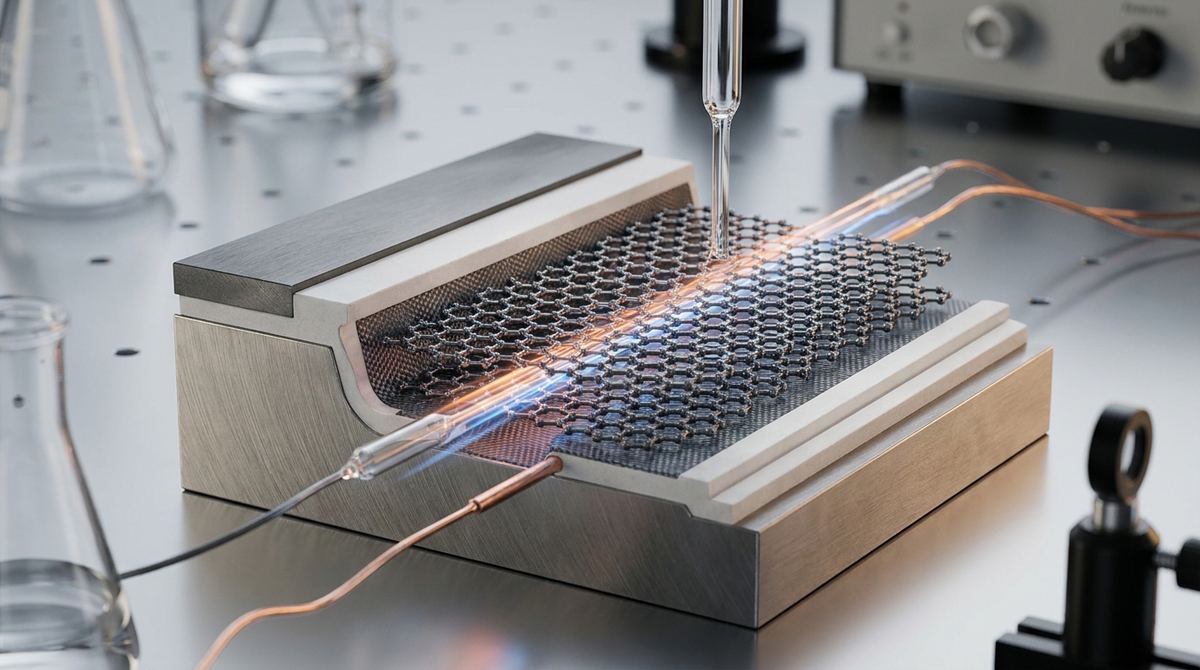
Imagine a world where we can control the flow of heat with the same precision that a one-way street controls the flow of traffic. In our current era of electronics, heat is an enemy—a chaotic byproduct that slows down computers and threatens the stability of delicate quantum calculations. As we move toward a future of ultra-fast, nanoscale technology, we face a fundamental barrier: how do we manage heat when it becomes a quantum phenomenon? This is where the revolutionary work of Hadi Mohammed Soufy and Colin Benjamin enters the conversation. Their research into magic-angle twisted bilayer graphene suggests a way to create a microscopic valve, a device capable of directing the flow of heat in a single direction, effectively acting as a universal thermal machine.
The primary obstacle in the next generation of computing, particularly quantum computing, is thermal management. In traditional silicon-based processors, heat is dissipated through bulky heat sinks and fans. However, as we shrink components down to the atomic scale, the rules of physics change. In quantum systems, heat is not just a temperature rise; it is a source of noise that causes decoherence. Decoherence is the process where a quantum system loses its information because it interacts with its environment, often due to the random movement of heat-carrying particles.
When a quantum bit, or qubit, is subjected to even a tiny amount of unwanted thermal energy, its delicate state of superposition can collapse, rendering the computation useless. Therefore, engineers need a way to isolate quantum components from heat or to move heat away from sensitive areas without allowing it to leak back in. The problem is that traditional thermal conductors are passive; they allow heat to flow from hot to cold, but they cannot "rectify" it—they cannot act as a one-way street. To solve this, we need a device that can break the symmetry of thermal transport, allowing heat to escape a system while preventing it from re-entering.
The solution proposed by the researchers involves a specialized form of carbon called magic-angle twisted bilayer graphene. By taking two single layers of graphene and stacking them with a very specific rotation—exactly 1.1 degrees—the material undergoes a radical transformation. This slight twist creates a pattern called a Moire superlattice, which fundamentally changes how electrons move through the material. In this state, the graphene becomes a superconductor, meaning it can conduct electricity with zero resistance.
The breakthrough idea is to turn this superconducting material into a Josephson diode. A diode is a component that allows current to flow in one direction but not the other. While standard diodes work with electricity, a Josephson diode uses quantum mechanical effects to create this one-way street. By applying this concept to heat, the researchers suggest we can create a thermal machine. Instead of just conducting heat, this device would act as a thermal valve, controlling the direction of heat-carrying particles to maintain the precise, cold environments required for high-performance quantum technology.
To understand how this works, we must look at the complex dance of atoms and electrons within the graphene layers. Graphene is a single layer of carbon atoms arranged in a hexagonal lattice. When you place two such layers on top of each other, their atomic structures normally align. However, when they are rotated by the magic angle, the overlapping lattices create an interference pattern known as a Moire pattern. This pattern is much larger than the individual atoms, creating a new, periodic landscape for the electrons.
In regular graphene, electrons behave as massless particles, moving very fast across the surface. But the Moire superlattice creates what physicists call flat bands. In a flat band, the kinetic energy of the electrons is nearly zero, meaning they are no longer racing through the material. Instead, they become highly sensitive to one another. These intense electron-electron interactions are what trigger superconductivity. In this state, electrons pair up into Cooper pairs, allowing them to flow through the material without losing any energy to friction or resistance.
The Josephson effect occurs when these two superconducting regions are separated by a thin barrier, creating a junction. In a standard Josephson junction, the flow of Cooper pairs is symmetric; they can move back and forth with equal ease. However, by breaking the symmetry of the system—through an external electric field, mechanical strain, or the inherent geometry of the twist—the researchers can create a non-reciprocal response. This is the diode effect.
In the context of a thermal machine, we are not just looking at the movement of electrons, but the movement of quasiparticles. Heat in these materials is carried by these quasiparticles, which are collective excitations of the electrons. Because the Josephson diode breaks the symmetry of the system, it also breaks the symmetry of how these quasiparticles move. The device creates a landscape where it is energetically favorable for quasiparticles to move in one direction but highly unfavorable for them to move in the opposite direction. This directional preference is the essence of thermal rectification, turning the graphene stack into a functional thermal machine.
The research conducted by Soufy and Benjamin indicates that the magic-angle twisted bilayer graphene system can serve as a universal thermal machine. This is a significant theoretical finding because it suggests that the device's ability to control heat is not limited to a single specific temperature or state, but is a fundamental property of the system's quantum architecture. The findings imply that by tuning the voltage or the angle of the twist, the directionality and efficiency of the heat flow can be manipulated.
The study highlights that the non-reciprocal transport of quasiparticles is a direct result of the broken symmetry within the Moire superlattice. This means that the device does not rely on bulky mechanical parts to move heat, but rather on the fundamental quantum properties of the material itself. This allows for a level of control that is impossible with traditional materials. The researchers demonstrate that the system can effectively manage the flux of energy, providing a pathway to stabilize the thermal environment of a microscopic system.
The implications of this research are profound for the future of nanotechnology and quantum computing. If we can master the ability to control heat at the atomic scale, we can overcome one of the most significant hurdles in computing. Currently, quantum computers require massive, expensive dilution refrigerators to keep them near absolute zero. A device that can act as a one-way thermal valve could allow for much more efficient "on-chip" thermal management.
Beyond quantum computing, this research provides a new framework for understanding how heat and electricity interact in low-dimensional materials. As we move toward ultra-dense integrated circuits, where heat becomes a dominant factor in device failure, the ability to rectify heat flow could lead to more reliable and powerful nano-electronics. This research bridges the gap between fundamental quantum physics and practical thermal engineering, offering a blueprint for devices that can manipulate energy at its most fundamental level.
While the findings are highly promising, it is important to distinguish these theoretical and experimental observations from commercially ready technology. One of the most significant limitations is the extreme precision required to create the magic-angle twist. A deviation of even a fraction of a degree can destroy the Moire superlattice and the resulting flat bands, rendering the device useless. Scaling this process from a laboratory setting to a mass-manufacturing environment remains a massive engineering challenge.
Furthermore, the effects observed in these graphene systems typically require extremely low temperatures to maintain the superconducting state. While the research suggests the potential for a universal thermal machine, the current reality is that these devices operate in cryogenic environments. For this to be useful in consumer electronics, we would need to find ways to achieve similar non-reciprocal thermal transport at room temperature, which is a much more difficult physics problem. Finally, more testing is needed to determine the long-term stability of these twisted structures and how they perform under the continuous heat flux they are designed to manage.
The potential applications for magic-angle Josephson diodes are vast. In the realm of quantum information science, these devices could be integrated directly into quantum processor architectures. They could act as thermal shields for individual qubits, pumping heat away from the processing core and preventing it from leaking back into the sensitive quantum circuits. This would enable more stable, larger-scale quantum computers.
In the field of nano-electronics, these devices could be used to create highly efficient thermal rectifiers for heat-management in microchips. As chips become more dense, managing the localized hot spots that occur in high-performance processors becomes critical. A graphene-based thermal diode could provide a way to move heat away from these critical spots without the need for bulky cooling systems. Additionally, these materials could be used in highly sensitive thermal sensors, where the direction and magnitude of heat flow are used to detect minute temperature changes at the molecular level.
If you remember only one thing from this research, let it be this: magic-angle twisted bilayer graphene provides a way to create a quantum valve that can direct the flow of heat in one direction, offering a revolutionary way to manage temperature in the delicate world of nanoscale and quantum technologies.
Question: What is a Josephson diode and how does it differ from a normal diode?
Answer: A normal diode is a semiconductor device that allows electricity to flow in one direction but not the other. A Josephson diode is a quantum device that uses the principles of superconductivity and the Josephson effect to achieve this one-way flow. Instead of relying on the properties of silicon, it relies on the quantum tunneling of electron pairs through a barrier.
Question: Why is the magic angle so important in graphene research?
Answer: The magic angle, which is approximately 1.1 degrees, is the specific rotation required to create a Moire superlattice. This superlattice creates flat energy bands where electrons move much more slowly, allowing their interactions to become strong enough to create exotic states of matter like superconductivity. Without this precise angle, the material behaves like standard graphene and does not show these unique properties.
Question: Can these devices work at room temperature for everyday electronics?
Answer: Currently, the phenomena described in this research, such as superconductivity, require extremely cold, cryogenic temperatures. While the research suggests the potential for universal thermal machines, achieving these effects at room temperature is a separate and much more difficult challenge that scientists are still working to solve.
Question: How does heat move through a superconductor?
Answer: In a superconductor, heat is not carried by individual moving electrons in the same way it is in a normal metal. Instead, heat is transported by quasiparticles, which are collective excitations of the superconducting state. These quasiparticles carry energy through the lattice and the electron fluid, and the Josephson diode effect allows us to control their direction.
Question: What is a Moire pattern in the context of graphene?
Answer: A Moire pattern is an interference pattern that emerges when two periodic structures, like the lattices of two sheets of graphene, are stacked with a slight rotation. This pattern creates a new, much larger periodic structure that changes the electronic landscape of the material, leading to the formation of the flat bands necessary for the research findings.
The research into MATBG Josephson diodes represents a significant leap in our ability to manipulate heat at the quantum scale. By leveraging the unique properties of magic-angle twisted bilayer graphene, scientists like Hadi Mohammed Soufy and Colin Benjamin are paving the way for a new generation of thermal machines. While significant engineering hurdles remain—particularly regarding manufacturing precision and operating temperatures—the ability to create a one-way street for heat could be the key to unlocking the full potential of quantum computing and advanced nano-electronics. As we continue to master the art of twisting carbon layers, we move closer to a future where heat is no longer a chaotic obstacle, but a controlled and predictable component of our technological landscape.
Serious about B2B integration? Test our premium Pulsed Electrical Resistive Carbon Heating turbostratic graphene in your lab. 100g sample packs available now.
Explore More
Researchers discover naturally formed graphene sheets and carbon ovals in stingless bee hives, creating a novel emergent material with powerful blue light...

Discover how rippled graphene pores act as fluidic memristors, enabling advanced synaptic functionalities for the next generation of neuromorphic computing.

Learn how to use electromechanical responses in gapped graphene to measure electronic temperature and band gaps using traveling flexural waves.