
Unlocking Quasicrystal Physics in 30-Degree Twisted Bilayer Graphene
Research on 30° quasi-periodic twisted bilayer graphene reveals a unique, fractal-like energy structure under magnetic fields, paving the way for novel...
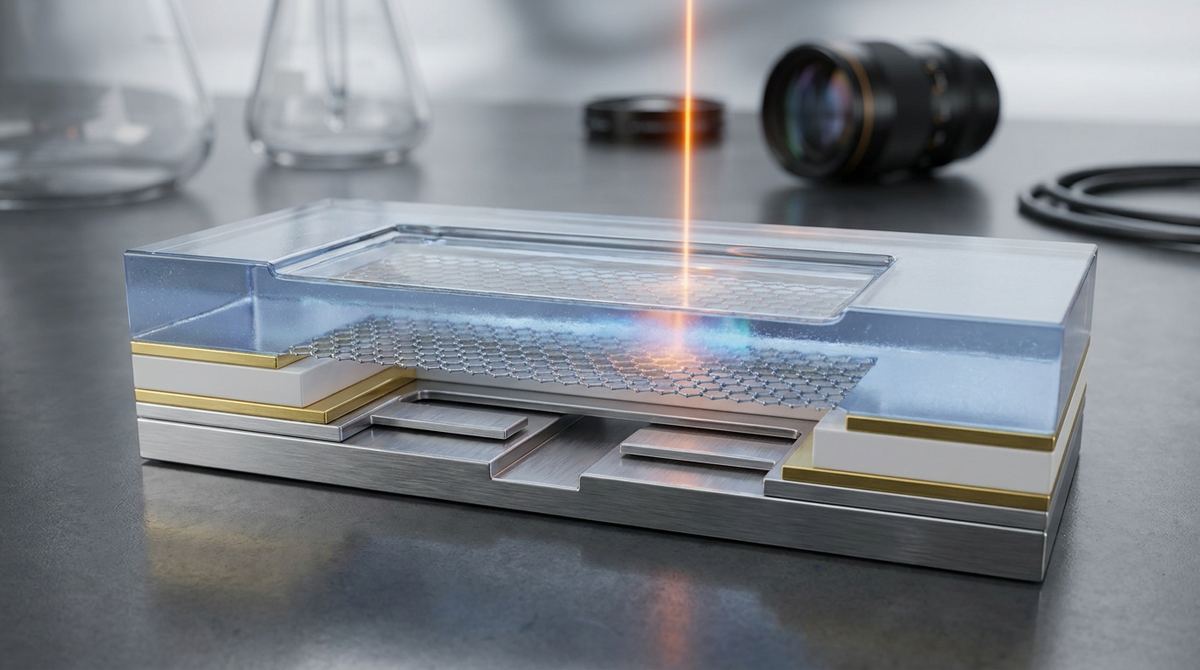
Imagine a world where light and matter are so tightly entwined that they lose their individual identities, merging into a new kind of hybrid particle. This phenomenon, known as strong coupling, is the cornerstone of next-generation quantum technologies. Scientists have long hypothesized that if you could push this interaction to an extreme, you might trigger a sudden, massive shift in the very nature of the system—a superradiant phase transition. This would be a sudden, spontaneous burst of light caused by the collective behavior of many particles. However, recent investigations into the behavior of graphene suggest that this particular quantum leap might be off-limits in certain high-tech materials. This discovery is not a failure, but a vital map for engineers, telling them exactly where the boundaries of quantum control exist.
In a recent and significant study, researchers Elsa Jöchl, Felix Helmrich, Frieder Lindel, Lucy Hale, Lorenzo Graziotto, Mona Jarrahi, Tobia F. Nova, Jérôme Faist, and Giacomo Scalari have explored the fundamental limits of these interactions. Their work focuses on the behavior of Dirac Landau polaritons, a highly specialized state where light and electrons in graphene interact under the influence of a magnetic field. By examining these systems, the team has provided clarity on why certain predicted quantum states might never manifest in the specific environment of graphene.
The central challenge in modern condensed matter physics is the pursuit of the ultra-strong coupling regime. In this regime, the interaction between a collection of emitters—such as atoms or electrons—and a light field becomes so intense that the vacuum state of the system changes. Theoretically, this should lead to a superradiant phase transition, a sudden reorganization of the system where light becomes a macroscopic part of the ground state. If achieved, this would open doors to entirely new ways of computing, sensing, and communicating.
However, theoretical models used in the past were often based on simplified systems, like collections of identical atoms that behave like simple harmonic oscillators. These simplified models predicted that as the coupling strength increases, a phase transition is inevitable. But graphene, a material with much more complex electronic properties, does not follow the same rules as these traditional models. Physicists needed to determine if the unique nature of electrons in graphene would permit or prevent such a transition. The problem was to bridge the gap between idealized mathematical models and the complex, real-world physics of Dirac fermions.
To understand this research, we must first understand what a polariton is. Think of a polariton as a hybrid creature, part light and part matter. When a photon (a particle of light) travels through a material and interacts very strongly with an electron, they become inseparable. They move together as a single entity called a polariton.
Next, we must consider the Dirac fermion. In most materials, electrons behave like little balls with mass that move in predictable ways. In graphene, however, the electrons behave as if they have no mass at all. They move at incredibly high speeds, mimicking the behavior of light particles. These are called Dirac fermions.
Finally, there is the Landau level. When you apply a magnetic field to graphene, it forces these fast-moving electrons into circular orbits. Because of quantum mechanics, these orbits can only happen at specific energy levels. These discrete energy steps are called Landau levels. The research explores what happens when these specific, energy-stepped electrons interact with light to form polaritons, specifically looking for that sudden "superradiant" switch.
The mechanics of this system rely on the interplay between the electronic structure of graphene and an external magnetic field. In a standard semiconductor, the energy levels created by a magnetic field—the Landau levels—are spaced evenly, much like the rungs on a ladder. This uniformity is essential for the collective synchronization required for a superradiant phase transition. If every rung is the same distance apart, it is easy for the system to transition into a new state where all particles act in unison.
Graphene changes the game entirely. Because of the Dirac nature of its electrons, the energy levels in graphene are not evenly spaced. Instead, the distance between the energy levels decreases as you move to higher energies. This non-linearity is a fundamental property of the Dirac spectrum. As the magnetic field strength is adjusted, the spacing between these Landau levels shifts in a square-root relationship rather than a linear one.
When this graphene is placed inside a micro-cavity, a device designed to trap light, the photons in the cavity begin to interact with these non-equally spaced Landau levels. The coupling strength depends on how well the energy of the light matches the energy gaps between the electronic levels. Because the gaps are changing as you move through the energy spectrum, the system cannot maintain the consistent, rhythmic interaction needed to reach the threshold for a superradiant phase transition. The structure of the material itself acts as a natural disruptor of the collective synchronization.
The study by Jöchl, Helmrich, and the team ultimately found an absence of the superradiant phase transition in Dirac Landau polaritons. Despite the intense coupling between the light and the electrons, the system did not undergo the sudden, spontaneous change in its ground state that theorists had predicted using older, simpler models.
The reason for this absence is rooted in the non-linearity mentioned earlier. The researchers demonstrated that the energy-level spacing in graphene is fundamentally incompatible with the conditions required for a superradiant phase transition. In a standard system, the energy levels allow for a collective resonance that can "pump" the vacuum state into a new phase. In the Dirac Landau system, the varying distances between the energy levels prevent this coherence from building up. The non-linearity of the spectrum acts as a barrier, effectively "smearing" the interaction and preventing the system from reaching the critical threshold necessary to trigger the transition. This finding proves that the Dirac nature of the particles fundamentally alters the rules of light-matter coupling.
While the absence of a transition might sound like a negative result, in the world of physics, it is incredibly significant. It provides a "no-go" boundary that is essential for future engineering. For decades, scientists have been searching for ways to achieve a superradiant phase transition to create new quantum technologies. This research tells us that if we are looking for this specific phenomenon, graphene's Landau levels are not the place to find it.
This result forces theorists to refine their models and look for other ways to achieve the transition. It clarifies that the "Dirac" nature of a material is not just a curiosity, but a fundamental constraint on how light and matter can behave. For engineers, this means they can stop chasing a specific type of phase transition in these systems and instead focus on the immense potential of the "strong coupling" regime that graphene does offer, which is different from the "superradiant" regime.
It is important to note that this research does not mean that graphene is useless for quantum light applications. It simply means that this specific phase transition is not achievable through this specific mechanism. The study focuses on a specific set of conditions: the interaction between Dirac Landau levels and light in a controlled environment.
Further testing is required to see if different configurations might yield different results. For example, by changing the geometry of the graphene, or by using different types of magnetic fields, could the non-linearity be overcome? Additionally, the effect of temperature remains a critical factor. Most of these quantum effects are most visible at extremely low temperatures, and understanding how thermal noise interacts with Dirac Landau polaritons will be a crucial next step for practical applications.
Even without the superradiant phase transition, the study of Dirac Landau polaritons has profound implications for real-world technology. The ability to control how light interacts with electrons in graphene is essential for the development of ultra-fast optoelectronic devices.
One major area is mid-infrared photonics. Graphene is highly sensitive to infrared light, and by tuning the magnetic field, researchers can control how the material absorbs or emits specific frequencies. This could lead to incredibly precise sensors for detecting chemical signatures or environmental changes.
Another application is in the field of quantum sensing. Even without a phase transition, the strong coupling between light and matter can be used to create sensors that are far more sensitive than anything currently available. These sensors could be used in medical imaging or in deep-space communication, where detecting the tiniest change in a signal is paramount.
Finally, the research contributes to the development of high-speed optical switches. By manipulating the electronic states of graphene with magnetic fields, it may be possible to create switches that control light at much higher speeds than current silicon-based technology allows.
If you take away only one thing from this research, let it be this: the unique way electrons move in graphene fundamentally changes how they interact with light, setting a physical limit that prevents a specific type of quantum transition from occurring.
What is a polariton? A polariton is a hybrid particle that emerges when light and matter interact so strongly that they lose their individual identities. Instead of having a separate photon and a separate electron, they become a single entity that shares the properties of both. This is essential for quantum technologies because it allows us to control light using the electrical properties of materials.
Why is graphene special in this context? Graphene is special because its electrons behave as if they have no mass, moving at incredibly high speeds. This makes them "Dirac fermions." This unique behavior leads to energy levels (Landau levels) that are spaced unevenly, which is different from most other materials.
What is a superradiant phase transition? This is a theoretical state where a collection of particles, like electrons, suddenly and spontaneously begins to interact with light in a massive, synchronized way. This would result in a sudden burst of light or a change in the fundamental state of the system.
Why did the researchers find that the transition doesn't happen in graphene? The transition requires all the energy levels to be spaced predictably so they can synchronize. Because graphene's energy levels are spaced unevenly due to the nature of Dirac fermions, the particles cannot achieve the collective synchronization needed to trigger the transition.
Does this mean graphene is bad for quantum research? Not at all. While it might not show this specific phase transition, graphene still allows for "strong coupling," which is a very useful state for creating high-speed switches, advanced sensors, and new types of infrared detectors.
The work conducted by Jöchl, Helmrich, and their colleagues provides a vital boundary for the field of quantum optics. By proving that the superradiant phase transition is absent in Dirac Landau polaritons, they have provided a clear map of the physical limits imposed by the unique electronic structure of graphene. This research underscores the importance of understanding the fundamental "no-go" zones in physics, ensuring that future engineers and scientists focus their efforts on the most promising pathways for the next generation of quantum technologies.
Serious about B2B integration? Test our premium Pulsed Electrical Resistive Carbon Heating turbostratic graphene in your lab. 100g sample packs available now.
Explore More
Research on 30° quasi-periodic twisted bilayer graphene reveals a unique, fractal-like energy structure under magnetic fields, paving the way for novel...

Researchers discover naturally formed graphene sheets and carbon ovals in stingless bee hives, creating a novel emergent material with powerful blue light...

Discover how rippled graphene pores act as fluidic memristors, enabling advanced synaptic functionalities for the next generation of neuromorphic computing.