
Unlocking Quasicrystal Physics in 30-Degree Twisted Bilayer Graphene
Research on 30° quasi-periodic twisted bilayer graphene reveals a unique, fractal-like energy structure under magnetic fields, paving the way for novel...
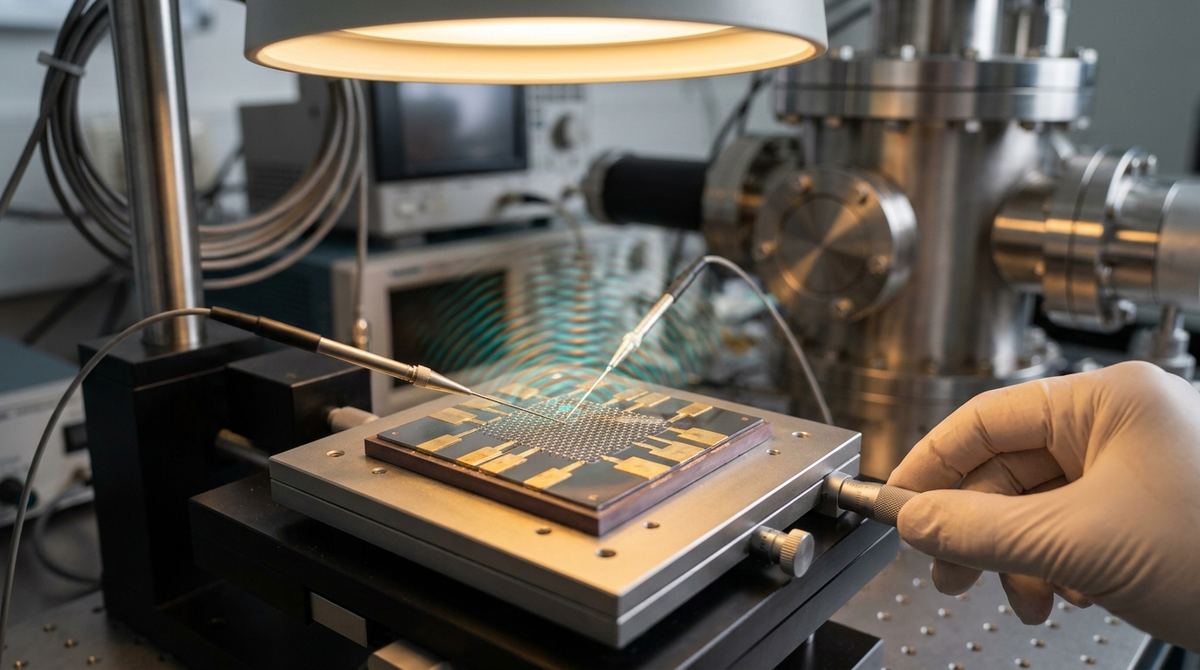
Imagine a world where wireless communication moves at speeds impossible to achieve with current technology, or where security scanners can identify hidden substances through complex packaging with perfect clarity. This future relies heavily on the terahertz frequency range, a part of the electromagnetic spectrum that sits between microwaves and infrared light. Controlling these waves is incredibly difficult because they are hard to generate and even harder to manipulate. However, recent theoretical and experimental investigations suggest that by using a specialized "sandwich" made of graphene and a semiconductor, we can use the interference of two lasers to catch and control these elusive waves. This research, spearheaded by Rohit Kumar Srivastav and Mrityunjay Kundu, explores a fascinating method to trigger resonant oscillations called magnetoplasmons, which could revolutionize how we handle ultra-fast signals.
The scientific community faces a significant hurdle known as the terahertz gap. While we have excellent tools for generating microwaves (used in Wi-Fi) and infrared light (used in remote controls), the terahertz regime remains notoriously difficult to bridge. Current electronic components are simply too slow to operate at terahertz frequencies because the physical movement of electrons in traditional semiconductors cannot keep up with the rapid oscillations of the waves. Conversely, traditional optical components are often too large or lack the ability to be tuned dynamically.
There is a fundamental mismatch between the speed of electronics and the speed of light. To bridge this gap, researchers need a medium that combines the best of both worlds: the incredible speed of light and the tunable, controllable nature of electronic carriers. Additionally, simply having a fast material is not enough; we need a way to excite specific modes of light, known as plasmons, that stay confined to a surface. These surface waves are much smaller than the wavelength of the light itself, which is essential for miniaturizing future technology. Without a way to efficiently excite these surface waves at specific frequencies, the terahertz regime will remain a difficult frontier for high-speed data and high-resolution sensing.
The breakthrough idea presented by Srivastav and Kundu involves using two different lasers to create a "beat" frequency. When you play two musical notes that are very close in pitch together, you hear a rhythmic pulsing or "beating" effect. This is exactly what happens when two laser beams with slightly different frequencies interact. Instead of just seeing two separate colors, the surface of the material perceives a new, slower rhythm caused by their interference.
By using p-polarized light—light where the electric field vibrates in a way that allows it to push electrons directly into the material—this rhythmic beating can be used to strike a "resonant" chord within the electrons of the graphene layer. When the rhythm of the laser beating matches the natural frequency at which the electrons want to wobble, you get resonance. This resonance excites surface magnetoplasmons, which are essentially dense packets of energy that travel along the surface of the material. This method allows scientists to control these fast-moving waves using much slower, more manageable laser rhythms.
To understand why this system works, we must look at the specific chemistry and physics of the materials involved. The system consists of a layer of graphene sitting atop an n-type Indium Antimonide (InSb) substrate. Graphene is a single layer of carbon atoms arranged in a hexagonal lattice. Its most important feature is its extremely high electron mobility, meaning electrons can move through it with very little resistance. This high mobility is the reason graphene can respond so quickly to light.
The substrate, n-type Indium Antimonide, is a semiconductor that has been "doped" with extra electrons. This provides a reservoir of charge carriers that can interact with the graphene. The interface where these two materials meet is the most critical part of the device. When p-polarized lasers hit this interface, the electric field component perpendicular to the surface acts as a driver, pushing the electrons back and forth.
The reason the "beating" is so effective lies in the concept of momentum matching. Normally, light waves move too fast and have too much momentum to easily transfer that energy into surface waves like plasmons. However, the interference between the two lasers creates a temporal modulation. This modulation acts like a bridge, allowing the high-frequency energy of the lasers to be converted into the specific, localized vibrations required to excite magnetoplasmons. The presence of the magnetic field (or the effect of the light's magnetic component) further splits the electron oscillations, creating these "magneto" plasmons, which are more stable and controllable than standard plasmons.
Through their investigation, Srivastav and Kundu demonstrated that the combination of graphene and n-type InSb provides a highly efficient environment for the resonant excitation of these waves. They found that by carefully choosing the frequency and polarization of the two lasers, they could precisely target the resonance of the surface magnetoplasmons.
Specifically, the research highlighted that the resonance is highly sensitive to the carrier density in both the graphene and the InSb. This sensitivity is actually a benefit; it means the frequency of the excited plasmons can be tuned by adjusting the electrical charge in the material. The study confirmed that the beating of two p-polarized lasers creates a robust mechanism for driving these oscillations, effectively overcoming the traditional barriers that make terahertz excitation so difficult. The results show that this hybrid graphene-semiconductor structure creates a unique electromagnetic environment that supports highly localized and controllable surface waves.
The ability to excite and control surface magnetoplasmons at terahertz frequencies is a major step forward for several reasons. First, it provides a way to achieve "sub-wavelength" control. Because these plasmons are confined to the surface and are much smaller than the light waves that created them, they allow us to manipulate light on a scale much smaller than traditional optics would allow. This is the key to miniaturization.
Second, it offers a tunable mechanism. In traditional systems, if you want a different frequency, you often need to change the hardware. In this graphene-InSb system, you can change the frequency of the excited waves simply by changing the voltage applied to the graphene or by slightly adjusting the laser frequencies. This flexibility is vital for the development of future communication networks that need to jump between different frequency bands to avoid congestion. Finally, it provides a potential pathway for high-efficiency terahertz sources, which have been a "holy grail" for physicists for decades.
While the results are scientifically significant, it is important to distinguish these findings from a finished commercial product. This research is primarily a fundamental study of the physical mechanisms at play. Transitioning from a theoretical or laboratory-scale experiment to a commercial device involves many hurdles.
One major limitation is the complexity of the setup. Using two precisely synchronized lasers to create a "beat" frequency is much more difficult than using a single light source, making integrated, on-chip devices a significant engineering challenge. Additionally, the quality of the graphene-InSb interface is paramount. Any defects, impurities, or structural irregularities at the junction can scatter the electrons, causing the plasmons to lose energy quickly (a phenomenon known as damping). Researchers still need to determine how these materials will behave in real-world environments where temperature fluctuations and manufacturing imperfections are common. The current work establishes the physics, but the engineering of a robust, scalable device remains a work in progress.
The practical implications of this research are vast and span several high-tech industries. In the realm of telecommunications, this could be a cornerstone for 6G technology. As we move toward much higher data rates, the ability to manipulate terahertz waves with extreme precision will be necessary to handle the massive influx of data from the Internet of Things and autonomous systems.
In the field of security and sensing, terahertz waves are famous for their ability to "see" through many non-metallic materials, such as clothing, plastics, and ceramics. If we can use graphene-based plasmonic sensors to detect specific molecular signatures at terahertz frequencies, we could create ultra-sensitive scanners for detecting explosives, narcotics, or even certain types of biological pathogens in a much more compact and portable format.
Medical imaging is another frontier. Terahertz radiation is non-ionizing, meaning it does not damage DNA like X-rays do. This makes it much safer for biological applications. A device based on these findings could potentially lead to high-resolution, non-invasive imaging techniques that can distinguish between healthy and cancerous tissue based on their unique dielectric properties.
If you take away only one concept from this research, let it be this: the combination of graphene's high-speed electrons and the rhythmic interference of two lasers provides a new, tunable way to control the elusive terahertz waves that will power the next generation of technology.
What exactly is a plasmon? A plasmon is a collective oscillation of the electrons in a material. Think of it like a wave moving through a crowded room of people; the "wave" is the movement of the crowd, even if the people themselves are just shifting back and forth in place. In this research, these waves are confined to the surface of the material.
Why is graphene so important here? Graphene is used because it is an incredibly efficient conductor for high-frequency signals. Because it is only one atom thick, its electrons are highly sensitive to external light and electric fields, making it the perfect medium to translate laser energy into surface waves.
What is the difference between microwaves and terahertz waves? Microwaves are lower in frequency and are used for things like your kitchen microwave or cellular signals. Terahertz waves are much higher in frequency, sitting just below infrared light. They carry much more information but are much harder to control and generate.
Why do we need two lasers instead of one? A single laser might not provide the right conditions to trigger the specific resonance needed for these magnetoplasmons. By using two lasers, we create a "beat frequency" through interference. This beat frequency acts as a specialized trigger that matches the natural resonance of the electrons in the graphene-semiconductor system.
Is this technology ready for my smartphone? Not yet. While the physics described by Srivastav and Kundu is a major breakthrough, it is currently in the fundamental research stage. Moving from a laboratory experiment using complex lasers to a tiny, cheap chip inside a smartphone requires many more years of engineering and material science development.
The research conducted by Rohit Kumar Srivastav and Mrityunjay Kundu offers a compelling glimpse into the future of terahertz technology. By leveraging the unique properties of graphene and the physics of optical beating, they have demonstrated a method to excite surface magnetoplasmons that could bridge the long-standing terahertz gap. While significant engineering challenges remain before these systems can be integrated into consumer electronics, the ability to precisely and tunably control light-matter interactions at this scale marks a significant milestone in the quest for faster, smaller, and more efficient communication and sensing technologies.
Serious about B2B integration? Test our premium Pulsed Electrical Resistive Carbon Heating turbostratic graphene in your lab. 100g sample packs available now.
Explore More
Research on 30° quasi-periodic twisted bilayer graphene reveals a unique, fractal-like energy structure under magnetic fields, paving the way for novel...

Researchers discover naturally formed graphene sheets and carbon ovals in stingless bee hives, creating a novel emergent material with powerful blue light...

Discover how rippled graphene pores act as fluidic memristors, enabling advanced synaptic functionalities for the next generation of neuromorphic computing.