
Nature's Nanotech: Graphene and Blue Emission Found in Bee Hives
Researchers discover naturally formed graphene sheets and carbon ovals in stingless bee hives, creating a novel emergent material with powerful blue light...
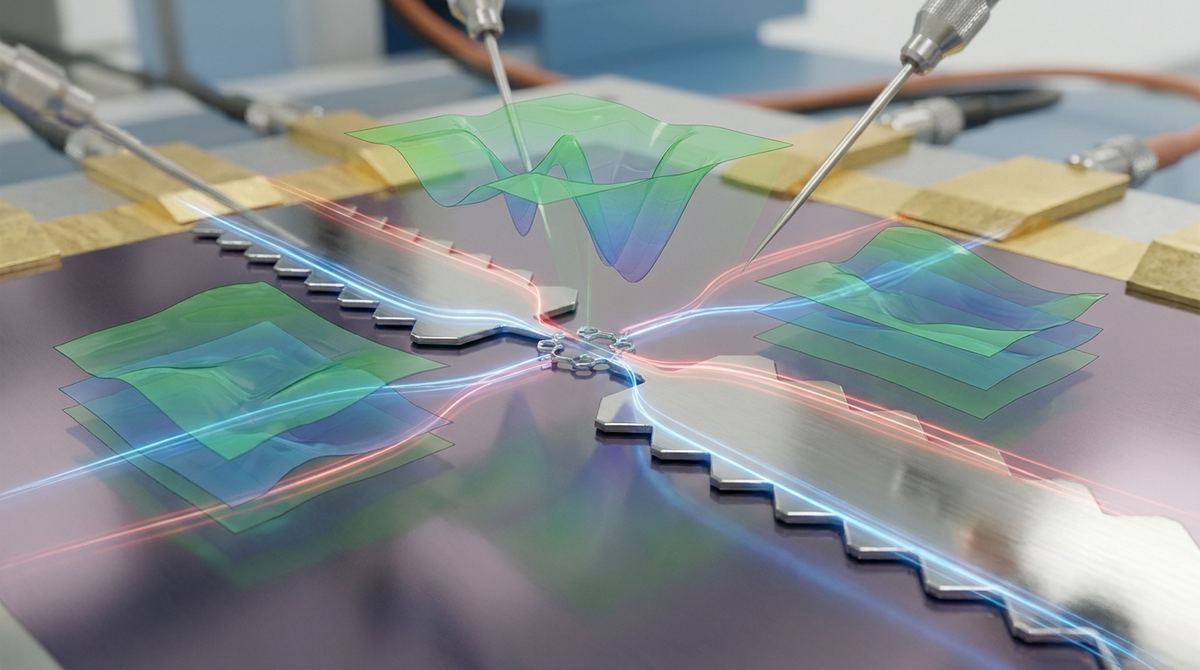
The future of computing may not lie in the movement of electrical charges, but in the manipulation of the fundamental symmetries of matter itself. In the quest to create faster, smaller, and more efficient electronic devices, scientists are looking toward the quantum realm, where the traditional rules of electricity are rewritten. One of the most promising candidates for this revolution is graphene, a single layer of carbon atoms that is incredibly conductive and incredibly versatile. However, graphene in its pure, pristine form is almost too perfect; its high degree of symmetry makes it difficult to control for specific quantum tasks. Recent theoretical breakthroughs suggest that by strategically breaking these symmetries through molecular engineering, we can unlock entirely new electronic properties. This research, conducted by R. K. Rohit, Jisvin Sam, and Sudipta Dutta, explores a sophisticated method to manipulate these symmetries by fusing a specific organic molecule into the structure of graphene nanoribbons. By doing so, they propose a way to transition from simple conduction to the complex, spin-dependent transport required for quantum information processing.
To understand the significance of this work, one must first understand the limitations of current semiconductor technology. Modern computers rely on the flow of electrons through silicon, where we control the presence or absence of charge to represent bits of information. As we shrink these components to the atomic scale, we encounter significant hurdles. Heat generation becomes a massive issue because moving charges through a material inevitably causes resistance and energy loss. Furthermore, traditional silicon-based electronics struggle to utilize the spin of an electron, a property that could theoretically allow for much higher data processing speeds and lower energy consumption.
Graphene has long been touted as the successor to silicon, but it possesses a unique problem: it lacks a natural bandgap. In electronics, a bandgap is essentially a "dead zone" that allows a material to turn off. Without a way to effectively stop the flow of electrons, graphene cannot act as a traditional transistor. While researchers have found ways to create nanoribbons to introduce a gap, the electronic properties of these ribbons are heavily dictated by their edges. In zigzag-edged graphene nanoribbons, the edge states create a high density of electrons that are extremely sensitive to their environment. While this sensitivity is useful, it also creates a lack of control. To make graphene truly useful for advanced quantum applications, we need to move beyond simple conduction and learn how to manipulate the very symmetries that govern the electrons, such as the bipartite and time-reversal symmetries.
The researchers, R. K. Rohit, Jisvin Sam, and Sudipta Dutta, suggest that we can treat graphene like a piece of fabric and the porphine molecule like a specialized stitch. In its natural state, the carbon lattice of graphene is highly balanced and symmetric, much like a perfectly woven cloth where every thread follows a repeating pattern. This balance is known as bipartite symmetry, meaning the carbon atoms can be divided into two identical-looking sublattices. When this symmetry is broken, the two sides of the lattice no longer behave the same way, which can open up a "gap" in the energy levels, effectively giving the material a way to turn on and off.
The second layer of control involves breaking time-reversal symmetry. In physics, time-reversal symmetry implies that if you were to play the movement of an electron in reverse, the physical laws would look exactly the same. Breaking this symmetry is a prerequisite for creating magnetic properties and spin-polarized currents, where electrons move based on their spin direction rather than just their charge. By inserting a porphine unit—a ring-shaped molecule—between two zigzag-edged graphene nanoribbons, the researchers aim to disrupt these symmetries. This molecular intervention acts as a precision tool, altering the electronic landscape of the nanoribbons to create new, exotic states of matter that do not exist in pure graphene.
To grasp the mechanics of this system, we must look at the architecture of the zigzag-edge graphene nanoribbon. These ribbons are nanometers wide, and their edges are characterized by a "zigzag" pattern of carbon atoms. This specific geometry causes the electronic wavefunctions to become highly localized at the edges, creating a high density of states at the Fermi level. This makes the edges extremely reactive and chemically sensitive, which is both a blessing and a curse for engineers.
The porphine molecule is a macrocyclic ligand, a ring of atoms that is remarkably stable and possesses unique electronic characteristics. When this porphine unit is fused between two of these nanoribbons, it acts as a molecular bridge. This fusion is not a simple contact; it is a chemical integration that modifies the hopping parameters of the electrons. In quantum mechanics, the hopping parameter describes how easily an electron can jump from one atom to another. By inserting the porphine, the researchers create a localized disruption in the periodic potential of the carbon lattice.
This disruption is the key to breaking bipartite symmetry. Because the porphine unit interacts differently with the two sublattices of the graphene, it creates a sublattice inequivalence. This change in the local environment causes the energy bands to shift, effectively opening a bandgap in the electronic structure. Simultaneously, the interaction between the molecular orbitals of the porphine and the edge states of the graphene introduces a mechanism to break time-reversal symmetry. This is often achieved through the introduction of spin-orbit coupling or through the magnetic moment inherent in certain molecular arrangements. When time-reversal symmetry is broken, the electrons no longer move symmetrically; instead, their paths become dependent on their spin, allowing for the creation of spin-polarized edge states.
The theoretical investigations by R. K. Rohit, Jisvin Sam, and Sudipta Dutta demonstrate that this molecular fusion leads to profound changes in the topological and electronic properties of the system. By carefully selecting the porphine unit and its orientation, it is possible to induce a topological phase transition. This means the material changes from a standard conductor to a topological insulator or a similar exotic state.
One of the most significant findings is the ability to control the electronic bandgap through molecular engineering. The researchers found that the magnitude and type of the gap produced by the porphine unit can be tuned by adjusting the chemical structure of the molecule. Furthermore, the breaking of time-reversal symmetry allows for the emergence of robust, spin-polarized edge states. These states are "topologically protected," meaning that the electrons flowing along the edges of the nanoribbons are shielded from backscattering caused by defects or impurities. In a standard conductor, an electron hitting an impurity will bounce back, creating resistance and heat. In a topologically protected state, the electron simply flows around the obstacle without losing energy, much like a river flowing around a rock rather than splashing against it.
The implications of these findings are profound for the future of materials science and microelectronics. First, the ability to open a bandgap in a carbon-based system solves one of the primary hurdles to using graphene in traditional logic circuits. If we can create a material that is both extremely small and capable of acting as a high-speed switch, we are one step closer to the end of the silicon era.
Second, the creation of spin-polarized, topologically protected edge states is a holy grail for spintronics. Spintronics is a field of electronics that uses the spin of an electron, rather than its charge, to process and store information. Because spin states are much more stable and require much less energy to manipulate than charge, spintronic devices could lead to computers that are orders of magnitude more efficient than what we have today. The ability to engineer these states using simple molecular units like porphine suggests that we do not need to rely on heavy, exotic, or rare-earth metals to achieve these quantum effects; we can use organic chemistry to do the heavy lifting.
While the theoretical results are highly promising, there is a significant gap between a mathematical model and a physical device. The study presented by Rohit, Sam, and Dutta is a theoretical framework, and the actual synthesis of such a precise molecular architecture remains a monumental challenge. Creating a single-molecule junction where a porphine unit is perfectly fused between two zigzag-edged nanoribbons requires atomic-scale precision that current manufacturing technologies struggle to achieve consistently.
Furthermore, the stability of these states under varying environmental conditions must be tested. Quantum effects like topological protection are often highly sensitive to temperature. While the research suggests these states are robust against structural defects, they may still require extremely low temperatures (near absolute zero) to remain stable in a practical device. Researchers will need to determine if these symmetry-breaking effects can be maintained at room temperature, which is essential for any consumer-grade electronic application. Finally, the scalability of this "bottom-up" molecular assembly method—where molecules are built atom by atom—needs to be proven before it can be used in a mass-production semiconductor fabrication plant.
The potential real-world applications for this research span several high-tech industries. In the realm of quantum computing, these nanoribbons could serve as the backbone for quantum interconnects or as the basis for topological qubits. Topological qubits are particularly exciting because their inherent protection against noise and decoherence could solve one of the biggest problems in quantum computing: the fragility of quantum information.
In the field of high-speed telecommunications, the energy-efficient transport of spin-polarized currents could enable ultra-fast signal processing with minimal heat generation, reducing the cooling requirements for massive data centers. Additionally, the extreme sensitivity of these symmetry-broken edge states to external fields makes them ideal candidates for the next generation of quantum sensors. These sensors could be used in everything from medical imaging at the molecular level to detecting minute magnetic fluctuations in geological surveys.
If there is one takeaway from this research, it is that the future of electronics lies in "symmetry engineering." By using organic molecules to strategically break the mathematical symmetries of carbon lattices, we can transform graphene from a simple conductor into a sophisticated tool for quantum information and ultra-efficient spintronics.
What is a zigzag-edge graphene nanoribbon?
A zigzag-edge graphene nanoribbon is a narrow strip of carbon atoms where the edge of the strip follows a jagged, zigzag pattern. This specific shape is important because it causes electrons to cluster at the edges, creating unique electronic properties that are not found in flat, wide sheets of graphene.
Why is breaking symmetry important in physics?
Symmetry often means that a material is uniform and predictable, which is great for certain things but bad for others. By breaking symmetries, like the balance between two sublattices or the direction of time, we can force electrons to behave in new ways, such as moving only in one direction or carrying spin information.
What role does the porphine molecule play?
The porphine molecule acts as a precision bridge between two graphene ribbons. It is used because its chemical structure allows scientists to disrupt the natural balance of the graphene's atomic lattice, which is necessary to create a bandgap and induce magnetic or topological properties.
What is the difference between traditional electronics and spintronics?
Traditional electronics rely on the flow of electrical charge to process information. Spintronics uses the "spin" or the intrinsic angular momentum of the electron. This is a much more efficient way to handle data because spin states can be manipulated with very little energy and are more stable for quantum calculations.
Can we use this technology in our smartphones today?
Not yet. This research is currently in the fundamental, theoretical stage. While it provides a roadmap for what might be possible, the challenge of manufacturing these molecular structures with perfect precision and at room temperature means it is likely many years, if not decades, away from consumer products.
The work of R. K. Rohit, Jisvin Sam, and Sudipta Dutta represents a vital step toward the integration of molecular chemistry and quantum physics. By demonstrating how the fusion of a porphine unit can break bipartite and time-reversal symmetries in graphene nanoribbons, they have provided a blueprint for creating new classes of materials. As we move toward a future defined by quantum computing and ultra-efficient spintronics, the ability to engineer matter at the molecular level will be the defining factor in technological progress. The transition from simple charge-based conduction to complex, symmetry-driven quantum transport may well be the breakthrough that defines the next era of human computing.
Serious about B2B integration? Test our premium Pulsed Electrical Resistive Carbon Heating turbostratic graphene in your lab. 100g sample packs available now.
Explore More
Researchers discover naturally formed graphene sheets and carbon ovals in stingless bee hives, creating a novel emergent material with powerful blue light...

Discover how rippled graphene pores act as fluidic memristors, enabling advanced synaptic functionalities for the next generation of neuromorphic computing.

Learn how to use electromechanical responses in gapped graphene to measure electronic temperature and band gaps using traveling flexural waves.