
Unlocking Quasicrystal Physics in 30-Degree Twisted Bilayer Graphene
Research on 30° quasi-periodic twisted bilayer graphene reveals a unique, fractal-like energy structure under magnetic fields, paving the way for novel...
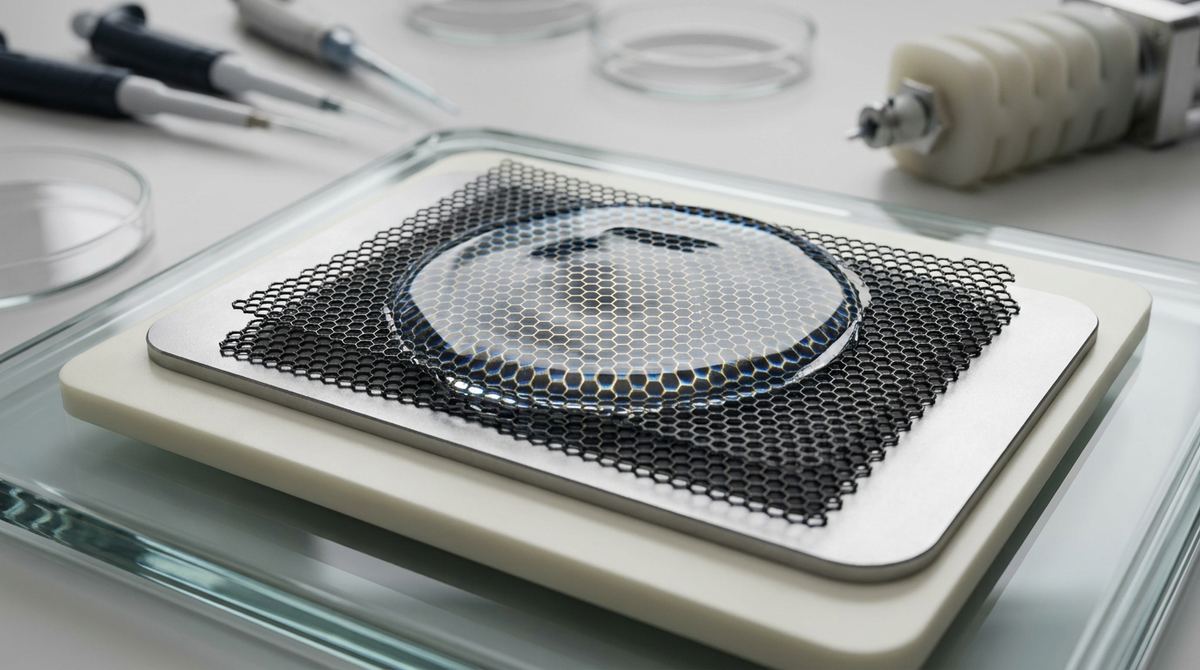
Imagine two sheets of paper, both printed with a fine grid of tiny dots. If you lay them perfectly on top of one another, the dots align, and you see a single, clear grid. But if you rotate one sheet by just a tiny fraction of a degree, a spectacular new pattern emerges—large, swirling waves of light and shadow that were not present on either individual sheet. This phenomenon, known as a moiré pattern, is the fundamental principle behind one of the most exciting frontiers in modern physics: twisted bilayer graphene. By simply twisting two layers of carbon atoms, scientists can create entirely new states of matter, including superconductivity and exotic magnetism, that do not exist in ordinary graphene. However, in the real world, these layers are never perfectly placed; they are subject to tiny, unavoidable stretches and pulls known as strain. Understanding how this strain alters the material's magical properties is the focus of groundbreaking new theoretical work. In a recent study, Eyal Keshet, Yaar Vituri, and Erez Berg have introduced a sophisticated mathematical framework to help scientists navigate this complexity. By utilizing a method known as loop expansion, they have provided a way to calculate how physical deformation affects the delicate electronic dancing ground of these twisted carbon layers. This research represents a critical step in moving from observing these strange effects to actually controlling them for future technologies.
To understand why this research is so vital, we must first understand the extreme sensitivity of twisted bilayer graphene. When two layers of graphene are stacked at a specific, narrow angle—often called the magic angle—the electrons within the material begin to behave in highly unusual ways. In standard graphene, electrons zip through the carbon lattice with incredible speed, making it an excellent conductor. But at the magic angle, the moiré pattern creates a landscape where the electrons slow down significantly. Because they are moving so slowly, they start to "feel" each other's presence more strongly. This is what physicists call a strongly correlated system. In these systems, the movement of a single electron is intimately tied to the movement of all its neighbors, leading to collective behaviors like superconductivity, where electricity flows with zero resistance.
The problem is that this delicate electronic balance is incredibly fragile. In a laboratory setting, it is nearly impossible to create a perfectly pristine, unstrained bilayer system. The process of transferring graphene layers onto a substrate almost always introduces some level of mechanical strain. This strain acts as a disruptive force, twisting the moiré pattern and shifting the energies of the electrons. If the strain is too high or too uneven, the magic of the material disappears, and the superconductivity or topological properties vanish. For years, physicists have struggled to model these systems because the math required to account for both the strong electron interactions and the physical deformation of the lattice is overwhelmingly complex. Standard mathematical tools often fail when interactions are this strong, leaving scientists to guess how much strain a material can endure before its useful properties are lost.
The researchers, Keshet, Vituri, and Berg, approached this problem by using a clever mathematical strategy called loop expansion. To understand loop expansion without a degree in theoretical physics, imagine you are trying to predict the movement of a person walking through a crowded ballroom. If you only look at the person's individual steps, you might get a rough idea of their path. But to truly understand their movement, you have to account for how they bump into others, how the crowd shifts in response to them, and how the floor itself might be slightly uneven. A simple calculation might cover the person's basic steps, but to get a highly accurate prediction, you have to account for the "loops" of interaction—the complex, circular ways that people influence one another in a crowded space.
In the realm of quantum physics, loop expansion works similarly. Instead of trying to solve the entire, chaotic interaction of trillions of electrons all at once, physicists start with a simplified model of how the electrons behave. They then systematically add "loops" to their equations. Each loop represents a more complex layer of interaction. The first loop might account for simple collisions, while subsequent loops account for more intricate, multi-particle interactions. By adding these layers of complexity one by one, researchers can build a highly accurate mathematical map of the system. The brilliance of the work by Keshet, Vituri, and Berg lies in how they applied this loop expansion specifically to the problem of strain. They developed a way to incorporate the physical stretching and pulling of the graphene lattice into these complex interaction loops, allowing them to see how strain ripples through the quantum states of the electrons.
To appreciate the scale of this mathematical achievement, one must understand the underlying physics of the moiré superlattice. Graphene is a single layer of carbon atoms arranged in a hexagonal honeycomb pattern. When you take two such layers and rotate them, the hexagonal lattices do not line up perfectly. This misalignment creates a new, much larger periodic pattern called a moiré superlattice. This superlattice acts like a new playground for electrons. It effectively creates "flat bands" in the electronic energy spectrum. In a normal material, electrons have a lot of kinetic energy, which makes them move quickly. In a flat band, the kinetic energy is nearly zero.
When the kinetic energy is minimized, the potential energy—the energy resulting from how electrons repel or attract one another—becomes the dominant force. This is where the "strong correlation" happens. Because the electrons aren't rushing past each other, they spend more time in close proximity, allowing their mutual electrostatic repulsion to dictate their behavior. This interaction is the engine behind the exotic states of matter found in twisted bilayer graphene. However, the geometry of this playground is dictated by the precise angle of the twist and the uniformity of the layers.
Strain enters the equation by distorting the hexagons. If you pull on one side of the graphene sheet, the hexagons become elongated or compressed. This changes the local area of the moiré pattern. Because the electronic properties are so strictly tied to the geometry of the pattern, even a microscopic change in the shape of the hexagons can radically shift the energy of the electrons. This is essentially like changing the shape of the ballroom floor while the dancers are mid-step; the dancers (the electrons) will have to change their rhythm and pattern to accommodate the new terrain. The researchers have provided the mathematical toolkit to predict exactly how that change in rhythm will occur.
The primary contribution of Keshet, Vituri, and Berg is a theoretical framework that allows for the controlled study of these strained systems. Their work demonstrates that it is possible to use the loop expansion method to systematically account for the way mechanical strain perturbs the electronic states in twisted bilayer graphene. Specifically, they have shown how the "pseudomagnetic fields" generated by strain interact with the existing electronic landscape. In these materials, strain doesn't just physically move atoms; it acts on the electrons as if a magnetic field were being applied, even if no actual magnet is present.
By applying loop expansion, the researchers were able to move beyond simple approximations. They showed that by calculating higher-order terms in the expansion, one could capture the complex interplay between the lattice deformation and the strong electron-electron interactions. This means that instead of just saying "strain changes the properties," we can now begin to say "a specific amount of strain in a specific direction will change the electronic density in this specific way." This provides a much more granular and predictable understanding of how the material's quantum states evolve as the lattice is deformed. This is a massive leap from previous models that often required massive amounts of computational power or relied on overly simplified assumptions that didn't hold up in real-world, strained conditions.
The implications of this research are profound for the field of condensed matter physics and the future of materials science. For a long time, the "magic" of twisted bilayer graphene was seen as a delicate curiosity—something that was difficult to replicate and even harder to control because of its sensitivity to strain. If we cannot predict how strain affects the material, we cannot reliably use it in a device. For example, if you are building a quantum computer using these materials, you need to know exactly how much mechanical stress a component can take before the quantum information stored in the electron states is destroyed.
By providing a mathematical roadmap for handling strain, this research moves the field from the realm of discovery to the realm of engineering. It gives scientists a predictive tool to design specific electronic behaviors by intentionally introducing controlled strain. This could lead to "strain engineering," where researchers purposefully deform a material to "tune" its properties—for example, turning superconductivity on or off or creating new topological states. This level of control is the holy grail of materials science, turning the chaotic effects of manufacturing into a precise tool for functional design.
While this work is a significant theoretical milestone, it is important to maintain a sense of perspective. This is a theoretical and mathematical study, meaning it provides a framework of equations and predictions rather than a physical prototype. The researchers have provided the "rulebook," but the "game" is still being played in laboratories. There is a gap between these mathematical models and the physical reality of laboratory-grown graphene.
Current manufacturing techniques for twisted bilayer graphene are still quite primitive compared to traditional silicon semiconductor production. Creating a perfectly uniform twist and managing strain during the transfer process is an immense engineering challenge. Furthermore, the loop expansion method is a mathematical approximation. While it is much more accurate than simpler methods, it still involves approximations that become less reliable as the interactions become even more extreme or as the strain becomes highly non-uniform. Future research will need to bridge the gap between these mathematical models and experimental measurements to ensure that the predictions hold true in real-world, messy, imperfect materials.
The ability to control and predict the electronic properties of strained twisted bilayer graphene opens doors to several revolutionary technologies. One of the most promising areas is quantum computing. Many of the exotic states found in twisted graphene are "topologically protected," meaning they are resistant to small amounts of noise and error. If we can use strain to precisely tune these states, we could create more stable and scalable qubits for quantum information processing.
Another application lies in the development of ultra-sensitive sensors. Because the electronic properties of these materials are so sensitive to strain, they could theoretically be used to create sensors capable of detecting infinitesimal mechanical vibrations or pressure changes at the atomic scale. This could have massive implications for everything from medical diagnostics to seismic monitoring.
Finally, there is the potential for a new generation of "twistronics"-based electronics. As we look beyond traditional silicon-based transistors, the ability to manipulate electron flow through lattice geometry and strain offers a pathway toward much faster, more energy-efficient electronic components. This could lead to a new era of computing where the physical structure of the material itself performs the logic of the circuit.
If you take away only one concept from this research, let it be this: the ability to mathematically predict how physical deformation affects quantum properties transforms "accidental" discoveries in graphene into "intentional" engineering, paving the way for highly controlled quantum technologies.
How does twisting graphene actually change its electrical properties? When you twist two layers of graphene, you create a moiré pattern that acts like a new, much larger grid for the electrons. This pattern slows the electrons down, making them interact with each other much more strongly than they do in a single layer of graphene. These strong interactions are what lead to strange phenomena like superconductivity.
What exactly is "strain" in the context of these materials? Strain refers to the physical stretching, squeezing, or twisting of the graphene layers. In the real world, it is almost impossible to make a perfectly flat and unstrained sample; there is always some level of mechanical deformation that can change how the atoms are positioned.
Why is strain such a problem for scientists? Because the electronic properties of twisted graphene are so dependent on the exact geometry of the moiré pattern, even a tiny bit of strain can drastically change how the electrons behave. This makes it very difficult to predict if a material will remain a superconductor or a magnet if it is under stress.
What is "loop expansion" and why was it used? Loop expansion is a mathematical technique used to solve complex problems where particles interact strongly. Instead of trying to solve everything at once, it starts with a simple model and adds layers of complexity (the "loops") one by one. This allows researchers to calculate how complex forces, like strain, affect the system.
Is this research making quantum computers a reality? Not directly, but it is a vital step. To build a quantum computer, we need materials that we can control with extreme precision. By providing a way to predict how strain affects these materials, this research provides the mathematical tools necessary to design more reliable and stable quantum components.
The work of Eyal Keshet, Yaar Vituri, and Erez Berg represents a significant leap forward in our understanding of the complex relationship between mechanical structure and quantum behavior. By providing a rigorous mathematical framework via loop expansion, they have begun to solve one of the most persistent problems in the study of twisted bilayer graphene: the unpredictable effect of strain. As we move from the era of observing new phenomena to an era of engineering them, such theoretical breakthroughs will be the foundation upon which the next generation of quantum and electronic technologies is built.
Serious about B2B integration? Test our premium Pulsed Electrical Resistive Carbon Heating turbostratic graphene in your lab. 100g sample packs available now.
Explore More
Research on 30° quasi-periodic twisted bilayer graphene reveals a unique, fractal-like energy structure under magnetic fields, paving the way for novel...

Researchers discover naturally formed graphene sheets and carbon ovals in stingless bee hives, creating a novel emergent material with powerful blue light...

Discover how rippled graphene pores act as fluidic memristors, enabling advanced synaptic functionalities for the next generation of neuromorphic computing.