
Graphene Sensors and a New Method for Dark Matter Detection
Researchers propose a new method for dark matter detection using angular scanning, a technique that may rely on graphene's unique electronic sensitivity.
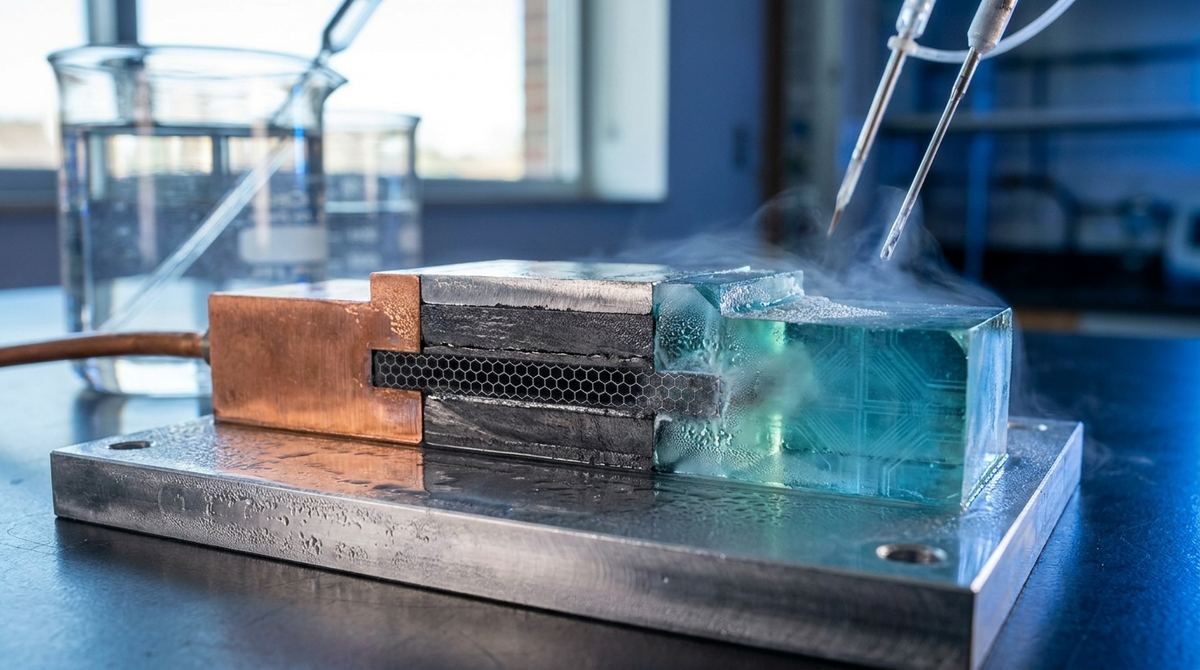
Imagine a refrigerator that has no moving parts, no bulky compressors, and no chemical refrigerants. Instead of using gas to move heat, this device uses the fundamental rules of quantum mechanics to suck heat away from sensitive electronic components. As our technology moves toward an era of quantum computing and ultra-sensitive sensors, the biggest enemy is heat. Even a tiny amount of thermal energy can knock a quantum bit out of its delicate state, causing errors that crash complex calculations. If we could create a way to cool these specific electronic systems directly, without needing to freeze the entire machine to near absolute zero, we would unlock a new frontier of computing power.
Modern microelectronics and the emerging field of quantum computing face a massive thermodynamic wall. In traditional silicon chips, heat is a byproduct of resistance, and we manage it with fans, heat sinks, or liquid cooling. However, quantum systems operate on much more fragile principles. In a quantum processor, information is stored in states that are incredibly sensitive to temperature. Even the slightest thermal vibration can cause decoherence, which is the process where a quantum state collapses into a classical state, destroying the information being processed.
The current solution is to use dilution refrigerators, which cool entire experimental setups to temperatures just a fraction of a degree above absolute zero. While effective, this approach is cumbersome and energy-intensive. It cools the entire environment, including the hardware that does not necessarily need to be that cold. This is an inefficient use of energy and a logistical nightmare for scaling up quantum computers to thousands or millions of qubits. There is a desperate need for a more localized, efficient, and continuous method of cooling the electrons themselves. If we can find a way to manipulate the electronic temperature directly through phase transitions, we could manage heat at the source, enabling more stable and scalable quantum architectures.
The solution proposed by the researchers involves a phenomenon called the Pomeranchuk effect. To understand this, we have to think about how materials change when they change temperature. When a substance like helium-3 transitions from a solid to a liquid, it can actually absorb a significant amount of heat because the liquid state is much more disordered and has higher entropy than the solid state.
The researchers are looking at a specific type of "frozen" electron state called a Wigner crystal. In certain materials, electrons repel each other so strongly that they stop moving around freely and instead lock into a rigid, repeating pattern, much like atoms in a diamond. This is the Wigner crystal. The idea is to use the transition between this ordered crystal state and a disordered liquid state to act as a heat sponge. By carefully controlling the transition, we can create a cycle where the system absorbs thermal energy from its surroundings to fuel the change in state. This is not just a one-time event; the goal is to make this process continuous, creating a steady flow of heat away from our electronic components.
To make this work, the researchers focus on graphene, a single layer of carbon atoms that possesses extraordinary electronic properties. In graphene, electrons are not just simple particles with charge; they also possess what physicists call "flavor" degrees of freedom. These flavors include the electron's spin and its "valley" index, which refers to specific locations in the momentum space where the electron can exist.
The researchers, including Robin J. Dolleman, Ammon Fischer, Lennart Klebl, Alexander Rothstein, Dante M. Kennes, Bernd Beschoten, Florian Libisch, and Christoph Stampfer, have explored how these flavors can be used to enhance the cooling effect. In a standard Wigner crystal, the electrons are locked into a grid. However, when you have "flavor-degenerate" electrons, it means there are multiple equivalent states that each electron can occupy. This multiplicity is critical.
When the system transitions from the highly ordered Wigner crystal to a more disordered liquid state, the electrons gain access to all these different "flavor" combinations. This creates a massive increase in entropy. Because the change in entropy is so large, the amount of heat the system can absorb during the transition is much higher than it would be in a system without these extra degrees of freedom. The researchers suggest that by using the unique structure of graphene and the interplay of Coulomb repulsion and kinetic energy, we can tune the system to trigger these transitions at the right moments. The Coulomb repulsion is the force that pushes the electrons apart to form the crystal, while the kinetic energy is the force that wants to make them move like a liquid. By using electrical gates to change the density of the electrons, we can tip the balance between these two forces, effectively driving the cooling cycle.
This research serves as a feasibility study, meaning it investigates whether the theoretical concept of continuous electronic Pomeranchuk cooling can actually work in a controlled environment. The study suggests that the presence of flavor degeneracy—specifically the combination of spin and valley degrees of freedom—is the key to making this process efficient enough to be useful.
The researchers found that the entropy jump associated with the transition from a flavor-degenerate Wigner crystal to a liquid state is significant. This large jump in entropy is what allows the system to act as an effective heat sink. The study models how the temperature of the electronic system can be lowered by driving the system through these phase transitions. The results indicate that it is theoretically possible to achieve continuous cooling, rather than just a single, momentary cooling event. This is achieved by oscillating the electron density or the temperature, creating a cycle that continuously pulls heat out of the electronic system. While the study is a high-level investigation into the physics, it provides a mathematical and theoretical roadmap for how such a quantum refrigerator could be constructed.
The implications of this research are profound for the future of condensed matter physics and quantum engineering. If continuous electronic cooling can be realized, it would represent a paradigm shift in how we manage thermal energy at the nanoscale.
First, it offers a path toward "on-chip" cooling. Instead of cooling a whole laboratory setup, we could integrate these cooling mechanisms directly into the architecture of a quantum chip. This would allow for much higher precision in controlling the temperature of individual qubits, significantly reducing error rates in quantum computations. Second, it provides a way to bypass the limits of traditional cryogenics. As we move toward larger quantum processors, the sheer amount of cooling power required by standard dilution refrigerators will become a bottleneck. A localized, electronic cooling method would alleviate this pressure. Finally, this research opens up new ways to study quantum phases of matter. By having more precise control over the electronic temperature, scientists can explore exotic states of matter that are currently obscured by thermal noise.
While the feasibility study is promising, it is important to distinguish between a successful theoretical model and a ready-to-use commercial product. This research is currently in the fundamental science stage and is not describing a commercially available technology.
Several significant challenges remain. First, the purity of the materials is paramount. The formation of a Wigner crystal requires an extremely clean environment. Any impurities or defects in the graphene or the substrate can act as "pinning centers," which grab onto the electrons and prevent them from moving or transitioning smoothly. If the crystal is "stuck" due to defects, the cooling cycle will fail. Second, the control mechanisms required to oscillate the electron density with the necessary precision and speed are incredibly complex. Third, the temperature ranges at which these effects are most prominent are currently extremely low. To be truly revolutionary, these systems will eventually need to operate at temperatures more accessible to standard cryogenic equipment or, eventually, even higher. The transition from a theoretical feasibility study to a working prototype requires extensive experimental validation.
The practical applications for continuous electronic Pomeranchuk cooling extend far beyond the laboratory. In the realm of quantum computing, as mentioned, this could become a standard component of quantum hardware, ensuring that qubits remain stable and coherent during long, complex calculations. This is essential for the development of "fault-tolerant" quantum computers, which can correct their own errors.
In the field of ultra-sensitive sensing, this technology could revolutionize how we detect extremely weak signals. For instance, quantum sensors used in medical imaging or mineral exploration rely on maintaining very low temperatures to minimize noise. A localized cooling mechanism could allow these sensors to operate with much higher sensitivity and in smaller, more portable packages. Additionally, in high-precision metrology—the science of measurement—this could allow for even more accurate standards for time, mass, and electrical current, pushing the boundaries of what is measurable in the physical world.
If you take away only one piece of information from this research, let it be this: scientists are finding ways to use the quantum "flavors" of electrons in graphene to create a new kind of refrigerator that could cool quantum computers from the inside out, potentially solving one of the most difficult obstacles in the race to build powerful quantum processors.
What is a Wigner crystal?
A Wigner crystal is a state of matter where electrons, which usually move freely through a conductor, become frozen into a regular, repeating pattern. This happens when the repulsive force between the electrons is much stronger than their tendency to move around, causing them to settle into a stable, crystal-like structure.
What is the Pomeranchuk effect?
The Pomeranchuk effect is a counter-intuitive phenomenon where a substance absorbs heat as it transitions from a solid to a liquid state because the liquid state has much higher entropy. In the context of this research, it is being adapted to use electronic transitions to absorb heat from a system.
Why is graphene used in this research?
Graphene is used because of its unique electronic structure, specifically its "valley" degree of freedom. This provides additional ways for electrons to arrange themselves, which increases the amount of entropy they can absorb during a phase transition, making the cooling effect much stronger.
Is this a real refrigerator you can buy?
No, this is currently a theoretical feasibility study. While the science is sound and the potential is high, building a functional, continuous cooling device requires solving many engineering challenges, such as material purity and precise electrical control.
How does this help quantum computers?
Quantum computers are extremely sensitive to heat, which causes errors in the quantum bits (qubits). This research explores a way to cool those specific electronic components directly, which could make quantum computers much more stable, efficient, and easier to scale up.
The study of continuous electronic Pomeranchuk cooling via flavor-degenerate Wigner crystals represents a brilliant intersection of quantum physics and thermal engineering. By leveraging the complex internal degrees of freedom of electrons in graphene, researchers are exploring how to turn a fundamental phase transition into a powerful tool for heat management. While the path from a feasibility study to a practical quantum refrigerator is filled with engineering hurdles, the potential rewards—more stable, scalable, and efficient quantum technologies—are too significant to ignore. As we continue to master the quantum realm, the ability to control heat at the level of a single electron may be the key that unlocks the next era of human technology.
Serious about B2B integration? Test our premium Pulsed Electrical Resistive Carbon Heating turbostratic graphene in your lab. 100g sample packs available now.
Explore More
Researchers propose a new method for dark matter detection using angular scanning, a technique that may rely on graphene's unique electronic sensitivity.

Build a flexible graphene battery sensor for real-time temperature and strain monitoring, a crucial step toward preventing thermal runaway in Li-ion cells.

Research on 30° quasi-periodic twisted bilayer graphene reveals a unique, fractal-like energy structure under magnetic fields, paving the way for novel...