
Unlocking Quasicrystal Physics in 30-Degree Twisted Bilayer Graphene
Research on 30° quasi-periodic twisted bilayer graphene reveals a unique, fractal-like energy structure under magnetic fields, paving the way for novel...
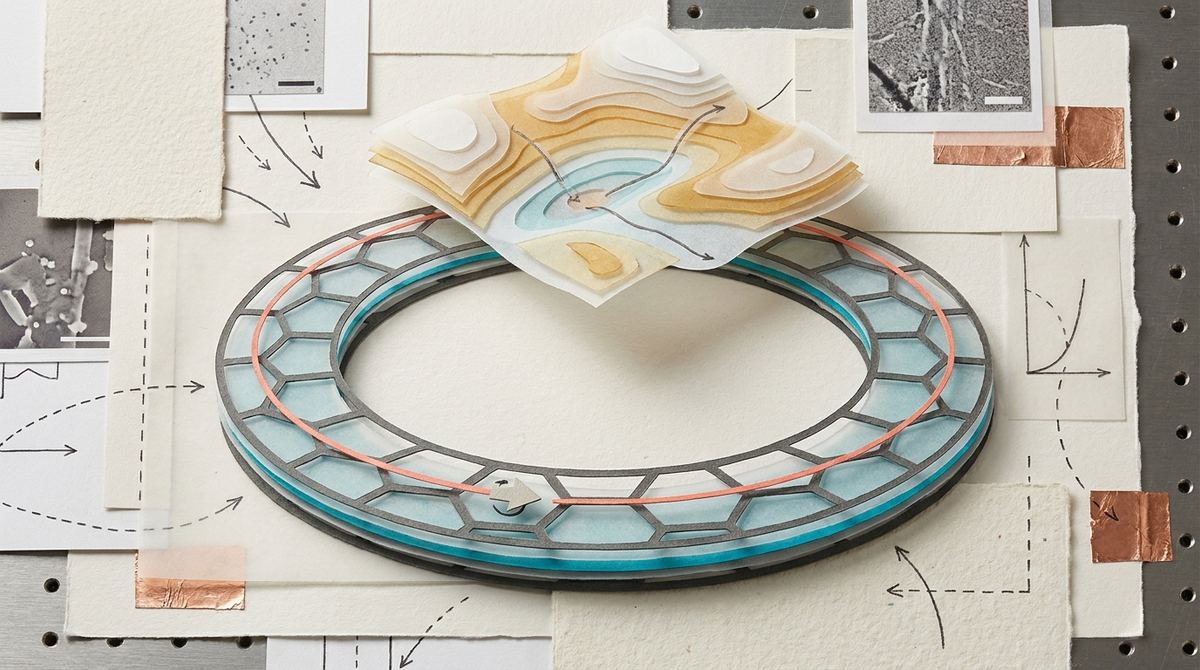
Imagine a tiny, microscopic ring so small that a single electron can travel through it. As this electron moves, it possesses a property called spin, which you can think of as a tiny internal compass needle. In the traditional world of electronics, we control information by moving charges around. But in the quantum world, we want to control the orientation of that compass needle. The challenge is that manipulating a single electron's spin is incredibly difficult without disturbing everything else nearby. However, what if we could control the spin simply by the path the electron takes? By designing the geometry of the ring, we can induce a mathematical twist that forces the spin to change in a predictable way. This research explores the profound ways that the shape of a path can act as a control mechanism for quantum information.
As we push the boundaries of classical computing, we are hitting a wall known as the heat wall and the scaling limit. Standard transistors rely on the movement of electrical charge, which inevitably generates heat due to resistance. As we pack more transistors into smaller spaces, managing this heat becomes an engineering nightmare. This has led the scientific community toward spintronics, a field that uses the spin of an electron rather than its charge to process information. Spin is much more efficient and generates significantly less heat.
However, spintronics faces a much deeper problem: control and stability. In a standard material, the spin of an electron is easily knocked out of alignment by thermal noise or electromagnetic interference. This is known as decoherence, and it is the primary reason why building a large-scale, stable quantum computer is so difficult. If we want to use spins as "qubits" for quantum computing, we need a way to manipulate them that is robust and resistant to the chaotic environment of a real-world circuit. Currently, we use external magnetic fields to flip spins, but magnetic fields are difficult to localize at the scale of a single atom or a single nano-ring. We need a way to control spin using the intrinsic properties of the material and the geometry of the electron's path, rather than relying on messy, external magnetic forces.
The solution proposed by the mathematical framework explored in this research involves a concept called holonomy. To understand holonomy, imagine you are a pilot flying a plane from the equator to the North Pole, turning 90 degrees, flying to a new point on the equator, turning 90 degrees again, and then flying back to your starting point. Even though you only made turns in a specific direction, you would find that when you return to your starting point, your plane is facing a different direction than when you began. This change in orientation, caused solely by the curvature of the Earth and the path you traveled, is a form of holonomy.
In the quantum realm, electrons experience something very similar. When an electron moves through a specific type of material—like a ring with strong spin-orbit coupling—its "spin" undergoes a similar shift. This shift is not caused by a magnet, but by the "curvature" of the interaction between the electron's motion and the material's electric field. This is known as a geometric phase. By carefully designing the shape of a nano-ring, we can use this geometric phase to "program" the electron's spin. Instead of applying a magnetic field to flip a switch, we simply move the electron in a loop, and the geometry of that loop does the work for us. This is a much more stable and precise way to handle quantum information.
To implement this, researchers look toward advanced two-dimensional materials, such as graphene or other graphene-like lattices, which can be engineered to have high spin-orbit coupling. Spin-orbit coupling is the fundamental mechanism at play here. It is a relativistic effect where an electron moving through an electric field (like the one created by the nuclei in a crystal lattice) perceives that field as a magnetic field. This "effective" magnetic field interacts with the electron's spin, causing it to rotate.
In a ring-shaped structure, the electron is forced to move in a closed loop. As it travels, the spin-orbit coupling acts as an "effective gauge connection." In physics, a gauge connection is a mathematical tool that describes how a property, like spin or phase, changes as you move through space. Because the electron is moving in a circle, the spin-orbit coupling creates a continuous "twist" along the path. By the time the electron completes a full revolution, it has acquired a specific, measurable phase shift known as Wilson holonomy.
The beauty of this system is that the phase shift depends on the geometry of the ring and the strength of the spin-orbit interaction, rather than the exact timing or speed of the electron. This is why it is so powerful for quantum computing. If the control mechanism is based on the geometry (the shape) rather than the timing (the pulse duration), the system becomes much more "topologically protected." This means that even if the electron's speed varies slightly due to noise, the total "twist" acquired over the full loop remains the same, ensuring the information remains intact.
The research conducted by N. Bolivar provides a rigorous mathematical bridge between these geometric shifts and the observable energy states of the system. Specifically, the study focuses on the relationship between Wilson holonomy and spectral monodromy. While holonomy describes the change in the electron's state after a loop, spectral monodromy describes how the energy levels of the entire system behave when you change a parameter, such as the intensity of the spin-orbit coupling, and then return it to its original state.
The findings demonstrate that these two concepts are deeply linked. In many quantum systems, if you change a parameter and come back to where you started, you expect everything to return to its original state. However, in these spin-orbit rings, the energy levels can actually "wrap around" a singularity in a way that they do not return to their original values. This is the spectral monodromy. The research shows that this monodromy is a direct signature of the underlying geometric holonomy.
Crucially, the paper identifies "loop observables." These are measurable physical quantities—such as specific electrical currents or voltage fluctuations—that can be used to detect whether the electron has undergone a geometric phase shift. This is vital because, in a laboratory setting, you cannot directly "see" a phase shift, but you can measure an electrical signal. By linking the abstract mathematical properties of monodromy to measurable observables, the research provides a roadmap for how to actually verify and use these geometric effects in a real device.
This research matters because it moves us away from "brute force" quantum control and toward "topological" quantum control. In the current era of Noisy Intermediate-Scale Quantum (NISQ) technology, the biggest hurdle is the error rate. Every time we apply a magnetic pulse to a qubit, we risk introducing noise that causes decoherence. The findings discussed here suggest a way to circumvent this by using the inherent geometry of the material.
If we can create a device where the information is encoded in the geometry of the path, the information is protected by the topology of the system. This is similar to how a knot in a rope is more stable than a loose loop; you can shake the rope, but the knot remains. By using Wilson holonomy, we are essentially "knotting" the quantum information into the path of the electron. This could lead to a new class of quantum gates that are naturally resistant to the errors that currently plague quantum processors.
Furthermore, this research provides a mathematical toolkit for material scientists. By understanding how spectral monodromy relates to loop observables, engineers can design new types of nano-rings in 2D materials with specific, pre-programmed geometric responses. This turns the material itself into a component of the logic gate, rather than just a passive substrate for the electron.
While the theoretical framework is robust, there is a significant gap between these mathematical models and actual hardware. The research is primarily focused on the mathematical physics of these connections, and translating these "effective gauge connections" into a physical device remains a monumental engineering challenge.
First, the precision required to fabricate nano-rings with perfectly controlled spin-orbit coupling is immense. At the scale where these effects are most prominent, even a single misplaced atom or a tiny defect in the crystal lattice can disrupt the electron's path and destroy the delicate geometric phase. This is known as scattering, and it can lead to decoherence.
Second, temperature is a major factor. While the geometric phase is theoretically robust, in a real-world environment, thermal vibrations (phonons) can interact with the electron's spin, causing it to lose its "memory" of the loop before it completes the circuit. For these devices to work, they will likely need to operate at extremely low, cryogenic temperatures, which limits their immediate commercial application in consumer electronics.
Finally, the scalability of these rings is unproven. While we can model a single ring, creating a complex circuit of millions of interconnected rings—each with its own carefully tuned geometry—is a level of manufacturing complexity that current semiconductor technology is not yet prepared to handle.
The most immediate application for this research lies in the field of spintronics. As manufacturers look for ways to increase the efficiency of data storage and processing, the ability to control spin through geometry could lead to ultra-low-power memory devices. Instead of using high-energy currents to flip magnetic bits, a device could use the geometric phase of electron paths to switch states, drastically reducing heat generation.
Another significant application is in the development of topological quantum computers. These are machines where information is stored in "non-local" ways that are immune to local noise. By using the Wilson holonomy described in this research, we could create qubits that are much more stable, potentially allowing us to reach the "fault-tolerant" stage of quantum computing much sooner than currently predicted.
Finally, these principles could be applied to highly sensitive quantum sensors. Because the geometric phase is so sensitive to the path and the environment, a spin-orbit ring could be used to detect incredibly minute changes in local electric or magnetic fields. Such sensors would have applications in medical imaging, mineral exploration, and fundamental physics research, where detecting tiny signals amidst heavy background noise is critical.
If you remember only one thing from this research, let it be this: The shape of a path can be just as powerful as a physical force. By using the geometry of a nano-ring to "twist" the spin of an electron, we can create a way to control quantum information that is far more stable and precise than using traditional magnetic fields.
What exactly is spin-orbit coupling?
Spin-orbit coupling is a phenomenon where an electron's movement through an electric field creates an effective magnetic field from the perspective of the electron. This interaction causes the electron's spin, which is a fundamental quantum property, to rotate or change orientation as the electron moves through a material.
Why is geometry so important in quantum mechanics?
In quantum mechanics, the state of a particle is determined not just by its position and momentum, but also by its phase. When a particle follows a path in a complex environment, it can acquire a "geometric phase" that depends entirely on the shape and curvature of that path. This allows us to use geometry as a tool to control quantum states.
What is the difference between holonomy and monodromy?
Holonomy refers to the change in a property, like an electron's spin, after it has traveled along a closed loop. Monodromy is a broader mathematical concept that describes how the entire energy spectrum of a system changes when you move through its parameters and return to the starting point. In these rings, the two are deeply interconnected.
Can this technology be used in current smartphones?
It is unlikely that this technology will appear in smartphones in the near future. Currently, these effects require extremely small, precisely engineered nano-structures and often require extremely cold temperatures to prevent noise from destroying the quantum states. It is a technology for the future of high-performance computing.
How does "topological protection" help quantum computers?
Topological protection refers to the idea that certain quantum properties depend on the overall shape or "topology" of a system rather than its exact local details. Because a geometric phase depends on the whole loop rather than a single moment in time, it is much harder for local noise or small errors to disrupt the information, making the computer much more reliable.
This research points toward a practical lesson: graphene-based materials are most powerful when their nanoscale properties are connected to a clear engineering problem. The result is not a finished commercial product by itself, but it gives researchers and manufacturers a better map for designing lighter, more sensitive, or more durable systems. Future work still needs testing under real operating conditions, but the direction is promising because it joins materials science with application-driven design.
Serious about B2B integration? Test our premium Pulsed Electrical Resistive Carbon Heating turbostratic graphene in your lab. 100g sample packs available now.
Explore More
Research on 30° quasi-periodic twisted bilayer graphene reveals a unique, fractal-like energy structure under magnetic fields, paving the way for novel...

Researchers discover naturally formed graphene sheets and carbon ovals in stingless bee hives, creating a novel emergent material with powerful blue light...

Discover how rippled graphene pores act as fluidic memristors, enabling advanced synaptic functionalities for the next generation of neuromorphic computing.