
Disorder and Coulomb Repulsion: A New Theory for Superconducting Domes in 2D
New research explains the superconducting dome in 2D materials, proposing that inherent disorder enhances Coulomb repulsion, ultimately suppressing...
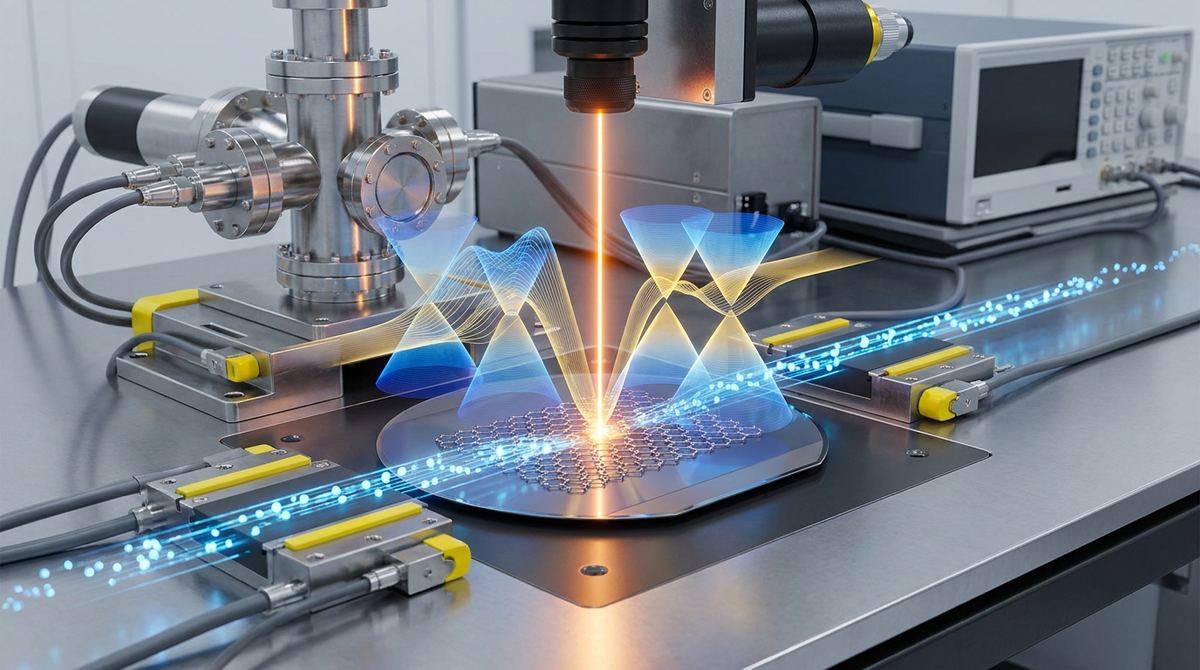
Graphene is a material of superlatives. It is the strongest material ever tested, incredibly lightweight, and a phenomenal conductor of both heat and electricity. Yet for all its strengths, it has one critical weakness that has held it back from revolutionizing digital electronics: it has no "off" switch. Like a faucet that can't be fully closed, electrical current flows through graphene with almost no resistance, which is fantastic for wires but a dealbreaker for transistors, the building blocks of modern computing. A transistor must be able to reliably stop the flow of current to represent a digital "0." For years, scientists have sought a way to give graphene this missing feature without destroying its other amazing properties. Now, a breakthrough experiment offers a radical new solution: instead of permanently altering the material, what if you could simply use light to command a band gap into existence, on demand and in an instant?
The core challenge lies in graphene's fundamental electronic structure. It is a semimetal, or a zero-gap semiconductor. Its electrons behave like relativistic particles with no mass, allowing them to move at incredible speeds. This behavior is visualized in physics as a "Dirac cone," a graph of electron energy versus momentum that looks like two cones touching at a single point. This meeting point, the Dirac point, signifies that there is no forbidden energy range—no band gap—that electrons must overcome to become mobile. In a semiconductor like silicon, this band gap is intrinsic to the material. It acts as an energy barrier, and by applying a voltage, you can control whether electrons have enough energy to cross it, effectively switching the current on and off. Without this gap, graphene is permanently "on."
Previous attempts to engineer a band gap involved methods like cutting graphene into tiny nanoribbons, chemically doping it, or straining the lattice. While sometimes successful, these methods are static; the band gap, once created, is fixed. More importantly, these invasive techniques often introduce defects and disrupt the pristine hexagonal lattice, degrading the very electronic properties that make graphene so special. The ideal solution would be a method that is non-invasive, reversible, and tunable. In a recent paper, a team of researchers including Fei Wang, Xuanxi Cai, Xiao Tang, Jinxi Lu, Wanying Chen, Tianshuang Sheng, Runfa Feng, Haoyuan Zhong, Hongyun Zhang, Pu Yu, and Shuyun Zhou has provided the first direct experimental observation of such a solution.
The central concept behind this work is known as Floquet engineering. At its heart, it is a way to control the properties of a material not by changing its chemical composition or static structure, but by rhythmically shaking it with a periodic force, such as an electromagnetic wave from a laser. Imagine a simple pendulum. It has a natural, resting state. If you begin pushing it back and forth at a specific, repeating frequency, its behavior changes dramatically. It no longer acts like a simple pendulum; its motion is now governed by the interplay between its natural properties and the external drive you are applying.
Floquet engineering applies this same principle to the quantum world of electrons in a material. The electrons in graphene have a set of allowed energy levels, described by the Dirac cone. By illuminating the graphene sheet with a powerful, continuous-wave laser beam of circularly polarized light, the researchers introduce a strong, periodic "push" on the electrons. This intense, rotating electric field forces the electrons into a new, dynamic state. In this light-dressed state, the original energy landscape is completely reconfigured. The laser's rhythmic driving effectively creates a new set of rules for where the electrons are allowed to be, and in doing so, it pries open a forbidden energy zone right at the Dirac point. This newly created, temporary band gap is called a Floquet-induced gap. It exists only while the laser is on, and its size can be tuned by changing the laser's intensity.
The experiment required a sophisticated setup to both manipulate the graphene and observe the results in real time. The researchers used a technique called time-resolved and angle-resolved photoemission spectroscopy (tr-ARPES), a powerful tool for mapping the electronic band structure of materials. First, a pristine, single-layer sheet of graphene was prepared and placed inside an ultra-high vacuum chamber. This environment is crucial to prevent any atoms or molecules from the air from contaminating the graphene surface and interfering with the measurements.
The experiment then used a two-laser "pump-probe" system. The "pump" was an intense, mid-infrared laser with circular polarization. This laser's job was not to measure anything but to "dress" the graphene—to provide the periodic driving force that creates the Floquet state. Its energy was specifically chosen to interact strongly with the electrons in the graphene without being absorbed in a way that would simply heat or damage the material. Following this pump pulse, an ultrashort "probe" pulse of high-energy ultraviolet light was fired at the sample. This second laser pulse had just enough energy to knock electrons completely out of the graphene sheet.
These ejected photoelectrons then traveled to a hemispherical electron analyzer, a highly sensitive detector that measures two key properties for each electron: its kinetic energy and the angle at which it departed. From this information, scientists can reconstruct the electron's momentum *before* it was ejected. By repeating this process for millions of electrons, they can build a complete, two-dimensional map of the allowed energy and momentum states within the material—a direct snapshot of its band structure. By taking this snapshot while the pump laser was on, they could directly "see" if the Dirac cone had indeed been split open.
The results were a clear and direct confirmation of long-held theoretical predictions. The tr-ARPES measurements showed that when the pump laser was off, the graphene exhibited its classic, pristine Dirac cone structure with the upper and lower bands meeting perfectly at a single point. This was the baseline, the signature of a zero-gap semimetal. However, when the intense, circularly polarized pump laser was turned on, the band structure transformed dramatically. The data clearly showed that the Dirac point was no longer a single point but had opened up into a distinct gap.
This observed gap demonstrated the tell-tale signs of a Floquet-induced state. Its size was directly proportional to the intensity of the pump laser; a more powerful laser created a larger gap, demonstrating tunability. This finding is a landmark achievement. While the theory of Floquet engineering in graphene has been discussed for over a decade, providing unambiguous experimental proof has been a monumental challenge. This work moves the concept from the chalkboard to the laboratory bench, confirming that light can be used as a tool to fundamentally re-engineer the electronic properties of a quantum material on an ultrafast timescale.
This discovery is significant for several reasons. On a fundamental scientific level, it validates a powerful concept in condensed matter physics: that a material's properties are not fixed but can be dynamically manipulated with external fields. It opens up a new avenue for "materials on demand," where properties like conductivity or optical response can be switched and tuned at the speed of light. This has profound implications for our understanding of light-matter interactions and the engineering of quantum states.
From a technological perspective, the ability to induce a reversible band gap in graphene is a critical step toward overcoming its limitations in digital applications. It provides a non-destructive way to make graphene behave like a semiconductor. This could pave the way for entirely new classes of devices that merge the speed of electronics with the control of photonics. Creating a band gap is the first and most essential step in building a transistor. While this method is not yet a practical transistor, it provides a crucial proof-of-concept for a new type of switch, one that could potentially operate at terahertz frequencies—thousands of times faster than today's gigahertz-scale silicon processors. The findings are a major advancement for the field of graphene electronics.
Despite the excitement, it is important to maintain a realistic perspective. This is a foundational physics experiment conducted under highly controlled laboratory conditions, not a demonstration of a market-ready device. Several significant hurdles remain. The Floquet state is transient; the band gap exists only as long as the powerful pump laser is illuminating the sample, which requires a continuous and significant energy input. This process can also generate excess heat, which could damage the graphene or interfere with device operation.
Furthermore, the size of the band gap induced in this experiment, while clearly observable, may still be too small for practical, room-temperature digital logic, which requires a gap large enough to prevent electrons from leaking across it due to thermal energy. The experimental setup is also complex and bulky, relying on ultra-high vacuum and sophisticated laser systems. A major engineering challenge will be to find ways to replicate this effect in a compact, integrated, and energy-efficient manner suitable for a microchip. The quality and uniformity of the starting material are also paramount; scaling this effect up would require a reliable supply of large-area, defect-free graphene, a persistent challenge in the graphene manufacturing techniques landscape.
Looking ahead, the long-term potential for this technology is vast, even if it diverges from traditional computing. The most immediate applications are likely to be in the field of photonics and high-frequency electronics. The ability to switch graphene from a conductor to an insulator with light makes it an ideal candidate for ultrafast optical modulators and switches for fiber-optic communications. Such a device could control data streams at unprecedented speeds.
Another promising area is in the development of novel sensors, particularly photodetectors. A device based on this principle could be tuned to be sensitive to specific frequencies of light by adjusting the properties of the driving laser. Furthermore, Floquet engineering can be used to create exotic quantum states of matter, such as Floquet topological insulators. These materials have the unique property of being insulators in their bulk while having perfectly conducting channels along their edges. This could lead to new electronic pathways that transmit information with virtually zero energy loss, a revolutionary concept for energy-efficient electronics and quantum computing.
The key takeaway from this research is that light can be used as a dynamic tool to fundamentally change the rules of electronics inside graphene. By rhythmically pulsing graphene with a laser, scientists can force this naturally gapless material to have a temporary and controllable electronic "off" switch, opening a new frontier for creating ultra-fast, light-controlled devices.
What is a band gap and why is it important for electronics? A band gap is a range of energy levels that electrons in a solid material are forbidden from occupying. In a semiconductor like silicon, this gap is what allows a transistor to switch off. By controlling whether electrons have enough energy to jump across this gap, we can control the flow of current. Graphene naturally lacks this feature, making it an excellent conductor but poorly suited for digital logic.
What is Floquet engineering in simple terms? Floquet engineering is a technique for changing a material's properties by applying a periodic driving force, like a laser. Think of it as controlling the behavior of a system by shaking it in a very specific, rhythmic way. This external "shake" creates a new, hybrid state where the material exhibits properties it doesn't normally have, such as a band gap in graphene.
Is this the first method ever used to create a band gap in graphene? No, other methods like chemical doping or cutting graphene into nanoribbons have successfully created band gaps before. The crucial difference is that those methods are static and often damage the material. The Floquet method is unique because it is dynamic, reversible, non-invasive, and tunable in real time simply by adjusting the laser.
How does this experimental observation advance the field? For years, the idea of creating Floquet-induced band gaps in graphene was a purely theoretical concept. This research provides the first direct, unambiguous experimental proof that it is possible. Moving a concept from theory to a verified observation is a critical step that validates the approach and energizes further research and development.
When can we expect to see commercial devices based on this technology? Commercialization is still a long way off, likely a decade or more. This research is a fundamental scientific breakthrough. The next steps involve refining the technique, finding more energy-efficient ways to induce the effect, and overcoming the immense engineering challenges of integrating this system onto a practical chip-scale platform.
The work by Fei Wang and his colleagues marks a pivotal moment in the study of graphene and quantum materials. By successfully demonstrating a Floquet-induced band gap, they have not just observed a new phenomenon; they have validated a new paradigm for materials science. This research transforms our view of graphene from a static material with a fixed set of properties to a dynamic electronic canvas that can be reconfigured on demand with light. While the path to practical applications is long and challenging, this discovery provides a powerful new tool in the quest to harness the full potential of two-dimensional materials, promising a future of electronics that are faster, more efficient, and more versatile than anything we have today.
Serious about B2B integration? Test our premium Pulsed Electrical Resistive Carbon Heating turbostratic graphene in your lab. 100g sample packs available now.
Explore More
New research explains the superconducting dome in 2D materials, proposing that inherent disorder enhances Coulomb repulsion, ultimately suppressing...

Researchers reveal how twisting two graphene layers creates a tunable, atomic-scale sieve, enabling layer-selective hydrogenation for next-generation proton...

Researchers use machine learning and X-ray spectroscopy to map how atomic dopants modulate graphene's electronic properties, a key step for advanced sensors...