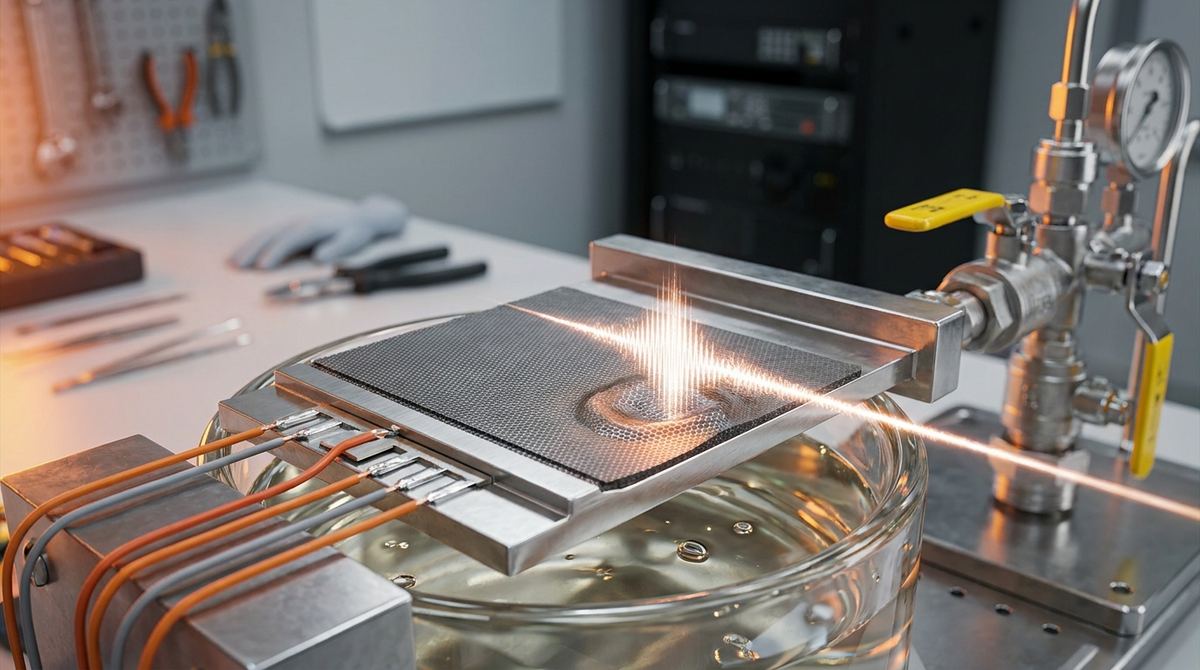
Imagine a world where the communication networks that power the internet operate at speeds we can barely comprehend, moving data not through slow electrical pulses, but through lightning-fast bursts of light. The bottleneck in our current technology is the inability to switch or modulate light with extreme speed and precision using small, efficient components. For decades, scientists have searched for a material that can bridge the gap between electronics and optics—a material that can be controlled by an electric field to change how it interacts with light. Graphene, a single layer of carbon atoms arranged in a hexagonal lattice, has emerged as the leading candidate for this role. Recent groundbreaking work has pushed this concept into a new regime: the non-perturbative, ultrafast realm.
The Problem This Research Is Solving
Modern telecommunications and computing are hitting a wall known as the electronic bottleneck. Traditional semiconductors, like the silicon used in today's computer chips, rely on the movement of charge carriers through a bandgap. While highly effective for digital logic, silicon is inherently limited in how fast it can switch light signals. When we try to use light directly for high-speed data, we run into a fundamental difficulty: most materials react to light in a linear, predictable way. If you shine a light on a standard material, it reflects or absorbs a specific amount based on its properties. To create an optical switch, you need a material that can change its response significantly when hit by a light pulse or a voltage.
The current challenge is twofold. First, we need materials that can respond at the scale of femtoseconds—one quadrillionth of a second. Second, we need to control the way light interacts with matter when that light is extremely intense. In most optical systems, light is treated as a gentle probe, a small nudge to the electrons. However, in high-speed, high-energy applications, we enter a regime where the light is so strong that it fundamentally reshapes the electronic state of the material. Understanding how to control this intense, non-perturbative interaction is essential for the next generation of ultrafast photonic devices.
The Key Idea in Plain English
The core idea behind this research is to use two different "knobs" to control how graphene reacts to intense light. The first knob is electrical. By applying a voltage to a device made of graphene (a process called gating), we can change the number of electrons available in the material. Think of this like adjusting the water level in a reservoir; by changing the density of electrons, we change how the material handles energy. The second knob is optical. Instead of using a weak light source, researchers use incredibly short, incredibly intense pulses of laser light.
When these two methods are combined, we move beyond the simple, predictable rules of standard optics. Instead of the light just passing through or bouncing off, the light and the electric field work together to drive the electrons into a highly energetic, non-equilibrium state. This allows for a type of control that is much more powerful and faster than anything currently used in silicon-based technology. By manipulating the density of electrons with a voltage and then hitting them with a powerful light pulse, we can dictate exactly how the material interacts with light in real-time.
How the Graphene-Based System Works
To understand the mechanism, we must look at the unique electronic structure of graphene. Unlike traditional semiconductors, graphene is a zero-gap semiconductor where the conduction and valence bands meet at discrete points known as Dirac points. The electrons in graphene behave like massless particles, moving at extremely high speeds. This unique structure is what makes its optical response so tunable.
In a standard setup, a gate electrode is placed near the graphene layer, separated by an insulating barrier. When a voltage is applied to this gate, it shifts the Fermi level—the highest energy level occupied by electrons—up or down. This shift directly changes the concentration of charge carriers. If the Fermi level is shifted high into the conduction band, the material becomes highly conductive and absorbs light differently than when the Fermi level is at the Dirac point.
The research focuses on what happens during an ultrafast optical pulse. When an intense laser pulse hits the graphene, it doesn't just slightly nudge the electrons. Instead, it undergoes a non-perturbative interaction. This means the strength of the light's electric field is comparable to the internal forces holding the electrons in their orbits. This intense field drives the electrons into a state of high excitation, creating a temporary, highly energetic plasma of electrons and holes.
The dynamics of these carriers are incredibly fast. Once the light pulse hits, the electrons begin to scatter against each other and against the vibrations of the carbon lattice, known as phonons. The nonlinear optical response is a direct result of these rapid movements. By using the gate voltage to set the initial density of electrons, researchers can pre-determine how these carriers will react to the intense light pulse. This synergy between the electrostatic environment and the intense electromagnetic field of the laser is what allows for the high degree of control over the material's nonlinear optical response.
What the Researchers Found
The research conducted by Xiaolong Lv, Yu Zhang, Yuxuan Wei, and Chuanshan Tian has provided a detailed map of these complex interactions. They discovered that the nonlinear optical response of graphene is not a static property but is highly sensitive to both the applied gate voltage and the intensity of the optical pulse. Specifically, they demonstrated how the gate voltage can be used to tune the magnitude and even the sign of the nonlinear response.
The team found that by shifting the Fermi level, they could essentially "program" how graphene reacts to an intense light pulse. In the non-perturbative regime, the light does more than just excite electrons; it drives a collective motion of the electron gas. The researchers observed that the interplay between the external electric field (the gate) and the intense optical field leads to a highly dynamic, time-dependent optical response. This means that the way the material interacts with light changes significantly during the lifetime of the ultrafast pulse itself.
One of the most critical findings is the ability to control carrier-carrier scattering and carrier-phonon scattering through external means. Because the researchers could control the carrier density via the gate, they could influence how quickly the energy from the light pulse was redistributed among the electrons. This level of control over carrier dynamics is the "holy grail" for designing devices that can switch light at terahertz frequencies.
Why the Result Matters
This research is significant because it moves graphene from being a theoretical curiosity to a practical tool for advanced photonics. Most current optical modulators are limited by the speed at which charge carriers can move through a semiconductor and recombine. This process is often too slow for the next frontier of data transmission. Graphene, because of its high carrier mobility and unique band structure, offers a path toward femtosecond-scale switching.
Furthermore, the ability to control the nonlinear response via a gate voltage means we can create components that are "reconfigurable." In traditional electronics, a component usually does one thing. In a graphene-based photonic circuit, you could theoretically change the function of a component—such as turning a modulator into a frequency converter—simply by changing the applied voltage. This versatility is essential for developing complex, integrated photonic circuits where space and energy efficiency are at a premium.
The shift from perturbative to non-perturbative control also opens doors to new physics. By operating in a regime where light is a primary driver of electronic behavior, we can explore phenomena that are inaccessible with conventional light sources. This could lead to entirely new classes of optical devices that operate on principles fundamentally different from the ones we use today.
Limitations and What Still Needs Testing
While these findings are transformative, it is important to distinguish between fundamental physics discovery and commercial readiness. The research conducted by Lv, Zhang, Wei, and Tian is a deep dive into the physics of the material under extreme conditions. Translating these findings into a commercial product involves several significant engineering hurdles.
First, the use of ultrafast, high-intensity laser pulses is a laboratory-scale method. For a commercial device, we need to achieve similar control using much lower power levels and more integrated, stable light sources. We cannot build a consumer-grade device that requires a massive, room-sized laser system to function.
Second, there is the issue of heat dissipation. When graphene is hit with intense light, a significant amount of energy is converted into heat through carrier-phonon scattering. While graphene is an excellent thermal conductor, managing the heat in a highly miniaturized, high-speed device is a massive engineering challenge. Excessive heat can change the very electronic properties we are trying to control.
Finally, material consistency and scalability remain hurdles. While we can create high-quality graphene in a lab, mass-producing graphene devices with the precision required for consistent optical performance is still an ongoing industrial challenge. Ensuring that every single device in a million-unit production run has the exact same gate sensitivity and optical response is a daunting task for semiconductor manufacturing.
Real-World Applications
The potential applications for graphene-based nonlinear optical control are vast and span multiple high-tech industries. In the realm of telecommunications, the most direct application is in the creation of ultrafast optical modulators and switches. These components would allow for much higher data rates in fiber-optic networks, helping to meet the exploding demand for bandwidth in the age of 5G, 6G, and beyond.
In the field of sensing, these materials could lead to incredibly sensitive photodetectors capable of detecting single photons or very weak signals by using the nonlinear response to amplify the signal. This has massive implications for medical imaging, LIDAR for autonomous vehicles, and environmental monitoring.
Furthermore, the ability to control light with light and electricity is a cornerstone of quantum information processing. Graphene's tunability could allow for the creation of on-chip quantum gates, where light pulses act as qubits. This could accelerate the development of practical, scalable quantum computers that use photons to carry and process information.
If You Remember One Thing
If you remember only one thing from this research, let it be this: Graphene is not just a material that conducts electricity well; it is a highly tunable platform that allows us to control the very way light interacts with matter, opening the door to ultra-fast, programmable light-based technologies.
FAQ
How does a gate voltage actually change how graphene interacts with light?
The gate voltage changes the number of electrons present in the graphene layer by shifting its Fermi level. When the number of electrons changes, the number of available states for light to interact with also changes. This means you can essentially tune the material's optical properties, like its absorption or its nonlinear response, simply by turning a voltage knob.
What is the difference between perturbative and non-perturbative light interaction?
In perturbative interaction, the light is weak and only slightly disturbs the electronic state of the material, following simple, predictable rules. In non-perturbative interaction, the light is so intense that its electric field is strong enough to fundamentally change how the electrons behave, driving them into highly energetic, non-equilibrium states.
Why is graphene better than silicon for high-speed optical devices?
Silicon has a bandgap, which means electrons need a certain amount of energy to move, and the processes of generating and recombining charge carriers are relatively slow. Graphene has a unique, gapless structure and extremely high electron mobility, allowing it to respond to light and electrical changes at much higher speeds, potentially in the femtosecond range.
Is graphene technology ready to be used in my smartphone today?
No, the research discussed here is primarily in the fundamental physics and laboratory demonstration stage. While the physics is proven, the engineering required to make these devices stable, heat-efficient, and cheap enough for mass production in consumer electronics is still being developed.
Can these graphene devices be used for more than just data transmission?
Absolutely. Because they can control light so precisely, they could be used in everything from high-speed medical imaging and autonomous vehicle sensors to advanced quantum computing components. The versatility of graphene's electronic structure makes it a candidate for many different optical applications.
Conclusion
The work by Xiaolong Lv, Yu Zhang, Yuxuan Wei, and Chuanshan Tian represents a significant step forward in our understanding of how light and matter interact at the most fundamental level. By mastering the control of graphene's nonlinear optical response through both electrical gating and ultrafast light pulses, we are opening a new chapter in photonics. While the road from laboratory discovery to commercial implementation is filled with engineering challenges, the potential to create faster, more efficient, and highly tunable optical technologies is a powerful driver for the future of information technology.