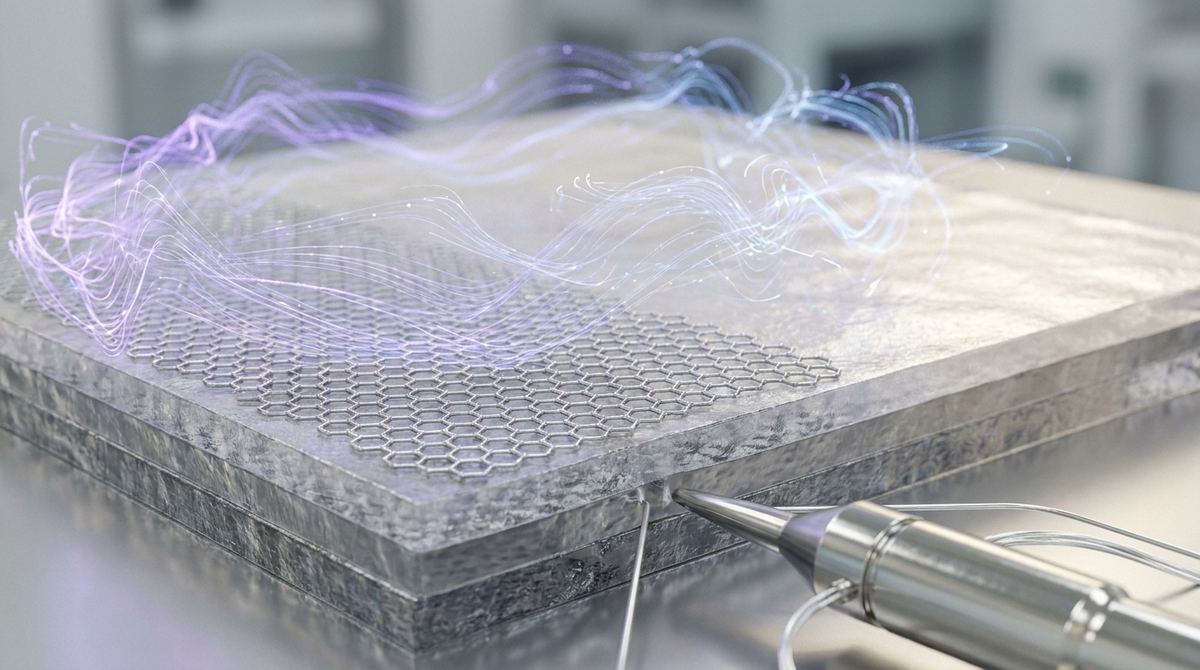
Imagine a highway where every car is so closely packed and moving so erratically that you can no longer describe the movement of a single vehicle. Instead of individual cars traveling from point A to point B, you see only a single, massive, churning wave of metal moving through the space. This is the essence of an incoherent metal. In traditional materials, electrons behave like predictable commuters, but in certain advanced materials, they lose their individual identity and act as a chaotic, collective swarm. Understanding this swarm is the holy grail of modern physics because it holds the key to creating materials that conduct electricity with zero resistance or process quantum information at incredible speeds.
The Problem This Research Is Solving
For nearly a century, the foundation of solid-state physics has rested on the Fermi Liquid Theory. This model treats electrons in a metal as a collection of nearly independent particles, called quasi-particles, that move through a crystal lattice. While this theory works perfectly for standard metals like copper or gold, it fails spectacularly when applied to certain highly advanced materials. These "strange metals" exhibit electrical resistance and heat properties that defy the standard mathematical models used by engineers and physicists alike.
When the standard model fails, we lose the ability to predict how a material will behave under extreme conditions. This is a massive roadblock in material science. If we cannot mathematically describe how electrons move in these highly correlated systems, we cannot design the next generation of superconductors or ultra-efficient electronic components. The problem is that in these materials, the interactions between electrons are so strong that the very concept of an "individual electron" becomes meaningless. The physics becomes a chaotic mess of many-body interactions that standard equations simply cannot solve. Without a universal way to describe this incoherence, we are essentially trying to build complex machines while working with a broken set of mathematical tools.
The Key Idea in Plain English
The research addresses this by moving away from the idea of individual particles altogether. Instead of trying to track every single electron, the researchers propose a way to describe the material as a single, unified quantum fluid. This approach shifts the focus from particle dynamics to the collective properties of the system. By treating the electrons as an integrated whole, the theory can account for the strange, non-standard ways these materials conduct electricity and heat.
This idea is revolutionary because it suggests that the chaos seen in these metals is not random, but follows a deeper, universal set of rules. By finding these rules, we can move from being observers of chaos to being architects of it. This means instead of being limited by the unpredictable behavior of electrons, we might eventually learn to harness that collective motion to create entirely new states of matter. This theory essentially provides a new mathematical language for a world where the concept of a single particle no longer exists.
How the Graphene-Based System Works
While the theory itself is a mathematical framework, its practical application and testing often rely on specialized structures like graphene. Graphene is a single layer of carbon atoms arranged in a hexagonal lattice. Because it is only one atom thick, every electron is essentially on the surface, making the interactions between them incredibly intense and highly visible. This makes graphene the perfect laboratory for observing the incoherent behavior described in the theory.
In a graphene-based system, engineers can use electrical gating to change the density of electrons within the layer. By tuning this density, they can drive the material from a standard state into a highly correlated state where the electrons begin to act in unison. The two-dimensional nature of the graphene lattice prevents electrons from moving around each other easily, forcing them into a state of high interaction. This interaction causes the electron-electron scattering rate to hit a fundamental limit known as the Planckian limit, where the rate of scattering is determined solely by temperature and fundamental constants of nature. The theory provides the math to predict exactly how this scattering occurs, allowing scientists to understand how the structure of the graphene lattice influences the collective flow of the electron swarm.
What the Researchers Found
In this theoretical work, Aaron Kleger, Nikolay Gnezdilov, and Rufus Boyack have proposed a unified framework that links the behavior of these incoherent metals to principles found in high-energy physics. One of the most striking aspects of their finding is the bridge they have built between condensed matter physics and the mathematical tools used to describe black holes and subatomic particles. This suggests that the math governing the chaos of electrons in a metal is fundamentally the same as the math governing the most extreme environments in the universe.
The researchers found that the "incoherence" of these metals is not a sign of disorder, but a sign of maximum entanglement. They demonstrated that when electrons are sufficiently coupled, the system enters a regime where the standard distinction between different types of energy transport disappears. Their theory provides a way to calculate the transport coefficients—such as electrical conductivity and thermal conductivity—without needing to assume the existence of individual quasi-particles. This mathematical breakthrough allows for a description of materials that was previously thought to be mathematically inaccessible, providing a roadmap for how to model highly correlated electron systems across different scales.
Why the Result Matters
The implications of a universal theory for incoherent metals are profound for both fundamental science and industrial engineering. In the realm of superconductivity, many of the highest-temperature superconductors known today exhibit strange metal behavior before they transition into a superconducting state. If we can master the theory of how these electrons behave in their incoherent phase, we might be able to design new materials that become superconductors at much higher temperatures, potentially eliminating the need for expensive liquid helium cooling in power grids.
Furthermore, this research has massive implications for the development of quantum computing. Quantum computers rely on the ability to maintain delicate quantum states without interference. However, the very interactions that make a metal "incoherent" also create noise that can destroy quantum information. By understanding the universal rules of these interactions, engineers can better design materials that protect quantum information or use the collective electron motion to create more stable qubits. This moves us from a stage of trial-and-error in quantum material design to a stage of precise, theory-driven engineering.
Limitations and What Still Needs Testing
It is important to note that this is a theoretical development. While the mathematical framework provided by the researchers is robust, it has not yet been fully realized in a commercial or mass-manufactured setting. The theory provides the "how" and "why" of the physics, but it does not automatically provide a recipe for a new material. There is still a significant gap between a mathematical proof and a physical device that can be sold in a store.
Experimental validation is the next critical step. Scientists will need to test these mathematical predictions in highly controlled laboratory settings, using materials like ultra-pure graphene or complex oxides. We need to see if the predicted transport properties actually match the measured electrical currents in real-world samples. Additionally, the theory must be tested across a wider variety of material geometries to ensure it is truly universal and not just applicable to specific two-dimensional lattices. Until these experimental hurdles are cleared, the theory remains a powerful prediction rather than a proven engineering blueprint.
Real-World Applications
The transition from theory to application could revolutionize several major industries. In the field of energy, the ability to predict and control electron transport could lead to the development of high-efficiency power transmission lines that operate with almost zero energy loss, drastically reducing the carbon footprint of global electrical grids.
In the electronics industry, the ability to manipulate electron correlation could lead to a new class of transistors that operate much faster than current silicon-based technology. These would not rely on the movement of individual particles, but on the controlled wave-like motion of the electron fluid, potentially allowing for higher clock speeds and lower heat generation. Finally, in the medical and sensing sectors, the high sensitivity of incoherent materials to external fields could lead to a new generation of ultra-precise quantum sensors, capable of detecting minute changes in magnetic or gravitational fields for advanced imaging and navigation.
If You Remember One Thing
If you remember only one thing from this complex theoretical breakthrough, let it be this: by learning to master the chaotic, collective motion of electrons in "strange metals," we are unlocking the ability to design materials with properties that were once thought to be physically impossible.
FAQ
What is an incoherent metal?
A normal metal is like a crowd of people walking through a corridor where everyone has their own space and path. An incoherent metal is more like a dense, flowing liquid where no individual person can be tracked because everyone is constantly bumping into and moving with everyone else. This collective behavior makes their electrical properties very different from the metals we use in everyday wires.
Why is graphene so important to this research?
Graphene is a two-dimensional material, meaning it is only one atom thick. This unique structure forces electrons to interact much more strongly than they would in a three-dimensional chunk of copper. Because the electrons are so crowded in this thin layer, the strange, collective effects that the researchers are studying become much easier to observe and measure in a lab.
Does this mean we will have room-temperature superconductors soon?
Not necessarily. While this theory provides a much-needed mathematical roadmap for finding new superconductors, it is still a theoretical discovery. It tells us how to look for them and how they should behave, but it doesn't create the material itself. We still need years of experimental work to turn these mathematical insights into actual physical materials.
How does this help computer technology?
Current computers rely on moving individual electrons through silicon, which generates heat and has speed limits. If we can use the principles of this theory to create materials where electrons move as a unified "fluid," we could potentially create processors that are much faster and much cooler, breaking the current limits of how small and efficient a microchip can be.
Is this research about a new material or a new way of thinking?
This research is primarily about a new way of thinking. It is a mathematical and theoretical framework. The researchers haven't discovered a new physical substance; rather, they have discovered a new way to describe the complex physics of materials that already exist or that we hope to create in the future.
Conclusion
This research points toward a practical lesson: graphene-based materials are most powerful when their nanoscale properties are connected to a clear engineering problem. The result is not a finished commercial product by itself, but it gives researchers and manufacturers a better map for designing lighter, more sensitive, or more durable systems. Future work still needs testing under real operating conditions, but the direction is promising because it joins materials science with application-driven design.