
Modeling Electron Transport in 2D Materials with New Boltzmann Equations
Researchers developed coupled dynamical Boltzmann transport equations that include long-range interactions, creating a more accurate model for electron...
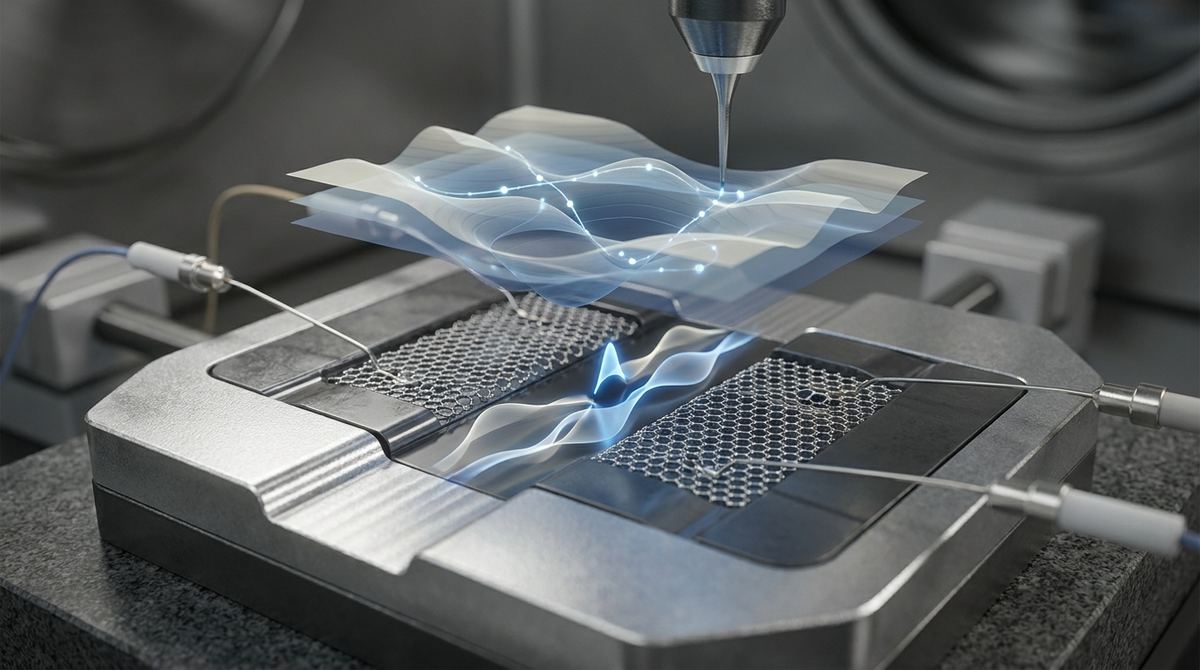
Imagine a computer that is completely immune to the small bumps, temperature fluctuations, and electrical noise that cause modern quantum computers to fail. This is the promise of topological quantum computing, a field that relies on finding a very special kind of particle called a Majorana bound state. These particles are unique because they are their own antiparticles, and they can store quantum information in a way that is protected from the chaotic environment of a standard chip. However, there is a massive problem in the physics community: it is incredibly difficult to tell if we have actually found a Majorana state or if we are just looking at a common, "trivial" state that is simply pretending to be a Majorana. Recent research into how these states behave under physical pressure offers a potential roadmap to finally distinguishing the real thing from the imitation.
In the quest for stable quantum computing, scientists are building complex architectures known as superconductor-semiconductor heterostructures. These materials consist of layers of semiconductors placed in contact with superconductors to induce specific quantum properties. The ultimate goal is to create a topological phase where Majorana bound states emerge at the ends of the material. These states are highly desirable because they obey non-Abelian statistics, meaning that moving them around each other—a process called braiding—can perform logic operations that are naturally protected from errors.
However, the reality of material science is that no material is perfect. Every semiconductor contains some level of disorder, which can manifest as impurities, structural defects, or variations in the thickness of the layers. This disorder introduces a frustrating phenomenon known as Andreev bound states. Andreev bound states are standard, non-topological excitations that occur when electrons are reflected at the interface between a normal metal or semiconductor and a superconductor. Under certain conditions, specifically when disorder is high, these Andreev states can migrate to zero energy. When they reach zero energy, they look almost identical to Majorana bound states in experimental measurements. This "imposter" problem makes it incredibly difficult for researchers to confirm whether they have achieved true topological protection or if they are simply seeing the effects of material imperfections.
The researchers, Shubhanshu Karoliya, Ekta, and Gargee Sharma, proposed a way to break this stalemate by using mechanical force. Instead of just looking at the electrical signals of a static material, they investigated how the system responds to strain. Strain is the internal stress caused by stretching or compressing a material. By applying controlled mechanical strain, we can physically alter the energy landscape of the semiconductor. Think of the energy levels in the semiconductor like a series of valleys and hills. By squeezing or pulling the material, we change the height of these hills and the depth of these valleys. This allows us to move the energy of the "imposter" Andreev states away from zero, or conversely, to push the system into the regime where the true Majorana states reside. This ability to tune the system with physical pressure provides a diagnostic tool to confirm when we have transitioned from a trivial state to a topological one.
While the specific research focuses on the intricate physics of superconductor-semiconductor interfaces, the principles are deeply relevant to the advanced 2D material architectures used in modern quantum engineering, including those involving graphene. In these heterostructures, the semiconductor provides the medium for the electrons to move, while the superconductor provides the "pairing" mechanism through the proximity effect. When these two materials are layered together, the superconducting properties leak into the semiconductor, creating a gap in the energy spectrum where no single-particle states can exist.
The presence of disorder in this setup creates a series of sub-gap states. As previously mentioned, the Andreev states arise because electrons and holes are reflected at the interface, creating a localized state. The effectiveness of this process depends heavily on the chemical potential and the electronic band structure of the semiconductor. This is where mechanical strain becomes a powerful lever. When a strain is applied, the atomic lattice of the semiconductor undergoes a deformation. This deformation changes the overlap of the electronic orbitals between atoms. Consequently, the electronic band structure is modified, shifting the effective potential that the electrons experience. This shift in potential directly influences the energy levels of the bound states. By carefully controlling the strain, one can manipulate the chemical potential of the semiconductor, effectively moving the system through different quantum phases.
The study conducted by Shubhanshu Karoliya, Ekta, and Gargee Sharma provides a detailed look at the crossover between these two distinct quantum states. They discovered that the transition between the trivial Andreev regime and the topological Majorana regime is not a sudden jump but a complex crossover that is heavily influenced by the level of disorder in the material. The researchers demonstrated that as strain is applied, the energy spectrum of the states undergoes a predictable evolution.
Specifically, they found that strain acts as a control parameter that can be used to steer the system away from the deceptive zero-energy Andreev states. By mapping out how the energy levels shift in response to mechanical deformation, the research provides a way to identify the exact point where a system becomes truly topological. This is a crucial finding because it suggests that even in the presence of significant disorder, the topological phase is not necessarily lost; rather, it is obscured. The ability to use strain to manipulate these energy levels provides a mathematical and physical framework for experimentalists to distinguish between a true topological phase and a disordered trivial phase. This helps clarify the conditions under which Majorana states are robust and when they are merely artifacts of material imperfections.
This research is significant because it provides a validation mechanism for the entire field of topological quantum computing. For years, the scientific community has been embroiled in debates regarding whether observed zero-energy signatures in nanowires and heterostructures were true Majoranas or just Andreev states caused by disorder. By proving that strain can control the crossover between these states, this work offers a experimentalist's toolkit to resolve these disputes.
If we can reliably identify Majorana bound states, we can move closer to building fault-tolerant quantum computers. Unlike current superconducting qubits, which require massive amounts of error correction to account for environmental noise, topological qubits would be inherently stable. This would drastically reduce the hardware overhead required for complex quantum simulations, such as molecular modeling for drug discovery or advanced cryptography. Furthermore, understanding the interplay between strain and disorder allows material scientists to engineer better, cleaner heterostructures, knowing exactly how much imperfection they can tolerate before the topological protection is compromised.
It is important to note that this research, while theoretically profound, is not a blueprint for an immediate commercial product. The study focuses on the fundamental physics of how states evolve under strain, which is a complex theoretical undertaking. In a real-world manufacturing environment, applying uniform, controlled, and reproducible strain to a microscopic quantum device is an immense engineering challenge.
Additionally, the study addresses the crossover in a controlled model of disorder. Real-world materials possess a wide variety of disorder types, ranging from surface oxidation to random impurity distributions, which may behave differently than the idealized models used in theoretical physics. While the research provides a clear path forward, much more testing is needed to see how these strain-controlled crossovers behave in actual, multi-layered physical devices during operation. The transition from a theoretical model to a scalable, strain-tunable quantum chip is a massive leap that requires further experimental validation.
The most direct application of this research lies in the development of topological quantum hardware. As we move toward the era of "Quantum Advantage," where quantum computers outperform classical ones for specific tasks, the stability of the qubit becomes the primary bottleneck. Technologies that utilize Majorana bound states could lead to a new generation of highly stable, scalable quantum processors.
Beyond computing, the ability to control electronic states via mechanical strain is a cornerstone of the burgeoning field of straintronics. This field seeks to use mechanical deformation to control the electrical properties of materials, potentially leading to new types of sensors, ultra-low-power transistors, and advanced memory storage devices. The insights gained from how strain affects topological states could inform the design of highly sensitive quantum sensors that can detect incredibly small forces or magnetic fields, opening new doors in medical imaging and geological exploration.
If you take away only one thing from this research, let it be this: mechanical strain can act as a master tuner for quantum states, allowing scientists to distinguish between genuine topological particles and deceptive imitations caused by material imperfections.
What is a Majorana bound state?
A Majorana bound state is a unique type of quasiparticle that behaves as its own antiparticle. In the context of quantum computing, these particles are sought after because their non-local nature allows them to store information in a way that is naturally protected from local environmental noise, which is the primary cause of errors in quantum computers.
Why is material disorder such a big problem for quantum physics?
Disorder refers to any imperfection in a material, such as an misplaced atom or a defect in the crystal lattice. In quantum systems, these imperfections create extra energy levels called Andreev bound states. These states can sometimes sit at zero energy, making them look exactly like the Majorana states scientists are looking for, which creates a massive "imposter" problem.
How does applying mechanical strain help solve this problem?
Mechanical strain changes the physical distance between atoms in a material. This change in atomic spacing alters the electronic potential and the energy levels of the particles within the material. By applying strain, scientists can shift the energy of the "imposter" states away from zero, allowing them to see if a true Majorana state remains, thereby confirming the topological nature of the system.
What is a superconductor-semiconductor heterostructure?
A heterostructure is a device made by layering different materials on top of one another. A superconductor-semiconductor heterostructure specifically layers a superconducting material (which has no electrical resistance) with a semiconductor (which can have its conductivity tuned). This combination allows for the creation of special quantum states, like Majoranas, at the interface where the two materials meet.
Is topological quantum computing ready for commercial use?
No, topological quantum computing is still in the early stages of research and development. While it offers a much more stable alternative to current quantum computing methods, we are still working on perfecting the materials and the methods to create and manipulate these special particles. This research is a vital step in building the foundation for that future technology.
The work by Shubhanshu Karoliya, Ekta, and Gargee Sharma provides a critical piece of the puzzle in the quest for stable quantum computing. By demonstrating how mechanical strain can control the crossover between trivial Andreev states and topological Majorana states, they have provided a way to navigate the complexities introduced by material disorder. As we continue to engineer increasingly complex 2D and semiconductor-based heterostructures, the ability to use physical strain as a diagnostic tool will be essential for distinguishing between a flawed system and a truly topological one, ultimately paving the way for the next generation of fault-tolerant quantum technology.
Serious about B2B integration? Test our premium Pulsed Electrical Resistive Carbon Heating turbostratic graphene in your lab. 100g sample packs available now.
Explore More
Researchers developed coupled dynamical Boltzmann transport equations that include long-range interactions, creating a more accurate model for electron...

Learn how to design and prototype graphene slit junctions for directional electron-beam formation and tunable spin filtering in nanoelectronic devices.

Researchers have developed a hydrodynamic backflow method to ease the fermion sign problem, a major hurdle in quantum simulations of materials like graphene.