
Modeling Electron Transport in 2D Materials with New Boltzmann Equations
Researchers developed coupled dynamical Boltzmann transport equations that include long-range interactions, creating a more accurate model for electron...
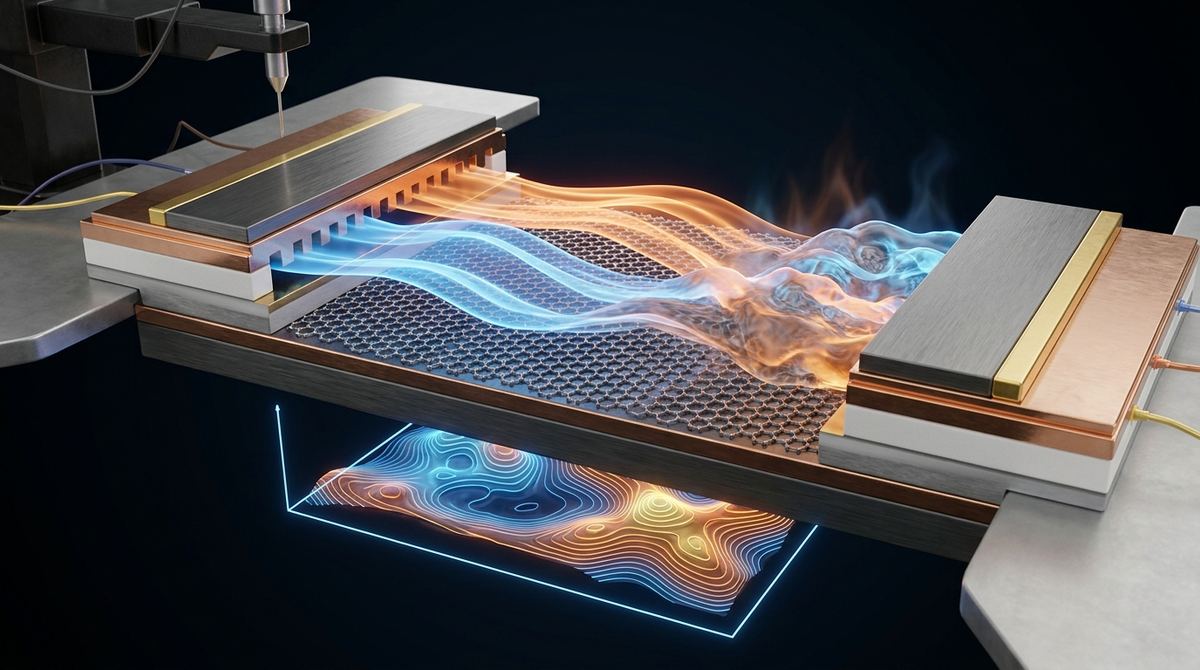
Imagine a world where the electrical components in your smartphone do not just move individual electrons through a crowded hallway, but instead manage a smooth, flowing river of electricity. In traditional electronics, electrons act like individual pedestrians bumping into walls and each other, creating heat and slowing down the device. However, in certain ultra-thin materials, electrons behave more like a liquid, flowing collectively in a way that scientists call hydrodynamics. If we could control how thick or runny this liquid is—essentially controlling its viscosity—we could create electronics that are incredibly fast and use almost no energy. This is the frontier of research being explored by Alexey Ermakov and Alessandro Principi, who are investigating how a quantum property called the valley index can be used to control this electronic flow.
As the technology industry pushes toward smaller and smaller transistors, the traditional way of moving electricity is hitting a fundamental wall. In standard silicon-based semiconductors, the movement of charge is governed by the drift-diffusion model, where electrons are treated as a gas of particles. As these devices shrink to the scale of a few atoms, the surface area of the material becomes enormous relative to its volume. This means electrons constantly collide with the edges of the material or with impurities in the structure. Each collision generates heat, a phenomenon known as Joule heating, which limits how fast a processor can run before it melts or requires massive cooling systems.
Current engineering is struggling to find ways to minimize this dissipation without losing the ability to switch the current on and off. The core problem is that we lack a way to control the collective behavior of electrons in a way that is both precise and efficient at the nanoscale. We are currently trying to manage a chaotic crowd of individual particles, whereas the future of computing might require managing a highly controlled, smooth-flowing fluid. To solve this, we need to move beyond just managing individual charges and begin managing the collective properties of the electron fluid itself.
To understand the work of Alexey Ermakov and Alessandro Principi, we first need to understand what a valley is. In certain materials like graphene, the electrons do not just have a charge and a spin; they also have a property called the valley index. You can think of the valley index as a second type of internal compass that the electron carries. Because of the way the atoms are arranged in the material, the electrons have two distinct states or "valleys" they can occupy. These are often referred to as the K and K' valleys.
The breakthrough idea is that the viscosity of the electron fluid—how much it resists flowing—is not a fixed property like the thickness of honey. Instead, the viscosity is tied to how these electrons interact with one another. If the electrons are distributed evenly between the two valleys, the fluid behaves one way. However, if we can force more electrons into one valley than the other, we change the way they collide and interact. This means we can use the valley index as a control knob. By shifting the balance of electrons between these quantum valleys, we can effectively change the viscosity of the electron fluid, allowing us to manipulate the flow of electricity with unprecedented precision.
The system described in this research relies on the unique physics of Dirac materials. In materials like graphene, the relationship between an electron's energy and its momentum is not the standard quadratic curve found in most materials; instead, it is linear, forming what is known as a Dirac cone. This specific structure is what allows electrons to behave like relativistic particles, similar to photons, which leads to the emergence of the Dirac fluid.
For a Dirac fluid to exist, the system must be in a regime where electron-electron scattering is much more frequent than scattering from impurities or lattice vibrations. When this happens, the electrons stop behaving like a gas and start behaving like a liquid. This is the hydrodynamic regime. In this state, the collective motion of the electrons is described by the Navier-Stokes equations, the same mathematical framework used to describe the flow of water or air.
The hexagonal lattice of graphene is essential here. The symmetry of this lattice creates the two distinct valleys in the momentum space. In a standard electronic system, we only care about the presence or absence of charge. In a Dirac fluid, we must also account for the distribution of electrons across these two valleys. The interactions between electrons are highly sensitive to this distribution. When electrons from different valleys collide, they exchange momentum in a way that dictates the overall viscosity of the system. The research explores how the mathematical parameters of these collisions change when we manipulate the valley population, thereby altering the fluid's resistance to flow.
The theoretical work conducted by Alexey Ermakov and Alessandro Principi demonstrates that the viscosity of a two-dimensional Dirac fluid is fundamentally linked to the valley degree of freedom. Their findings suggest that the viscosity is not a static value determined solely by temperature or material density. Instead, the viscosity is a tunable parameter.
Specifically, the researchers found that the viscous coefficient of the electron fluid depends on the ratio of electrons in the K valley compared to the K' valley. By creating a valley imbalance, or valley polarization, it is possible to alter the rate at which momentum is redistributed among the electrons. This change in momentum redistribution is what manifests as a change in viscosity. Essentially, their model shows that the "thickness" of the electronic liquid can be modulated by shifting the quantum state of the electrons. This provides a theoretical foundation for a new type of control mechanism in nano-electronics, where the valley index acts as a lever to adjust the hydrodynamic properties of the charge carriers.
This research is significant because it provides a roadmap for the field of valleytronics. For decades, the focus of semiconductor research has been on electronics (charge) and spintronics (spin). Valleytronics is the next logical step, proposing that we use the valley index as a way to encode and process information.
If we can control the viscosity of an electron fluid through valley manipulation, we gain a new tool for managing energy dissipation. A lower viscosity means a smoother flow, which can lead to much higher currents with significantly less heat generation. This could lead to a generation of transistors that are not only faster but also much more energy-efficient than anything currently possible with silicon. By moving from a regime of individual particle transport to a regime of collective fluid transport, we can circumvent many of the heat-related limitations that currently plague the scaling of microchips.
While the findings are mathematically robust, it is important to distinguish these theoretical predictions from commercial reality. This research is a theoretical model of how these properties should behave under ideal conditions. In a real-world laboratory or manufacturing environment, several challenges remain.
First, maintaining a stable Dirac fluid requires extremely high material purity. If there are too many defects or impurities in the graphene, the electrons will collide with the defects rather than with each other, destroying the hydrodynamic behavior and returning the system to a standard, resistive regime. Second, the "valley-controlled" aspect requires a way to reliably and quickly manipulate the valley population. While methods like electrical gating or optical excitation exist, doing so with the precision required for high-speed computing is an immense engineering challenge. Finally, these effects are most prominent at very low temperatures. For this to be useful in a consumer smartphone, the ability to maintain valley-controlled viscosity must be achieved at room temperature, which is a much harder physical hurdle to overcome.
The potential applications for valley-controlled Dirac fluids are vast and span several high-tech industries. In the realm of ultra-high-speed computing, this could lead to the development of "hydrodynamic transistors." These devices would rely on the smooth flow of electron fluids to switch signals, potentially operating at frequencies far beyond the limits of current silicon technology.
In the field of sensing, the extreme sensitivity of viscosity to the valley index could be used to create hyper-sensitive quantum sensors. These sensors could detect minute changes in electrical fields or chemical environments by observing changes in the flow properties of an electron liquid. Additionally, in the development of quantum computers, the ability to control quantum degrees of freedom like the valley index offers new ways to protect and manipulate quantum information, potentially leading to more stable and scalable qubits.
If you take away only one concept from this research, let it be this: the viscosity of an electron liquid in 2D materials is not fixed; it can be controlled by manipulating the quantum valley index of the electrons, offering a new way to manage energy and speed in future electronics.
How does an electron fluid differ from a regular gas? In a regular gas, particles mostly move independently and only interact when they happen to bump into each other. In an electron fluid, the particles are so closely linked by their electrical forces that they move together as a single, coordinated collective, much like how a liquid flows.
What is the valley index in simple terms? Think of the valley index as a hidden property that an electron has, similar to how a coin can be heads or tails. In certain materials, the arrangement of atoms creates two distinct "valleys" or states that the electron can occupy, and this state influences how it moves through the material.
Why does viscosity matter in a computer chip? Viscosity is a measure of how much a fluid resists flowing. In electronics, resistance causes heat. If we can control the viscosity of an electron fluid, we can essentially control how much heat is generated during the movement of electricity, which is crucial for making faster and cooler devices.
Is graphene the only material that can do this? While graphene is the most famous example due to its unique structure, other two-dimensional materials like transition metal dichalcogenides also possess valley degrees of freedom and could potentially host Dirac fluids.
Can we buy valley-controlled electronics today? No, this research is currently in the fundamental physics stage. It provides the mathematical proof that these effects are possible, but engineers still need to figure out how to build materials and devices that can actually use these properties at everyday temperatures.
The work of Alexey Ermakov and Alessandro Principi marks a significant step in our understanding of two-dimensional quantum fluids. By demonstrating that the viscosity of a Dirac fluid can be controlled via the valley index, they have opened a new door for the field of valleytronics. While significant engineering hurdles remain—particularly regarding material purity and operating temperatures—the ability to treat electrons as a tunable fluid rather than a chaotic gas offers a profound new way to approach the limits of microelectronics. As we continue to master the manipulation of these two-dimensional systems, the transition from traditional electronics to hydrodynamic, valley-controlled systems may become the key to the next revolution in computing.
Serious about B2B integration? Test our premium Pulsed Electrical Resistive Carbon Heating turbostratic graphene in your lab. 100g sample packs available now.
Explore More
Researchers developed coupled dynamical Boltzmann transport equations that include long-range interactions, creating a more accurate model for electron...

Learn how to design and prototype graphene slit junctions for directional electron-beam formation and tunable spin filtering in nanoelectronic devices.

Researchers have developed a hydrodynamic backflow method to ease the fermion sign problem, a major hurdle in quantum simulations of materials like graphene.