
Graphene-Silicon Modulator Unlocks High-Speed Data at New Wavelengths
Explore a breakthrough graphene-silicon slot-waveguide modulator. This high-speed device operates at both 1.5 μm and 2 μm, promising next-gen optical networks.
The global transition toward a hydrogen economy relies heavily on our ability to store hydrogen gas efficiently, safely, and quickly. While magnesium has long been a candidate for this task due to its lightweight nature and impressive capacity, it possesses a significant flaw: it is incredibly slow at absorbing and releasing hydrogen, and it typically requires high temperatures to function. This research, led by Runchen Zhou, Payam Edalati, Anthony Alhayek, Shivam Dangwal, Marc Novelli, Md. Amirul Islam, Baran Bidyut Saha, Thierry Grosdidier, and Kaveh Edalati, investigates how we can bypass these limitations. By using a process called high-pressure torsion to create unique boundaries between magnesium and graphene, these scientists have found a way to drastically improve the speed and efficiency of hydrogen storage through precise molecular engineering.
To understand the importance of this work, one must first understand the chemical bottleneck of magnesium. Magnesium is a metal that reacts with hydrogen to form magnesium hydride. This reaction is highly desirable because magnesium is light, making it ideal for fuel cells in electric vehicles or portable power units. However, the hydrogen atoms face two major hurdles. First, they struggle to break their molecular bond and enter the magnesium lattice, a process that usually requires substantial thermal energy. Second, the physical movement of these atoms into and out of the metal structure is a sluggish process. This slow reaction rate, known as poor kinetics, means that a fuel cell might take too long to refill or might require an expensive and bulky heating system to work.
The fundamental challenge is that for hydrogen to be a viable fuel for the modern world, the storage medium must respond almost instantly to the user. If a hydrogen-powered vehicle takes thirty minutes to absorb fuel, it loses its competitive edge against electric vehicles that can charge in minutes. Therefore, scientists are searching for ways to lower the energy barriers that hydrogen molecules must overcome to enter the metal and find ways to create more pathways for them to travel through the material.
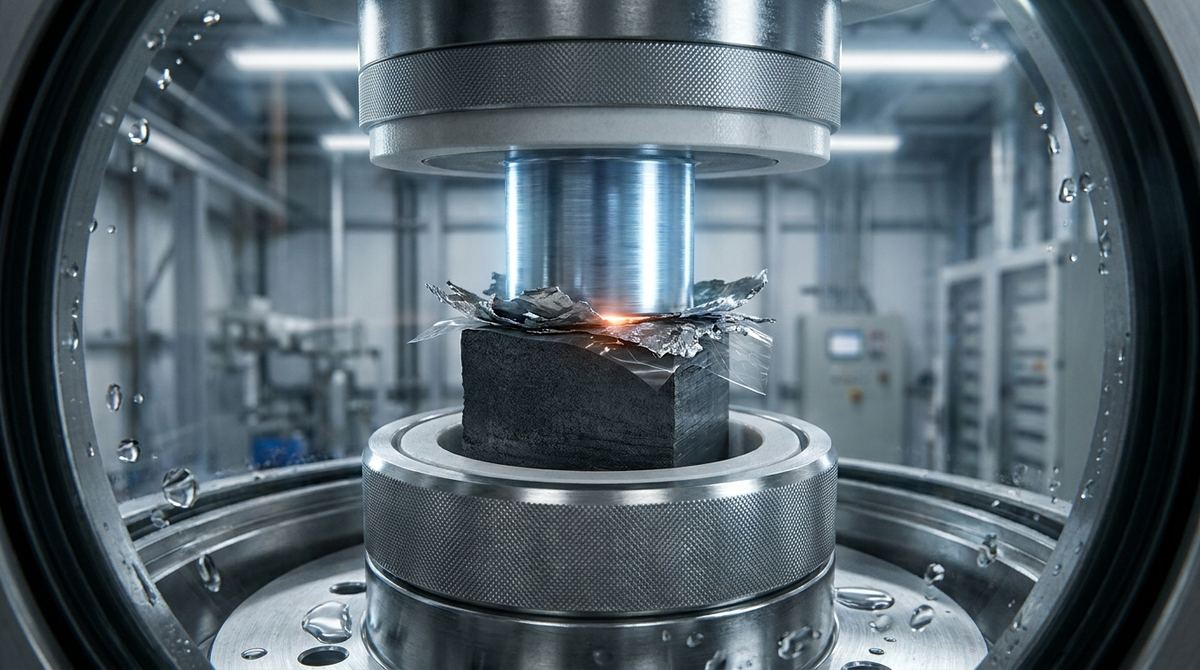
The researchers proposed a two-part solution involving a special material and a heavy-duty manufacturing technique. The first part is the addition of graphene, a single layer of carbon atoms that is incredibly strong and highly conductive. The second part is high-pressure torsion, or HPT. Think of HPT as a way of "crushing and twisting" a material at a microscopic level. By squeezing a magnesium-graphene mixture between two massive anvils and twisting it, the researchers can force the two materials together so intensely that they create new, high-energy boundaries where the metal meets the carbon.
These boundaries act like specialized highways for hydrogen atoms. Instead of hydrogen having to fight its way through a dense and difficult metal structure, it can find these unique interphase boundaries that make it much easier for the atoms to enter the magnesium. By manipulating these boundaries, the researchers aim to change the fundamental physics of how the hydrogen interacts with the metal, specifically targeting the energy requirements and the speed of the reaction.
The mechanics of this system rely on a concept known as severe plastic deformation. When high-pressure torsion is applied, the magnesium undergoes intense structural changes. The pressure and the twisting force create a massive number of defects, such as dislocations and grain boundaries, within the magnesium. These defects are not necessarily bad; in this context, they are useful tools. They increase the internal energy of the material and create more surface area at the microscopic level.
As the magnesium is deformed, the graphene sheets are not just floating inside the metal; they are being integrated into the very structure of the magnesium through the creation of interphase boundaries. An interphase boundary is a distinct region where the chemical and physical properties of the magnesium differ from the graphene. Because graphene is an excellent conductor of both electrons and heat, these boundaries provide a high-speed lane for the electronic interactions necessary for hydrogen dissociation.
When a hydrogen molecule approaches this magnesium-graphene interface, the electronic properties of the graphene help to weaken the bond between the two hydrogen atoms. Once the bond is weakened, the hydrogen atoms can more easily split into individual atoms and move into the magnesium lattice. The presence of the graphene also prevents the magnesium grains from growing too large, a common problem when metals are heated. By keeping the magnesium grains small and highly defective, the HPT process ensures that there is a constant, massive supply of these beneficial interphase boundaries throughout the entire material.
The core of this study focuses on the mathematical breakdown of reaction speeds through the lens of the Arrhenius equation. In chemistry, the rate of a reaction is determined by two main factors: the activation energy and the frequency factor. The activation energy is the height of the "energy hill" that a reaction must climb. If the hill is high, the reaction is slow and requires lots of heat. The frequency factor relates to how many times the molecules attempt to cross that hill in a given amount of time.
The researchers discovered that the magnesium-graphene system created by high-pressure torsion significantly modifies both of these parameters. Specifically, they observed a reduction in the activation energy required for hydrogen storage. This means that the "energy hill" was effectively lowered by the presence of the graphene-magnesium interphase boundaries. With a lower energy barrier, the hydrogen atoms can move much more freely, even at lower temperatures.
Furthermore, the study investigated the significance of the frequency factor. While many researchers focus solely on the energy barrier, this study highlights that the frequency factor is equally critical. The researchers found that the structure created by HPT influences the number of successful collisions and the arrangement of atoms at the interface. The interphase boundaries act as highly efficient sites where hydrogen atoms are more likely to find a place to land and enter the metal. This combination of a lower energy barrier and an optimized frequency factor results in much faster kinetics, meaning the hydrogen can move in and out of the metal much more rapidly than in pure magnesium.
The implications of these findings are profound for the field of materials science and renewable energy. By proving that we can use mechanical methods like HPT to engineer specific interphase boundaries, we move closer to creating "designer materials" that are tailor-made for specific tasks. We are no longer just relying on the natural properties of a metal; we are actively reshaping its internal landscape to optimize its performance.
This research provides a roadmap for making hydrogen storage commercially viable. If we can create magnesium-based storage systems that work at lower temperatures and with faster refill times, hydrogen becomes a much more attractive fuel for everything from heavy-duty shipping and trucking to large-scale grid storage for wind and solar energy. The ability to control the kinetics of hydrogen absorption through the manipulation of activation energy and the frequency factor offers a level of precision that was previously difficult to achieve in metal-hydride systems.
Despite these promising results, it is important to recognize that this technology is currently in the fundamental research phase. One of the primary limitations is the use of high-pressure torsion itself. HPT is an incredibly effective way to create these beneficial structures, but it is a laboratory-scale process. It is difficult and expensive to scale up a process that involves applying massive, controlled pressures and torsion to large quantities of material. Moving from small, disc-shaped samples in a lab to kilograms or tons of material for a fuel tank is a monumental engineering challenge.
Additionally, the long-term stability of these high-energy boundaries needs to be tested. Because these boundaries and defects are in a high-energy state, there is a risk that they might "anneal" or disappear over time, especially during repeated cycles of hydrogen absorption and desorption. If the beneficial interphase boundaries revert to a standard state after a few dozen uses, the material would lose its enhanced performance. Future research must focus on how to stabilize these engineered structures so they can withstand thousands of cycles in a real-world environment.
If the scaling and stability challenges are met, the applications for magnesium-graphene hydrogen storage are vast. The most immediate application would be in the transportation sector. Hydrogen fuel cell vehicles could benefit from much faster refueling times, making them more convenient for long-distance travel. Additionally, because magnesium is so much lighter than the steel tanks currently used in many hydrogen systems, the overall weight of the vehicle could be reduced, extending the driving range.
Beyond vehicles, this technology has significant potential for stationary energy storage. As we integrate more intermittent renewable energy sources like solar and wind into our power grids, we need ways to store large amounts of energy for when the sun is not shining or the wind is not blowing. Magnesium-based systems could provide a scalable, lightweight, and highly responsive way to store hydrogen as a medium for balancing the grid, providing a crucial component of a stable, carbon-neutral energy infrastructure.
If you take away only one concept from this research, let it be this: we can use mechanical force to create microscopic "highways" between graphene and magnesium that lower the energy required to store hydrogen, making clean energy storage faster and more efficient.
What exactly is magnesium hydrogen storage?
Magnesium hydrogen storage is a process where hydrogen gas is chemically reacted with magnesium to form a solid hydride. This allows a large amount of hydrogen to be stored in a very small, solid volume, which is much safer and more compact than storing hydrogen as a high-pressure gas.
Why is graphene so important in this process?
Graphene serves several roles. It acts as a structural scaffold that helps manage the magnesium grains and, most importantly, it creates specialized interphase boundaries. These boundaries act as catalytic sites that help break the hydrogen molecules apart and provide a low-resistance path for them to enter the metal.
What is the role of high-pressure torsion?
High-pressure torsion is a method of severe plastic deformation. By applying intense pressure and twisting the material, it forces the magnesium and graphene together at an atomic level, creating a massive number of defects and boundaries that are necessary for the improved performance.
Why do scientists talk about activation energy?
Activation energy is the minimum amount of energy required to trigger a chemical reaction. In hydrogen storage, if the activation energy is too high, you need a lot of heat to make the reaction happen. By lowering this energy barrier, we make the storage process much more efficient and easier to manage.
Is this technology ready for use in cars today?
No, this research is currently in the fundamental science stage. While it provides a breakthrough in understanding how to improve kinetics, the process used to create these materials is currently too difficult and expensive to use for mass-producing car fuel tanks. It is a vital step toward that future, however.
The research conducted by Zhou, Edalati, Alhayek, and their colleagues represents a significant leap in our ability to engineer advanced materials for the hydrogen economy. By moving beyond the simple mixture of components and focusing on the precise engineering of interphase boundaries through high-pressure torsion, they have demonstrated a way to overcome the inherent kinetic limitations of magnesium. While scaling this technology and ensuring its long-term stability remains a significant hurdle, the ability to manipulate activation energy and frequency factors through nano-scale structural engineering offers a powerful new tool in the quest for efficient, clean energy storage.
Serious about B2B integration? Test our premium Pulsed Electrical Resistive Carbon Heating turbostratic graphene in your lab. 100g sample packs available now.
Explore More
Explore a breakthrough graphene-silicon slot-waveguide modulator. This high-speed device operates at both 1.5 μm and 2 μm, promising next-gen optical networks.

New research reveals that mechanical strain doesn't just reduce but fundamentally reshapes heat flow in graphene, a critical insight for flexible...

Learn to build a gate reflectometry sensor using bilayer graphene. This practical guide details a non-contact method for material characterization.