
3D Atomic Imaging of Graphene Dynamics from a Single Low-Dose TEM Snapshot
A new physics-informed AI method reconstructs the 3D atomic structure and dynamics of graphene from a single low-dose TEM image, solving a key imaging...
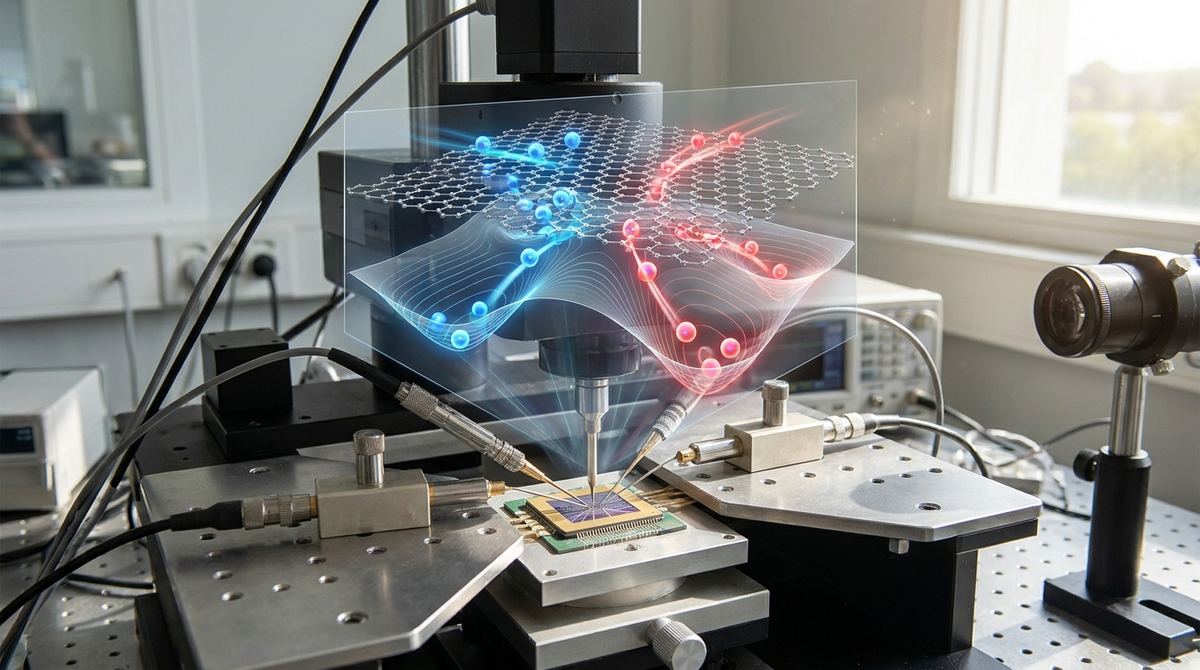
Imagine a computer that does not just rely on the presence or absence of an electric charge to process information, but instead uses the internal "flavor" or orientation of an electron. In the world of traditional silicon electronics, we move electrons around like water through a pipe, using charge to represent a one or a zero. But physicists are now looking toward a new dimension of data called valleytronics. In certain materials like graphene, electrons do not just exist as simple particles; they occupy specific, discrete energy states known as valleys. Because these valleys are distinct, they can act as a new type of information carrier, potentially leading to computers that are faster, smaller, and significantly more energy-efficient than anything we have today.
The primary challenge in the field of valleytronics is detection. While it is theoretically possible to manipulate the valley state of an electron, it is incredibly difficult to actually measure what those electrons are doing without destroying the very information we are trying to read. This is especially true when we move from a single layer of graphene to multilayers. In a single layer of graphene, the electronic structure is relatively simple, but when you stack multiple layers together, the electrons begin to interact across the layers. This interlayer coupling adds layers of complexity to the electronic landscape.
In these multilayer systems, the signal we want to measure—the valley polarization—often gets buried under much larger signals, such as the standard electrical resistance or the traditional Hall effect. Scientists need a reliable, unambiguous way to distinguish between a simple change in conductivity and a true change in the valley state. Without a clear signature, valleytronics remains a theoretical curiosity rather than a practical engineering tool. The current problem is identifying which specific electrical measurements can serve as a clear fingerprint for valley polarization in these complex, stacked carbon structures.
The research conducted by Fernando Peñaranda and Fernando de Juan focuses on finding these specific fingerprints. Instead of looking at the electricity in a general sense, they looked at two very specific ways that electrical currents behave when subjected to a magnetic field. The first is called in-plane linear magnetoconductivity, which is a subtle change in how easily electricity flows when a magnetic field is applied parallel to the material. The second is the anomalous Hall effect, which is a voltage that appears perpendicular to the direction of the current, even without a massive magnetic field.
The core idea is that the valley state of the electrons creates a unique geometric property in the material's structure, often referred to as Berry curvature. Think of Berry curvature as a sort of invisible, internal magnetic field that lives within the material's structure rather than being applied from the outside. This internal field pushes electrons sideways in a very specific way depending on which valley they occupy. By comparing how the material responds to an external magnetic field versus how it produces this anomalous voltage, researchers can determine exactly how much valley polarization is present.
To understand how this works, we must first look at the unique structure of graphene. Graphene is a single layer of carbon atoms arranged in a hexagonal honeycomb lattice. This lattice structure causes the energy levels of the electrons to meet at specific points in momentum space, called the K and K' points. These points are the valleys. Electrons in the K valley behave differently from electrons in the K' valley, even though they have the same charge and spin.
When we stack these layers to create a multilayer system, the electrons can hop between layers. This hopping changes the way the energy valleys are shaped. In these multilayers, the Berry curvature becomes a powerful tool. The Berry curvature acts as a source of a transverse force on the electrons. When an electric field is applied to move electrons through the graphene, this Berry curvature pushes them to the side. This movement creates a voltage perpendicular to the current, which is the anomalous Hall effect.
The researchers investigated how an external magnetic field interacts with this internal Berry curvature. When a magnetic field is applied in-plane, it doesn't just push the electrons via the Lorentz force; it also interacts with the valley degree of freedom. This interaction changes the conductivity of the material in a way that is linearly proportional to the magnetic field strength. This is a crucial distinction because standard conductivity changes usually follow a quadratic (squared) relationship with the magnetic field. This difference in how the conductivity reacts—linear versus quadratic—is the key to identifying the valley signature.
The study by Peñaranda and de Juan provides a theoretical framework for distinguishing between these transport signatures. They found that the anomalous Hall effect and the in-plane magnetoconductivity provide complementary information about the valley polarization in multilayer graphene. Specifically, the researchers demonstrated that the anomalous Hall effect is a direct consequence of the topological properties of the electronic bands, which is driven by the Berry curvature.
The findings highlight that the in-plane linear magnetoconductivity is a highly sensitive probe for the valley state. In many multilayer graphene configurations, the signal from the anomalous Hall effect might be difficult to isolate because it can be masked by other effects. However, the linear response of the conductivity to an in-plane magnetic field provides a distinct, measurable signal that directly relates to the distribution of electrons between the valleys. This means that instead of relying solely on complex transverse measurements, engineers might be able to use much simpler in-plane measurements to verify if a valleytronic device is working correctly.
This research is significant because it moves valleytronics from the realm of pure theory toward the realm of practical device characterization. For any new technology to transition from a laboratory experiment to a commercial product, engineers must be able to test and validate it. If we want to build a valleytronic processor, we need to know if our manufacturing process successfully achieved the desired valley polarization.
By identifying these specific transport signatures, this research provides a roadmap for testing. It tells experimentalists exactly what kind of electrical signals to look for to confirm that the "valley" information is being preserved. This ability to verify the state of the system is essential for the development of low-power, high-speed logic gates. If we can reliably control and measure the valley state, we can create a new class of non-volatile memory and logic that operates with a fraction of the energy required by current silicon-based chips.
While these findings are a major step forward, several hurdles remain before we see valleytronic components in consumer electronics. First, the study is primarily theoretical, meaning it provides the mathematical and physical basis for these observations. While it suggests what to look for, it does not provide a ready-made manufacturing protocol. Real-world materials are never perfect; they contain defects, impurities, and edge effects that can disrupt the valley state.
Furthermore, the effects being studied are often most pronounced at very low temperatures. In a practical computer, we need these effects to function at room temperature. The "valley coherence"—the ability of an electron to maintain its valley identity as it moves through a circuit—is highly sensitive to thermal fluctuations. If the temperature is too high, the electrons scatter off vibrations in the lattice, causing them to jump between valleys and destroying the information. Therefore, a significant amount of future research must focus on how to maintain valley polarization in graphene multilayers under ambient conditions and how to scale the fabrication of these multilayer structures with atomic precision.
The implications for real-world technology are profound. In the field of information technology, the most immediate application is the development of ultra-low-power logic. Current transistors work by moving charge, which generates heat due to resistance. Valleytronic logic could potentially bypass some of these energetic costs, allowing for much denser and more efficient processor architectures.
Beyond computing, valleytronics could revolutionize sensor technology. Because the valley state is so sensitive to the local environment, graphene-based valleytronic sensors could potentially detect extremely subtle changes in electric or magnetic fields, or even the presence of specific molecules. This could lead to highly sensitive biological sensors or advanced navigation tools. Additionally, the marriage of valleytronics and spintronics—a field called valley-spintronics—could create a multi-layered data encoding system where both the spin and the valley of an electron are used to store multiple bits of information in a single particle, exponentially increasing data density.
If you take away only one concept from this research, let it be this: the discovery of specific electrical signatures, like in-plane magnetoconductivity, provides a vital way to detect and verify the "valley" state of electrons in graphene, which is the essential first step toward creating a new generation of ultra-efficient valleytronic computers.
What exactly is a "valley" in graphene?
In the context of graphene, a valley refers to a specific energy minimum in the material's electronic structure. Instead of electrons being able to exist at any energy level, they are most likely to be found in certain regions of momentum space. Because there are two distinct, equivalent energy minima (often called the K and K' valleys), we can treat them as two different states or "flavors" of an electron, which allows us to use them to store information.
Why is graphene preferred for this type of research?
Graphene is ideal because of its unique honeycomb lattice and the way its electrons behave like massless particles. This specific structure gives rise to the Berry curvature, a geometric property that is essential for creating the anomalous Hall effect and other valleytronic phenomena. The ability to stack layers of graphene allows scientists to tune the electronic properties of the material, making it a highly versatile playground for new physics.
How is the anomalous Hall effect different from the normal Hall effect?
The normal Hall effect occurs when a magnetic field is applied to a conductor, causing electrons to move sideways and creating a voltage. The anomalous Hall effect is different because it can occur due to the internal topological properties of the material (the Berry curvature) even when the external magnetic field is very small or zero. It is a signature of the material's unique quantum structure rather than just the presence of an external magnet.
What is the difference between electronics, spintronics, and valleytronics?
Electronics uses the charge of an electron to represent information. Spintronics uses the "spin" or intrinsic angular momentum of the electron as a data carrier. Valleytronics uses the "valley" index, which is the specific energy state the electron occupies. Using these different properties allows for more complex and efficient ways of processing and storing data.
Is valleytronic technology going to replace my laptop anytime soon?
It is unlikely to replace current technology in the immediate future. While the theory is incredibly promising, there are significant engineering challenges, such as maintaining the valley state at room temperature and manufacturing perfect multilayer graphene at scale. We are currently in the stage where we are learning how to detect and control these states, which is a necessary precursor to building actual commercial devices.
The work of Fernando Peñaranda and Fernando de Juan marks a significant milestone in our understanding of how to communicate with the quantum properties of graphene. By distinguishing between the signatures of in-plane magnetoconductivity and the anomalous Hall effect, they have provided a crucial diagnostic tool for the future of valleytronics. While the path from these fundamental discoveries to a consumer-ready valleytronic chip is filled with engineering challenges, the ability to clearly identify the valley state opens the door to a future of unprecedented computational efficiency and a new era of quantum-inspired information technology.
Serious about B2B integration? Test our premium Pulsed Electrical Resistive Carbon Heating turbostratic graphene in your lab. 100g sample packs available now.
Explore More
A new physics-informed AI method reconstructs the 3D atomic structure and dynamics of graphene from a single low-dose TEM image, solving a key imaging...

Explore how to build a graphene-FGT voltage-tuned microwave filter. This guide details a prototype for electrically controlling magnetic damping in spintronics.

Researchers map ballistic transport in bilayer graphene junctions, revealing quantized conductance thresholds. This fundamental work is key to designing...